
Radio Technique
THE ACE XPO/MIXER. The long-awaited combined exponential and mixing options board (11G515) has been released by Ace RC, Inc., Box 511E, Higginsville, MO 64037, and I have built it and tested it. The board plugs into the Silver Seven transmitter and provides two channels with XPO/LIN option, one linear channel with adjustable trim authority, and the ability to mix any two channels (whether XPO or not) except the retract gear channel. Interconnections are shown for most of the customary arrangements, including V-tail, elevons, opposed flap/elevator, coupled ailerons and rudder, and throttle/tail-rotor mixing for helicopters.
The kit is easy to build because the printed circuits are widely spaced. The only caution I would make is to warn you to be very sure that you solder the connections on both sides of the board when such connections are provided. The only problem I had was traced back to missing one of them. Well, maybe that's not entirely true. I also had a problem which traced back to the fact that I had forgotten that when you ground any input in the series, all following inputs in that frame are skipped. I grounded channel 5 to get rid of it, and then had to spend a bit of time figuring out why my flapperons wouldn't work. The flap signal was on channel 6, which was being skipped.
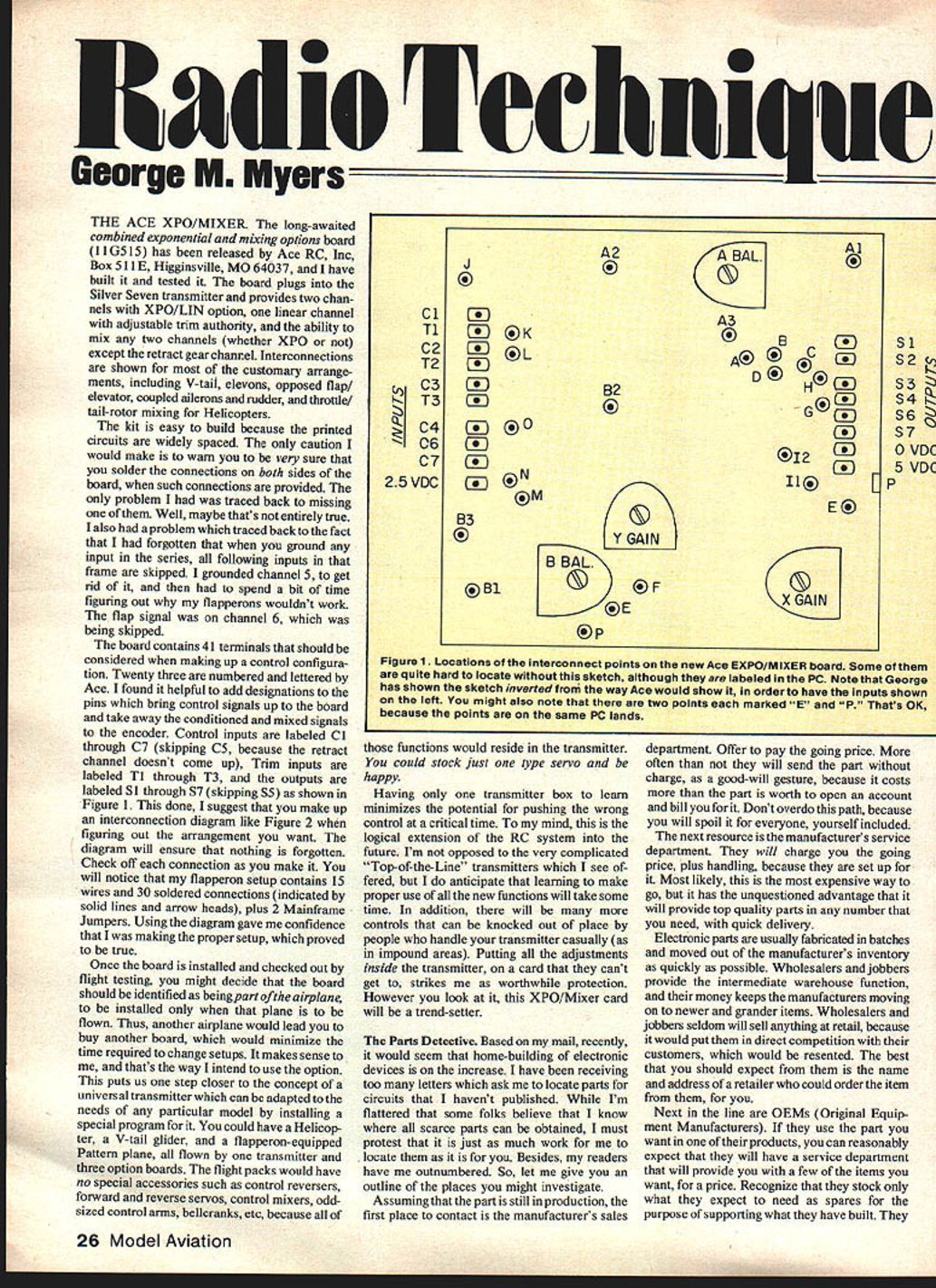
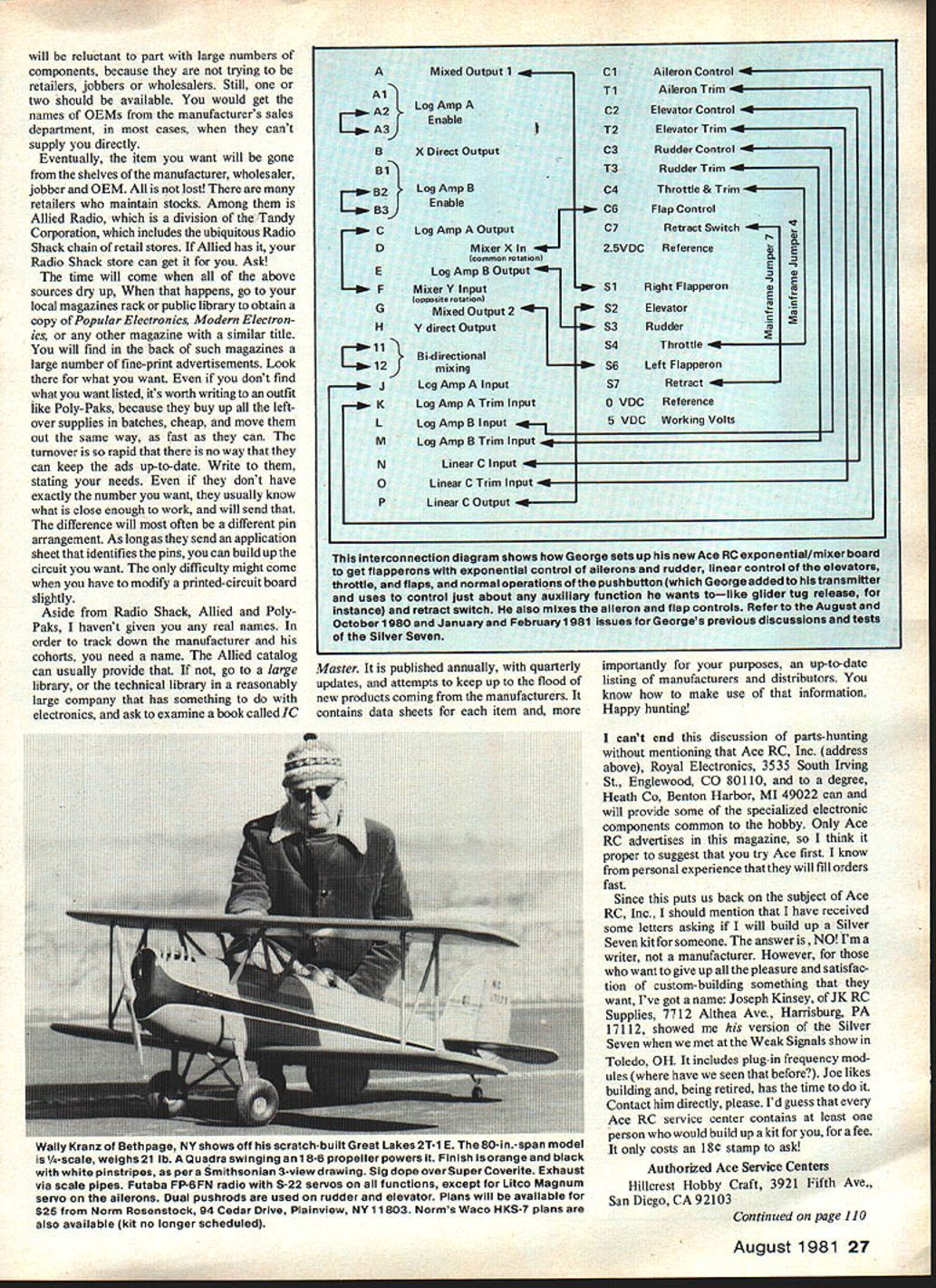
The board contains 41 terminals that should be considered when making up a control configuration. Twenty-three are numbered and lettered by Ace. I found it helpful to add designations to the pins which bring control signals up to the board and take away the conditioned and mixed signals to the encoder. Control inputs are labeled C1 through C7 (skipping C5, because the retract channel doesn't come up). Trim inputs are labeled T1 through T3, and the outputs are labeled S1 through S7 (skipping S5) as shown in Figure 1. This done, I suggest that you make up an interconnection diagram like Figure 2 when figuring out the arrangement you want. The diagram will ensure that nothing is forgotten. Check off each connection as you make it. You will notice that my flapperon setup contains 15 wires and 30 soldered connections (indicated by solid lines and arrowheads), plus 2 mainframe jumpers. Using the diagram gave me confidence that I was making the proper setup, which proved to be true.
Once the board is installed and checked out by flight testing, you might decide that the board should be identified as being part of the airplane, to be installed only when that plane is to be flown. Thus, another airplane would lead you to buy another board, which would minimize the time required to change setups. It makes sense to me, and that's the way I intend to use the option. This puts us one step closer to the concept of a universal transmitter which can be adapted to the needs of any particular model by installing a special program for it. You could have a helicopter, a V-tail glider, and a flapperon-equipped Pattern plane, all flown by one transmitter and three option boards. The flight packs would have no special accessories such as control reversers, forward and reverse servos, control mixers, odd-sized control arms, bellcranks, etc., because all of these functions would reside in the transmitter. You could stock just one type servo and be happy.
Having only one transmitter box to learn minimizes the potential for pushing the wrong control at a critical time. To my mind, this is the logical extension of the RC system into the future. I'm not opposed to the very complicated "top-of-the-line" transmitters which I see offered, but I do anticipate that learning to make proper use of all the new functions will take some time. In addition, there will be many more controls that can be knocked out of place by people who handle your transmitter casually (as in impound areas). Putting all the adjustments inside the transmitter, on a card that they can't get to, strikes me as worthwhile protection. However you look at it, this XPO/Mixer card will be a trend-setter.
The Parts Detective
Based on my mail recently, it would seem that home-building of electronic devices is on the increase. I have been receiving too many letters which ask me to locate parts for circuits that I haven't published. While I'm flattered that some folks believe that I know where all scarce parts can be obtained, I must protest that it is just as much work for me to locate them as it is for you. Besides, my readers have outnumbered me. So, let me give you an outline of places you might investigate.
Assuming that the part is still in production, the first place to contact is the manufacturer's sales department. Offer to pay the going price. More often than not they will send the part without charge, as a good-will gesture, because it costs more than the part is worth to open an account and bill you for it. Don't overdo this path, because you will spoil it for everyone, yourself included.
The next resource is the manufacturer's service department. They will charge you the going price, plus handling, because they are set up for it. Most likely, this is the most expensive way to go, but it has the unquestioned advantage that it will provide top-quality parts in any number that you need, with quick delivery.
Electronic parts are usually fabricated in batches and moved out of the manufacturer's inventory as quickly as possible. Wholesalers and jobbers provide the intermediate warehousing function, and their money keeps the manufacturers moving on to newer and grander items. Wholesalers and jobbers seldom will sell anything at retail, because it would put them in direct competition with their customers, which would be resented. The best route that you should expect from them is the name and address of a retailer who could order the item from them for you.
Next in line are OEMs (Original Equipment Manufacturers), who use the part you want in one of their products; you can reasonably expect that they will have a service department that will provide you with a few of the items you want, for a price. Recognize that they stock only what they expect to need as spares for the purpose of supporting what they have built. They will be reluctant to part with large numbers of components, because they are not trying to be retailers, jobbers or wholesalers. Still, one or two should be available. You would get the names of OEMs from the manufacturer's sales department, in most cases, when they can't supply you directly.
Eventually, the item you want will be gone from the shelves of the manufacturer, wholesaler, jobber and OEM. All is not lost! There are many retailers who maintain stocks. Among them is Allied Radio, which is a division of the Tandy Corporation, which includes the ubiquitous Radio Shack chain of retail stores. If Allied has it, your Radio Shack store can get it for you. Ask!
The time will come when all of the above sources dry up. When that happens, go to your local magazine rack or public library to obtain a copy of Popular Electronics, Modern Electronics, or any other similar title. You will find in the back of such magazines a large number of fine-print advertisements. Look there for what you want. Even if you don't find what you want listed, it's worth writing to an outfit like Poly-Paks, because they buy up all the leftover supplies in batches, cheap, and move them out the same way, as fast as they can. The turnover is so rapid that there is no way that they can keep the ads up-to-date. Write to them, stating your needs. Even if they don't have exactly the number you want, they usually know what is close enough to work and will send that. The difference will most often be a different pin arrangement. As long as they send an application sheet that identifies the pins, you can build up the circuit you want. The only difficulty might come when you have to modify a printed-circuit board slightly.
Aside from Radio Shack, Allied and Poly-Paks, I haven't given you any real names. In order to track down the manufacturer and his cohorts, you need a name. The Allied catalog can usually provide that. If not, go to a large library, or the technical library in a reasonably large company that has something to do with electronics, and ask to examine a book called IC Master. It is published annually, with quarterly updates, and attempts to keep up with the flood of new products coming from the manufacturers. It contains data sheets for each item and, more importantly for your purposes, an up-to-date listing of manufacturers and distributors. You know how to make use of that information. Happy hunting!
I can't end this discussion of parts-hunting without mentioning that Ace RC, Inc. (address above), Royal Electronics, 3535 South Irving St., Englewood, CO 80110, and, to a degree, Heath Co., Benton Harbor, MI 49022 can and will provide some of the specialized electronic components common to the hobby. Only Ace RC advertises in this magazine, so I think it proper to suggest that you try Ace first. I know from personal experience that they will fill orders fast.
Since this puts us back on the subject of Ace RC, Inc., I should mention that I have received some letters asking if I will build up a Silver Seven kit for someone. The answer is, NO! I'm a writer, not a manufacturer. However, for those who want to give up all the pleasure and satisfaction of custom-building something that they want, I've got a name: Joseph Kinsey, of JK RC Supplies, 7712 Althea Ave., Harrisburg, PA 17112, showed me his version of the Silver Seven when we met at the Weak Signals show in Toledo, OH. It includes plug-in frequency modules (where have we seen that before?), Joe likes building and, being retired, has the time to do it. Contact him directly, please. I'd guess that every Ace RC service center contains at least one person who would build up a kit for you, for a fee. It only costs an 18¢ stamp to ask!
Authorized Ace Service Centers
- Hillcrest Hobby Craft, 3921 Fifth Ave., San Diego, CA 92103
- L.R. Taylor & Co., 20831½ Roscoe Blvd., Canoga Park, CA 91306
- Authorized R/C Service, 941 North Main St., Orange, CA 92667
- GSP Products of Sacramento, 2238 Rogue River Dr., Sacramento, CA 95826
- Electronic Model Systems, West — Mark Schwing, 6175 E. Palo Alto Dr., Anaheim, CA 92807
- Paul's R/C Service, 8823 Ruggles, Omaha, NE 68134
- Digital Control Repair, 10044 Goliad, El Paso, TX 79924
- R/C Specialties, 2026 Snowmass Lane, Garland, TX 75042
- David Bowen, 1607 Jane, Pasadena, TX 77502
- John Deneke, 526 Doremus Ave., Glen Rock, NJ 07452
Keep the letters flowing (but don't ask me to find parts for you, please).
George M. Myers, 70 Froehlich Farm Rd., Hicksville, NY 11801.
Transcribed from original scans by AI. Minor OCR errors may remain.

