
Radio Technique
George M. Myers
Meeting summary
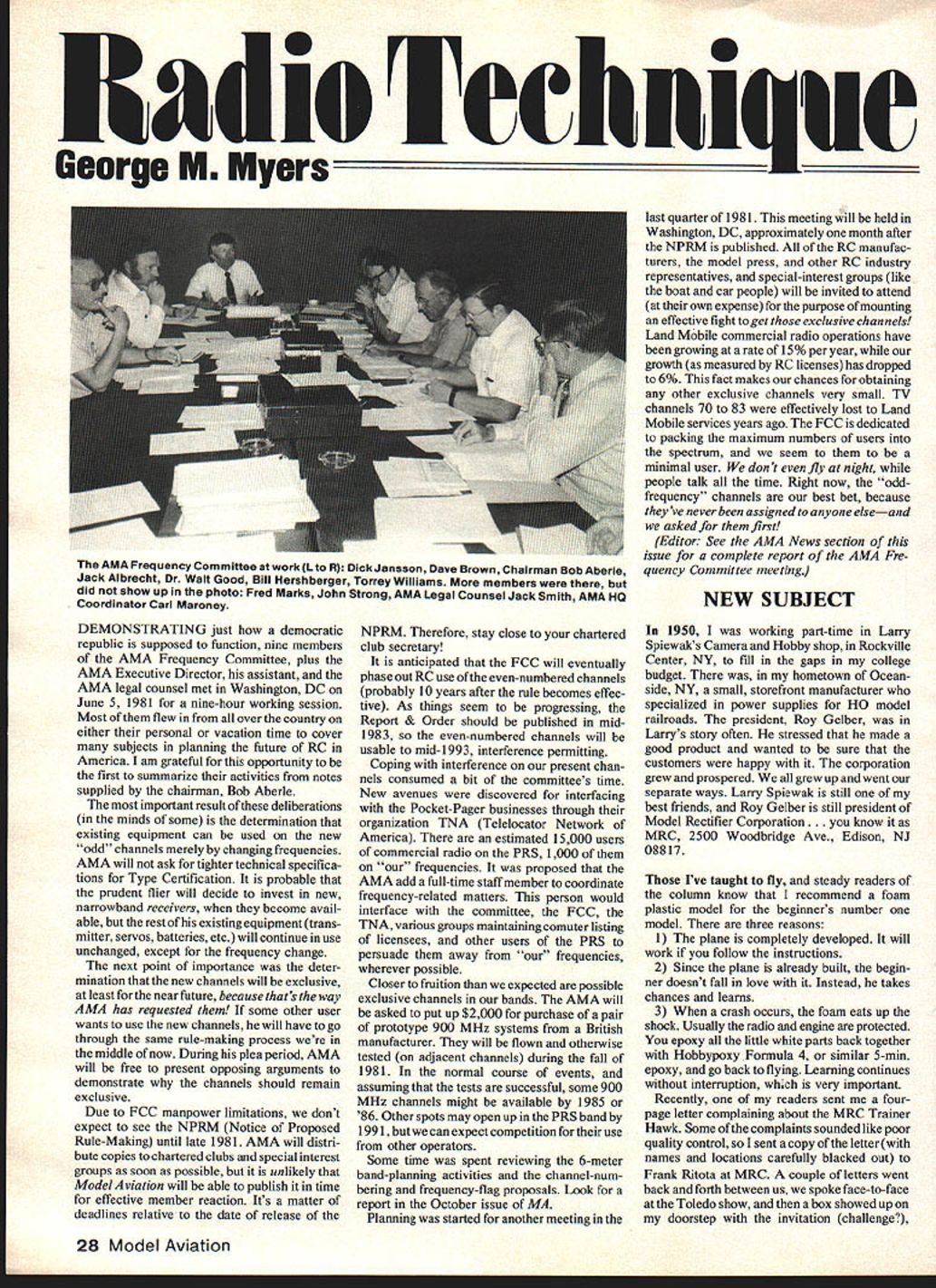
Nine members of the AMA Frequency Committee, plus the AMA Executive Director, his assistant, and AMA legal counsel, met in Washington, D.C., on June 5, 1981, for a nine-hour working session. Most attendees flew in from around the country on personal or vacation time to discuss planning the future of RC in America. The following summarizes the committee's activities (notes supplied by chairman Bob Aberle).
Equipment and channel policy
- Existing equipment can be used on the new odd-numbered channels by changing frequencies.
- AMA will not ask for tighter technical specifications for Type Certification. Prudent fliers will likely invest in new narrowband receivers when available, but transmitters, servos, batteries, etc., should continue unchanged except for the frequency change.
Exclusivity and rulemaking
- The new channels will be exclusive, at least in the near term, because AMA has requested exclusivity.
- Any other user seeking access to those channels must go through the same FCC rule-making process.
- During the notice-and-comment period, AMA can present opposing arguments to keep the channels exclusive.
NPRM and timeline
- Because of FCC manpower limitations, an NPRM (Notice of Proposed Rule Making) was not expected until late 1981.
- AMA will distribute the NPRM to chartered clubs and special-interest groups as soon as possible. Model Aviation may not be able to publish it in time for effective member response, so stay close to your chartered club secretary.
Key anticipated milestones:
- NPRM: late 1981 (expected)
- Report & Order: mid-1983 (expected)
- Even-numbered channels phased out: probably about 10 years after the rule becomes effective (even-numbered channels likely usable until about mid-1993, interference permitting)
Interference coordination
- Coping with interference on present channels took significant committee time.
- New avenues were found for interfacing with the pocket-pager businesses through TNA (Telelocator Network of America).
- Estimated PRS (Personal Radio Service) users: 15,000 total; about 1,000 on “our” frequencies.
- The committee proposed that AMA add a full-time staff member to coordinate frequency-related matters. This person would interface with the committee, the FCC, TNA, and groups maintaining computer listings of licensees, with the goal of persuading other PRS users away from AMA frequencies where possible.
900 MHz trials and future bands
- AMA will be asked to provide $2,000 to purchase a pair of prototype 900 MHz systems from a British manufacturer.
- These systems will be flight-tested (on adjacent channels) during fall 1981.
- If tests are successful, some 900 MHz channels might be available by 1985–86.
- Other opportunities in the PRS band may appear by 1991, but competition from other operators is expected.
Band planning and reports
- The committee reviewed 6-meter band-planning activities, channel-numbering, and frequency-flag proposals.
- A report on these matters was to appear in the October issue of Model Aviation.
Next meeting and industry mobilization
- Planning began for another meeting in the last quarter of 1981, to be held in Washington, D.C., about one month after the NPRM is published.
- Invited (at their own expense): all RC manufacturers, the model press, other RC industry representatives, and special-interest groups (boat and car modelers, etc.).
- Purpose: to mount an effective effort to secure exclusive channels for RC use.
Outlook
- Land Mobile commercial radio operations have been growing at about 15% per year, while RC growth (measured by RC licenses) has dropped to about 6% per year.
- This disparity makes obtaining additional exclusive channels difficult; TV channels 70–83 were effectively lost to Land Mobile services years ago.
- The FCC is focused on packing the maximum number of users into the spectrum, and RC appears to be a minimal user in their view.
- Given these pressures, the odd-frequency channels are the best immediate option because they have not been assigned to anyone else and AMA requested them first.
(Editor: See the AMA News section of this issue for a complete report of the AMA Frequency Committee meeting.)
Transcribed from original scans by AI. Minor OCR errors may remain.

