
Radio Technique
George M. Myers
The Electronic Bird-Dog (a multipurpose tool that's easy to build)
One thing I'm sure of is that my readers like gadgets that are simple, cheap and effective. Here is a device that finds RFI (Radio Frequency Interference) sources and costs about $25.
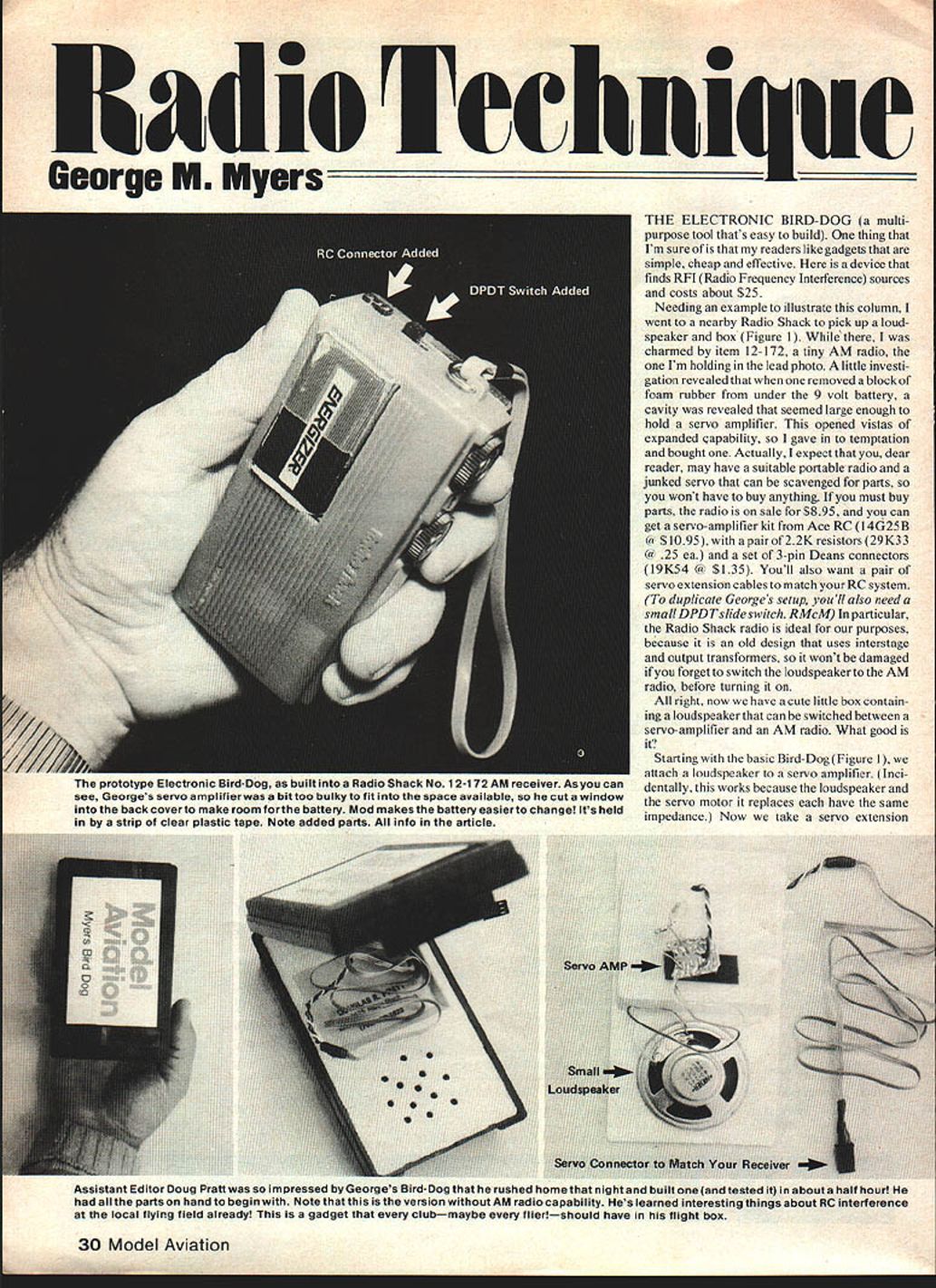
I picked up a tiny AM radio (Radio Shack item 12-172) to illustrate this column. When I removed a block of foam rubber from under the 9-volt battery, a cavity large enough to hold a servo amplifier was revealed. That opened vistas of expanded capability, so I bought one. You may already have a suitable portable radio and a junked servo that can be scavenged for parts, so you might not have to buy anything.
Parts (example)
- Radio Shack tiny AM radio (item 12-172) — about $8.95 (sale price referenced)
- Servo-amplifier kit (Ace RC 14G25B) — about $10.95
- Pair of 2.2K resistors (29K33) — about $0.25 each
- Set of 3-pin Deans connectors (19K54) — about $1.35
- Pair of servo extension cables to match your RC system
- (Optional) small DPDT slide switch
The Radio Shack radio is ideal because it uses interstage and output transformers (an older design), so it won't be damaged if you forget to switch the loudspeaker to the AM radio before turning it on.
Construction and hookup
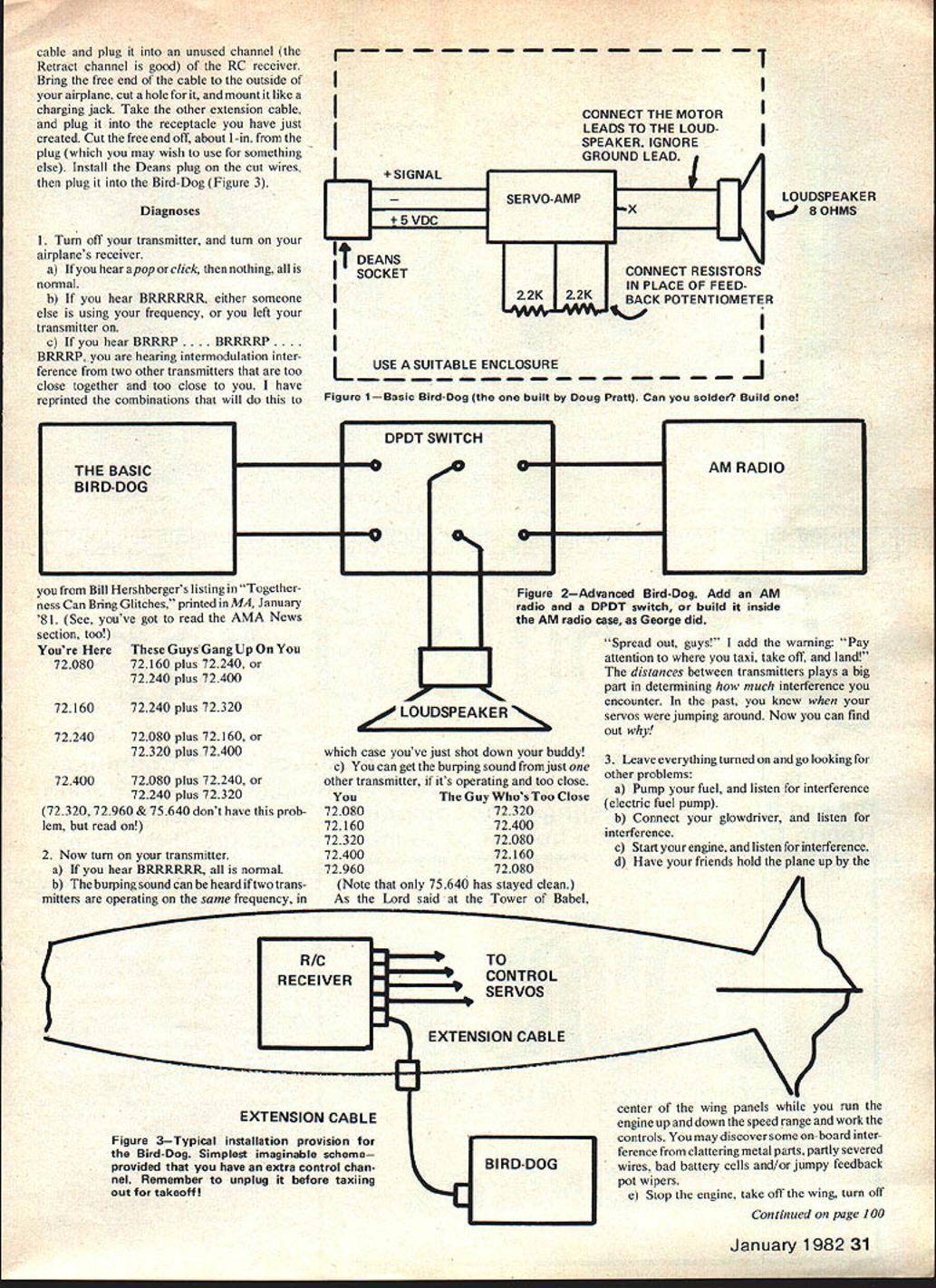
- Attach a loudspeaker to the servo amplifier. (This works because the loudspeaker and the servo motor it replaces each have similar impedance.)
- Take a servo extension cable and plug it into an unused channel on the RC receiver (the Retract channel is a good choice).
- Bring the free end of that cable to the outside of your airplane, cut a hole for it, and mount it like a charging jack.
- Take another extension cable, plug it into the receptacle you created, and cut the free end off about 1 inch from the plug (you may wish to save the plug for another use).
- Install the Deans plug on the cut wires, then plug it into the Bird-Dog.
Now you have a small box containing a loudspeaker that can be switched between the servo-amplifier and an AM radio.
Diagnoses
- Turn off your transmitter, and turn on your airplane's receiver.
- a) If you hear a pop or click and then nothing, all is normal.
- b) If you hear a continuous BRRRRRR, either someone else is using your frequency or you left your transmitter on.
- c) If you hear BRRRP . . . BRRRP . . . BRRRP, you are hearing intermodulation interference from two other transmitters that are too close together and too close to you. The following combinations can produce that effect (reprinted from Bill Hershberger's listing):
- You're here 72.080 — these guys gang up on you: 72.160 plus 72.240, or 72.240 plus 72.400
- You're here 72.160 — these guys gang up on you: 72.240 plus 72.320
- You're here 72.240 — these guys gang up on you: 72.080 plus 72.160, or 72.320 plus 72.400
- You're here 72.400 — these guys gang up on you: 72.080 plus 72.160, or 72.240 plus 72.320
- (Note: 72.320, 72.960 & 75.640 don't have this specific problem, but read on.)
- Now turn on your transmitter.
- a) If you hear BRRRRRR, all is normal (that is, you are hearing your own transmitter).
- b) A "burping" sound can be heard if two transmitters are operating on the same frequency; in that case you've just shot down your buddy.
- c) You can get the burping sound from just one other transmitter if it is operating and too close to you.
The Guy Who's Too Close (examples of near-frequency pairs that cause interference):
- 72.080 — 72.320
- 72.160 — 72.400
- 72.320 — 72.080
- 72.400 — 72.160
- 72.960 — 72.080
As the Lord said at the Tower of Babel, "Spread out, guys!" Pay attention to where you taxi, take off, and land. The distances between transmitters play a big part in how much interference you encounter. In the past you knew when your servos were jumping around; now you can find out why.
- Leave everything turned on and go looking for other problems:
- a) Pump your fuel and listen for interference (electric fuel pump).
- b) Connect your glowdriver and listen for interference.
- c) Start your engine and listen for interference.
- d) Have friends hold the plane up by the center of the wing panels while you run the engine through the speed range and work the controls. You may discover on-board interference from chattering metal parts, partly severed wires, bad battery cells, or jumpy feedback pot wipers.
- e) Stop the engine, remove the wing, turn off your transmitter, and start moving the wires around (gently) inside the plane. You may find fractured wires, loose or dirty plugs, a switch that has taken too much caster oil, an antenna wire fractured inside the insulation at the strain relief, or dozens of other little gremlins.
This tool lets you listen to the problems that are making your servos nervous. With a little practice, you'll learn to differentiate between RFI that will affect your flying and RFI that won't. Why crash in ignorance?
- Moving on to the advanced Bird-Dog, the AM receiver offers at least six more useful functions.
- a) Transmitter impound area check: the AM radio is the quickest way to discover if anyone has left a transmitter turned on. Merely touch the screw holding the volume control to the top of each transmitter antenna. If you hear BRRRR, you'll know it's on. (The AM receiver must be turned on, the volume must be turned up, and it must be tuned between stations.)
- b) Transmitter control check: hold the operating AM receiver near the transmitter antenna to get that BRRRR sound, then work the transmitter controls one at a time. The sound quality should change each time a control is moved.
- c) Locate strong electrical disturbances: hold the AM radio near noisy electric motors or high-tension lines and you can hear the static. I once used a portable radio to locate a washing machine switch that was arcing continuously and spoiling TV reception. On another occasion I located an electric light bulb that was fractured but kept welding itself together; it produced an annoying continuous noise on AM radio and sparkles on TV until I found it. Hold the AM radio next to your fuel pump while it's pumping and discover why your servos get nervous when someone is refueling nearby.
- d) Detect transmitters that "look off": some transmitters emit very little energy when their antenna is collapsed (metal-cased, disappearing antenna), while others emit quite a bit more (plastic-cased, part of a section left exposed). The AM radio tells you which ones to be wary of.
- e) Useful reception: the AM radio can give you time signals, weather forecasts (be wary if a front is expected to pass through while you're out flying), news, music, and company when you're in the shop and all alone.
- f) Weather advance warning: snaps and crackles will warn you of the approach of an electrical storm long before you see lightning or hear thunder. You might want to move most of your stuff into the car early.
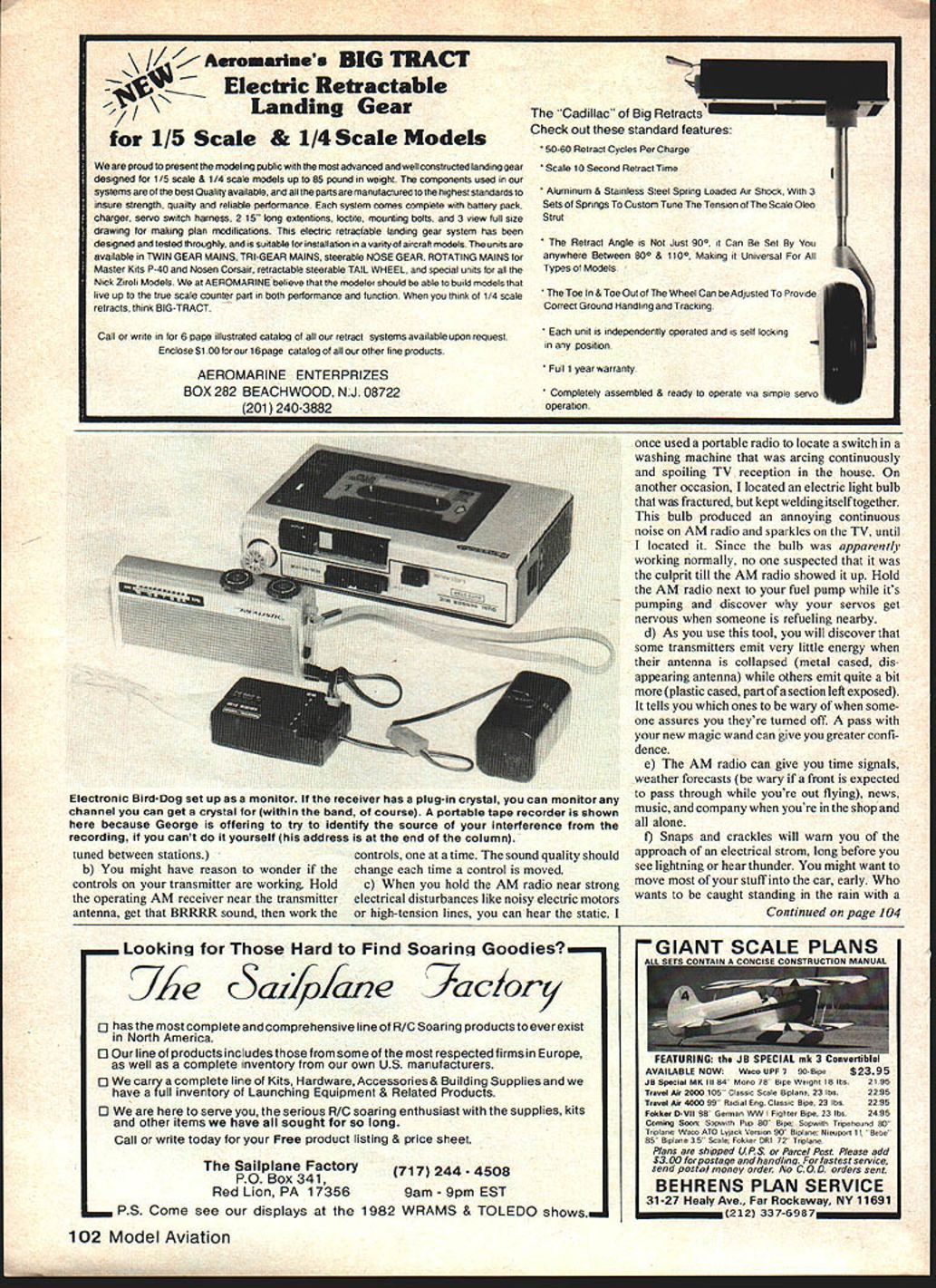
A bit of background: Paul Bell and Ron Farkas asked for a cheap RC channel monitor. We considered adding an output transformer to the detector stage of an RC receiver so you could listen with earphones or a loudspeaker. However, such a monitor isn't worth much for assessing causes of interference while your plane is in the air, because up in the sky the plane's receiver can hear signals for miles and up close all the monitor hears is your own transmitter.
If you want to survey the scene before you turn your transmitter on, you can plug the Bird-Dog into an RC receiver that offers interchangeable crystals (e.g., Airtronics XL). Plug in the crystal for the channels you are interested in and listen. In most cases you'll be interested in the channel you intend to fly, so your airplane is all the receiver you need.
The Electronic Bird-Dog (any version) will cost less than any scanner you can buy and it's more versatile. But it won't do any good if you don't use it. Get in the habit of carrying it in your flight box. If you use the suggested Radio Shack radio, it comes in a stout cardboard box that makes a nice protective cover; failing that, use a small camera case.
A final thought (compliments of Ron Farkas): One Bird-Dog checks all bands: 27, 35, 49, 53, 72 and 75 MHz. Ain't that nice?
Keep the letters coming.
George Myers 70 Froehlich Farm Rd. Hicksville, NY 11801
Transcribed from original scans by AI. Minor OCR errors may remain.

