
Radio Technique
Water, Corrosion and Your RC System
By George M. Myers
After a few hours of flying, most RC systems get covered with a fine layer of silicone oil from the engine's exhaust. That stuff gets everywhere, and it is hard to remove. One of my chemist friends looks forward to the day (not far in the future) when the world will be covered by a one-molecule-thick layer of silicones, and wonders what effect that will have on life. It isn't biodegradable.
That layer of silicone provides pretty good protection from the kind of corrosion that might be expected in most parts of the country away from chemical plant smokestacks and the seashore. That's why many RC systems lack specific protection from corrosion. But what about the folks who fly seaplanes, expect occasional off-field landings in swamps, or live in high-humidity areas where sea fogs blow in at night? Those folks have corrosion problems, or so their letters tell me.
If you see a green tinge around your "gold-plated" pins and sockets, you've got corrosion problems. Even fresh pond water is corrosive because it contains salts from fertilizer, highway runoff (salt melts ice, remember) and from indigenous wildlife (like ducks). So what should you do about it?
- Soak and clean corroded contacts
- Soak anything with a green tinge in white vinegar. Ten minutes should be long enough if you swish it around a bit. Vinegar contains acetic acid, which is strong enough to remove corrosion yet mild enough not to hurt your radio.
- Wash with fresh water, then dry the parts with a hair dryer.
- Inspect and repair
- Inspect corroded areas with a strong magnifying glass.
- Replace parts that need replacing. For minor corrosion, lay a film of solder over the affected area.
- Protect the receiver, servos and transmitter
- Open the receiver. Protect the servo sockets and the crystal socket with Scotch cellophane tape before coating.
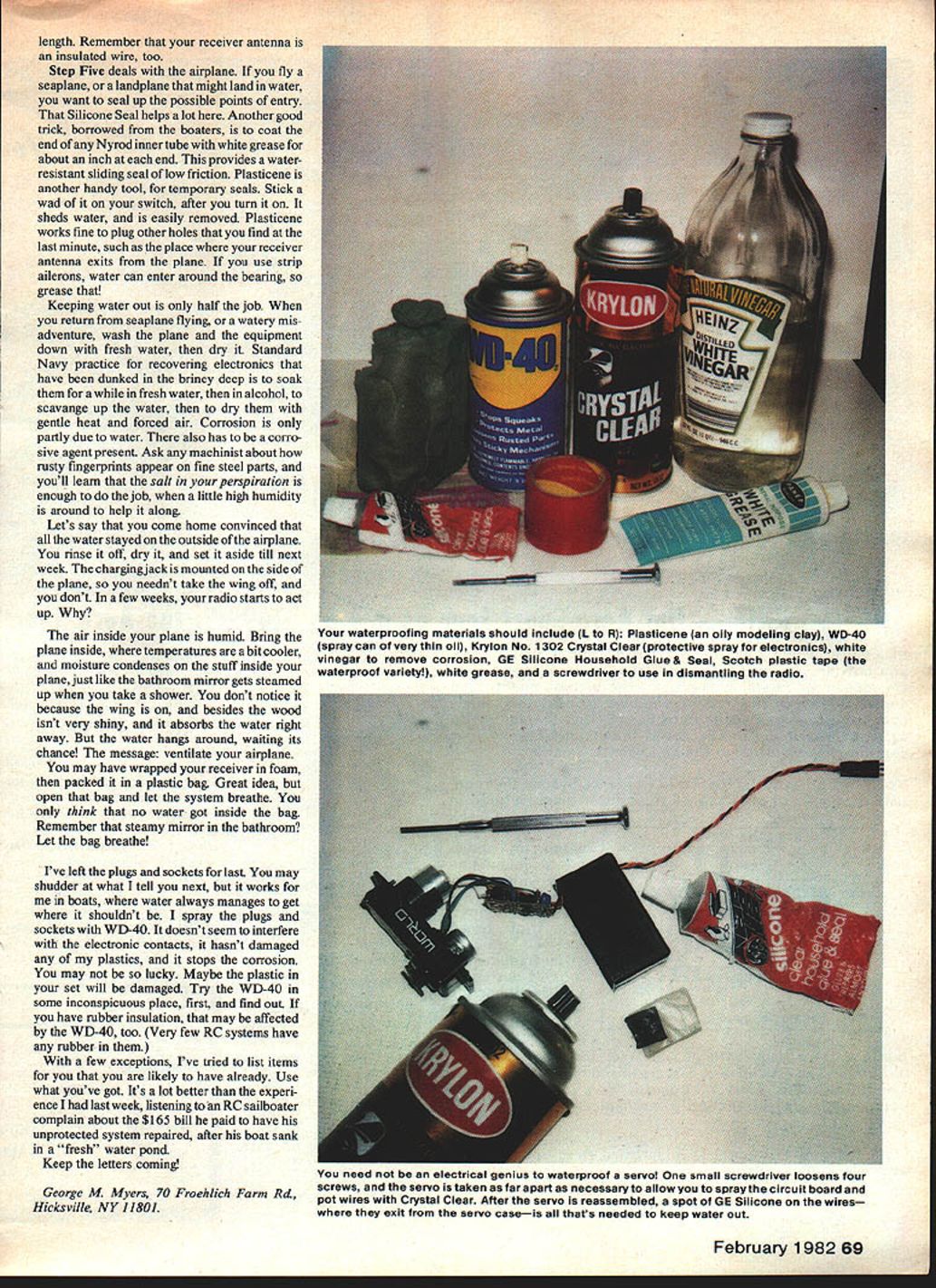
- Spray both sides of the circuit board with two coats of Krylon #1302 Crystal Clear. Make sure to get it under components on the boards. This material is formulated for electronic protection and will burn off at soldering temperatures if repairs are required.
- Remove the tape and reassemble the receiver when the coating is dry. Tape over the case seams with Scotch Plastic Tape #191 (or equivalent). Do not use ordinary mending tape, because if it gets immersed in water the tape separates from the glue and leaves a mess.
- Treat each servo the same way as the receiver. The battery may already be potted in silicone sealer to keep it from shifting under vibration. If not, spray and then pot the battery in GE Silicone Household Glue & Seal #361. Note: this silicone smells of acetic acid and might contribute to corrosion in some situations, so use caution.
- The switch harness: there is no simple way to waterproof the common switches used in airplane RC systems. If you want a waterproof switch, buy and install a waterproof type to replace the existing one.
- Treat the transmitter like the receiver. Tape over openings in switches and control potentiometers before spraying the Crystal Clear. Remove tape after the coating dries and close up the box. If you fly off salt water, consider replacing unsealed pots and switches with MIL-STD sealed types or have a repairman do it for you. Salt spray travels a long way and will find its way inside a transmitter if given half a chance.
- Seal wire ends and prevent wick-through
- Every plastic-insulated wire is a potential water pipe. Wherever possible, seal the ends of wires with Zap (or similar), grease, or silicone seal.
- Water vapor from humid air will travel up inside the insulation on wires and start corrosion inside receivers, servos, switches, etc. Block every possible entry point. Remember that the receiver antenna is insulated wire too.
- Seal the airplane and temporary fixes
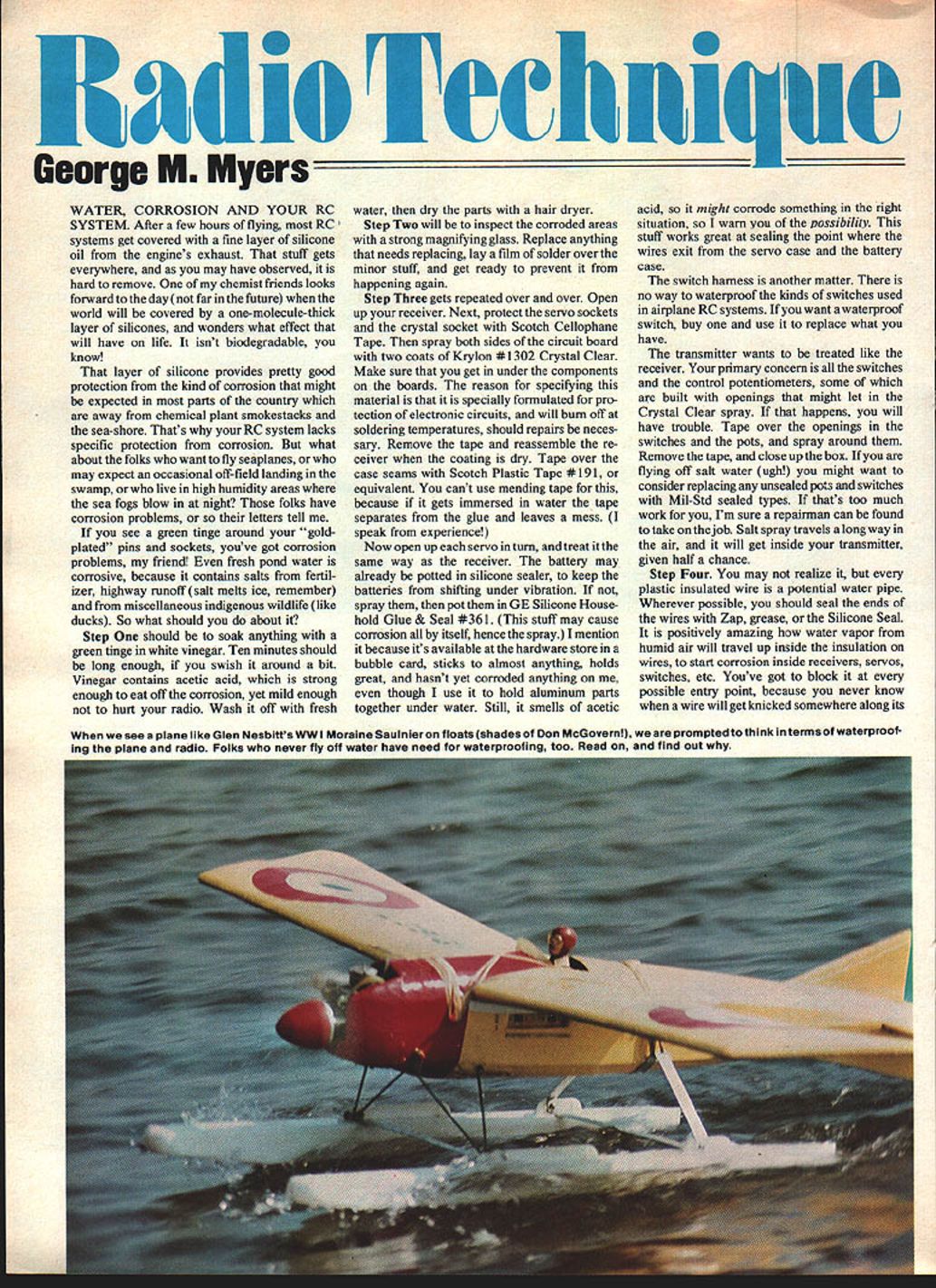
- If you fly a seaplane or a landplane that might land in water, seal possible points of entry with silicone seal.
- A boater's trick: coat the end of a nylon inner tube with white grease about an inch from the end to provide a water-resistant sliding seal with low friction.
- Plasticine is handy for temporary seals. Stick a wad on your switch after you turn it on — it sheds water and is easily removed. Plasticine can also plug holes such as where the receiver antenna exits the plane.
- If you use strip ailerons, water can enter around the bearing, so grease that area.
After exposure to water
- After seaplane flying or a watery misadventure, wash the plane and equipment with fresh water, then dry them.
- Standard Navy practice for recovering electronics dunked in salt water is to soak them for a while in fresh water, then in alcohol to scavenge the water, then dry with gentle heat and forced air.
- Corrosion requires a corrosive agent as well as water. Salt from perspiration is often enough to cause rust on fine parts when humidity is present.
Ventilation and storage
- Condensation can form inside an airplane when you bring it into a cooler environment, much like a bathroom mirror steaming up after a shower. You may not notice it because wood absorbs water and the wing is on.
- Ventilate your airplane. If you've wrapped a receiver in foam and packed it in a plastic bag, open the bag and let the system breathe. Moisture can be trapped and condense inside.
Plugs and sockets
- I spray plugs and sockets with WD-40. It seems to stop corrosion and hasn't interfered with contacts in my experience. It also hasn't damaged plastics I've used it on, but your mileage may vary.
- Test WD-40 in an inconspicuous place first to ensure it doesn't attack any plastics or rubber insulation (very few RC systems have rubber insulation).
Anecdote and final note
- I've tried to list items you are likely to have already. Use what you've got — it's a lot better than the experience of an RC sailboater I heard from, who paid $165 to repair an unprotected system after his boat sank in a "fresh" water pond.
Keep the letters coming!
George M. Myers 70 Froehlich Farm Rd. Hicksville, NY 11801
Transcribed from original scans by AI. Minor OCR errors may remain.

