
Radio Technique
George M. Myers
Those New Frequencies
Another milestone toward practical use of additional RC frequencies was reached January 9–10, 1982, when RC manufacturers convened in Pasadena, CA. The meeting was called to explore the AMA proposal to the FCC for 73 new channels, to review the draft of an AMA Phase‑In Plan for utilization of the new channels, and to establish an industry group to coordinate manufacturers' responses.
Mr. Lee Renaud, president of Airtronics, Inc., will serve as president of the new group, and Mr. John Maloney, president of World Engines, will serve as secretary/treasurer. Among the labels represented were Ace RC, Airtronics, E.K. Logictrol, EMS, Futaba, Kraft, Millicott, MRC, Novak, Sanwa and World Engines. It is too soon to predict what this organization will become, but AMA plans and proposals were examined in detail.
The AMA proposal was explained by Fred Marks of the AMA Frequency Committee, who has been presenting the AMA picture to FCC commissioners. The AMA Phase‑In Plan was presented by Jack Albrecht, also a committee member, who has worked hard to make this plan a reality.
The key interest at this time is the Phase‑In Plan, which is considered essential to avoiding false starts and unnecessary conflicts. The essentials are:
- Existing radios won't work with 20 kHz spacing, so you won't be able to fly 50 airplanes at the same time on one field simply by plugging in new crystals.
- AMA tests have shown that existing radios will work on 40 kHz spacing, but there are problems with images and intermodulation. Therefore, channels usable immediately after the FCC's Report & Order is published will be limited to those listed below.
I expect the NPRM to appear in February 1982 and the Report & Order (R&O) to be published in Fall 1982. If the R&O is published as hoped, AMA contemplates use of the listed channels at AMA‑sanctioned events in 1983, subject to FCC clearance. When that happens, Low Band radio users will be able to change frequencies by installing new crystals themselves. High Band users generally will not be able to do that unless their radios already have plug‑in crystals or can be modified to accept a crystal socket. Some will opt to obtain an FCC second‑class (commercial) license for broader privileges.
The new channels are closer together than before and will require precise alignment to avoid interfering with buddies on adjacent channels. The AMA plan also contemplates assigning boats and cars to 75 MHz to avoid interference with airplanes; I personally think that is a mistake and will reserve further comment until after the NPRM is published.
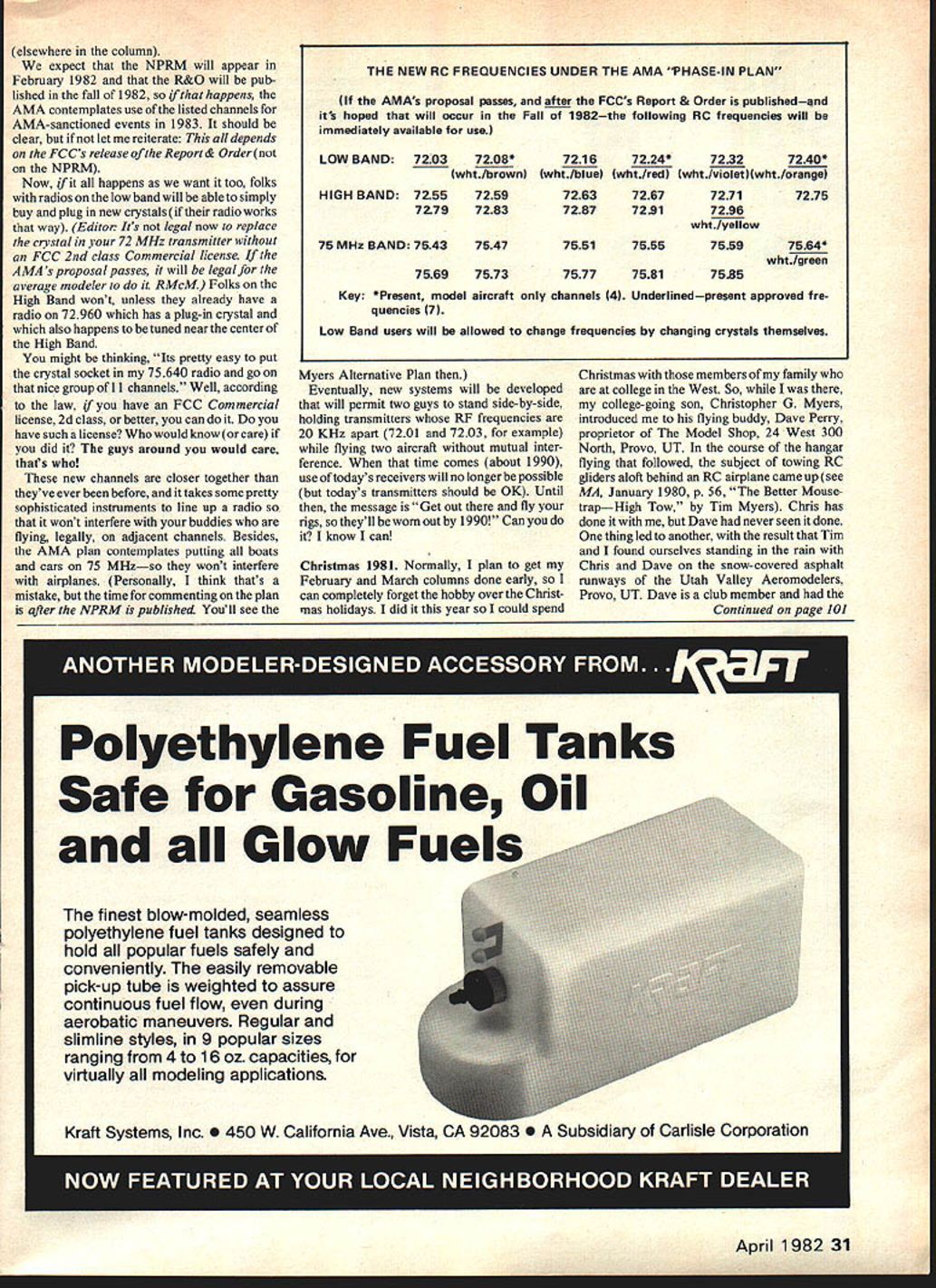
The New RC Frequencies Under the AMA "Phase‑In Plan"
(If the AMA proposal passes and the FCC publishes the Report & Order—hoped for Fall 1982—the following RC frequencies would be immediately available.)
Low Band
- 72.03
- 72.08*
- 72.16
- 72.24*
- 72.32
- 72.40*
- Color codes (where used): 72.03 (white/brown), 72.08 (white/blue), 72.16 (white/red), 72.24 (white/violet), 72.32 (white/orange), 72.40 (white/??)
Low Band users will be allowed to change frequencies by changing crystals themselves.
High Band
- 72.55
- 72.59
- 72.63
- 72.67
- 72.71
- 72.75
- 72.79
- 72.83
- 72.87
- 72.91
- 72.96
- Color codes (where used): 72.96 (white/yellow)
75 MHz Band
- 75.43
- 75.47
- 75.51
- 75.55
- 75.59
- 75.64*
- 75.69
- 75.73
- 75.77
- 75.81
- 75.85
- Color codes (where used): 75.64 (white/green)
Key:
- * present model‑aircraft only channels (four such channels noted)
- Underlining in the original indicated presently approved frequencies (seven such frequencies)
Myers' Alternative Plan
Eventually, new systems should be developed that permit two pilots to stand side‑by‑side on transmitters whose RF frequencies are 20 kHz apart (for example, 72.01 and 72.03) and fly two aircraft without mutual interference. When that time comes (perhaps around 1990), today's receivers will likely be obsolete (although today's transmitters should still be usable). Until then, my advice is: get out and fly your rigs now—enjoy them while they last.
If you want to hedge a bit when buying now, look for radios with interchangeable RF modules or boards. Manufacturers might support such radios with new channel boards or modules if feasible. Either way, you'll be flying and having fun while the regulatory and technology situation develops.
Christmas 1981 — Towing RC Gliders
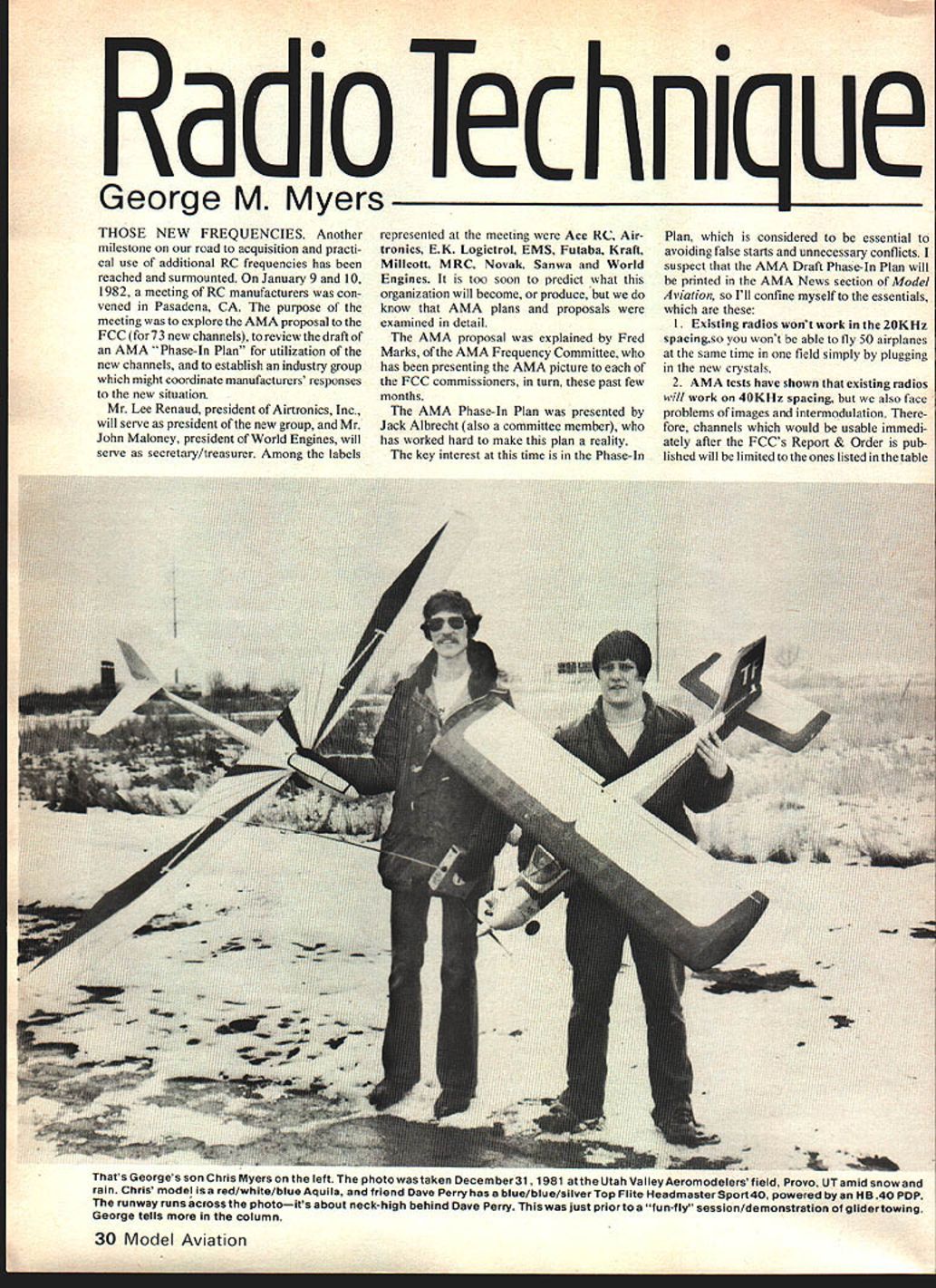
Normally I try to finish my February and March columns early so I can forget the hobby over the Christmas holidays. This year I finished early so I could spend Christmas with family out West. While there, my son Christopher G. Myers introduced me to his flying buddy Dave Perry, proprietor of The Model Shop, 24 West 300 North, Provo, UT. In the course of hangar‑flying the subject of towing RC gliders aloft behind an RC airplane came up.
Chris had done some towing with me, but Dave had never seen it. One thing led to another, and Tim and I found ourselves standing in the rain with Chris and Dave on the snow‑covered asphalt runways of the Utah Valley Aeromodelers. Dave is a club member and had the key to the field. We agreed to demonstrate using Chris' Aquila sailplane (stock except for a releasable tow hook) and Dave's Headmaster Sport .40 (completely stock). Dave stripped about 70 ft. of line off his fishing reel; we found a beverage‑can pull tab on the ground and made a towline.
I put Dave's plane up for a trim and familiarization flight and found it was set up for very mild handling (slow aileron rolls and not enough elevator for stalls or snap‑rolls). Tim tried Chris' sailplane and found it short on control authority; Chris had taped the spoilers closed, and Tim likes to use them on tow for better control. Landings were faster and flatter than we’re accustomed to, flying at roughly sea level compared to our usual higher‑altitude sites. The snow helped brake the landing rolls.
Dave produced a toy snow shovel from his truck and cleared a "runway" about 100 yards long and half a wingspan wide. We kept our flying patterns well to the right because power poles and power lines were close to the field. The cloud ceiling fell, and rain began to turn to snow, so it became a "Do it, or forget it" situation. We had to leave the next morning to get Tim back to his Eastern college, so we did it.
After two false starts while sorting out problems, we began making tows. Tim and I towed Chris' sailplane back at reasonably low altitude several times for the benefit of photographers. Both planes performed flawlessly and escaped damage. The main differences we noticed compared with sea‑level or high‑altitude flying were longer takeoff runs and shallower climbs.
What's this got to do with the new RC channels? Not much technically—except that in spite of lousy weather and my intention to avoid RCing over the holidays, we flew and had fun. Some readers have written asking which new radio to buy and say they intend to wait until things settle. My view is you'll be sitting out a long time if you wait. The AMA Phase‑In Plan contemplates continued production and use of existing radios for some time, so buy what you like now and enjoy it.
Keep the letters flowing.
George M. Myers 70 Froehlich Farm Rd. Hicksville, NY 11801
Transcribed from original scans by AI. Minor OCR errors may remain.

