
Radio Technique
George M. Myers
GO ANYWHERE that RC flying is done and you will find people who are having trouble starting their engines. Clarence Lee writes a beautiful column in RC Modeler which explains both theory and practice for small engines, and if my circle of friends is a fair sample, the column is widely read and understood. This leaves one wondering why starting problems are so common. Upon closer examination we find that it's usually a glow plug that isn't working properly, or a starting battery that isn't connected, or an exhausted battery.
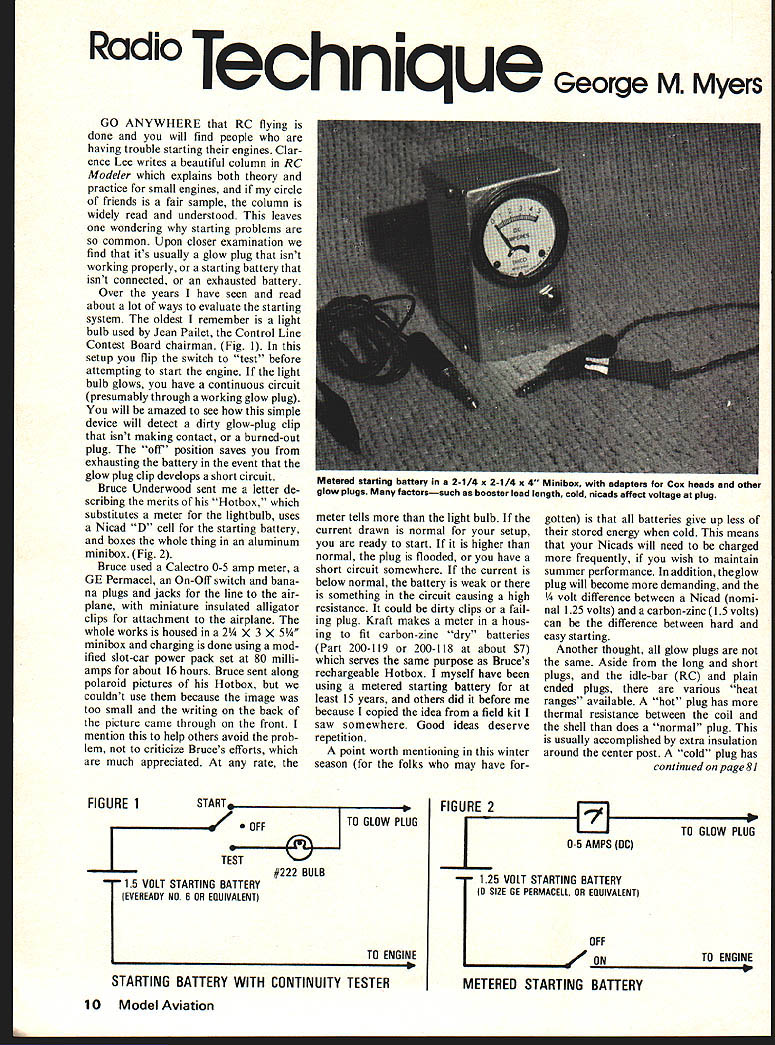
Over the years I have seen and read about a lot of ways to evaluate the starting system. The oldest I remember is a light bulb used by Jean Paillet, the Control Line Contest Board chairman (Fig. 1). In this setup you flip the switch to "test" before attempting to start the engine. If the light bulb glows, you have a continuous circuit (presumably through a working glow plug). You will be amazed to see how this simple device will detect a dirty glow-plug clip that isn't making contact, or a burned-out plug. The "off" position saves you from exhausting the battery in the event that the glow plug clip develops a short circuit.
Bruce Underwood sent me a letter describing the merits of his "Hotbox," which substitutes a meter for the lightbulb, uses a Nicad D cell for the starting battery, and boxes the whole thing in an aluminum minibox (Fig. 2).
Bruce used a Calectro 0-5 amp meter, a GE Permacel, an On-Off switch and banana plugs and jacks for the line to the airplane, with miniature insulated alligator clips for attachment to the airplane. The whole works is housed in a 2-1/4 x 3 x 5 minibox and charging is done using a modified slot-car power pack set at 80 milliamps for about 16 hours. Bruce sent along polaroid pictures of his Hotbox, but we couldn't use them because the image was too small and the writing on the back of the picture came through on the front. I mention this to help others avoid the problem, not to criticize Bruce's efforts, which are much appreciated. At any rate, the meter tells more than the light bulb. If the current drawn is normal for your setup, you are ready to start. If it is higher than normal, the plug is flooded, or you have a short circuit somewhere. If the current is below normal, the battery is weak or there is something in the circuit causing a high resistance. It could be dirty clips or a failing plug. Kraft makes a meter in a housing to fit carbon-zinc "dry" batteries (Part 200-119 or 200-118 at about $7) which serves the same purpose as Bruce's rechargeable Hotbox. I myself have been using a metered starting battery for at least 15 years, and others did it before me because I copied the idea from a field kit I saw somewhere. Good ideas deserve repetition.
A point worth mentioning is this winter season (for the folks who may have forgotten) is that all batteries give up less of their stored energy when cold. This means that your Nicads will need to be charged more frequently, if you wish to maintain summer performance. In addition, the glow plug will become more demanding, and the 1.25 volt difference between a Nicad (nominal 1.25 volts) and a carbon-zinc (1.5 volts) can be the difference between hard and easy starting.
Another thought, all glow plugs are not the same. Aside from the long and short plugs, and the idle-bar (RC) and plain-ended plugs, there are various "heat ranges" available. A "hot" plug has more thermal resistance between the coil and shell than does a "normal" plug; this is usually accomplished by extra insulation around the center post. A "cold" plug has
Radio Technique/Myers
less resistance, and therefore will cool to a lower average temperature during the engine run. If your engine is hard to start, try to obtain a hotter plug. This will also improve idling.
Overall, the thing that separates easy starting from hard starting is knowledge. If you know that your starting battery has an adequate charge, the glow plug is in good condition, connections are clean and tight, and the wire from the battery to the plug is a heavy enough gauge to carry the current without dropping too much voltage, you will get a start. That last point deserves some comment. A three-foot length of 20-gauge lamp cord will drop 3 volts when trying to light a Cox plug at 3 amps. That's enough to convert a cold day into a miserable session of gashed fingers and alcohol fires. Use the most copper you can—14 gauge is good—and keep the leads short.
The best way to see the information that you want in this column is to let me know about it at 70 Froehlich Farm Rd., Hicksville, NY 11801.
(Editor's Note: In the January issue, a schematic appeared for LED devices. While the schematic was correct many readers ran into trouble by using an 82-ohm resistor where an 82K belongs. The colors for 82K are Grey, Red, Orange.)
Transcribed from original scans by AI. Minor OCR errors may remain.

