
Radio Technique
George M. Myers
THE WATSON STABILIZER. No, it isn't a gyro! When you hook it up to the yaw (rudder) servo of your helicopter, you convert that servo's function from a force control to a yaw-rate control. More stick deflection means a faster (constant, stabilized) rate of yawing (no speed-up). A gyroscope is a device that tries to maintain a constant position in space. The Watson Stabilizer doesn't care anything about its position in space.
To regress a bit, I bought my Heliboy 80 kit in November 1979 and flew it through the fall of 1980. At that time I found myself with severe glitch problems. I sent the Futaba radio back for a checkout and substituted my 1971 Pro-Line, but glitching continued. Thereupon, I dismantled the Heliboy and, finding that the engine had swallowed too many glow-plug elements, sent that back for repair, also. In the meantime I found that the tail-rotor drive section of the main reduction gear had been damaged, so I ordered a replacement for that. Other problems were found and rectified.
Thanks to York Diamon of Futaba, the radio was returned promptly, and likewise, thanks to Jim Newman of Midwest Model Supply, the HP .61F was returned in good condition (along with stern warnings about overcompressing the engine when burning nitrated fuels, plus appropriate shims for the engine's head).
However, the radio came back first, so I put it in a 36/600 sailboat. I spent most of my spare time in 1981 racing the RC sailboat, with the result that the Heliboy languished in a box of parts. Late in 1981 I received a Watson Stabilizer for evaluation. It should be mentioned that I have received several letters from readers inquiring about this device. I couldn't answer them, because I had no personal experience with it, and I make a determined effort to write only about things I have tested and used long enough to develop a worthwhile opinion.
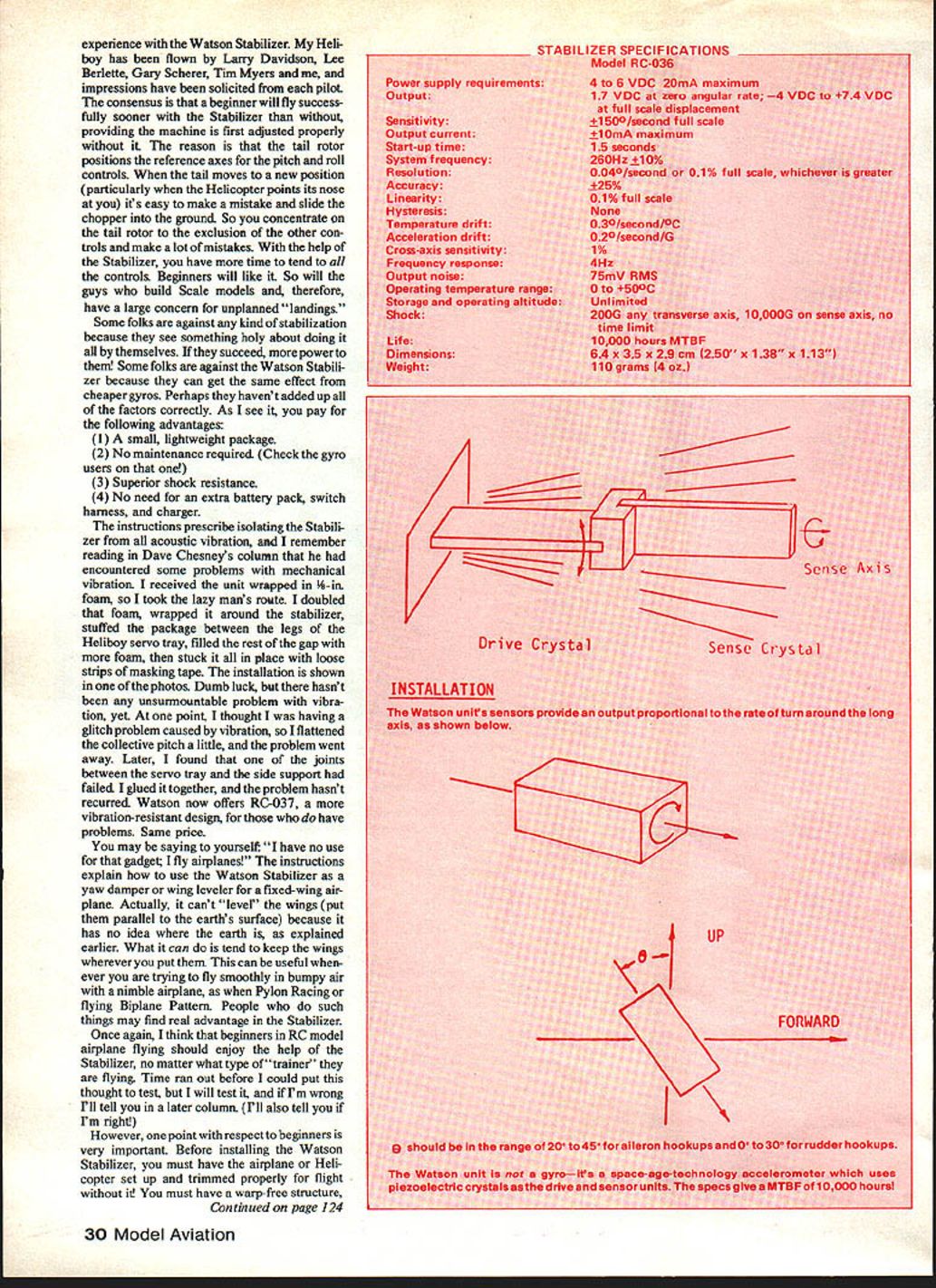
The Heliboy was reassembled and adjusted without the Watson Stabilizer. When I was satisfied that it was flying as before (except without the glitches), I modified a Kraft KPS-15 II servo to accept the Stabilizer, installed it in the helicopter, and went back to flying. Full instructions for the necessary modification are included with the Stabilizer, but you must specify the servo you're going to use with it when placing the order with Watson Industries, Inc., 3041 Melby Road, Eau Claire, WI 54701. Order Model RC-036 @ $16.95.
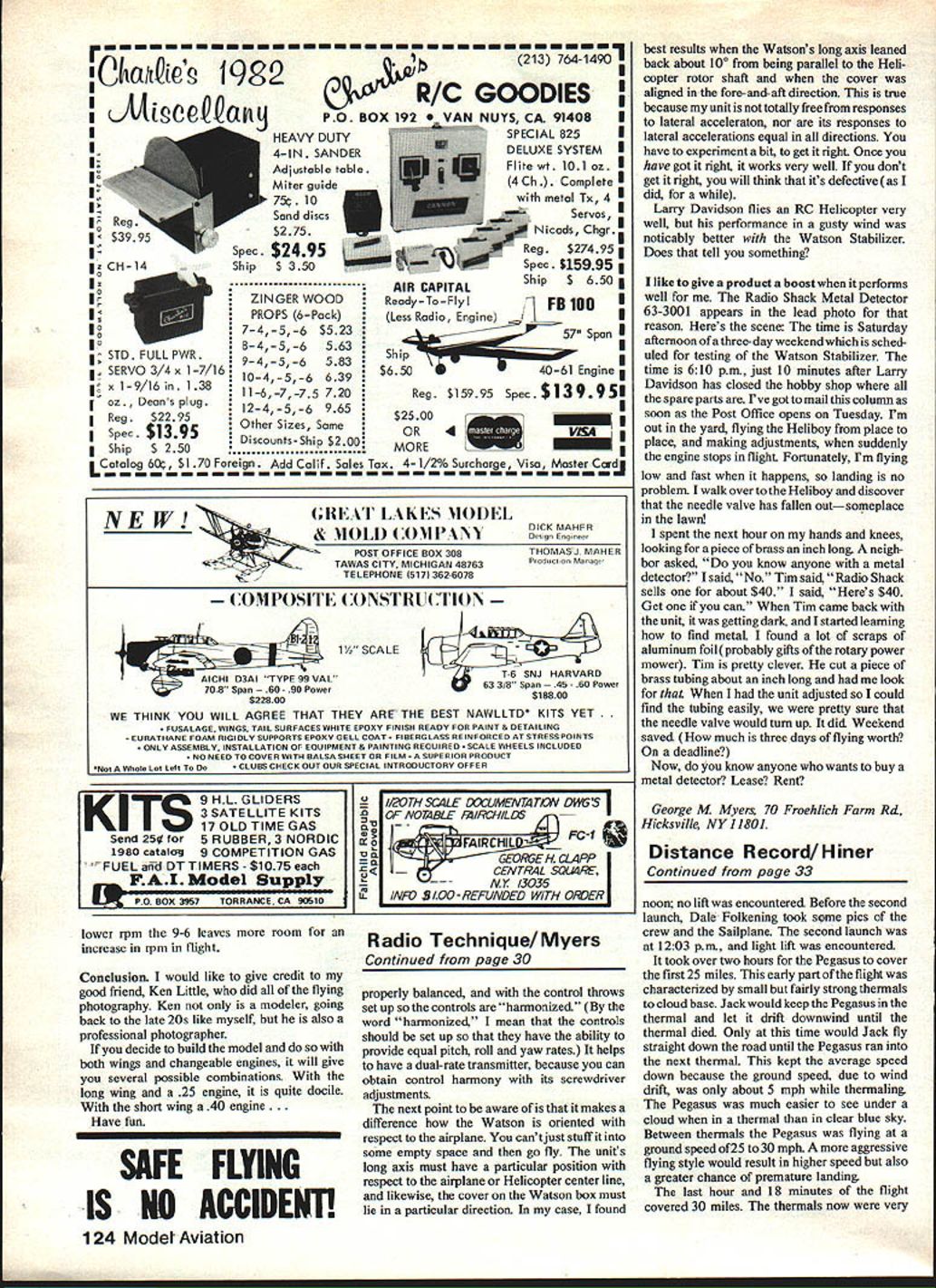
Basically, add a pigtail to the yaw servo, joining black-to-black and red-to-red (bring power). The Stabilizer requires about 20 mA, about the same as a servo at idle. Join the signal lead to the servo amplifier PC board through the resistor supplied. If you look into the open box, the sensor consists of two piezo-electric crystals joined end-to-end 90° apart. One crystal is driven to vibrate in bending at its resonant frequency (14,000–17,000 cpm); the other crystal senses. The sense crystal is equipped with electrodes to pick off a voltage when it is bent. As a result of the sensor geometry, the output relates to angular motion in the resonant-frequency band; the electronics use a notch-filter-type circuit to eliminate sensor voltages except in that band. Hence the output of the sensor is essentially zero unless the helicopter, either stationary (hovering) or flying in a straight line or through a loop or roll, produces significant input. When the unit senses tail motion it produces an output arranged to oppose the action caused by the electrical control signals already inside the tail-rotor servo, resulting in smoother flying.
How to Use the Watson Stabilizer
- Turn the transmitter on. Set rudder trim neutral. Unplug the Watson Stabilizer.
- Turn the receiver on. Mark the servo's neutral position.
- Plug the Watson Stabilizer in. Adjust the ZERO potentiometer to the previous position.
- Move the transmitter rudder control hard-over in one direction. Mark extreme servo positions.
- Lay the Watson Stabilizer on a hard surface (floor or a towel-covered floor). Roll the Watson 90° face to one side and then to the other. Observe servo deflection. Adjust the GAIN potentiometer to get the maximum jump equal to the maximum deflection response to control inputs. Repeat until satisfied.
- If the servo responses to the Watson Stabilizer are unequal (left vs. right), adjust the SYMMETRY pot. It interacts with ZERO, so you will have to work back and forth between them.
Rolling the sensor can induce some bending of the sense crystal by moving the assembly in the rolling direction. However, such bending ordinarily takes place at very low frequencies. If the crystals are rolled about a common axis, some energy will transfer from the driver crystal to the sense crystal at its resonant frequency. The notch-filter-type electronics eliminate sensor voltages except in the resonant-frequency band. Hence the output of the sensor is essentially zero unless the aircraft or helicopter produces significant input in that band. The Stabilizer's output opposes undesired tail-rotor motion produced by control mixing, resulting in smoother flying.
The first thing you notice when flying a Stabilizer-equipped helicopter is nothing. The chopper obeys your commands as you expect. Only when you switch OFF the Stabilizer (I added a servo-operated ON/OFF switch to the system for testing) do you realize that something was helping you keep the tail rotor under control. In effect, the Stabilizer adds damping to the tail-rotor response, about like what would happen if you hooked a length of chain to the tail boom and let it drag on the ground.
If you switch the Stabilizer ON/OFF in flight, you discover that the Stabilizer cuts down on the total response obtained from the yaw control. That's because you've become accustomed to seeing the tail swing at an ever-increasing rate in response to a "hard-over" command. With the Stabilizer acting, you get a slower, constant rate of swing. This rate is adjustable with the unit's gain control, which is set at the factory to produce a maximum servo deflection of ±30° (against a servo that normally swings ±45°). You can turn it up till the servo oscillates, or turn it down to get less stabilization, as you wish. My suggestion is to use it as you receive it, at least for a while.
You may also discover that the trim control on your rudder stick has to be readjusted if you switch the Stabilizer ON/OFF. This can be done with the unit's internal ZERO control. Once again, this was set at the factory to match the servo specified in the order, and I suggest that you use it "as is" for a while.
At this point (taking a gallon of fuel to mean four hours of flying), I have about eight hours of flying time with the Stabilizer installed. The unit appears to be reliable and I haven't had any failures. It does add some weight and complexity, and it costs $169.95, but if you fly helis that require steady tail control it may be worthwhile.
My Heliboy has been flown by Larry Davidson, Lee Berlette, Gary Scherer, Tim Myers and me, and impressions have been solicited from each pilot. The consensus is that a beginner will fly successfully sooner with the Stabilizer than without, provided the machine is first adjusted properly without it. The reason is that the tail rotor positions the reference axes for the pitch and roll controls. When the tail moves to a new position (particularly when the Heliboy points its nose at you) it's easy to make a mistake and slide the chopper into the ground. If you concentrate on the tail rotor to the exclusion of the other controls you can make a lot of mistakes. With the help of the Stabilizer, you have more time to tend to all the controls. Beginners will like it. So will the guys who build scale models and, therefore, have a large concern for unplanned "landings."
Some folks are against any kind of stabilization because they see something holy about doing it all by themselves. If they succeed, more power to them! Some folks are against the Watson Stabilizer because they can get the same effect from cheaper gyros. Perhaps they haven't added up all of the factors correctly. As I see it, you pay for the following advantages:
- A small, lightweight package.
- No maintenance required. (Check the gyro users on that one!)
- Superior shock resistance.
- No need for an extra battery pack, switch harness, and charger.
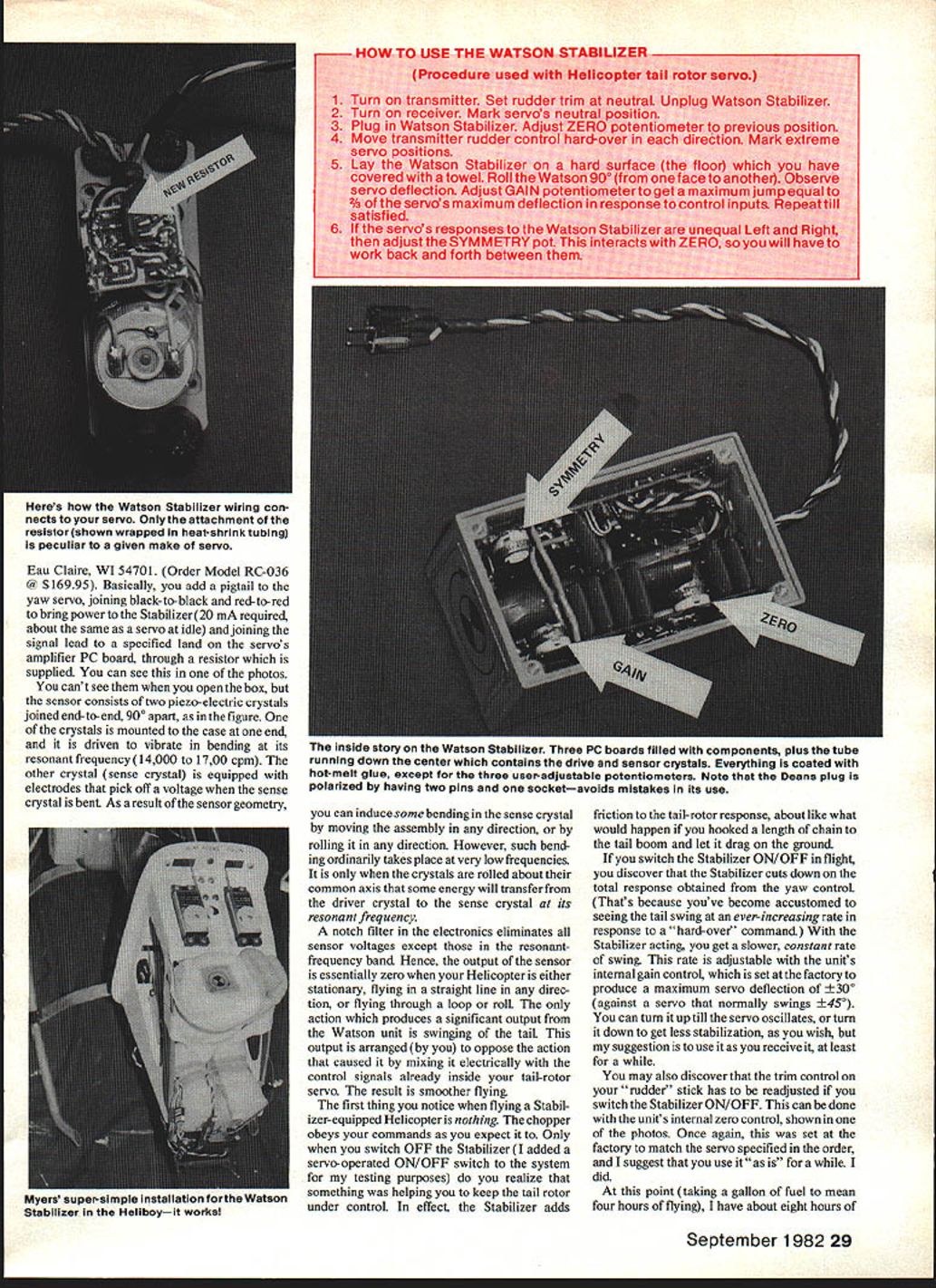
The instructions prescribe isolating the Stabilizer from all acoustic vibration, and I remember reading in Dave Chesney's column that he had encountered some problems with mechanical vibration. I received the unit wrapped in 3/8-in. foam, so I took the lazy man's route. I doubled that foam, wrapped it around the stabilizer, stuffed the package between the legs of the Heliboy servo tray, filled the rest of the gap with more foam, then stuck it all in place with loose strips of masking tape. The installation is shown in one of the photos in the original article. Dumb luck, but there hasn't been any unsurmountable problem with vibration yet. At one point I thought I was having a glitch problem caused by vibration, so I flattened the collective pitch a little, and the problem went away. Later, I found that one of the joints between the servo tray and the side support had failed. I glued it together, and the problem hasn't recurred. Watson now offers RC-037, a more vibration-resistant design, for those who do have problems. Same price.
You may be saying to yourself: "I have no use for that gadget; I fly airplanes!" The instructions explain how to use the Watson Stabilizer as a yaw damper or as an aid to holding wing position for a fixed-wing airplane. Actually, it can't "level" the wings (put them parallel to the earth's surface) because it has no idea where the earth is, as explained earlier. What it can do is tend to keep the wings wherever you put them. This can be useful whenever you are trying to fly smoothly in bumpy air with a nimble airplane, as when Pylon Racing or flying biplane pattern. People who do such things may find real advantage in the Stabilizer.
Once again, I think that beginners in RC model airplane flying should enjoy the help of the Stabilizer, no matter what type of trainer they are flying. Time ran out before I could put this thought to test, but I will test it, and if I'm wrong I'll tell you in a later column. (I'll also tell you if I'm right!)
However, one point with respect to beginners is very important. Before installing the Watson Stabilizer, you must have the airplane or Heliboy set up and trimmed properly for flight without it! You must have a warp-free structure, properly balanced, and with the control throws set up so the controls are "harmonized." By "harmonized," I mean that the controls should be set up so that they have the ability to provide equal pitch, roll and yaw rates. It helps to have a dual-rate transmitter, because you can obtain control harmony with its screwdriver adjustments.
The next point to be aware of is that it makes a difference how the Watson is oriented with respect to the airplane. You can't just stuff it into some empty space and then go fly. The unit's long axis must have a particular position with respect to the airplane or helicopter center line, and likewise the cover on the Watson box must lie in a particular direction. In my case I found best results when the Watson's long axis leaned back about 10° from being parallel to the helicopter rotor shaft and when the cover was aligned in the fore-and-aft direction. This is true because my unit is not totally free from responses to lateral acceleration, nor are its responses to lateral accelerations equal in all directions. You have to experiment a bit to get it right. Once you have got it right, it works very well. If you don't get it right, you will think that it's defective (as I did, for a while).
Larry Davidson flies an RC helicopter very well, but his performance in a gusty wind was noticeably better with the Watson Stabilizer. Does that tell you something?
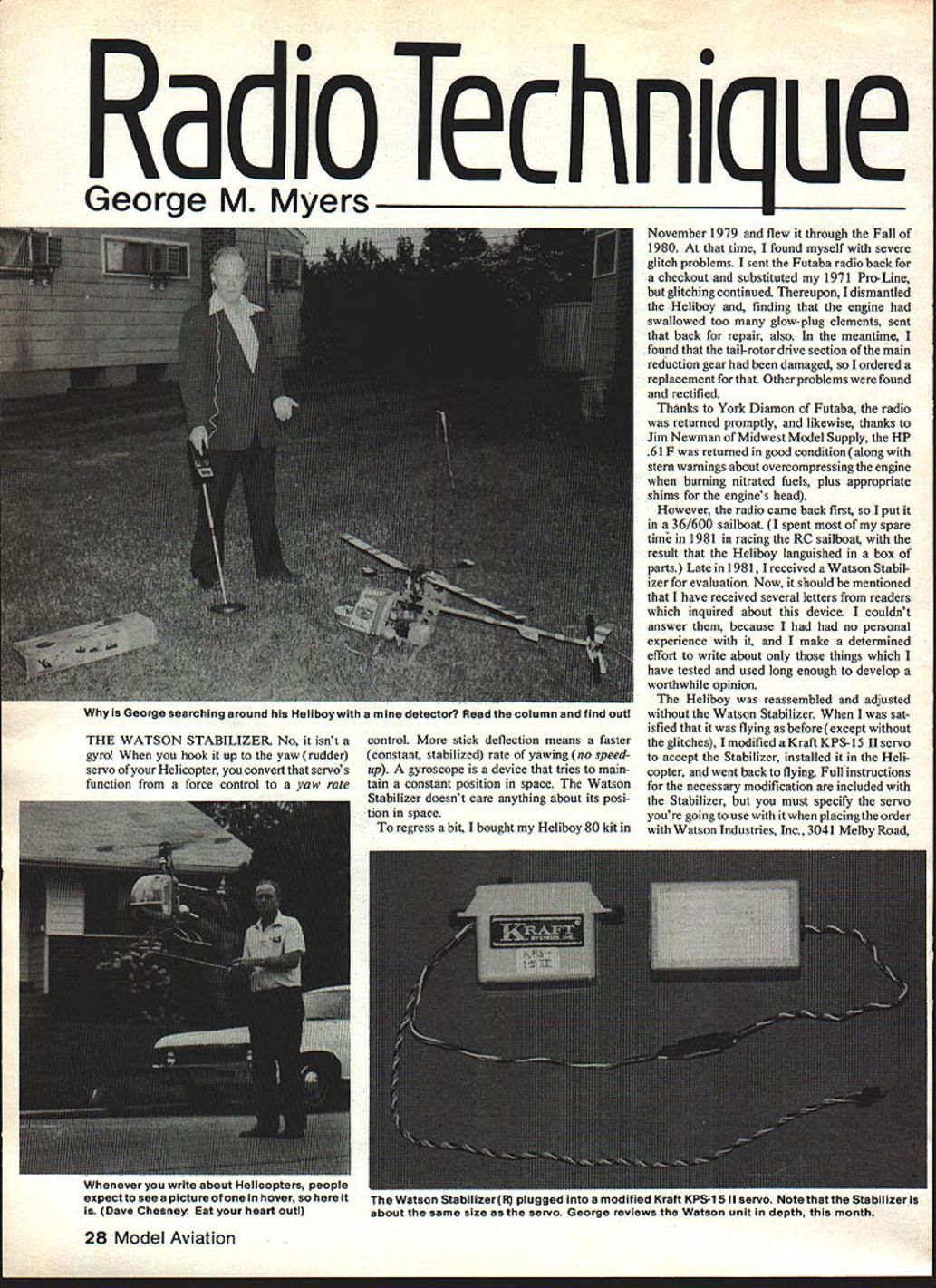
I like to give a product a boost when it performs well for me. The Radio Shack Metal Detector 63-3001 appears in the lead photo for that reason. Here's the scene: it's Saturday afternoon of a three-day weekend scheduled for testing of the Watson Stabilizer. The time is 6:10 p.m., just 10 minutes after Larry Davidson has closed the hobby shop where all the spare parts are. I've got to mail this column as soon as the Post Office opens on Tuesday. I'm out in the yard, flying the Heliboy from place to place, and making adjustments, when suddenly the engine stops in flight. Fortunately, I'm flying low and fast when it happens, so landing is no problem. I walk over to the Heliboy and discover that the needle valve has fallen out—someplace in the lawn!
I spent the next hour on my hands and knees, looking for a piece of brass an inch long. A neighbor asked, "Do you know anyone with a metal detector?" I said, "No." Tim said, "Radio Shack sells one for about $40." I said, "Here's $40. Get one if you can." When Tim came back with the unit, it was getting dark, and I started learning how to find metal. I found a lot of scraps of aluminum foil (probably gifts of the rotary power mower). Tim is pretty clever. He cut a piece of brass tubing about an inch long and had me look for that. When I had the unit adjusted so I could find the tubing easily, we were pretty sure the needle valve would turn up. It did! Weekend saved!
Now, do you know anyone who wants to buy a metal detector? Lease? Rent?
George M. Myers 70 Froehlich Farm Rd. Hicksville, NY 11801
Transcribed from original scans by AI. Minor OCR errors may remain.

