
Radio Technique
George M. Myers
My involvement in helicopters has taught me that the public loves them. For example, all I have to do is put an RC helicopter on the lawn and people passing by in automobiles will stop, folks will flock in from all over the neighborhood, and the questions start flowing. It seems that all airplanes should have jets (in the common view), so there isn't very much interest in airplanes with propellers on the nose—unless the model happens to be a large and colorful scale model. On the other hand, everyone sees one or more full-scale helicopters flying overhead every day, so the public identifies with helicopters, large and small. The fact that I can fly the model safely, in my yard, makes the model even more attractive. (Fly in a space bounded by houses and fences, so children and animals can't run into danger without first meeting interference.)
When you take an RC helicopter to a "stiff-wing" flying field, you find yourself banished to the approach end of the runway. Well, I can agree that the puddle of exhaust fumes surrounding a chopper is disagreeable, the noise (while quieter than airplanes, generally) is continuous, and the fear of being struck with the main rotor while your attention is engaged elsewhere is reasonable. But the real problem (I think) is jealousy.
The helicopter makes possible dimensions of flying that are simply not available to stiff-wing pilots. The most commonly heard complaint is "All they can do is hover!" Somehow, helicopters are seen to be worthless unless looping and rolling about the sky "like airplanes." It's easier to discount the challenge of learning to execute precise hovering flight than it is to learn how to do it. It's also a whole lot easier to "fly like an airplane" than to hover precisely, in my experience. The most important difference is you have to keep it closer than an airplane, so you can see what's happening.
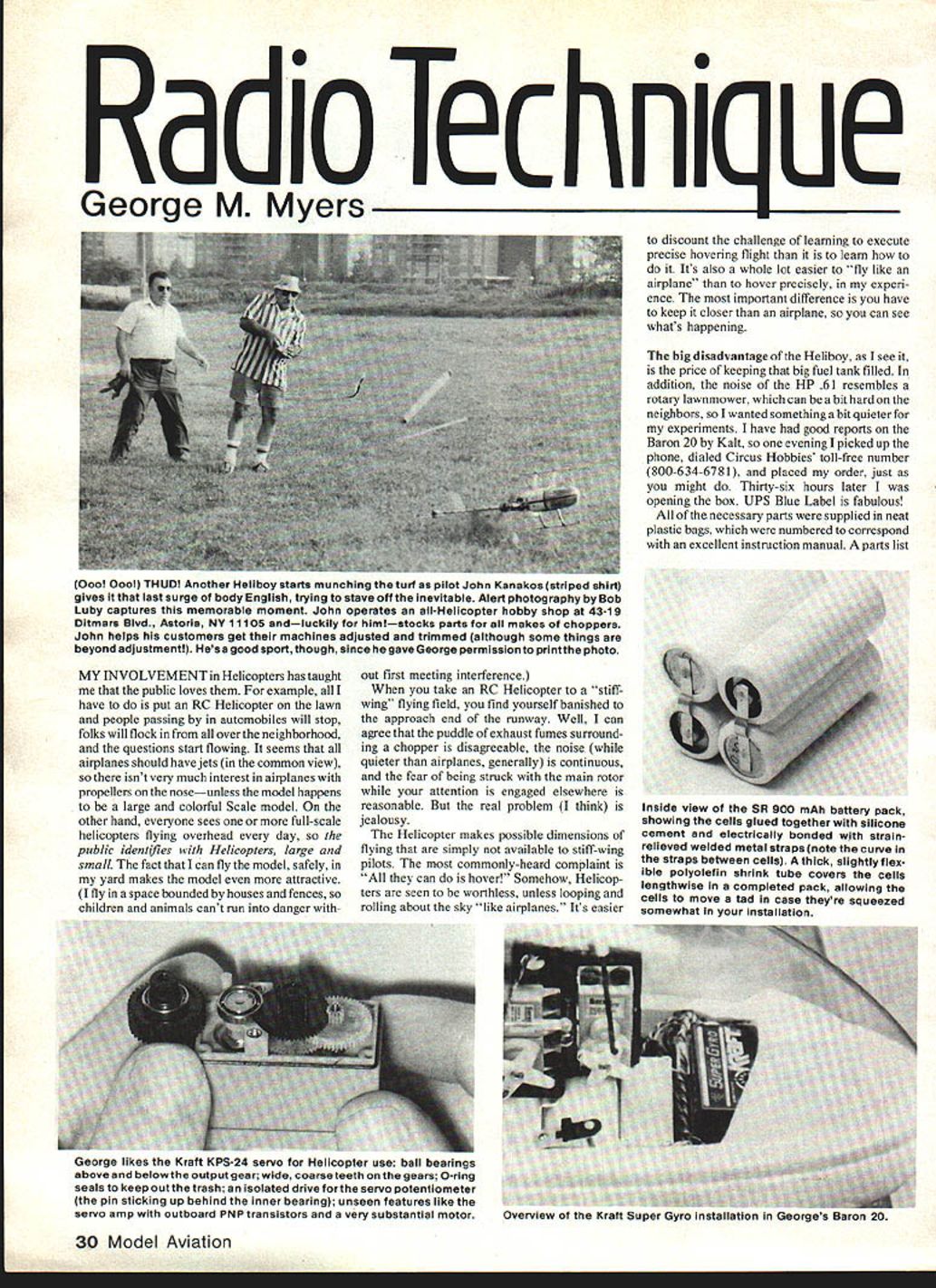
The big disadvantage of the Heliboy, as I see it, is the price of keeping that big fuel tank filled. In addition, the noise of the .61 HP resembles a rotary lawnmower, which can be a bit hard on the neighbors, so I wanted something a bit quieter for my experiments. I have had good reports on the Baron 20 by Kalt, so one evening I picked up the phone, dialed Circus Hobbies' toll-free number (800-634-6781), and placed my order, just as you might do. Thirty-six hours later I was opening the box. UPS Blue Label is fabulous!
All of the necessary parts were supplied in neat plastic bags, which were numbered to correspond with an excellent instruction manual. A parts list and an assembly drawing were provided, pinned over the workbench during construction. Metric hex wrenches were provided. Also add: No. 1 cross-point screwdriver, 13/64 open-end wrench, plus a bottle of ZAP and some paint. Parts count was always exactly right—no bag empty when it came time to go to the next step. Initial flights were done with the Apollo D6C4SHM (see Oct. '82 RT). The radio/gyro found the machine surprisingly easy to fly. Circus Hobbies' Baron 20 and Apollo are an excellent combination; I can recommend them to anyone contemplating starting RC helicopters. However, I really bought the machine so I could investigate the following areas:
- Single-stick control for helicopters
- XPO control (pitch, roll, and yaw)
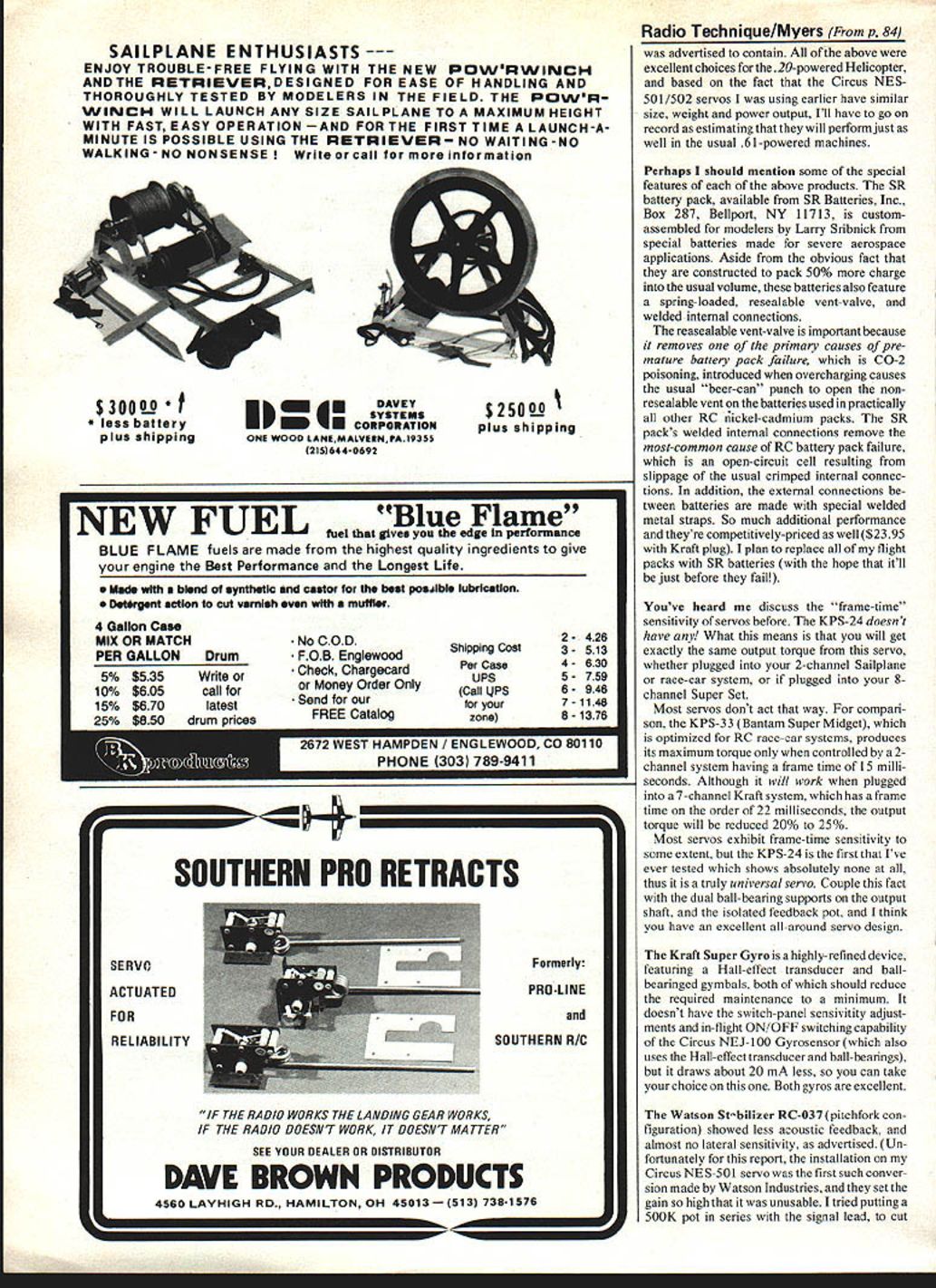
- The Kraft Super Gyro (currently the least expensive on the market)
- The Watson RC-037 Stabilizer (lightest and easiest on the battery pack, and designed to resist the vibration of the smaller, high-rpm engine)
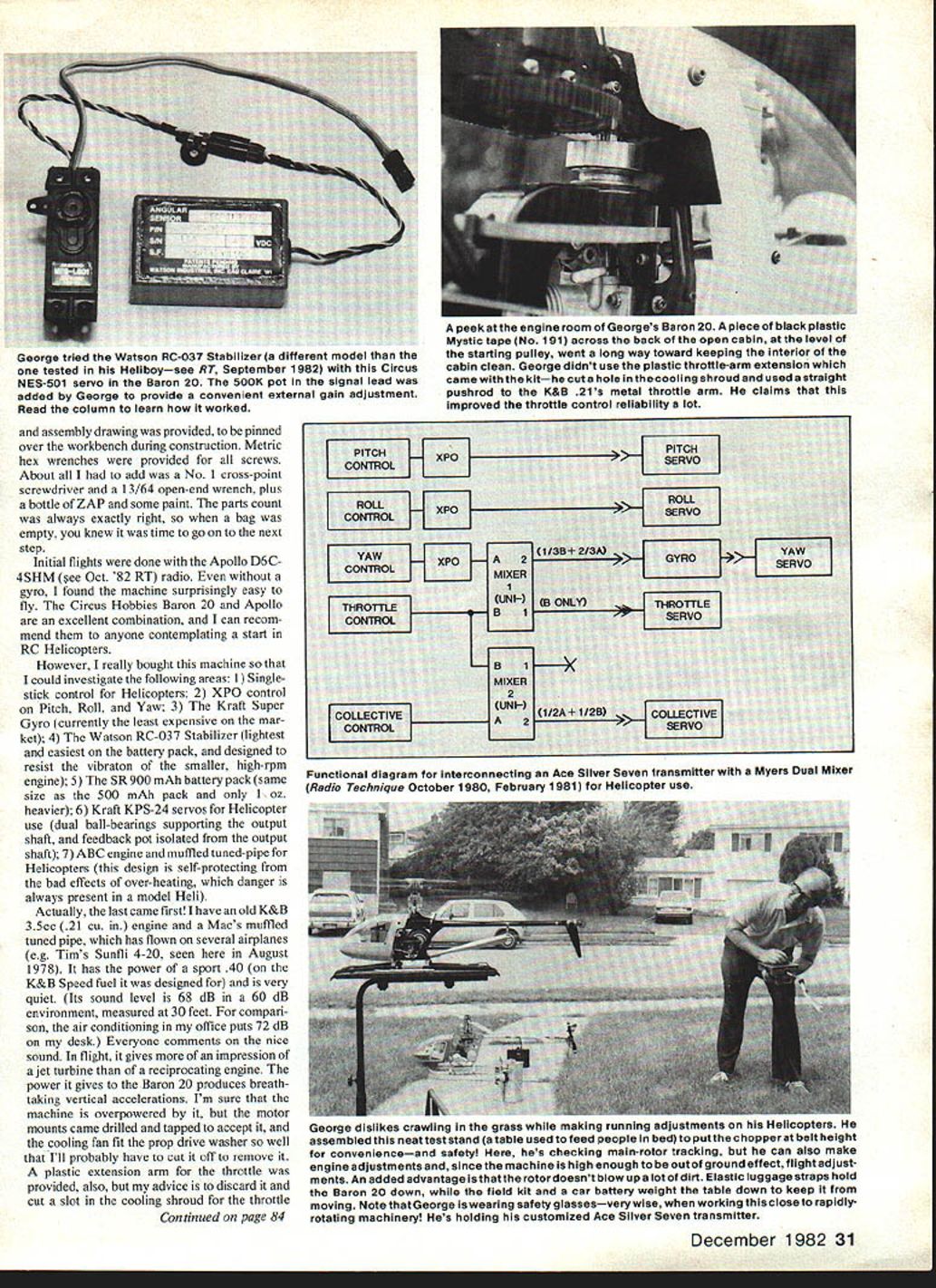
- The SR 900 mAh battery pack (same size as the 500 mAh pack and only 1 oz. heavier)
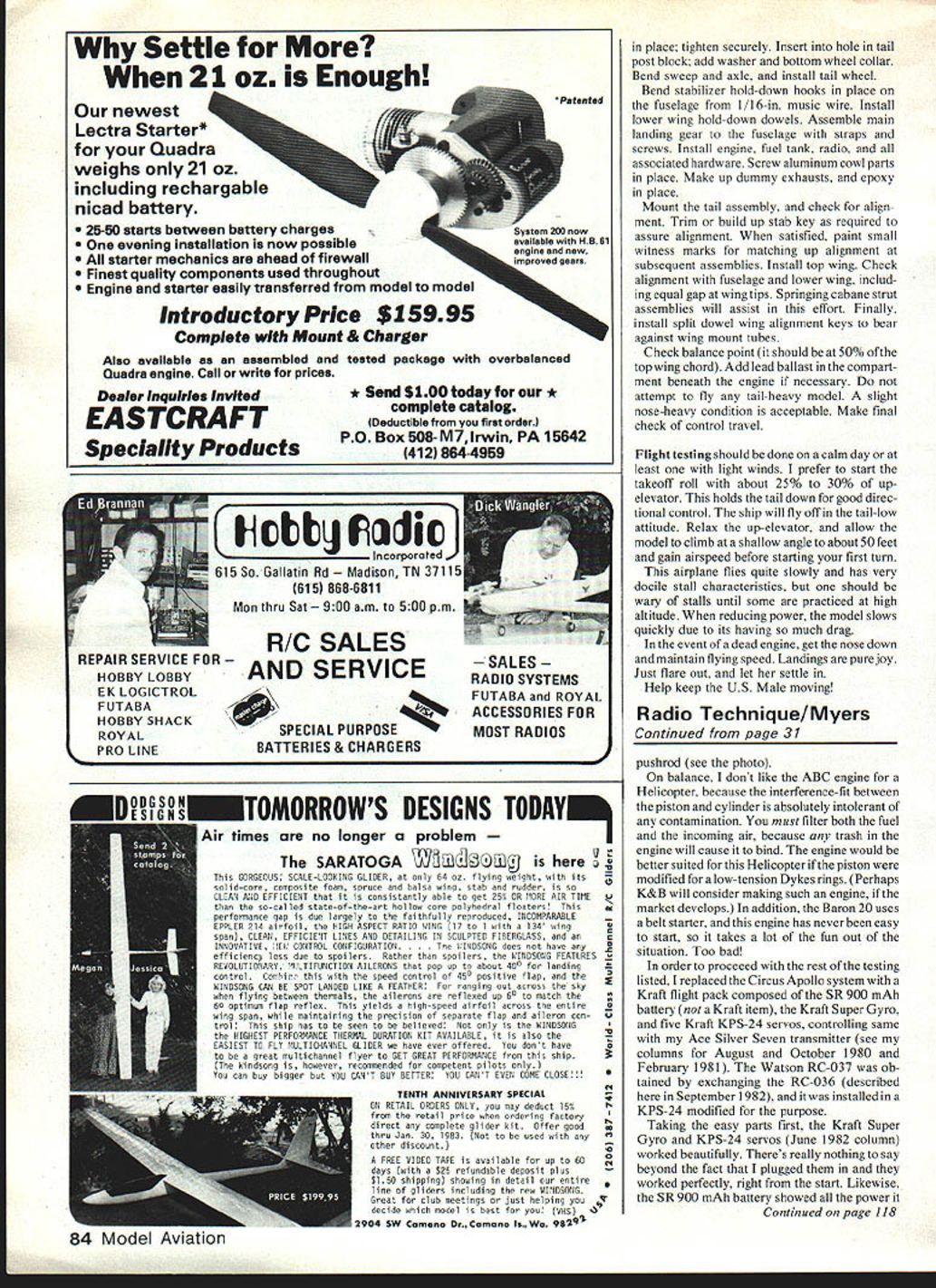
- Kraft KPS-24 servos for helicopter use (dual ball-bearings supporting the output shaft, and feedback pot isolated from the output shaft)
- ABC engine and muffled tuned-pipe for helicopters (this design is self-protecting from the bad effects of overheating, which danger is always present in a model heli)
Actually, the last came first. I have an old K&B .35 cu. in. engine and a Mac's muffled tuned pipe, which has flown on several airplanes (e.g., Tim's Sunfli 4-20, seen here in August 1978). It has the power of a .40 (on the K&B Speed fuel it was designed for) and is very quiet. Its sound level is 68 dB in a 60 dB environment, measured at 30 feet. For comparison, the air conditioning in my office puts 72 dB on my desk. Everyone comments on the nice sound. In flight, it gives more of an impression of a jet turbine than a reciprocating engine. The power it gives to the Baron 20 produces breathtaking vertical accelerations. I'm sure that the machine is overpowered by it, but the motor mounts came drilled and tapped to accept it, and the cooling fan on the prop drive washer was also well balanced. I'll probably have to cut it off to remove it.
A plastic extension arm for the throttle was provided, also, but my advice is to discard it and cut a slot in the cooling shroud for the throttle pushrod (see the photo).
On balance, I don't like the ABC engine for a helicopter, because the interference fit between the piston and cylinder is absolutely intolerant of any contamination. You must filter both the fuel and the incoming air, because any trash in the engine will cause it to bind. The engine would be better suited for this helicopter if the piston were modified for a low-tension Dykes ring. (Perhaps K&B will consider making such an engine, if the market develops.) In addition, the Baron 20 uses a belt starter, and this engine has never been easy to start, so it takes a lot of the fun out of the situation. Too bad!
In order to proceed with the rest of the testing listed, I replaced the Circus Apollo system with a Kraft flight pack composed of the SR 900 mAh battery (not a Kraft item), the Kraft Super Gyro, and five Kraft KPS-24 servos, controlling same with my Ace Silver Seven transmitter (see my columns for August and October 1980 and February 1981). The Watson RC-037 was obtained by exchanging the RC-036 (described here in September 1982), and it was installed in a KPS-24 modified for the purpose.
Taking the easy parts first, the Kraft Super Gyro and KPS-24 servos (June 1982 column) worked beautifully. There's really nothing to say beyond the fact that I plugged them in and they worked perfectly, right from the start. Likewise, the SR 900 mAh battery showed all the power it was advertised to contain. All of the above were excellent choices for the .20-powered helicopter, and based on the fact that the Circus NES-501/502 servos I was using earlier have similar size, weight and power output, I'll have to go on record as estimating that they will perform just as well in the usual .61-powered machines.
Continued (From p. 84)
Perhaps I should mention some of the special features of each of the above products. The SR battery pack, available from SR Batteries, Inc., Box 287, Bellport, NY 11713, is custom-assembled for modelers by Larry Sribnick from special batteries made for severe aerospace applications. Aside from the obvious fact that they are constructed to pack 50% more charge into the usual volume, these batteries also feature a spring-loaded, resealable vent-valve, and welded internal connections.
The resealable vent-valve is important because it removes one of the primary causes of premature battery pack failure, which is CO2 poisoning, introduced when overcharging causes the usual "beer-can" punch to open the non-resealable vent on the batteries used in practically all other RC nickel-cadmium packs. The SR pack's welded internal connections remove the most common cause of RC battery pack failure, which is an open-circuit cell resulting from slippage of the usual crimped internal connections. In addition, the external connections between batteries are made with special welded metal straps. So much additional performance and they're competitively priced as well ($23.95 with Kraft plug). I plan to replace all of my flight packs with SR batteries (with the hope that it'll be before they fail).
You've heard me discuss the "frame-time" sensitivity of servos before. The KPS-24 doesn't have any. What this means is that you will get exactly the same output torque from this servo, whether plugged into your 2-channel sailplane or race-car system, or if plugged into your 8-channel super set.
Most servos don't act that way. For comparison, the KPS-33 (Bantam Super Midget), which is optimized for RC race-car systems, produces its maximum torque only when controlled by a 2-channel system having a frame time of 15 milliseconds. Although it will work when plugged into a 7-channel Kraft system, which has a frame time on the order of 22 milliseconds, the output torque will be reduced 20% to 25%.
Most servos exhibit frame-time sensitivity to some extent, but the KPS-24 is the first that I've ever tested which shows absolutely none at all, thus it is a truly universal servo. Couple this fact with the dual ball-bearing supports on the output shaft, and the isolated feedback pot, and I think you have an excellent all-around servo design.
The Kraft Super Gyro is a highly refined device, featuring a Hall-effect transducer and ball-bearing gimbals, both of which should reduce the required maintenance to a minimum. It doesn't have the switch-panel sensitivity adjustments and in-flight ON/OFF switching capability of the Circus NEL-100 gyro sensor (which also uses the Hall-effect transducer and ball bearings), but it draws about 20 mA less, so you can take your choice on this one. Both gyros are excellent.
The Watson Stabilizer RC-037 (pitchfork configuration) showed less acoustic feedback, and almost no lateral sensitivity, as advertised. Unfortunately for this report, the installation on my Circus NES-501 servo was the first such conversion made by Watson Industries, and they set the gain so high that it was unusable. I tried putting a 500K pot in series with the signal lead to cut down the sensitivity—which worked—but that brought in some kind of RF pickup that interfered with control.
Just to be fair to the unit, I transferred the RC-037 to the Heliboy, where the RC system has more room to spread out. It worked perfectly! I got to the point where I could fly "right-hand only" (no yaw input at all). So I guess that the message is that you need some separation between the Watson Stabilizer and the rest of the RC system components. About an inch of foam does the job in the Heliboy, but I didn't have room for that in the crowded cabin of the Baron 20.
Finally, I set up my Ace Silver Seven similarly to the Apollo system (but without the ACC function). I tried several flights with the XPO function set in the middle curve of the three offered by Ace. I had hoped that I could set the machine up for limited control in the stick's midrange, for hovering, and maximum control on the outer range, for aerobatics. With XPO working on pitch, roll and yaw, I was unhappy; I'll work on it some more, but right now I prefer linear control.
In the same vein, single-stick control (which seems so logical) just didn't work for me. I can fly the machine, but it will take some hours of practice before I can say that I'm really comfortable with it.
There is a method to my madness here, in that all of the people I've met who fly both helicopters and stiff-wing aircraft have complained that flying one degrades their performance in the other. I believe that the same thing has happened to me, and I put the cause down to the fact that I've been flying both types of machine with the same 2-stick box. That's OK, in that the same style of control movements will produce loops and rolls, but it's bad in that there is nothing in stiff-wing flying which relates to hovering. You bang the sticks around a lot when hovering—you don't have much use for precise proportional control.
So, in order to get over years of proportional training of my reflexes, I thought it might be a good idea to fly helicopters with a box that feels different. Then I might train my reflexes to respond according to the feel of the transmitter, as well as to eye-hand coordination. Only time will tell if this can be made to work.
Faye Peoples, who is an RC helicopter pioneer and one of the best chopper pilots around, flies single-stick. I spoke to him at the East Coast Helicopter Championships, held in Lincroft, NJ (Horace Hagan, CD) on August 15, 1982. Faye said that he has spent most of the past year flying sailplanes, and that his helicopter flying was worse than it's been in years.
I've overrun my page limit again! Keep the letters coming, folks.
George M. Myers 70 Froehlich Farm Rd. Hicksville, NY 11801
Transcribed from original scans by AI. Minor OCR errors may remain.

