
Radio Technique
George M. Myers
Using the new frequencies
Please understand: I am writing this in September 1982, in anticipation of an FCC report and order assigning long-needed new channels. The following manufacturers have made known their willingness to convert your existing equipment for use on the new channels:
Conversion services
- Airtronics — Exchange crystals, retune.*
- Circus Hobbies — Exchange crystals, retune.*
- Futaba — Exchange crystals, retune.*
- World Engines — Exchange crystals, retune.*
- Kraft — Exchange modules — $30
*Cost: $10. (Probably limited-time offer.)
Recommended frequencies (Airplanes only)
- 72.03
- 72.55
- 72.59
- 72.63
- 72.67
- 72.71
- 72.75
- 72.79
- 72.83
- 72.87
- 72.91
It is also recommended that flyers on 75.64 move off it. Either convert the set to one of the other 75 MHz frequencies (then use it in a boat or car) or convert to one of the 72 MHz "Airplane Only" frequencies listed above.
You don't have to make the move right away. You have five years until the FCC rules you off the old channels permanently.
Converting an old wide-band receiver doesn't make it a narrow-band unit. You'll still have to buy a new narrow-band receiver sometime during the next eight years.
Message received — understood
Safety-of-flight gadget
I first started thinking about an automatic engine-shutdown device after seeing helicopter engines stop in flight and the machines crash in near-vertical parabolic arcs. Most helicopter flying I’ve done or witnessed takes place at altitudes of 50 feet or less; that simply doesn't leave time or space to autorotate and save the machine.
On the other hand, my Heliboy will run about a half-hour in forward flight (part throttle, about 50 mph). If a battery wire should break, the machine could fly away on a wide arc, climb as fuel burns off, and come down many miles away. We need an on-board device that will shut down the engine for any of the following reasons:
- Loss of on-board battery power to the radio.
- Loss of signal from the transmitter.
- Severe RF interference that lasts a couple of seconds (I think a 5-second delay would be adequate).
Helicopter fliers are acutely aware of the damage main rotor blades can inflict. Several have shown stitched scars on arms and legs; when stitches are required, the number seems to be about six. Practically everyone keeps far from people, houses, roads, etc., but no one stays far enough away to account for flyaways. I’ve heard tales of people trying to bring down runaway machines by throwing clothing or the transmitter at the main rotor blades. There has to be a better way.
Perhaps the reason we haven't heard much about flyaway helicopters traveling great distances is that about 95% of helicopter flying has been hovering or done at low altitude, so most out-of-control situations resulted in crashes nearby. That is changing as better machines and on-board stabilizers make helicopter flying easier.
A simple spring solution
A simple spring may provide the answer. If you use a throttle with very low friction (for example, a ball-bearing throttle barrel) and a coreless-motor throttle servo, you can fit a spring working in the OFF direction. Once battery voltage is removed, the spring can overpower the servo (coreless servos offer almost no resistance when power is off), so the engine will stop. Constantly running against the spring may reduce servo life; only time and testing will show whether that reduction is significant.
Shortly after finishing this column I heard from World Engines about a new OS helicopter throttle (Part No. 18909) for their .60 chopper engine that works on this principle. Details on availability and price were not all in yet, but I know the throttle barrel rides in ball bearings and it has a return spring. Used without a Servo Gard, it only protects against throttle linkage failure or a broken wire to the servo. The ball bearings reduce friction — you'd still want a coreless-motor servo to eliminate mechanical resistance from a "dead" servo. This new throttle is optimized for mid-range response, a big plus for helicopters since so much flying is done at part throttle.
Servo Gard (R.F. Enterprises)
The Servo Gard, manufactured by R.F. Enterprises, 106 North Main Street, Arlington, OH 45814 — $37.95 postpaid, can do several useful things:
- Shut the throttle down to a preset value when the flight pack battery voltage drops below a preset number (about 4.6 VDC). You can set the throttle shutdown point to allow the chopper to descend at a comfortable rate while retaining control on other channels.
- Shut down the throttle (to the same preset point) after loss of control pulses from the receiver. If pulses resume and the rest of the system is functioning, you can bring engine speed back up.
- With a minor modification (the addition of a standby battery pack), total primary battery failure will also cause the throttle to go to the preset value, allowing the chopper to descend even if no other controls are functioning.
A crash may still occur, but a descent under power is likely to be less destructive than a rapid autorotation and impact. Note the devices discussed here do not help if the engine dies for mechanical reasons, or if the needle settings are so far off that the engine won’t resume.
Important setup points:
- Ensure that when the throttle moves to the preset (idle) point, rotor RPM is not so low that the rotor stalls. Somewhere in the 60–70% range might be about right.
- When the engine is shut down the gyro is taken out of the system; if you rely on a gyro to maintain attitude, this could be troublesome.
- If you have too much friction in the throttle system, the servo may not move the throttle to the preset position. Use ball bearings in the throttle or reduce friction as much as possible, and use a coreless-motor servo if necessary.
I prefer a system that moves the throttle to a preset point rather than one that simply kills the ignition, but other schemes (for example, a separate receiver channel to set throttle to dead, with a switch to re-enable it) have appeal. The important thing is to have some means of controlling the engine in the event of radio-chain failure.
One last comment about transmitters: if you have a transmitter with a battery that automatically switches to a reserve battery when the main battery fails, that's good. Many transmitters simply switch off when the battery voltage drops below the useful range — that is bad. An audible low-battery alarm is a handy device.
Rick Williams of R.F. Enterprises tells me he's working on improvements to address RC interference. Watch this column for future developments.
Batteries — SR Batteries
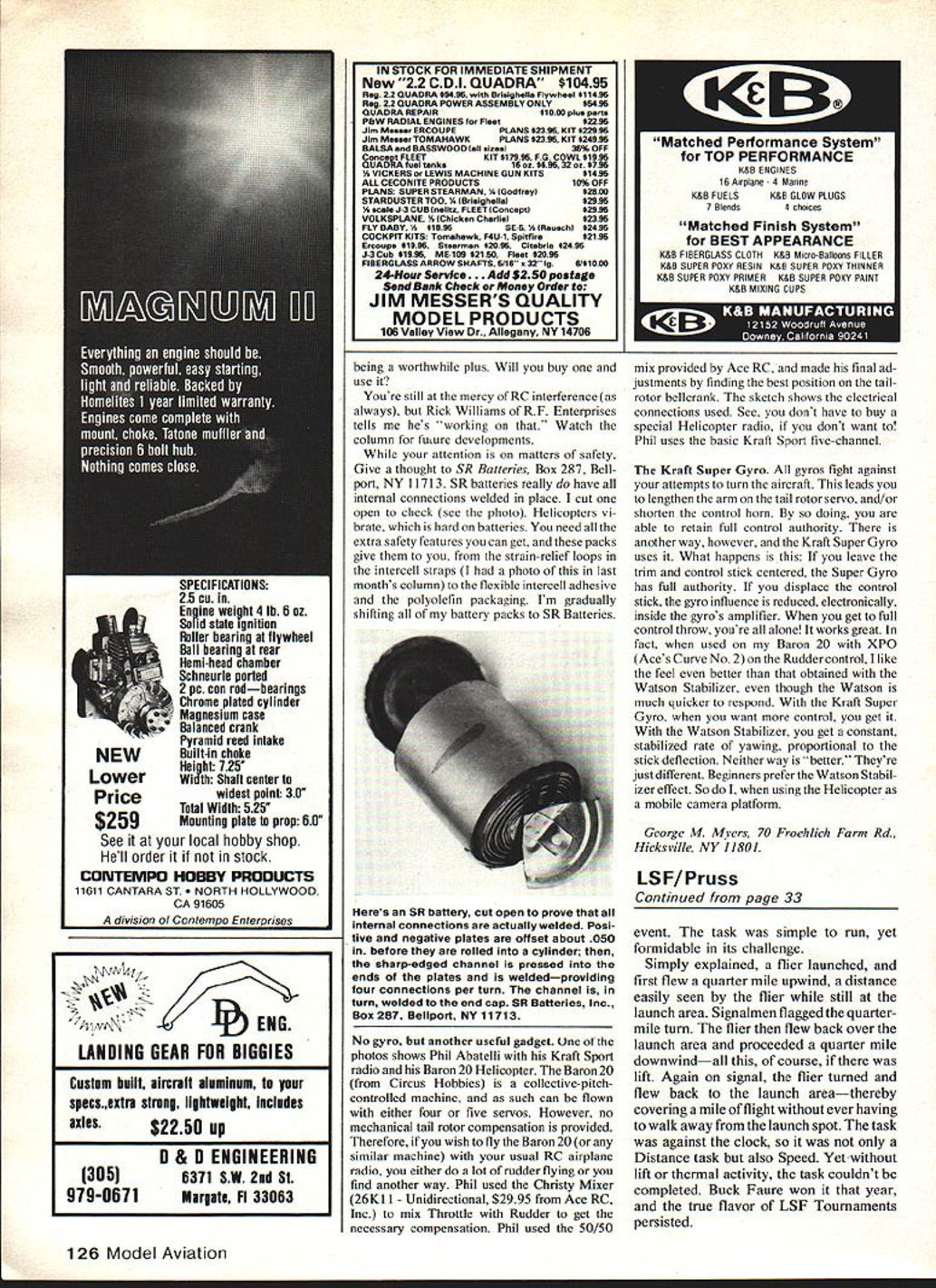
While thinking about safety, consider SR Batteries, Box 287, Bellport, NY 11713. SR batteries have all internal connections welded in place. I cut one open to check. Helicopters vibrate, which is hard on batteries; you need all the extra safety features you can get. These packs include strain-relief loops in the intercell straps, flexible intercell adhesive, and polyolefin packaging. I'm gradually shifting all my battery packs to SR Batteries.
Here’s what I observed when cutting one open: positive and negative plates are offset about .050 in. before being rolled into a cylinder; a sharp-edged channel is pressed into the ends of the plates and welded, providing four connections per turn. The channel is then welded to the end cap.
Mixer solution — Christy Mixer
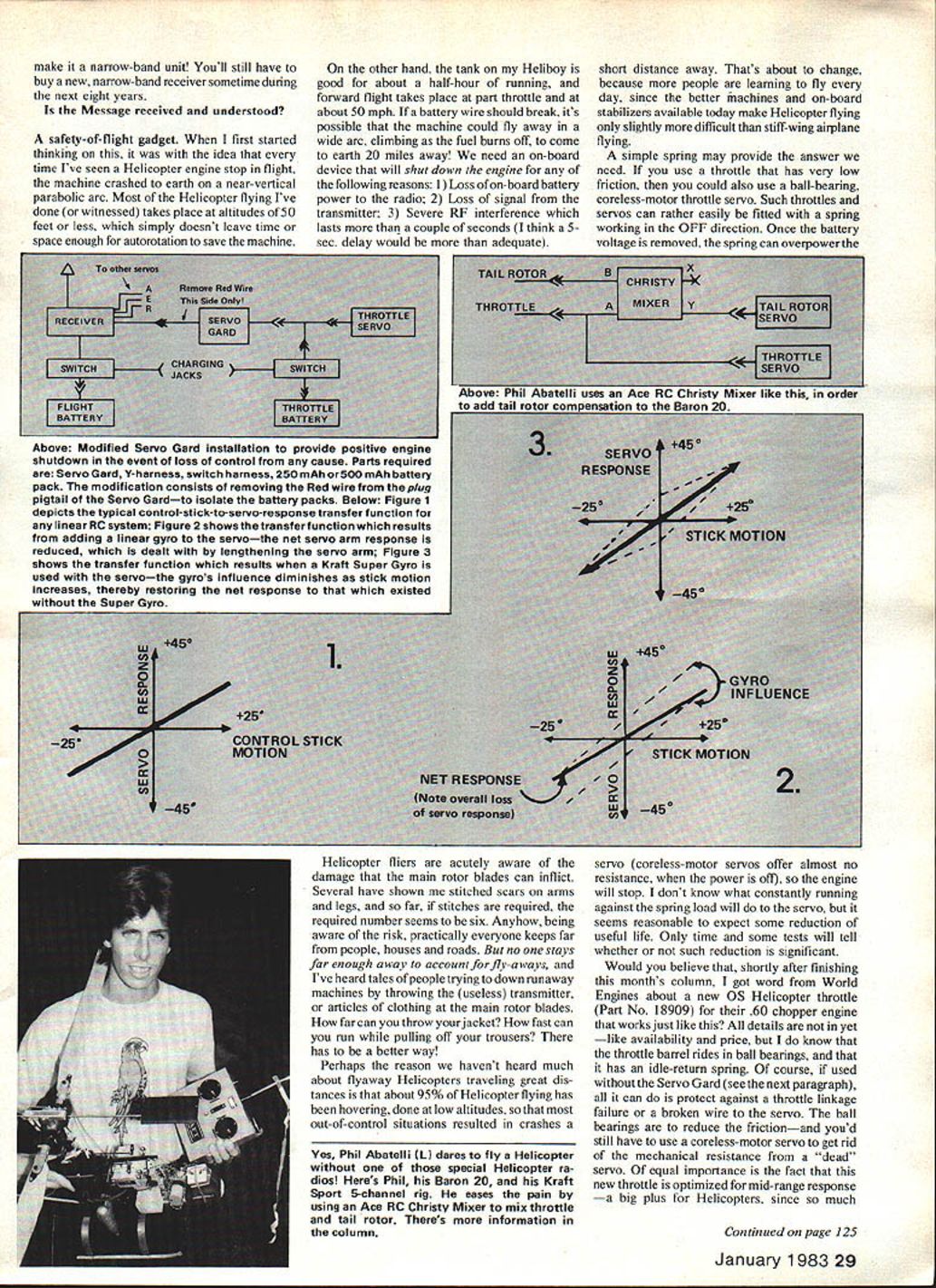
No gyro, but another useful gadget: Phil Abatelli flies a Baron 20 collective-pitch helicopter and uses a Kraft Sport 5-channel radio. The Baron 20 has no mechanical tail-rotor compensation, so Phil used the Ace RC Christy Mixer (26K11 — Unidirectional, $29.95 from Ace RC, Inc.) to mix throttle and rudder for the necessary compensation. He used the 50/50 mix provided by Ace RC and made final adjustments mechanically on the tail-rotor bellcrank. The sketch (in the original) shows the electrical connections used. You don’t have to buy a special helicopter radio if you don’t want to.
The Kraft Super Gyro
All gyros fight against your attempts to turn the aircraft, which often leads you to change servo geometry to retain full control authority. The Kraft Super Gyro reduces gyro influence electronically as you displace the control stick. If the trim and control stick are centered, the Super Gyro has full authority; as you move toward full control throw the gyro influence is reduced and at full throw you have full control. It works well. In my Baron 20 with XPO (Ace's Curve No. 2) on the rudder, I preferred the feel to that of the Watson Stabilizer, though the Watson is quicker to respond. The Watson gives a constant stabilized rate of yaw proportional to stick deflection; the Super Gyro gives full control when you ask for it. Neither is inherently better — they suit different flying styles. Beginners prefer the Watson effect; I prefer it when using the helicopter as a mobile camera platform.
George M. Myers 70 Froehlich Farm Rd. Hicksville, NY 11801
Transcribed from original scans by AI. Minor OCR errors may remain.

