
Radio Technique
George M. Myers
You Can Fly Choppers, Too!
I seem to run my hobby life in one-year increments. For example, 1979 was spent developing the technique of towing RC sailplanes behind RC power planes (see "High Tow," MA, January 1980); 1980 was spent developing my version of the Ace RC Silver Seven transmitter (RT August and October 1980 and February 1981); 1981 was spent racing RC sailboats; and now 1982 has gone to RC helicopters, gyros and the Watson Stabilizer. Some of my friends (notably Bob Aberle) wonder when I'll get back to designing and building model airplanes again. I keep a few projects going on the back burner, so we'll just have to wait and see on that. But for now, I'm off on my latest crusade!
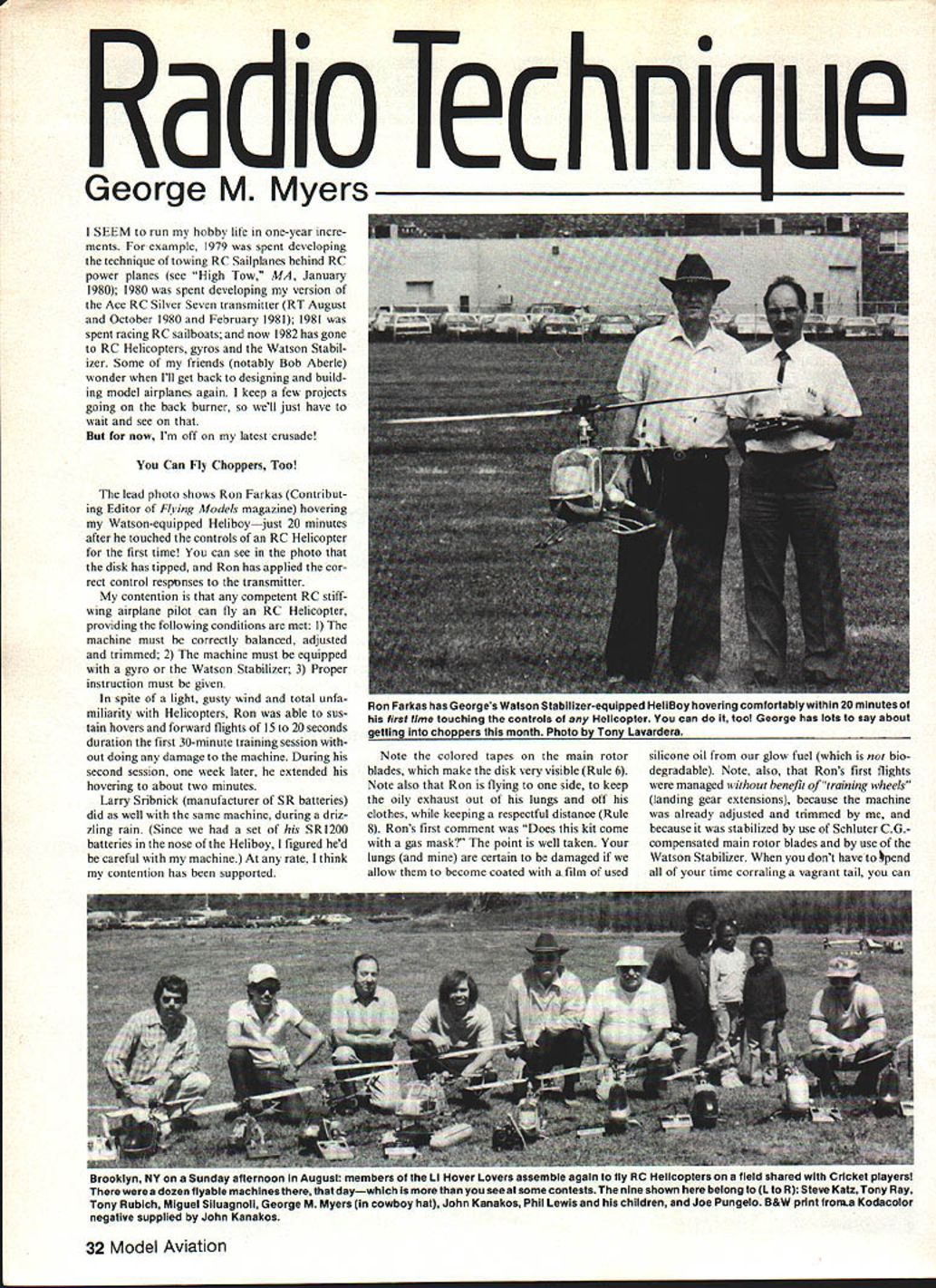
The lead photo shows Ron Farkas (Contributing Editor of Flying Models magazine) hovering my Watson-equipped Heliboy—just 20 minutes after he touched the controls of an RC Helicopter for the first time! You can see in the photo that the disk has tipped, and Ron has applied the correct control responses to the transmitter.
My contention is that any competent RC stiff-wing airplane pilot can fly an RC Helicopter, providing the following conditions are met:
- The machine must be correctly balanced, adjusted and trimmed.
- The machine must be equipped with a gyro or the Watson Stabilizer.
- Proper instruction must be given.
In spite of a light, gusty wind and total unfamiliarity with helicopters, Ron was able to sustain hovers and forward flights of 15 to 20 seconds duration the first 30-minute training session without doing any damage to the machine. During his second session, one week later, he extended his hovering to about two minutes.
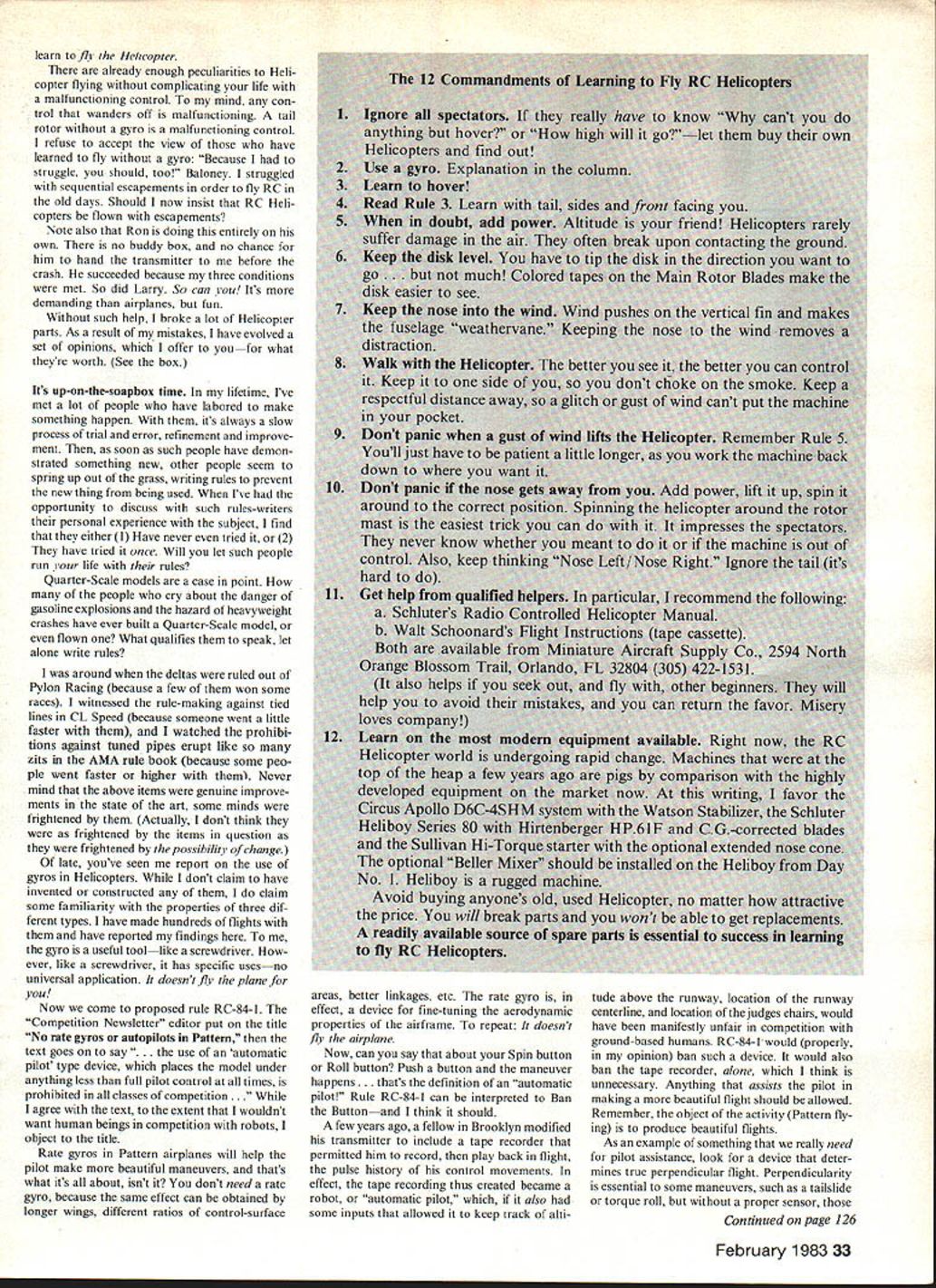
Larry Sribnick (manufacturer of SR batteries) did as well with the same machine, during a drizzling rain. (Since we had a set of his SR1200 batteries in the nose of the Heliboy, I figured he'd be careful with my machine.) At any rate, I think my contention has been supported.
Note the colored tapes on the main rotor blades, which make the disk very visible (Rule 6). Note also that Ron is flying to one side, to keep the oily exhaust out of his lungs and off his clothes, while keeping a respectful distance (Rule 8). Ron's first comment was "Does this kit come with a gas mask?" The point is well taken. Your lungs (and mine) are certain to be damaged if we allow them to become coated with a film of used silicone oil from our glow fuel (which is not biodegradable). Note, also, that Ron's first flights were managed without benefit of "training wheels" (landing gear extensions), because the machine was already adjusted and trimmed by me, and because it was stabilized by use of Schluter C.G.-compensated main rotor blades and by use of the Watson Stabilizer. When you don't have to spend all of your time corralling a vagrant tail, you can learn to fly the Helicopter.
There are already enough peculiarities to Helicopter flying without complicating your life with a malfunctioning control. To my mind, any control that wanders off is a malfunctioning control. A tail rotor without a gyro is a malfunctioning control. I refuse to accept the view of those who have learned to fly without a gyro: "Because I had to struggle, you should, too." Baloney. I struggled with sequential escapements in order to fly RC in the old days. Should I now insist that RC Helicopters be flown with escapements?
Note also that Ron is doing this entirely on his own. There is no buddy box, and no chance for him to hand the transmitter to me before the crash. He succeeded because my three conditions were met. So did Larry. So can you! It's more demanding than airplanes, but fun.
Without such help, I broke a lot of Helicopter parts. As a result of my mistakes, I have evolved a set of opinions, which I offer to you—for what they're worth. (See the box.)
It's up-on-the-soapbox time. In my lifetime, I've met a lot of people who have labored to make something happen. With them, it's always a slow process of trial and error, refinement and improvement. Then, as soon as such people have demonstrated something new, other people seem to spring up out of the grass, writing rules to prevent the new thing from being used. When I've had the opportunity to discuss with such rules-writers their personal experience with the subject, I find that they either (1) have never even tried it, or (2) they have tried it once. Will you let such people run your life with their rules?
Quarter-scale models are a case in point. How many of the people who cry about the danger of gasoline explosions and the hazard of heavyweight crashes have ever built a quarter-scale model, or even flown one? What qualifies them to speak, let alone write rules?
I was around when the deltas were ruled out of pylon racing (because a few of them won some races). I witnessed the rule-making against tied lines in CL Speed (because someone went a little faster with them), and I watched the prohibitions against tuned pipes erupt like so many zits in the AMA rule book (because some people went faster or higher with them). Never mind that the above items were genuine improvements in the state of the art; some minds were frightened by them. (Actually, I don't think they were as frightened by the items in question as they were frightened by the possibility of change.)
Of late, you've seen me report on the use of gyros in helicopters. While I don't claim to have invented or constructed any of them, I do claim some familiarity with the properties of the different types. I have made hundreds of flight tests with them and have reported my findings here. To me, the gyro is a useful tool—like a screwdriver. However, like a screwdriver, it has specific uses—no universal application. It doesn't fly the plane for you.
Now we come to proposed rule RC-84-1. The "Competition Newsletter" editor put on the title "No rate gyros or autopilots in Pattern," then the text goes on to say "... the use of an 'automatic pilot' type device, which places the model under control without human pilot control at all times, is prohibited in all classes of competition...". While I agree with the text, to the extent that I wouldn't want human beings in competition with robots, I object to the title.
Rate gyros in Pattern airplanes will help the pilot make more beautiful maneuvers, and that's what it's all about, isn't it? You don't need a rate gyro, because the same effect can be obtained by longer wings, different ratios of control-surface areas, better linkages, etc. The rate gyro is, in effect, a device for fine-tuning the aerodynamic properties of the airframe. To repeat: It doesn't fly the airplane.
Now, can you say that about your Spin button or Roll button? Push a button and the maneuver happens. That's the definition of an "automatic pilot." Rule RC-84-1 can be interpreted to ban the Button—and I think it should.
A few years ago, a fellow in Brooklyn modified his transmitter to include a tape recorder that permitted him to record, then play back in flight, the pulse history of the control movements. In effect, the tape recording thus created became a "robot" or "automatic pilot", which, if it had also had some inputs that allowed it to keep track of altitude above the runway, location of the runway centerline, and location of the judges' chairs, would have been manifestly unfair in competition with ground-based humans. RC-84-1 would (properly, in my opinion) ban such a device. It would also ban the tape recorder, alone, which I think is unnecessary. Anything that assists the pilot in making a more beautiful flight should be allowed.
As an example of something that we really need for pilot assistance, look for a device that determines true perpendicular flight. Perpendicularity is essential to some maneuvers, such as a stall turn or torque roll, but without a proper sensor, those maneuvers are really only "luck" maneuvers for the RC pilot. The airshow pilot, sitting inside his airplane, can see the horizon and precisely duplicate such maneuvers upon command (skill permitting). RC-84-1 would prohibit the use of something we need—before it is even developed! It would be a simple matter to modify a Thermic Sniffer for use as an aerodynamic yaw sensor (AYS). An AYS would make more efficient RC sailplane flight possible, which could be very important for F3B flying and for special events like the Great Race. RC-84-1 would prohibit the development of such a device, before anyone creates it.
I think that banning gyros is a stupid move. On the other hand, banning Spin buttons, Roll buttons and robots has merit. RC-84-1 should be withdrawn and rewritten to say precisely what it means. Failing that, it should be defeated. Write to your district RC Contest Board member and tell him how you feel—or suffer the consequences. You'll find him listed on page 109 of this issue of Model Aviation.
The complete rule-making procedure was described on pages 1–4 and 15 of the June 1982 "Competition Newsletter," which was printed and distributed separately from the magazine, and I'll bet you don't know where you put it!
Have a Merry Christmas and a Happy New Year! With all those nice new frequencies to play with, why shouldn't everyone be happy?
George M. Myers 70 Froehlich Farm Rd., Hicksville, NY 11801
The 12 Commandments of Learning to Fly RC Helicopters
- Ignore all spectators. If they really have to know "Why can't you do anything but hover?" or "How high will it go?"—let them buy their own helicopters and find out!
- Use a gyro. Explanation in the column.
- Learn to hover!
- Read Rule 3. Learn with tail, sides and front facing you.
- When in doubt, add power. Altitude is your friend! Helicopters rarely suffer damage in the air. They often break upon contacting the ground.
- Keep the disk level. You have to tip the disk in the direction you want to go . . . but not much! Colored tapes on the main rotor blades make the disk easier to see.
- Keep the nose into the wind. Wind pushes on the vertical fin and makes the fuselage "weathervane." Keeping the nose to the wind removes a distraction.
- Walk with the helicopter. The better you see it, the better you can control it. Keep it to one side of you, so you don't choke on the smoke. Keep a respectful distance away, so a glitch or gust of wind can't put the machine in your pocket.
- Don't panic when a gust of wind lifts the helicopter. Remember Rule 5. You'll just have to be patient a little longer, as you work the machine back down to where you want it.
- Don't panic if the nose gets away from you. Add power, lift it up, spin it around to the correct position. Spinning the helicopter around the rotor mast is the easiest trick you can do with it. It impresses the spectators. They never know whether you meant to do it or if the machine is out of control. Also, keep thinking "Nose Left/Nose Right." Ignore the tail (it's hard to do).
- Get help from qualified helpers. In particular, I recommend the following:
- Schluter's Radio Controlled Helicopter Manual.
- Walt Schoonard's Flight Instructions (tape cassette).
Both are available from Miniature Aircraft Supply Co., 2594 North Orange Blossom Trail, Orlando, FL 32804 (305) 422-1531. (It also helps if you seek out, and fly with, other beginners. They will help you to avoid their mistakes, and you can return the favor. Misery loves company!)
- Learn on the most modern equipment available. Right now, the RC helicopter world is undergoing rapid change. Machines that were at the top of the heap a few years ago are pigs by comparison with the highly developed equipment on the market now. At this writing, I favor the Circus Apollo D6C-4SHM system with the Watson Stabilizer, the Schluter Heliboy Series 80 with Hirtenberger HP-61F and C.G.-corrected blades, and the Sullivan Hi-Torque starter with the optional extended nose cone. The optional "Beller Mixer" should be installed on the Heliboy from Day No. 1. Heliboy is a rugged machine. Avoid buying anyone's old, used helicopter, no matter how attractive the price. You will break parts and you won't be able to get replacements. A readily available source of spare parts is essential to success in learning to fly RC helicopters.
Transcribed from original scans by AI. Minor OCR errors may remain.

