
Radio Technique
George M. Myers
What will we do with the new frequencies? In the January 1983 issue I spoke of the new RC channels in terms of anticipation and gave some manufacturers' prices for conversions of "old" equipment. Now we can speak of our new RC channels as fact (as of December 20, 1982) and add some more data on conversion prices.
Ace RC, Inc. — conversions and policy
- Conversion of Ace or Pro-Line RF deck in the transmitter: $10.
- Conversion of Silver Seven or Pro-Line receiver: $12.50.
- Exchange Digital Commander receiver for a Silver Seven receiver: $20.
When you consider that Ace did not build the Pro-Line units, this has to be considered one heck of a deal — and a very adventurous attitude for an American manufacturer to take (considering product liability suits, etc.). Point (3), exchange of a unit that Ace RC did build (at a time when the new channels were only a wish), shows the results of a lot of testing done by Ace people during the summer of 1982, which clearly demonstrated to them that the Digital Commander receiver didn't work to their satisfaction on a 40 kHz channel spacing. (No doubt we'll be finding other receivers with the same problem.) Ace RC is bending over backward to help you and your AMA show how the new RC channels can be used to advantage, and I think you should keep that in mind when considering your next purchase — be it on one of the older, proven channels, or on one of the new ones.
Another American builder, Cannon RC Systems, has the crystals waiting and will make the conversion for a system price of $10 for the crystals plus whatever labor charges the state of repair your system warrants (expect a minimum of about $17 for the labor to convert a brand-new system).
I'll report on other systems' conversion prices as I learn them. At this time I can't say what owners of some of the "oldies but goodies," like E.K. Logictrol, Orbit, and Heath, will do, but I'm sure that something will come up. For now, if they work, I'd say "use as is" until they don't.
By the way, the conversion prices I listed in the January 1983 column were the prices for a pair of crystals only and did not include any labor cost. You can get the crystals at that price, but you'll have to tune the equipment yourself. Service charge for installing the new crystals and returning the equipment will be in the range of what Ace RC is charging — World Engines, for example, has an $18 service charge. I'd like to point out that the price of $10 for a pair of crystals, which is what many of the manufacturers quoted, is a real bargain — they're really worth about $25! They're offering this price as a gesture of good will to the AMA.
Club reactions and frequency management
I function as a reporter for Model Aviation, among other things, and it is in that capacity that I have visited with some local RC clubs to inquire for reactions to this new reality of channel availability. Here is a distillation of what I've heard from members of:
- Whitman Flyers — sport RC airplane club.
- Long Island Silent Flyers — competition RC sailplanes.
- Hover Lovers — sport RC helicopters.
- Hecksher Model Yacht Club — competition sailboats.
Let's assign members their own private channel. Remember, the FCC saw fit to give us a total of 80 channels because they expect some will be unusable. The sailboat club went ahead and assigned channels anyway.
- How will we ever manage channels? Use simple, practical club rules — for example, a "five-in-the-sky" rule (no more than five active aircraft at once on the field) and a visible marker system (clothespins or similar) to reserve frequencies. Most clubs will find inexpensive ways to coordinate — it won't break the treasury.
- Changing frequencies: the FCC has given some explicit guidance allowing changes of RC transmitter frequencies in certain circumstances (see FCC Docket 82-181 RM-3248, p. 8, para. 24). Manufacturers still have to work out the details of channel-changing with the FCC.
- Expect interference: some channels will suffer interference, both real and perceived. Primary users (PRS) have generally avoided frequencies such as 7208, 7216, 7224, 7232, 7240, and 7296 MHz out of courtesy, although they have legal permission to use them. No doubt some primary users will start using those frequencies; over time they may expect us to move out to new channels where they are not authorized to follow. If we choose not to move, the consequences are ours. All channels may be clear in your area, but markets such as Houston, Kansas City, Cincinnati, Seattle, and Schenectady have shown different experiences.
- Performance on 40 kHz spacing: actual flight tests (such as those done by Ace RC) have shown that excellent performance can be obtained on 40 kHz spacing, provided your equipment is good enough. The secret to success on the new channels is a better receiver.
- When to convert: if you have a new radio that works great with no interference, you might wait to convert — until the batteries die, you have crash damage, interference crops up, or December 1988 — whichever comes first! Manufacturer service departments will be busy, so consider allowing those who need relief most to get their sets serviced first. Some people will rush to convert or buy new radios on the new channels; they will be the pioneers. Remember that the channels given to us include some expected to be unusable.
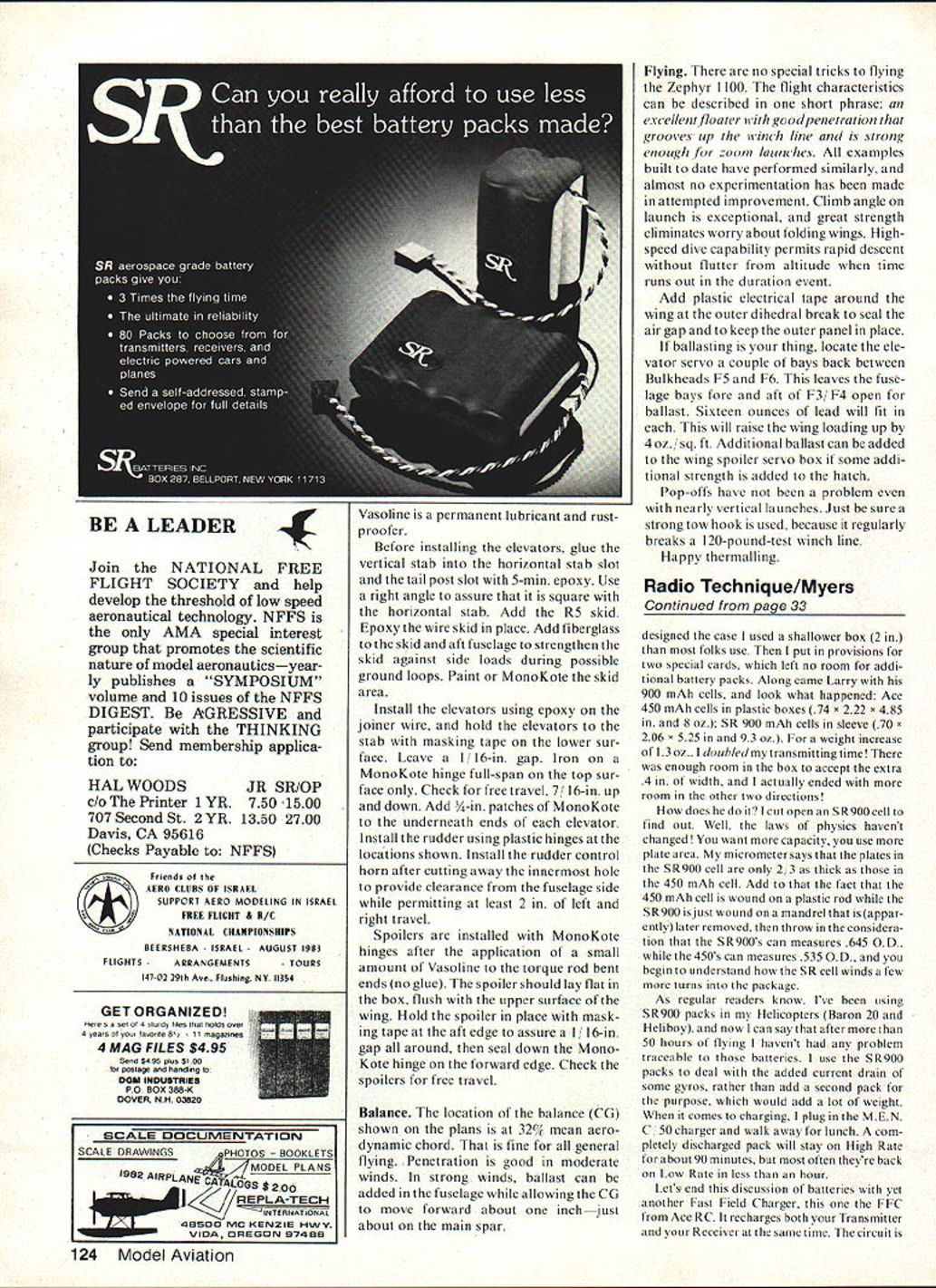
The essence of the situation is that we will be testing the new channels for a while. In response to that, the AMA has created the office of Frequency Coordinator (one per AMA district). This person is the single point of contact for information on frequency matters. In the beginning, his most important function will be to receive your interference reports. These reports will be collated, correlated with other such reports, then shipped to HQ for incorporation into a database we hope to have computerized. Then it will be possible to enter the database with your ZIP Code and get a list of channels with known interference problems specific to your area. (Watch AMA News for names and details.)
Better batteries
Larry Sribnick and SR Batteries, Inc.
The object of this essay is to make you as concerned about the quality of the batteries in your RC system as Larry Sribnick is. Now is a good time to perform some maintenance on your RC systems, because it should be midwinter as you read this.
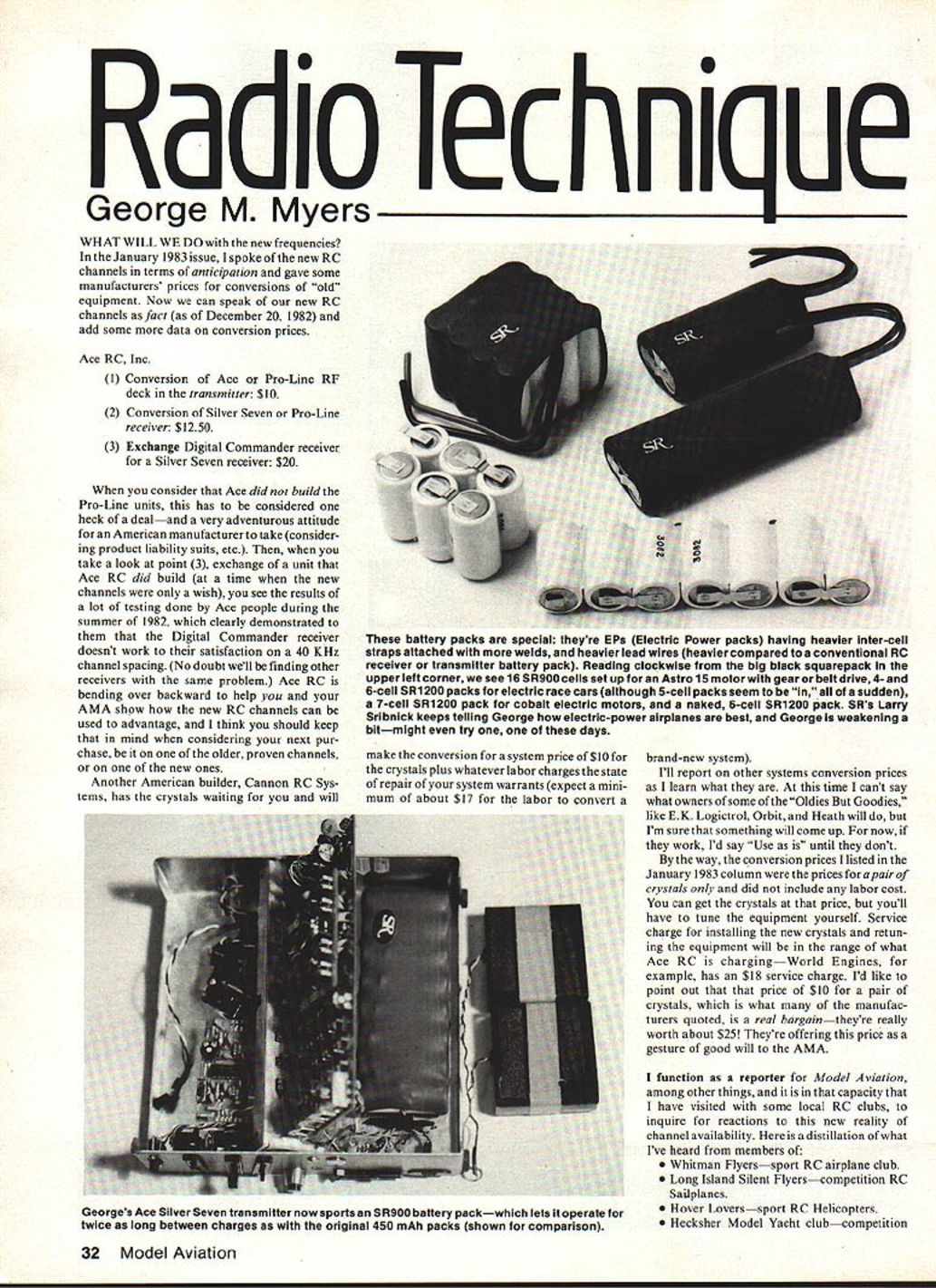
Who is Larry Sribnick? Larry Sribnick is SR Batteries, Inc., Box 287, Bellport, NY 11713, a custom-builder of battery packs for RC system owners. Larry offers a fantastic array of transmitter packs, flight packs, and electric power packs for planes, cars, boats, etc. If you can't find what you want in Larry's catalog now, you probably will after you place your order. Whether you are after your LSF Level V, trying to set a record, or just looking for some more flight packs, you should write to Larry. Remember, he custom-builds battery packs.
All of the cells used in SR packs are aerospace quality, 100% individually screened for quality and loaded with interesting features such as resealable vents and all-welded construction. The cells are assembled in a unique manner that permits the pack to have a little flexibility to conform to irregular supports inside your model. One result is that the cells show a very small loss of power in storage (typically about 1% per day).
SR batteries are designed for fast charging but accept the usual C/10 overnight charge just as well as the batteries you are accustomed to. These cells are designed to have essentially constant capacity between -5°F and 125°F, which covers most use conditions nicely. But the feature I find most charming is that they pack more energy in a smaller volume.
Take, as an example, my Silver Seven transmitter. I use it for all kinds of experiments and have long wanted more battery capacity in it. However, I have rather small hands, so when I designed the case I used a shallower box (2 in.) than most folks use. Then I put in provisions for two special packs, which left no room for additional battery packs. Along came Larry with his 900 mAh cells, and look what happened: Ace put 450 mAh cells in plastic boxes (7.4 x 2.22 x 4.85 in., 8 oz.); SR 900 mAh cells in sleeve (7.0 x 2.06 x 5.25 in., 9.3 oz.). For a weight increase of 1.3 oz. I doubled my transmitting time! There was enough room in the box to accept the extra 4 in. of width, and I actually ended with more room in the other two directions.
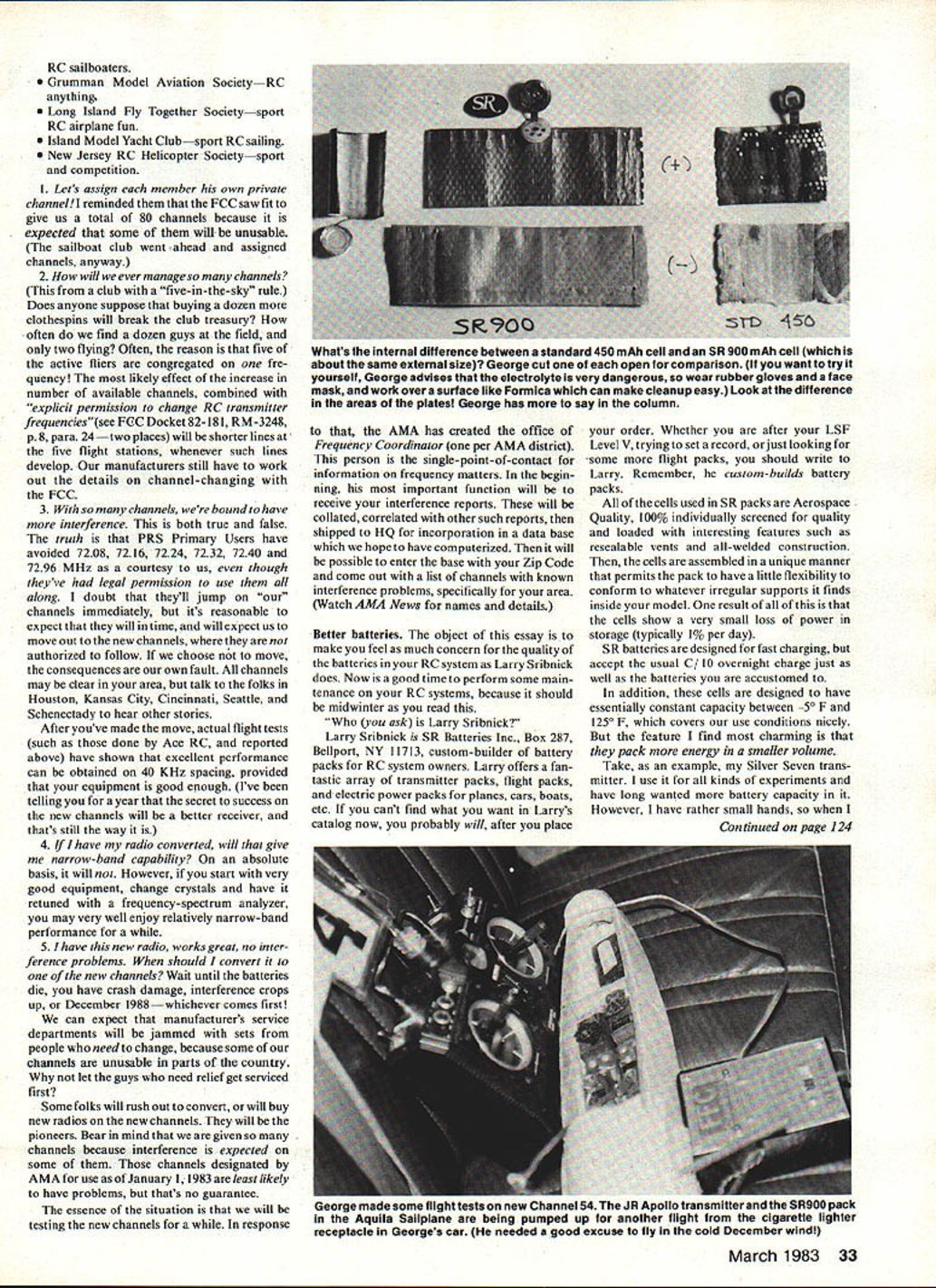
How did he do it? The laws of physics haven't changed: you want more capacity, you use more plate area. My micrometer says that the plates in the SR 900 cell are about 2.3 times as thick as those in the 450 mAh cell. Add to that the fact that the 450 mAh cell is wound on a plastic rod while the SR 900 is wound on a mandrel that is later removed, and consider that the SR 900's can measures .645 in. O.D., while the 450's can measures .535 in. O.D., and you begin to understand how the SR cell winds a few more turns into the package.
As regular readers know, I've been using SR900 packs in my helicopters (Baron 20 and Heliboy), and after more than 50 hours of flying I haven't had any problem traceable to those batteries. I use the SR900 packs to deal with the added current drain of some gyros, rather than add a second pack for the gyros, which would add a lot of weight. When it comes to charging, I plug in the M.E.N.C. 50 charger and walk away for lunch. A completely discharged pack will stay on High Rate for about 10 minutes and be charged up to about 90% in that time. On Low Rate it reaches near full charge in less than an hour.
Fast field charger — Ace RC FFC
Let's end this discussion of batteries with another fast field charger, the FFC from Ace RC. It recharges both your transmitter and your receiver at the same time. The circuit is an update of Doug Spreng's Battery Management System (published in RCM), which has withstood the test of time. It works off a 12-volt battery and gets the job done in less than an hour in most cases. You can use it on the SR900 packs, but it will take longer.
I built one of the kits a few months ago and have used it with good results. Since people ask me, from time to time, for a good field charger, I now feel that I can say you'll like this one. It's simple to operate, temperature-compensated, and reasonably priced. It charges the most common four-cell/eight-cell combination only, and it charges at 500 mA to about 85% of a full charge on the flight pack and 50% of a full charge on the transmitter, then reverts both to a safe 35 mA constant charge rate.
George M. Myers 70 Froehlich Farm Rd. Hicksville, NY 11801
Transcribed from original scans by AI. Minor OCR errors may remain.

