
Radio Technique
George M. Myers
LIVING WITH THE NEW RC CHANNELS
Part 2
Right now, we're in a use-it-or-lose-it situation. We've been given our new RC channels on an exclusive, secondary-user basis. Nobody has been designated as a primary user, so nobody shares them with us. The AMA has designated certain channels for immediate use on the basis that the selected channels will be most compatible with converted existing equipment. If we are slow to occupy these channels, that action will be taken as evidence that we really don't need them, with the result that other users will start appearing on our channels.
Among other things, I serve as District Frequency Coordinator for District II, and in that capacity I have received another printout of known Common Carrier transmitters that might affect our flying. This listing (which is known to be incomplete) lists 85 transmitters (nationwide) that are located directly on last year's 72 MHz frequencies, and another 342 located ±10 kHz from the new channels. In my district, the count is four on-channel and 36 adjacent-channel transmitters to be checked.
Last month I discussed how you might assess your receiver's sensitivity to those adjacent-channel transmitters. As the figures showed, you haven't much to fear if you are a couple of miles away from the usual Common Carrier transmitter, which will be operating at 25 watts or less with a relatively wide-beam (therefore low-gain) antenna.
This month I want to take up a more likely interference: that which we do to ourselves. The situation is complex, and Frequency Committee member Bill Hershberger has told me that the printout of possible combinations takes four feet of computer paper. According to Bill, only the manufacturers can really deal with this, by designing a new, narrow-band receiver for us. They're working on it, but I want to try now, don't you?
What follows is a simple procedure for checking the most likely interference problems. For any one transmitter, the list of possibilities is short. For a more structured approach, a flight-line arrangement is offered that should avoid most of the problems.
Third-Order Mixing Products Interference (3MPI). Sounds sort of ominous, doesn't it? What it means is that you can get servo jitters on Red/White (72.240) when transmitters on Brown/White (72.080) and Blue/White (72.160) are operating too close. The cure is to spread out a little (about 15 ft. apart).
In recent years you could go to RC sailboat races or RC indoor electric car races and see the drivers standing shoulder-to-shoulder while using every available RC channel. The possibilities for 3MPI are at a maximum in such a situation, yet the interference was seldom seen. This leads me to conclude that 3MPI is something to be aware of, but not to lose any sleep over.
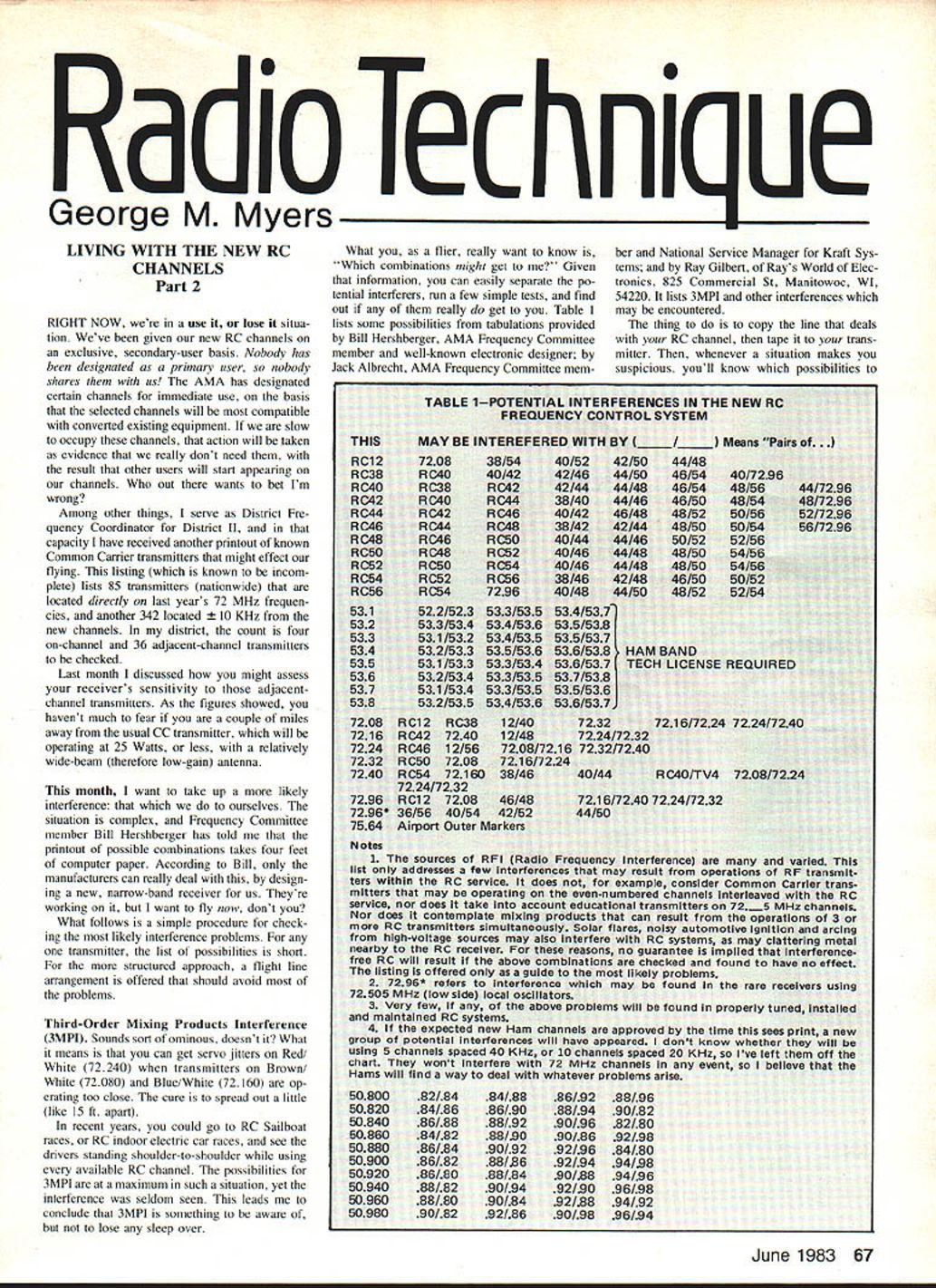
What you, as a flier, really want to know is, "Which combinations might get to me?" Given that information, you can easily separate the potential interferers, run a few simple tests, and find out if any of them really do get to you. Table 1 lists some possibilities from tabulations provided by Bill Hershberger (AMA Frequency Committee member and well-known electronic designer), Jack Albrecht (AMA Frequency Committee member and National Service Manager for Kraft Systems), and Ray Gilbert (Ray's World of Electronics, 825 Commercial St., Manitowoc, WI 54220). It lists 3MPI and other interferences which may be encountered.
The thing to do is to copy the line that deals with your RC channel, then tape it to your transmitter. Then, whenever a situation makes you suspicious, you'll know which possibilities to check.
TABLE 1 — POTENTIAL INTERFERENCES IN THE NEW RC FREQUENCY CONTROL SYSTEM (See printed table for specific channel combinations and pairs.)
Notes
- The sources of RFI (Radio Frequency Interference) are many and varied. This list only addresses a few interferences that may result from operations of RF transmitters within the RC service. It does not, for example, consider Common Carrier transmitters that may be operating on the even-numbered channels interleaved with the RC service, nor does it take into account educational transmitters on 72.5 MHz channels. Nor does it contemplate mixing products that can result from the operations of three or more RC transmitters simultaneously. Solar flares, noisy automobile ignition and strong local high-voltage power lines also are sources of RFI. For these reasons, no guarantee is implied that the interferences listed will result if the above combinations are checked and found to have an effect. The listing is offered only as a guide to the most likely problems.
- 72.96 refers to interference which may be found in the rare receivers using 72.505 MHz (low-side) local oscillators.
- Very few, if any, of the above problems will be found in properly tuned, installed and maintained RC systems.
- If the unexpected new Ham channels are approved by the time this sees print, a new list of possible interfering combinations will have to be prepared. I don't know whether they will be assigned five channels spaced 40 kHz or ten channels spaced 20 kHz, so I've left them off the chart. The new Hams will find a way to deal with whatever problems arise.
Radio Technique
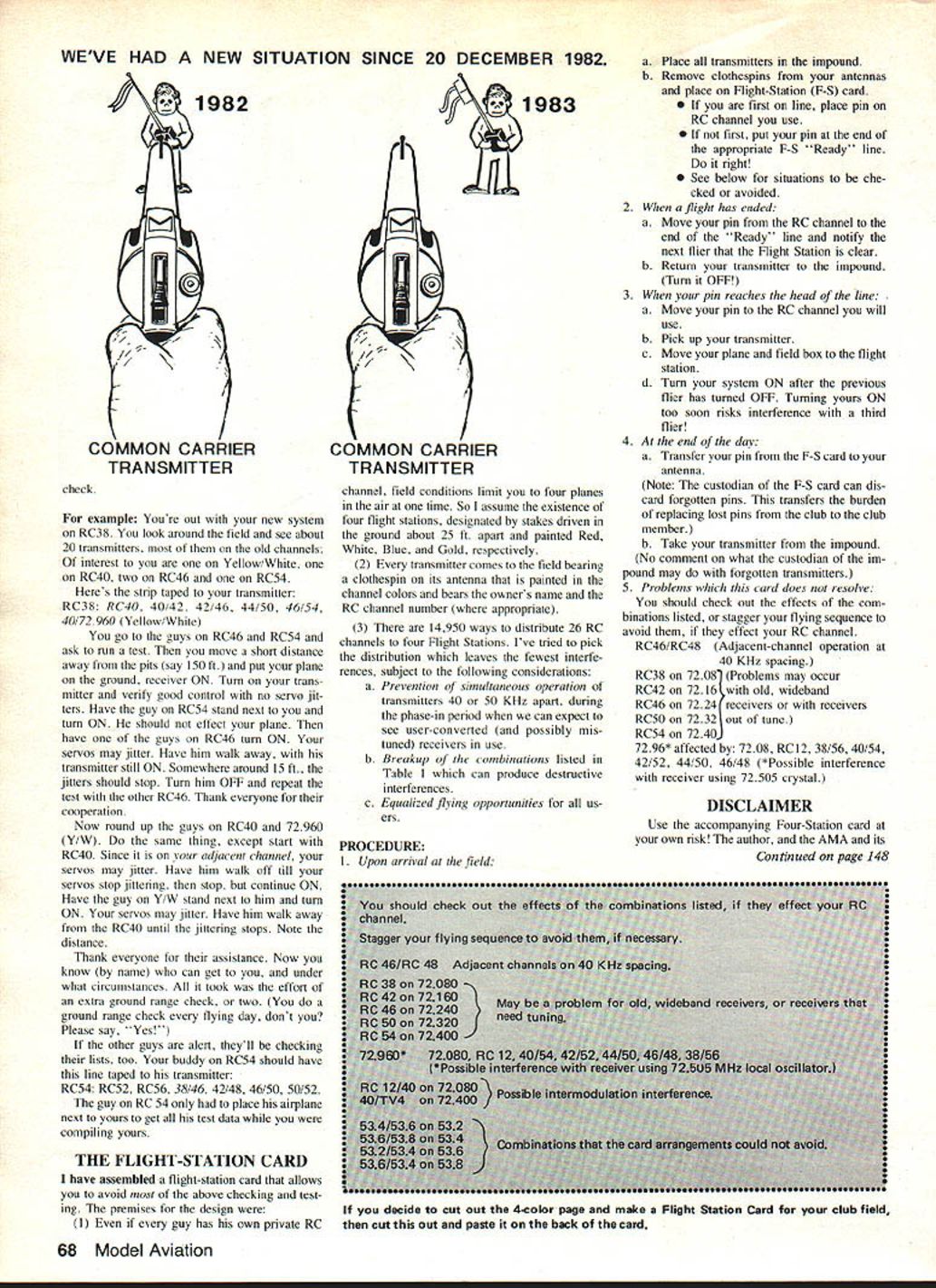
WE'VE HAD A NEW SITUATION SINCE 20 DECEMBER 1982
For example: You're out with your new system on RC38. You look around the field and see about 20 transmitters, most of them on the old channels. Of interest to you are one on Yellow/White, one on RC40, two on RC46 and one on RC54.
Here's the strip taped to your transmitter: RC38; RC40, 40/42, 42/46, 44/50, 46/54, 40/72.960 (Yellow/White)
You go to the guys on RC46 and RC54 and ask to run a test. Then you move a short distance away from the pits (say 150 ft.) and put your plane on the ground, receiver ON. Turn on your transmitter and verify good control with no servo jitters. Have the guy on RC54 stand next to you and turn ON. He should not affect your plane. Then have one of the guys on RC46 turn ON. Your servos may jitter. Have him walk away, with his transmitter still ON. Somewhere around 15 ft. the jitters should stop. Turn him OFF and repeat the test with the other RC46. Thank everyone for their cooperation.
Now round up the guys on RC40 and Yellow/White (72.960). Do the same thing, except start with RC40. Since it is on your adjacent channel, your servos may jitter. Have him walk off until your servos stop jittering, then stop, but continue ON. Have the guy on Yellow/White stand next to him and turn ON. Your servos may jitter. Have him walk away from the RC40 until the jittering stops. Note the distance. Thank everyone for their assistance. Now you know (by name) who can get to you, and under what circumstances. All it took was the effort of an extra ground range check or two. (You do a ground range check every flying day, don't you? Please say, "Yes!")
If the other guys are alert, they'll be checking their lists, too. Your buddy on RC54 should have his line taped to his transmitter: RC54; RC52, RC56; 38/46, 46/50, 50/52. The guy on RC54 only had to place his airplane next to yours to get all his test data while you were compiling yours.
THE FLIGHT-STATION CARD
I have assembled a flight-station card that allows you to avoid most of the above checking and testing. The premises for the design were:
- Even if every guy has his own private RC channel, field conditions limit you to four planes in the air at one time. So I assume the existence of four flight stations, designated by stakes driven in the ground about 25 ft. apart and painted Red, White, Blue and Gold, respectively.
- Every transmitter comes to the field bearing a clothespin on its antenna that is painted in the channel colors and bears the owner's name and the RC channel number (where appropriate).
- There are 14,950 ways to distribute 26 RC channels to four Flight Stations. I've tried to pick the distribution which leaves the fewest interferences, subject to the following considerations:
- a. Prevention of simultaneous operation of transmitters 40 or 50 kHz apart during the phase-in period when we can expect to see user-converted (and possibly mistuned) receivers in use.
- b. Breakup of the combinations listed in Table 1 which can produce destructive interferences.
- c. Equalized flying opportunities for all users.
PROCEDURE:
- Upon arrival at the field:
a. Place all transmitters in the impound. b. Remove clothespins from your antennas and place on Flight-Station (F-S) card.
- If you are first on line, place pin on RC channel you use.
- If not first, put your pin at the end of the appropriate F-S "Ready" line. Do it right!
- See below for situations to be checked or avoided.
- When a flight has ended:
a. Move your pin from the RC channel to the end of the "Ready" line and notify the next flier that the Flight Station is clear. b. Return your transmitter to the impound. (Turn it OFF!)
- When your pin reaches the head of the line:
a. Move your pin to the RC channel you will use. b. Pick up your transmitter. c. Move your plane and field box to the flight station. d. Turn your system ON after the previous flier has turned OFF. Turning yours ON too soon risks interference with a third flier!
- At the end of the day:
a. Transfer your pin from the F-S card to your antenna. (Note: The custodian of the F-S card can discard forgotten pins. This transfers the burden of replacing lost pins from the club to the club member.) b. Take your transmitter from the impound. (No comment on what the custodian of the impound may do with forgotten transmitters.)
- Problems which this card does not resolve:
You should check out the effects of the combinations listed, or stagger your flying sequence to avoid them, if they affect your RC channel.
- RC46 / RC48 — Adjacent channels on 40 kHz spacing.
- RC38 on 72.080 (Problems may occur)
- RC42 on 72.160 (May be a problem for old, wideband receivers, or receivers that need tuning.)
- RC46 on 72.240
- RC50 on 72.320
- RC54 on 72.400
72.960 affected by: 72.080, RC12, 40/54, 42/52, 44/50, 46/48, 38/56 (*Possible interference with receivers using a 72.505 MHz local oscillator.)
RC12/40 on 72.080 — Possible intermodulation interference. 40/54 on 72.400
Combinations that the card arrangements could not avoid.
If you decide to cut out the four-color page and make a Flight Station Card for your club field, then cut this out and paste it on the back of the card.
DISCLAIMER Use the accompanying Four-Station card at your own risk. The author, and the AMA and its officers and agents, will not guarantee that following the instructions given in this article will protect the RC operator from interference, nor will they accept any responsibility for damages incurred, directly or indirectly, as a result of using the accompanying card as instructed.
George M. Myers 70 Froehlich Farm Rd. Hicksville, NY 11801
Transcribed from original scans by AI. Minor OCR errors may remain.

