
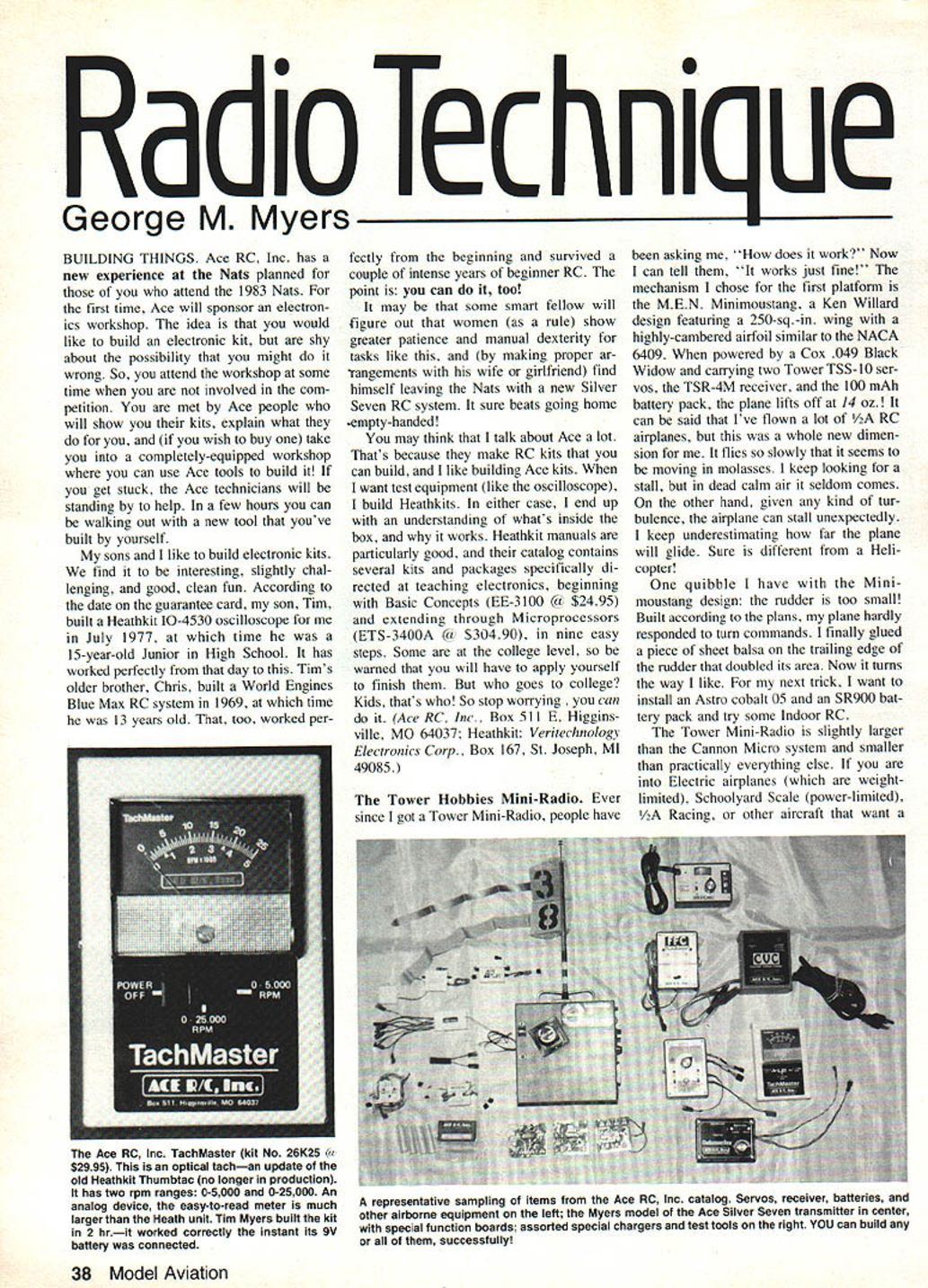
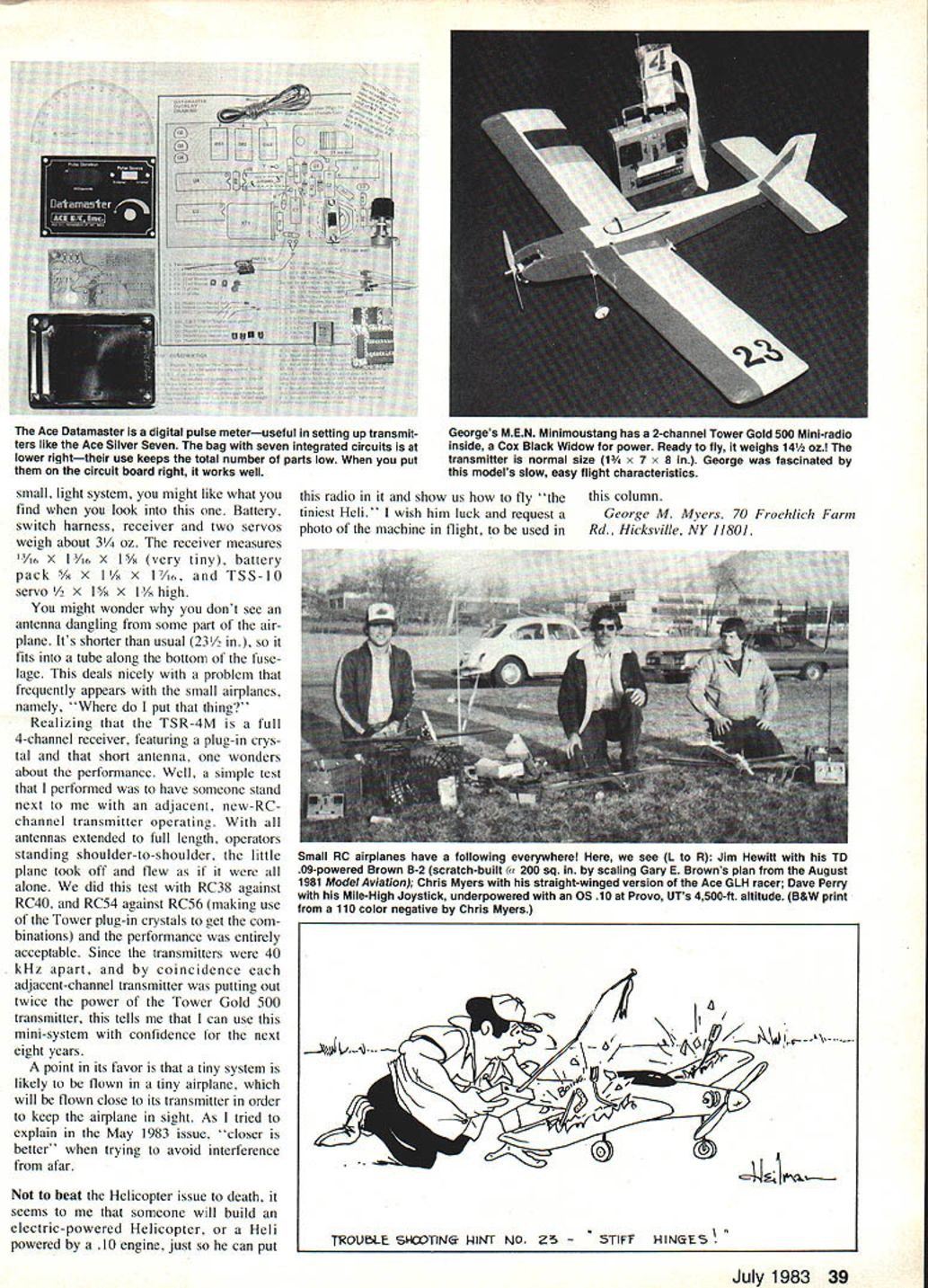
Radio Technique
George M. Myers
Building Things
Ace RC, Inc. has a new experience planned at the 1983 Nats for those of you who attend. For the first time, Ace will sponsor an electronics workshop. The idea is that you would like to build an electronic kit, but are shy about the possibility that you might do it wrong. So you attend the workshop at some time when you are not involved in the competition. You are met by Ace people who will show you their kits, explain what they do for you, and (if you wish to buy one) take you into a completely equipped workshop where you can use Ace tools to build it. If you get stuck, the Ace technicians will be standing by to help. In a few hours you can be walking out with a new tool that you've built by yourself.
My sons and I like to build electronic kits. We find it interesting, slightly challenging, and good, clean fun. According to the date on the guarantee card, my son Tim built a Heathkit 10-4530 oscilloscope for me in July 1977, at which time he was a 15-year-old junior in high school. It has worked perfectly from that day to this. Tim's older brother, Chris, built a World Engines Blue Max RC system in 1969, at which time he was 13 years old. That, too, worked perfectly from the beginning and survived a couple of intense years of beginner RC. The point is: you can do it, too!
It may be that some smart fellow will figure out that women (as a rule) show greater patience and manual dexterity for tasks like this, and (by making proper arrangements with his wife or girlfriend) find himself leaving the Nats with a new Silver Seven RC system. It sure beats going home empty-handed!
You may think that I talk about Ace a lot. That's because they make RC kits that you can build, and I like building Ace kits. When I want test equipment (like the oscilloscope), I build Heathkits. In either case, I end up with an understanding of what's inside the box, and why it works. Heathkit manuals are particularly good, and their catalog contains several kits and packages specifically directed at teaching electronics, beginning with Basic Concepts (EE-3100 at $24.95) and extending through Microprocessors (ETS-3400A at $304.90), in nine easy steps. Some are at the college level, so be warned that you will have to apply yourself to finish them. But who goes to college? Kids, that's who! So stop worrying, you can do it.
(Ace RC, Inc., Box 511 E, Higginsville, MO 64037; Heathkit: Veritechnology Electronics Corp., Box 167, St. Joseph, MI 49085.)
The Tower Hobbies Mini-Radio
Ever since I got a Tower Mini-Radio, people have been asking me, "How does it work?" Now I can tell them, "It works just fine!" The mechanism I chose for the first platform is the M.E.N. Minimoustang, a Ken Willard design featuring a 250-sq.-in. wing with a highly cambered airfoil similar to the NACA 6409. When powered by a Cox .049 Black Widow and carrying two Tower TSS-10 servos, the TSR-4M receiver, and the 100 mAh battery pack, the plane lifts off at 14 oz. It can be said that I've flown a lot of 1/2A RC airplanes, but this was a whole new dimension for me. It flies so slowly that it seems to be moving in molasses. I keep looking for a stall, but in dead calm air it seldom comes. On the other hand, given any kind of turbulence, the airplane can stall unexpectedly. I keep underestimating how far the plane will glide. Sure is different from a helicopter!
One quibble I have with the Minimoustang design: the rudder is too small. Built according to the plans, my plane hardly responded to turn commands. I finally glued a piece of sheet balsa on the trailing edge of the rudder that doubled its area. Now it turns the way I like. For my next trick, I want to install an Astro Cobalt 05 and an SR900 battery pack and try some indoor RC.
The Tower Mini-Radio is slightly larger than the Cannon Micro system and smaller than practically everything else. If you are into electric airplanes (which are weight-limited), schoolyard scale (power-limited), 1/2A racing, or other aircraft that want a small, light system, you might like what you find in the Ace catalog. A battery switch harness, receiver, and two servos weigh about 3/4 oz.; the receiver measures 1 1/16 x 3/4 x 1/8 in., very tiny; the battery pack is 5/8 x 1 1/16 in. You might wonder why you don't see an antenna dangling from some part of the plane. It's shorter than the usual 23 in. and fits in a tube along the bottom fuselage.
Realizing that the TSR-4M is a full 4-channel receiver, featuring a plug-in crystal and its short antenna, one wonders about the performance. A simple test that I performed was to have someone stand next to me with an adjacent, new-RC-channel transmitter operating. With all antennas extended to full length, operators standing shoulder-to-shoulder, the little plane took off and flew as if it were alone. We did this test with RC38 against RC40, and RC54 against RC56 (making use of the Tower plug-in crystals to get the combinations), and the performance was entirely acceptable. Since the transmitters were 40 kHz apart, and by coincidence each adjacent-channel transmitter was putting out twice the power of the Tower Gold 500 transmitter, this tells me that I can use this mini-system with confidence for the next eight years.
A point in its favor is that a tiny system is likely to be flown in a tiny airplane, which will be flown close to its transmitter in order to keep the airplane in sight. As I tried to explain in the May 1983 issue, "closer is better" when trying to avoid interference from afar.
Not to beat the helicopter issue to death, it seems to me that someone will build an electric-powered helicopter, or a heli powered by a .10 engine, just so he can put this radio in it and show us how to fly "the tiniest heli." I wish him luck and request a photo of the machine in flight to be used in this column.
George M. Myers 70 Froehlich Farm Rd. Hicksville, NY 11801
Transcribed from original scans by AI. Minor OCR errors may remain.

