
Radio Technique
George M. Myers
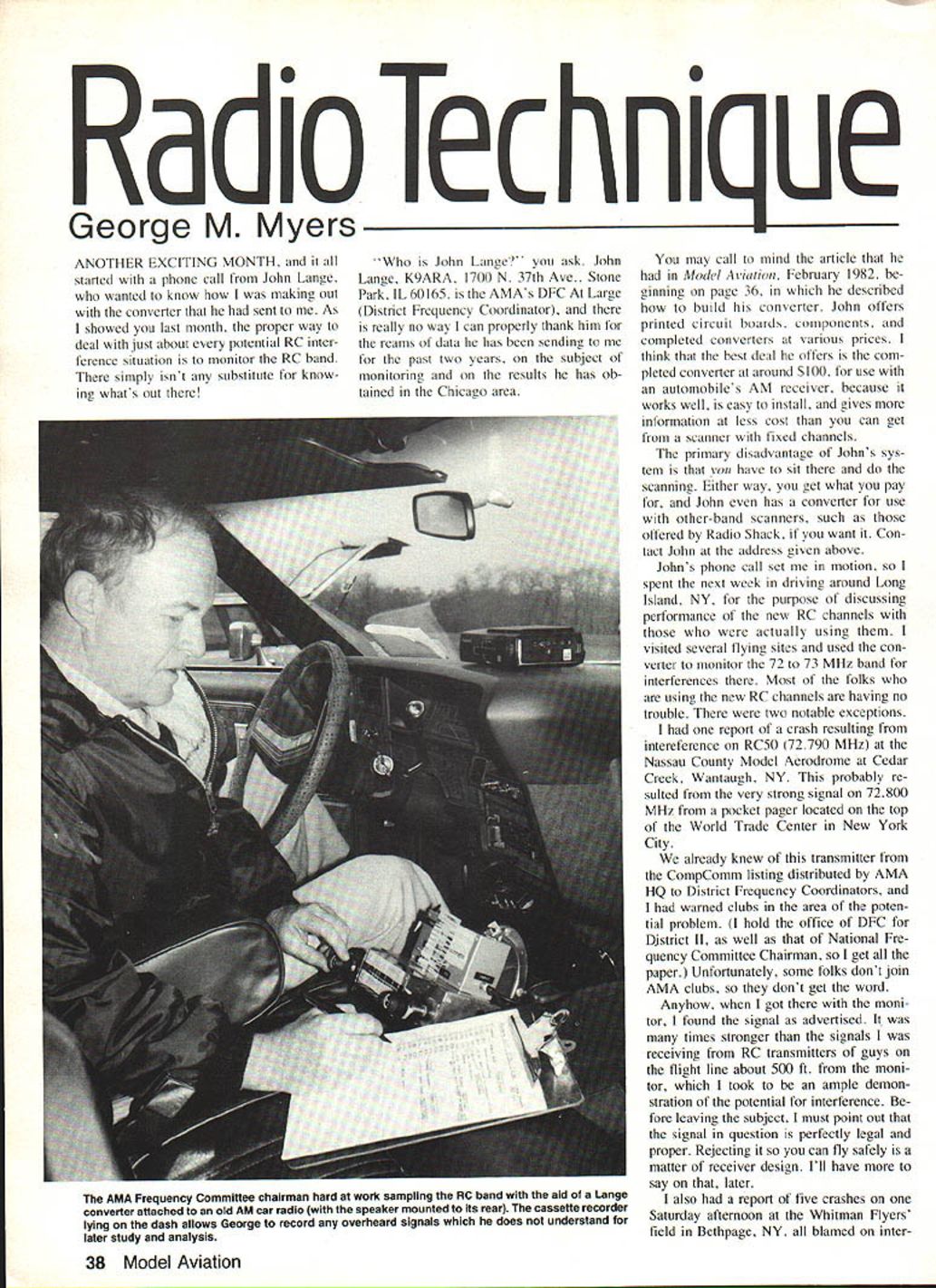
Another exciting month, and it all started with a phone call from John Lange, who wanted to know how I was making out with the converter that he had sent to me. As I showed you last month, the proper way to deal with just about every potential RC interference situation is to monitor the RC band. There simply isn't any substitute for knowing what's out there!
Who is John Lange? John Lange, K9ARA, 1700 N. 37th Ave., Stone Park, IL 60165, is the AMA's DFC At Large (District Frequency Coordinator), and there is really no way I can properly thank him for the reams of data he has been sending to me for the past two years on the subject of monitoring and on the results he has obtained in the Chicago area.
You may recall the article he had in Model Aviation, February 1982, beginning on page 36, in which he described how to build his converter. John offers printed circuit boards, components, and completed converters at various prices. I think the best deal he offers is the completed converter at around $100, for use with an automobile's AM receiver, because it works well, is easy to install, and gives more information at less cost than you can get from a scanner with fixed channels.
The primary disadvantage of John's system is that you have to sit there and do the scanning. Either way, you get what you pay for, and John even has a converter for use with other-band scanners, such as those offered by Radio Shack, if you want it. Contact John at the address given above.
John's phone call set me in motion, so I spent the next week driving around Long Island, NY, to discuss performance of the new RC channels with those who were actually using them. I visited several flying sites and used the converter to monitor the 72–73 MHz band for interference. Most of the folks using the new RC channels are having no trouble. There were two notable exceptions.
I had one report of a crash resulting from interference on RC50 (72.790 MHz) at the Nassau County Model Aerodrome at Cedar Creek, Wantagh, NY. This probably resulted from the very strong signal on 72.800 MHz from a pocket pager located on the top of the World Trade Center in New York City.
We already knew of this transmitter from the CompComm listing distributed by AMA HQ to District Frequency Coordinators, and I had warned clubs in the area of the potential problem. (I hold the office of DFC for District II, as well as that of National Frequency Committee Chairman, so I get all the paper.) Unfortunately, some folks don't join AMA clubs, so they don't get the word.
Anyhow, when I got there with the monitor, I found the signal as advertised. It was many times stronger than the signals I was receiving from RC transmitters of guys on the flight line about 500 ft. from the monitor, which I took to be an ample demonstration of the potential for interference. Before leaving the subject, I must point out that the signal in question is perfectly legal and proper. Rejecting it so you can fly safely is a matter of receiver design. I'll have more to say on that later.
I also had a report of five crashes on one Saturday afternoon at the Whitman Flyers' field in Bethpage, NY, all blamed on interference. One of the crashes had been on the 6-meter band, so there was nothing I was prepared to do about that. But when I got to the field, I picked up that pocket-pager transmitter on 72.800, loud and clear as before.
Given that I had no information on the receivers in question, I'm prepared to accept that as the probable cause of problems on RC50 (72.790 MHz—only 10 kHz away) and RC52 (72.830 MHz—only 30 kHz away), which were reported. I might even accept it as a possible explanation for a problem on RC48 (72.750 MHz—50 kHz separation), though at that separation it seems unlikely unless the pager transmitter was out of adjustment at the time—which can happen.
This left a crash on 72.240 (Red/White) to be considered. While I couldn't find any interference on that channel at the time I was monitoring, I did find a strong beacon signal of some sort on 72.280. The possibility exists that the receiver in question was a couple of years old and might have gone through a few crashes—"but it still works!" If that were the case, the real cause of the crash would have been need for re-tuning. Another, equally valid possibility is that the signal was so much stronger than the RC transmitter's signal that it would have interfered no matter how much tuning was done. This, too, would be solvable with receiver design, as I'm about to discuss.
THE KRAFT KPR-8FD RECEIVER
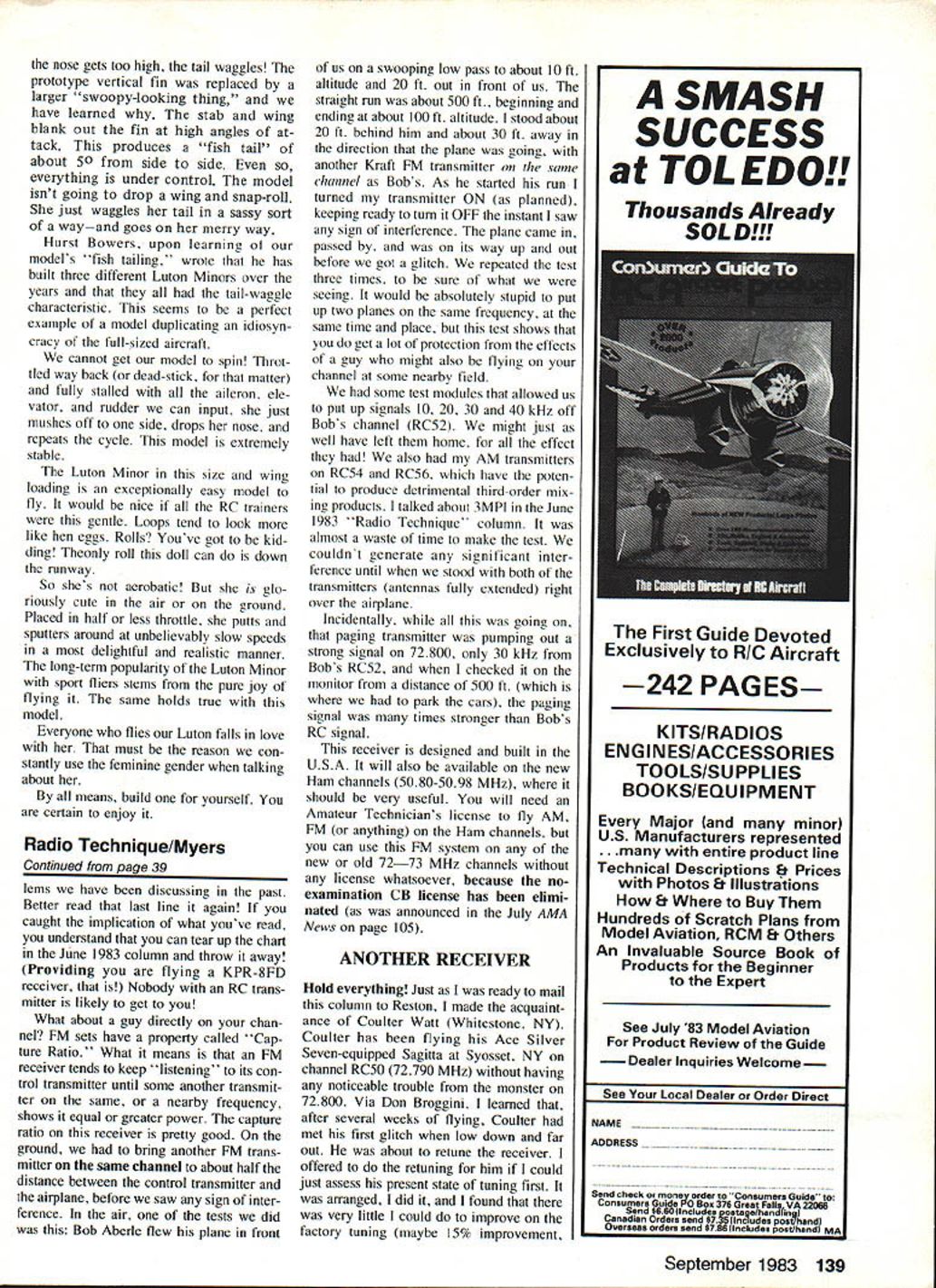
There is a certain excitement that comes when you realize that you have a piece of the future in your hands! I felt that excitement after Bob Aberle and I concluded some testing on prototypes of the KPR-8FD receiver. Here is a receiver that you can buy this year, put into service now and keep using through 1991 (when we go to using all 50 channels for aircraft)—and then keep on using it throughout all of the foreseeable future!
You may remember that I showed a photo of this receiver last month, which was taken at the Kraft booth in the Weak Signals show at Toledo. Now Bob and I have a couple to field test and report upon. It's a little early to give full test results, but these are some of the preliminaries.
The receiver is a true narrow-band design, suitable for use with channels spaced 10 kHz apart, which is what we have when you consider our positions with respect to the Common Carrier and Personal Radio Service transmitters on the even-numbered frequencies (72.08, 72.24, etc.). Because it is a dual-conversion design, it is immune to image problems with other RC transmitters and to most of the various intermodulation problems we have been discussing in the past. Better read that last line again! If you caught the implication of what you've read, you understand that you can tear up the chart in the June 1983 column and throw it away (providing you are flying a KPR-8FD receiver, that is). Nobody with an RC transmitter is likely to get to you!
What about a guy directly on your channel? FM sets have a property called capture ratio. What it means is that an FM receiver tends to keep listening to its control transmitter until some other transmitter on the same, or a nearby frequency, shows equal or greater power. The capture ratio on this receiver is pretty good. On the ground, we had to bring another FM transmitter on the same channel to about half the distance between the control transmitter and the airplane before we saw any sign of interference.
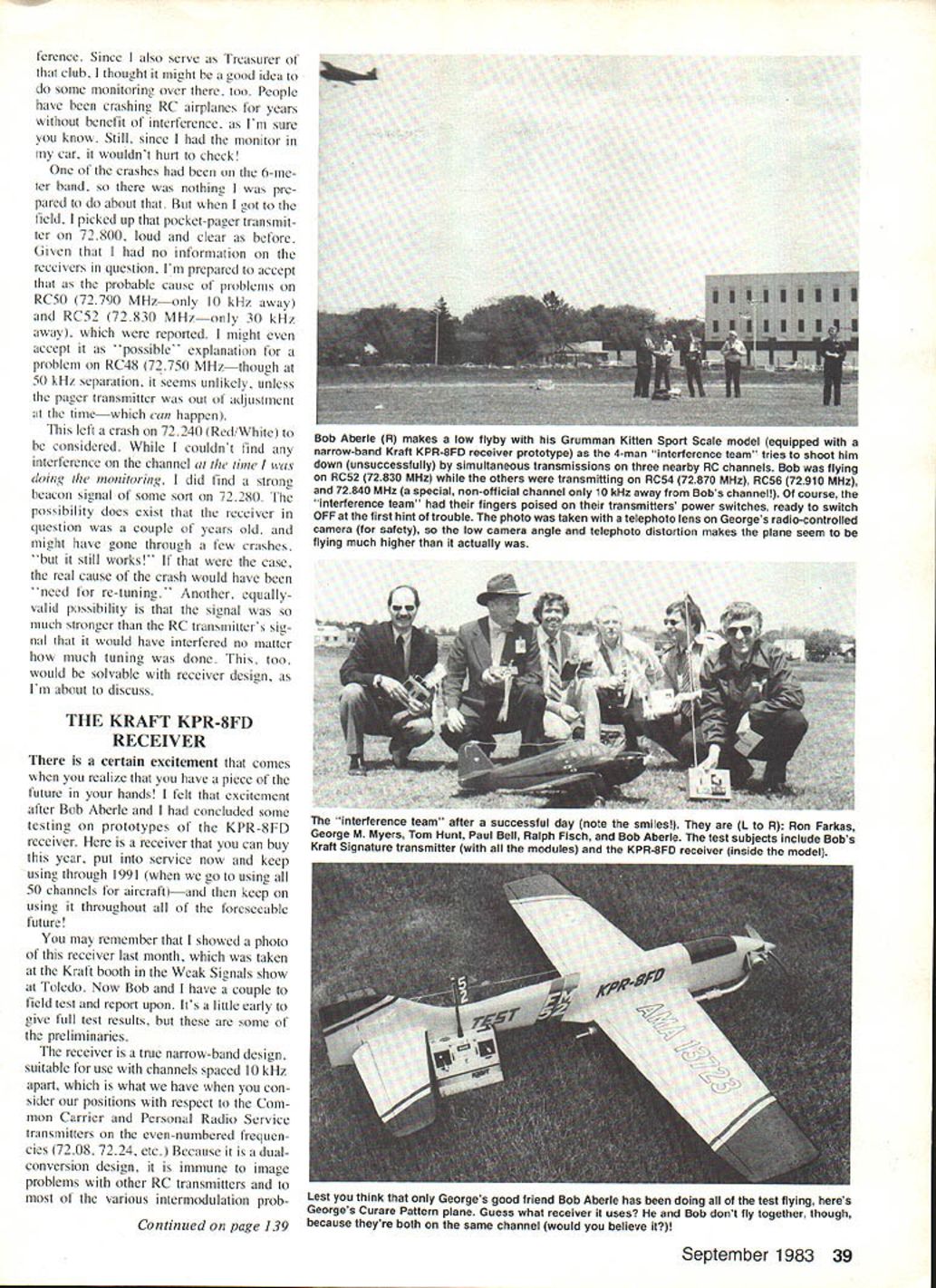
In the air, one of the tests we did was this: Bob Aberle flew his plane in front of us on a low swooping pass to about 10 ft. altitude and 20 ft. out in front of us. The straight run was about 500 ft., beginning and ending at about 100 ft. altitude. I stood about 20 ft. behind him and about 30 ft. away in the direction the plane was going, with another Kraft FM transmitter on the same channel as Bob's. As he started his run I turned my transmitter ON (as planned), keeping ready to turn it OFF the instant I saw any sign of interference. The plane came in, passed by, and was on its way up and out before we got a glitch. We repeated the test three times, to be sure of what we were seeing. It would be absolutely stupid to put up two planes on the same frequency at the same time and place, but this test shows that you do get a lot of protection from the effects of a guy who might also be flying on your channel at some nearby field.
We had some test modules that allowed us to put up signals 10, 20, 30 and 40 kHz off Bob's channel (RC52). We might just as well have left them home, for all the effect they had! We also had my AM transmitters on RC54 and RC56, which have the potential to produce detrimental third-order mixing products. I talked about 3MPI in the June 1983 "Radio Technique" column. It was almost a waste of time to make the test. We couldn't generate any significant interference until we stood with both of the transmitters (antennas fully extended) right over the airplane.
Incidentally, while all this was going on, that paging transmitter was pumping out a strong signal on 72.800, only 30 kHz from Bob's RC52, and when I checked it on the monitor from a distance of 500 ft. (which is where we had to park the cars), the paging signal was many times stronger than Bob's RC signal.
This receiver is designed and built in the U.S.A. It will also be available on the new Ham channels (50.80–50.98 MHz), where it should be very useful. You will need an Amateur Technician's license to fly AM, FM (or anything) on the Ham channels, but you can use this FM system on any of the new or old 72–73 MHz channels without any license whatsoever, because the no-examination CB license has been eliminated (as was announced in the July AMA News on page 105).
ANOTHER RECEIVER
Hold everything! Just as I was ready to mail this column to Reston, I made the acquaintance of Coulter Watt (Whitestone, NY). Coulter has been flying his Ace Silver Seven–equipped Sagitta at Syosset, NY on channel RC50 (72.790 MHz) without having any noticeable trouble from the monster on 72.800. Via Don Brogdin, I learned that after several weeks of flying Coulter had his first glitch when the paging transmitter at the World Trade Center was temporarily turned up.
I offered to do the retuning for him if I could just assess his present state of tuning first. It was arranged, I did it, and I found that there was very little I could do to improve on the factory tuning (maybe 15% improvement, at most) because the problem was simply that the aircraft's receiver had reached the point of overload.
It wouldn't have mattered what the tuner did—the pager would have overpowered the receiver. Coulter was using an Astro-Flight regulator and the installation was neat and clean. The only remedy was to move the flying site or to change channels. In other words, the paging transmitter was just too close and too strong. I told Coulter that he could talk to the paging company. Maybe they would reduce the power or relocate. That seldom helps.
Transcribed from original scans by AI. Minor OCR errors may remain.

