
Radio Technique
George M. Myers
New Frequencies — No Problems?
RC50 (72.790 MHz) might be the least desirable new RC channel in the New York City area because Empire Paging (EP) transmits 70 watts on 72.80 MHz from the top of the World Trade Center (WTC). That is 10 kHz off the center of RC50 and 28 miles from where we do most of our flying. We can see the WTC from the second floor of my house on a clear day.
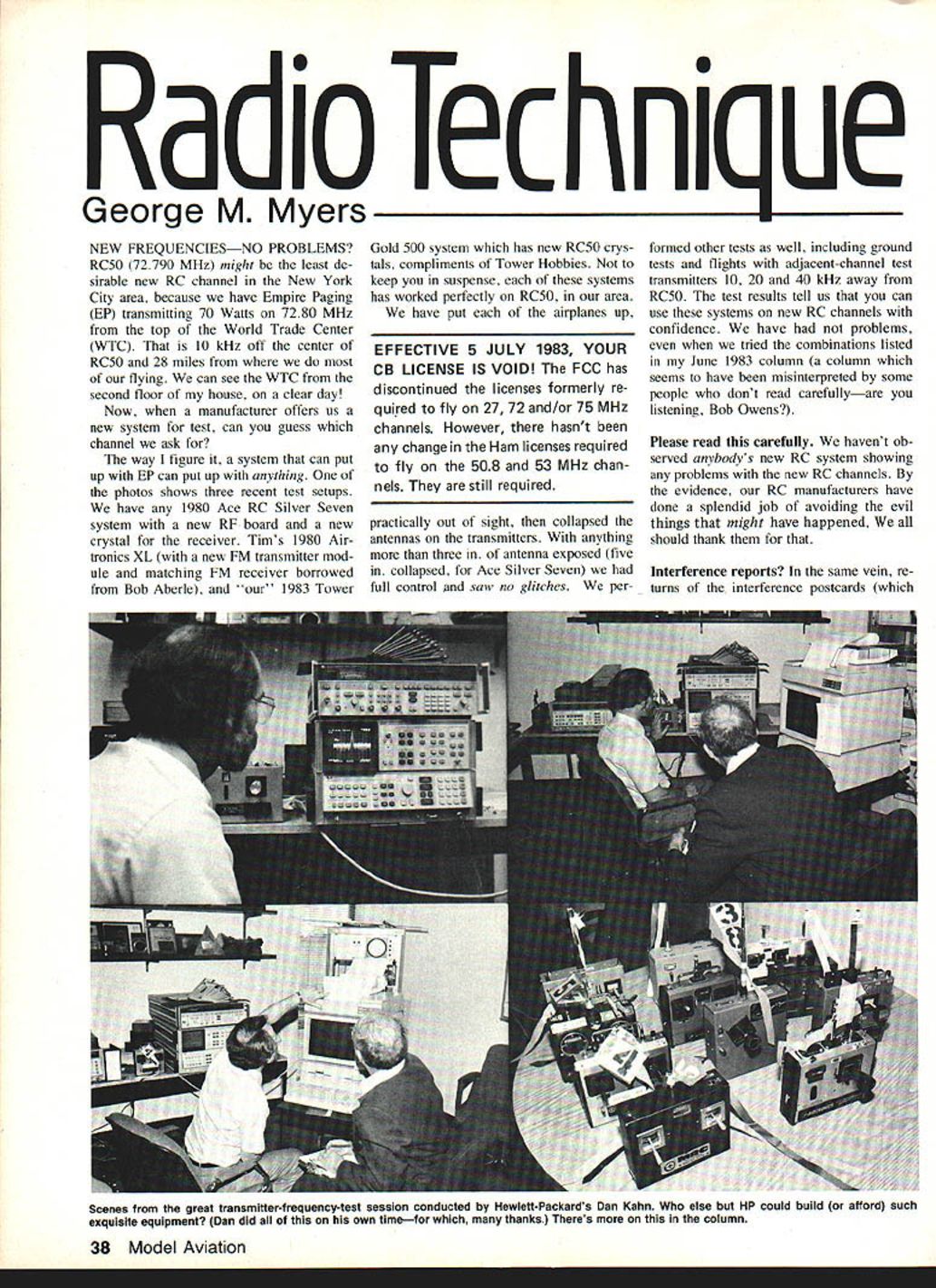
When a manufacturer offers us a new system for test, can you guess which channel we ask for? The way I figure it, a system that can put up with EP can put up with anything. One of the photos shows three recent test setups:
- a 1980 Ace RC Silver Seven system with a new RF board and a new crystal for the receiver,
- Tim's 1980 Airtronics XL (with a new FM transmitter module and a matching FM receiver borrowed from Bob Aberle),
- our 1983 Tower Gold 500 system with new RC50 crystals, compliments of Tower Hobbies.
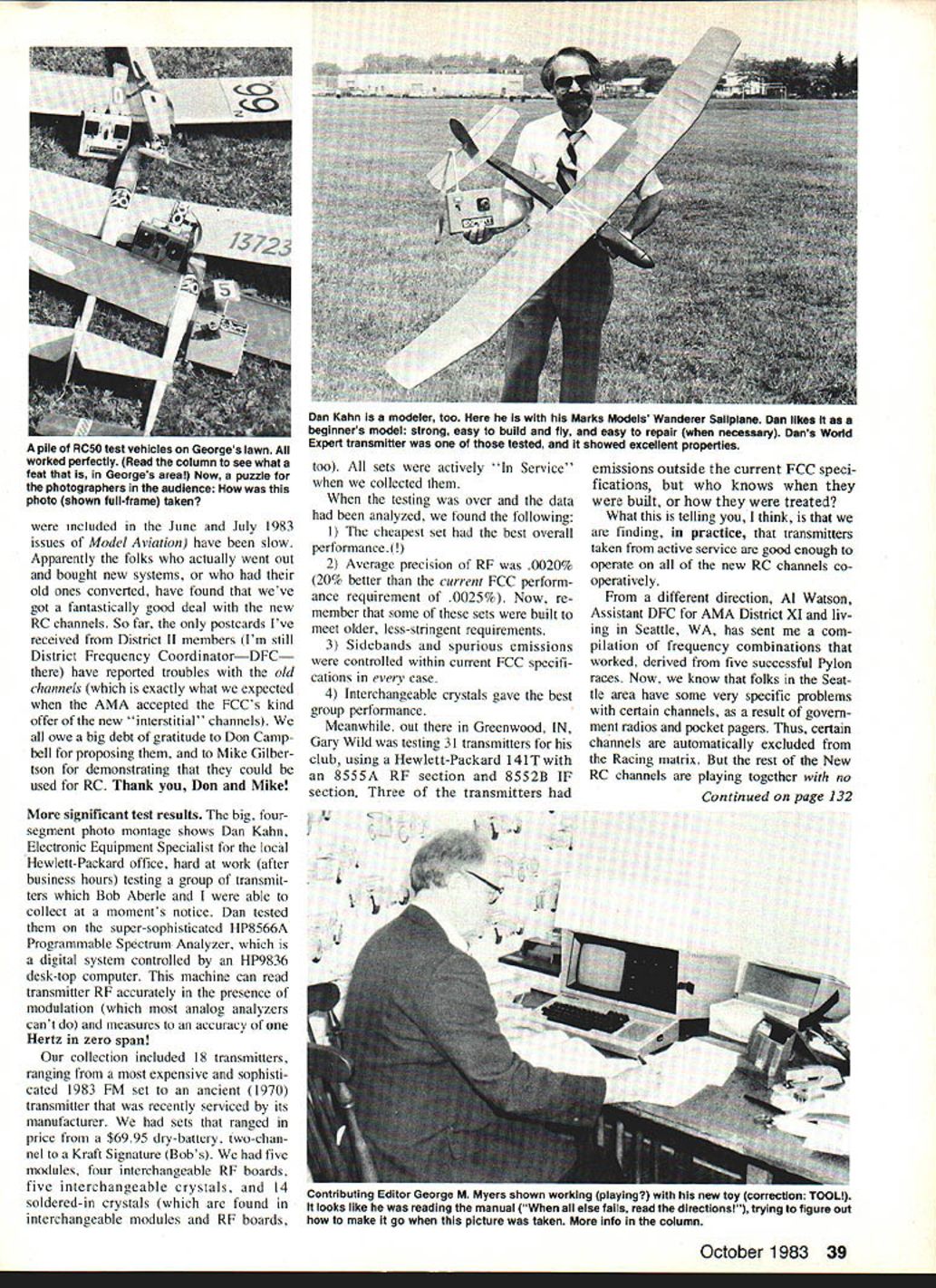
Not to keep you in suspense, each of these systems has worked perfectly on RC50 in our area.
Effective 5 July 1983, your CB license is void. The FCC has discontinued the licenses formerly required to fly on 27, 72 and/or 75 MHz channels. However, there hasn't been any change in the ham licenses required to fly on the 50.8 and 53 MHz channels—they are still required.
We put each of the airplanes up, practically out of sight, then collapsed the antennas on the transmitters. With anything more than three inches of antenna exposed (five inches for the Ace Silver Seven) we had full control and saw no glitches. We performed other tests as well, including ground tests and flights with adjacent-channel test transmitters 10, 20 and 40 kHz away from RC50. The test results tell us that you can use these systems on the new RC channels with confidence. We have had no problems, even when we tried the combinations listed in my June 1983 column (a column which seems to have been misinterpreted by some people who don't read carefully—are you listening, Bob Owens?).
Please read this carefully. We haven't observed anybody's new RC system showing any problems with the new RC channels. By the evidence, our RC manufacturers have done a splendid job of avoiding the evil things that might have happened. We all should thank them for that.
Interference Reports
Returns of the interference postcards (included in the June and July 1983 issues of Model Aviation) have been slow. Apparently the folks who actually went out and bought new systems, or who had their old ones converted, have found that we've got a fantastically good deal with the new RC channels. So far, the only postcards I've received from District II members (I'm still District Frequency Coordinator—DFC—there) have reported troubles with the old channels, which is exactly what we expected when the AMA accepted the FCC's kind offer of the new "interstitial" channels.
We all owe a big debt of gratitude to Don Campbell for proposing the new channels, and to Mike Gilbertson for demonstrating that they could be used for RC. Thank you, Don and Mike!
My thanks to Al Watson and Gary Wild for their reports. That kind of help makes my job easier. I really enjoy hearing from folks who go out and get valid test data for themselves, instead of wasting time listening to the know-it-alls who haven't actually done anything.
What else can I tell you? The potential for various kinds of interference was, and still is, present. You should monitor our band in order to know what to avoid, and it's still a good idea to check with your DFC when planning a contest. If you do encounter problems with any new RC channels, report them to your DFC! Beyond that, you can fly the new RC channels with confidence.
More Significant Test Results
Dan Kahn, Electronic Equipment Specialist for the local Hewlett-Packard office, spent time after business hours testing a group of transmitters which Bob Aberle and I were able to collect at a moment's notice. Dan tested them on the super-sophisticated HP8566A Programmable Spectrum Analyzer, a digital system controlled by an HP9836 desk-top computer. This machine can read transmitter RF accurately in the presence of modulation (which most analog analyzers can't do) and measures to an accuracy of one hertz in zero span.
Our collection included 18 transmitters, ranging from a most expensive and sophisticated 1983 FM set to an ancient (1970) transmitter that was recently serviced by its manufacturer. We had sets that ranged in price from a $69.95 dry-battery, two-channel to a Kraft Signature (Bob's). We had five modules, four interchangeable RF boards, five interchangeable crystals, and 14 soldered-in crystals (which are found in interchangeable modules and RF boards, too). All sets were actively "in service" when we collected them.
When the testing was over and the data had been analyzed, we found the following:
- The cheapest set had the best overall performance.
- Average precision of RF was 0.0020% (20% better than the current FCC performance requirement of 0.0025%). Remember that some of these sets were built to meet older, less-stringent requirements.
- Sidebands and spurious emissions were controlled within current FCC specifications in every case.
- Interchangeable crystals gave the best group performance.
Meanwhile, out in Greenwood, IN, Gary Wild was testing 31 transmitters for his club using a Hewlett-Packard 141T with an 8555A RF section and 8552B IF section. Three of the transmitters had emissions outside the current FCC specifications (who knows when they were built, or how they were treated?).
What this is telling you, I think, is that we are finding, in practice, that transmitters taken from active service are good enough to operate on all of the new RC channels cooperatively.
From a different direction, Al Watson, Assistant DFC for AMA District XI in Seattle, WA, has sent me a compilation of frequency combinations that worked, derived from five successful pylon races. Folks in the Seattle area have specific problems with certain channels due to government radios and pocket pagers; thus certain channels are automatically excluded from the racing matrix. But the rest of the new RC channels are playing together with no problems.
Personal Notes, Tools and Requests
Have I acquired a new hobby? If I'm slow in answering your letters, I apologize—you know the excuses.
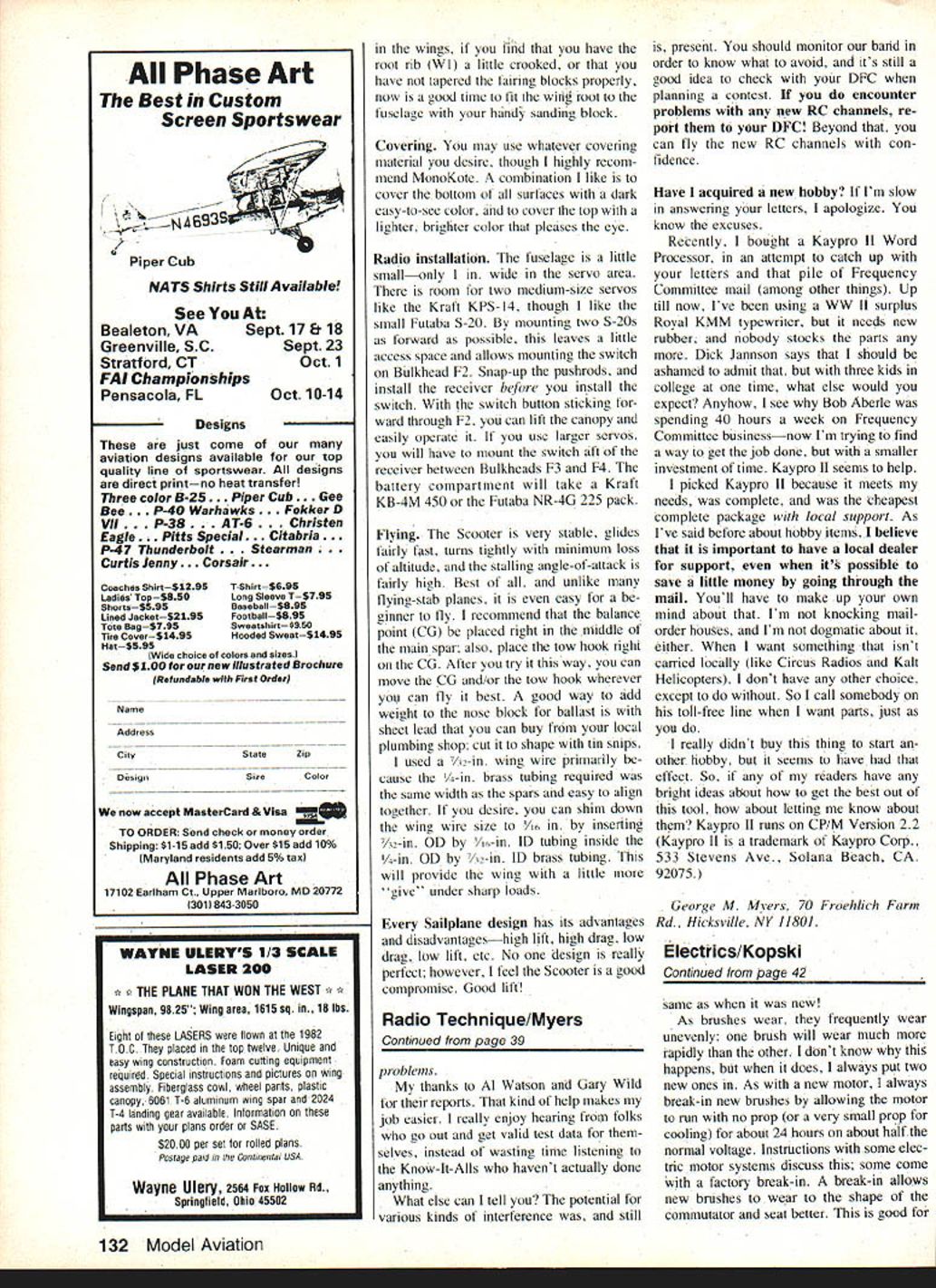
Recently I bought a Kaypro II word processor in an attempt to catch up with your letters and that pile of Frequency Committee mail (among other things). Up till now I've been using a World War II surplus Royal KMM typewriter, but it needs new rubber and nobody stocks the parts any more. Dick Jannson says that I should be ashamed to admit that, but with three kids in college at one time, what else would you expect? Anyhow, I see why Bob Aberle was spending 40 hours a week on Frequency Committee business—now I'm trying to find a way to get the job done with a smaller investment of time. Kaypro II seems to help.
I picked Kaypro II because it meets my needs, was complete, and was the cheapest complete package with local support. As I've said before about hobby items, I believe it is important to have a local dealer for support, even when it's possible to save a little money by going through the mail. You'll have to make up your own mind about that. I'm not knocking mail-order houses, and I'm not dogmatic about it either. When I want something that isn't carried locally (like Circus Radios and Kalt Helicopters), I don't have any other choice except to do without. So I call somebody on his toll-free line when I want parts, just as you do.
I really didn't buy this thing to start another hobby, but it seems to have had that effect. If any of my readers have bright ideas about how to get the best out of this tool, how about letting me know about them? Kaypro II runs on CP/M Version 2.2. (Kaypro II is a trademark of Kaypro Corp., 533 Stevens Ave., Solana Beach, CA 92075.)
George M. Myers 70 Froehlich Farm Rd. Hicksville, NY 11801
Transcribed from original scans by AI. Minor OCR errors may remain.

