
Radio Technique
George M. Myers
NEW! The advent of the new RC frequencies has added more than just a bunch of new frequencies for us to fly on — the FCC regulations also allow us to use a new method of radio transmission: FM. In the past, all of our RC sets have used either CW (carrier wave) signals switched ON or OFF (this was mainly back in the early days of single-channel, rudder-only, rubberband-powered escapement systems) or AM (amplitude modulation). AM is familiar to practically everyone in the world — it's what most radio stations used until fairly recent times.
But now, many of our "entertainment" radio stations are using FM (frequency modulation) transmission. It lets us have true high-fidelity sound, and it is resistant to static.
Now, we all know that you can't listen to an FM radio station on an AM radio and vice versa, right? If that's true, then the same situation must occur in our FM and AM RC gear, right?
Wrong! This is such a strange situation that we're going to take a close look at it this month.
The question
Will AM transmitters fly FM receivers, and vice versa? I think this is a very timely question, and I'm addressing it as a direct result of a letter from one of my readers, David Shema (AMA 5180) of Bozeman, MT:
"My question is, 'Is all this normal?'"
The experiment (David Shema)
- Turned ON my FM transmitter and his AM receiver. Result: I had solid control over his plane — the servo functions were moved around, but I had solid control — no glitches and no jitter.
- Turned everything OFF. Turned on his AM transmitter and my FM receiver. Result: he had solid control over my Heliboy.
- Later in the day, while he was flying (about 200 feet away), I turned on my receiver. He still had solid control of my Heliboy (on the ground) as well as his airplane (in the air).
- When the flying was done, we went over to my house to look at our transmitter signals on my oscilloscope.
It's gratifying to meet one of those people who actually check things out and report the results. What Mr. Shema obtained is entirely normal.
Why commercial AM and FM broadcast radios don't interfere
Commercial AM and FM broadcast radios are free from mutual interference for two reasons:
- They operate on different radio-frequency (RF) bands:
- AM: 0.55 through 1.60 MHz
- FM: 88 through 108 MHz
- They use different intermediate frequencies (IF):
- AM uses 455 kHz
- FM uses 10.7 MHz
Why RC AM and RC FM can interfere
RC AM and RC FM transmissions on the same RC channel will interfere with one another because they occupy the same RF frequency (one of the new RC channels). With the new 50 channels authorized for RC model aircraft, both AM and FM RC systems will also be using the same 455 kHz IF (except for the rare dual-conversion sets that use 10.7 MHz as well).
An unthinking few have suggested using old RC crystals in new FM RC systems — an idea both illegal and foolish. The reason we worked hard to get away from the old 72.08 etc. channels was because of overrun interference.
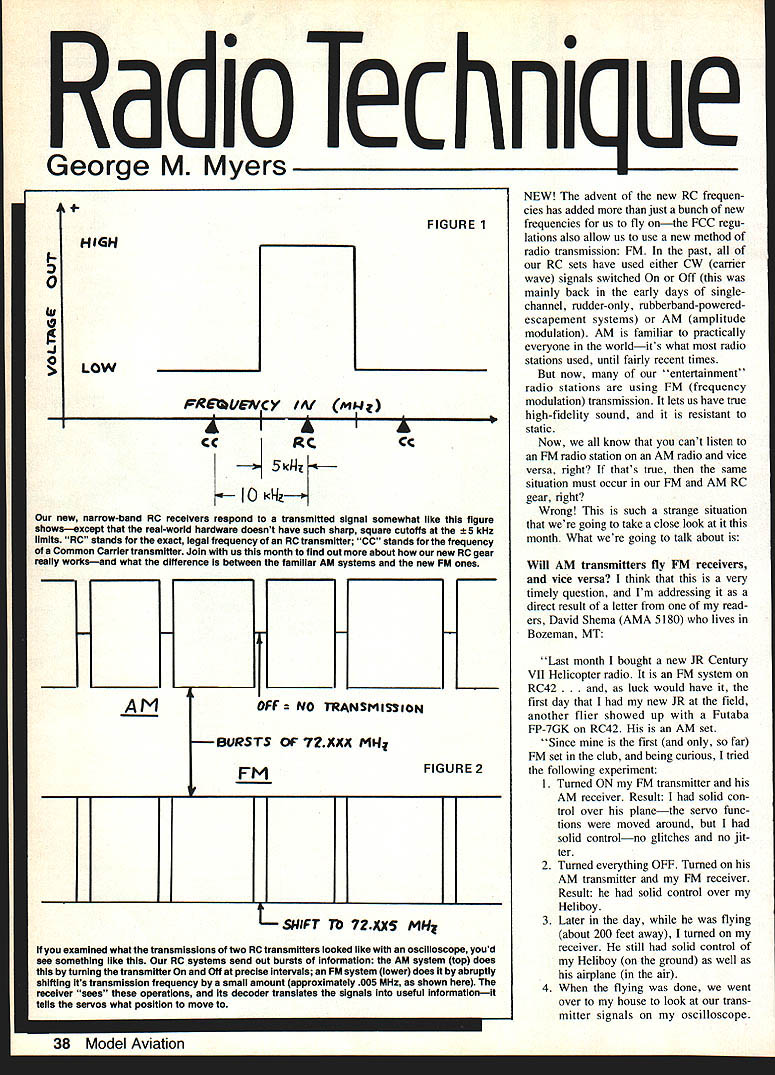
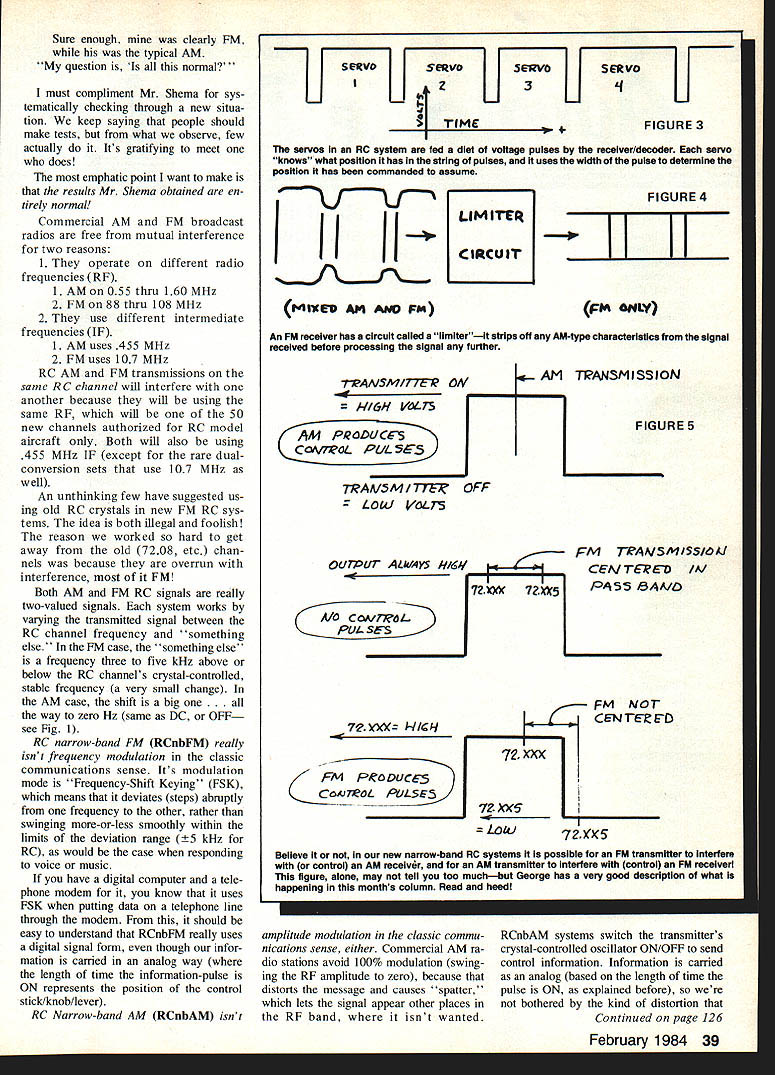
Both AM and FM RC signals are really two-valued signals. Each system works by varying the transmitted signal between the RC channel frequency and "something else."
- In the FM case, the "something else" is a frequency three to five kHz above or below the RC channel's crystal-controlled stable frequency — a very small change.
- In the AM case the shift is big — from carrier to zero (same as OFF).
(See Fig. 1.)
Modulation details: RCnbFM and RCnbAM
RC narrow-band FM (RCnbFM) really isn't frequency modulation in the classic communications sense. Its modulation mode is Frequency-Shift Keying (FSK), which means the frequency deviates in steps — abruptly — to the other value rather than swinging smoothly within the limits of the deviation range. A typical RC deviation range is ±5 kHz; the receiver responds to these stepped frequency shifts.
If you have a digital computer and a telephone modem, you know that the modem uses FSK when putting data on a telephone line. From this, it should be easy to understand that RCnbFM really uses a digital signal form, even though our information is carried in an analog way (the length of time the information pulse is ON represents the position of the control stick/knob/lever).
RC narrow-band AM (RCnbAM) isn't classic amplitude modulation either. Commercial AM radio stations avoid 100% modulation (swinging the RF amplitude to zero) because that distorts the message and causes "splatter," which lets the signal appear in other places in the RF band where it isn't wanted.
RCnbAM systems switch the transmitter's crystal-controlled oscillator ON/OFF to send control information. Information is carried as an analog (based on the length of the ON pulse), so we aren't bothered by the kind of distortion that would confuse voice or music. RC system designers are still concerned with spatter, however, so they don't use abrupt ON/OFF switching. Instead, they use a shaped transition from ON to OFF to ON that minimizes spatter.
Cross-talk from imperfect hardware
There are significant deviations from ideal performance in the hardware of both systems.
As a consequence of the ON/OFF signal shaping mentioned above, an AM transmitter puts a little frequency shift into the transmitted RF signal each time it turns the signal ON or OFF. That shift is a small FM component, and it is needed to control spatter. But that small shift is decoded by a narrow-band FM receiver because the receiver is designed to detect exactly that kind of small frequency shift. Catch-22.
All servos are controlled the same way: we send little pulses of voltage to them. The ON time of the pulse determines the servo output shaft position (see Fig. 2).
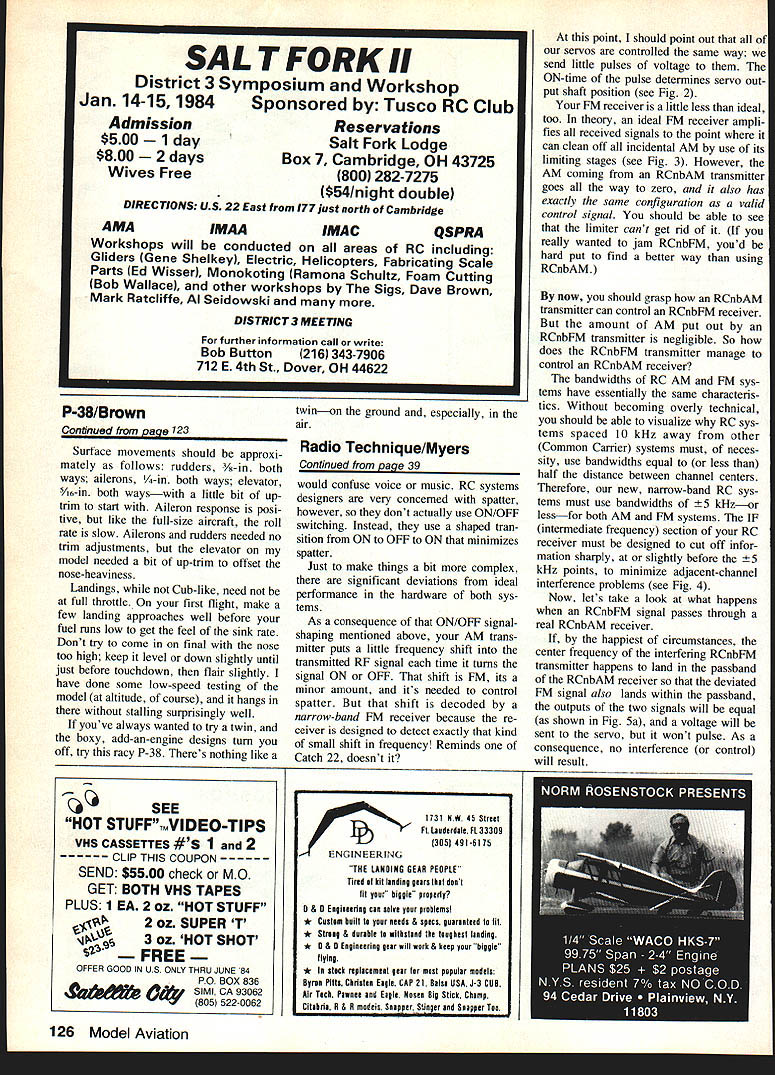
An FM receiver ideally amplifies all received signals to the point where it can clean off incidental AM by use of its limiting stages (see Fig. 3). However, the AM coming from an RCnbAM transmitter goes all the way to zero, and it also has exactly the same configuration as a valid control signal. The limiter can't get rid of that. If you really wanted to jam RCnbFM, you'd be hard put to find a better way than using RCnbAM.
Bandwidth, IF passband, and cross-decode
The bandwidths of RC AM and FM systems have essentially the same characteristics. RC systems spaced 10 kHz apart must, of necessity, use bandwidths equal to (or less than) half the distance between channel centers. Therefore, our new narrow-band RC systems must use bandwidths of ±5 kHz (or less) for both AM and FM systems. The IF section of an RC receiver must be designed to cut off information sharply, or it will pass signals slightly before the ±5 kHz points, increasing adjacent-channel interference.
What happens when an RCnbFM signal passes through a real RCnbAM receiver?
- If the center frequency of the interfering RCnbFM transmitter happens to land in the passband of the RCnbAM receiver so that the deviated FM signal also lands within the passband, the outputs of the two signals will be similar and a voltage will be sent to the servo, but it won't be pure; as a consequence, no controlled interference (or valid control) will result (see Fig. 5a).
- However, today's crystals are usually accurate to about ±1.8 kHz on average (±0.75 kHz at best). For a worst-case analysis, take double one of those values as the difference between the center frequencies of your RCnbAM transmitter and the interfering RCnbFM system, then add the ±3.5 kHz FM deviation. In many cases the deviation will land outside the RCnbAM receiver's passband (see Fig. 5b). As a result, the decoded FM signal will now generate pulses that can control your servo — even though that servo is hooked to an AM receiver.
You might ask, "Why don't FM set manufacturers select their crystals so that their deviations are centered in the band?" They might be doing that. If so, it would help the new FM set avoid interference with the AM set, but only if the crystal in the AM set is also perfectly centered. Tolerances being what they are, I wouldn't want to bet on that happening.
Practical conclusions
- It is normal to see an FM transmitter controlling an AM receiver, and vice versa.
- You can't fly AM and FM on the same channel at the same time. Under some conditions, they will cross-control one another.
When Bob Aberle and I test new RC systems, we will put the test airplane up quite high, then turn on the "other kind" of transmitter on the same channel. In general, FM systems seem to resist interference better, but that resistance is not absolute.
Our test involves slowly collapsing the antenna of the transmitter on the system being tested until the test airplane throws a fit. Then we get busy yanking out the test antenna and turning off the interference. Usually, the FM antenna is more collapsed when the excitement starts than the AM antenna is in the opposite test. But the thing to remember is that each always hits the other under some conditions.
That's why you can't fly FM and AM systems on the same RC channel at the same time.
George M. Myers 70 Froehlich Farm Rd., Hicksville, NY 11801.
Transcribed from original scans by AI. Minor OCR errors may remain.

