
Radio Technique
George M. Myers
The Future Is Coming
The future is coming. RC systems that obtain their radio frequencies by synthesis, rather than by use of a special, unique crystal, are definitely in our future. Synthesized RF (SRF) will be less expensive and more reliable. (Ask any CBer if he wants to go back to using 80 plug‑in crystals.)
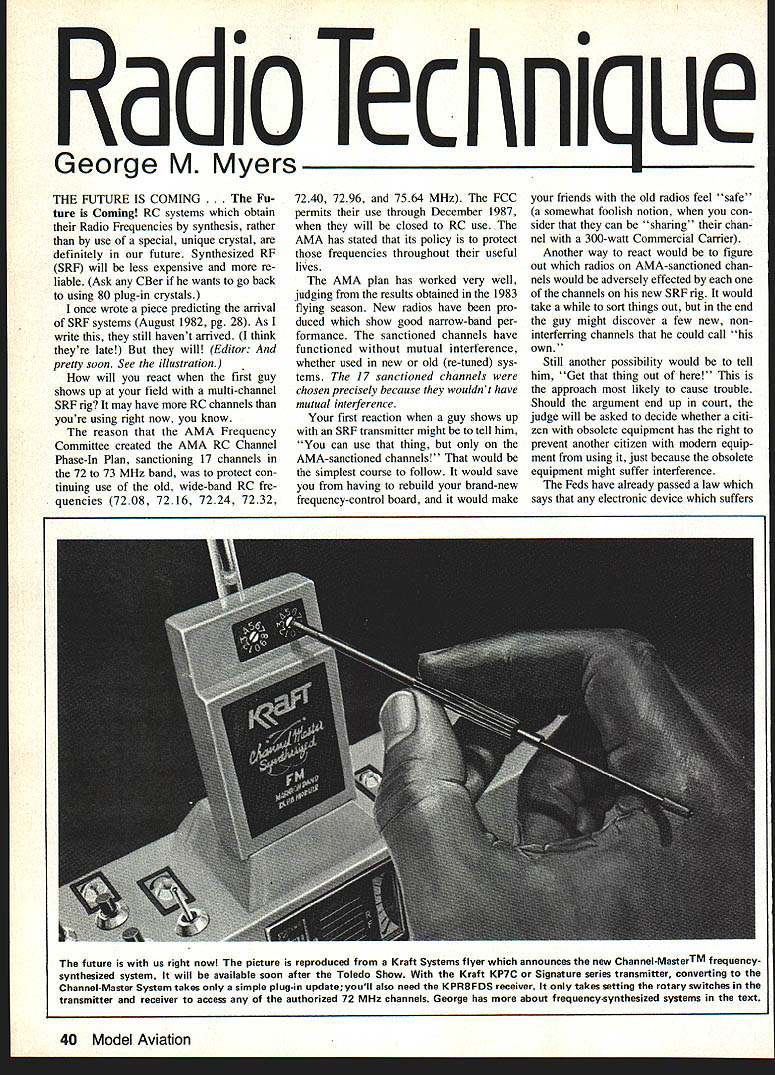
I once predicted the arrival of SRF systems (August 1982, pg. 28). As I write this, they still haven't arrived. (I think they're late.) But they will. (Editor: And pretty soon. See the illustration.) When the first person shows up at your field with a multi‑channel SRF rig, it may have more RC channels than you're using right now.
AMA Frequency Plan
The AMA Frequency Committee created the AMA RC Channel Phase‑In Plan, sanctioning 17 channels in the 72–73 MHz band to protect continuing use of the old, wide‑band RC frequencies. The old frequencies are:
- 72.08 MHz
- 72.16 MHz
- 72.24 MHz
- 72.32 MHz
- 72.40 MHz
- 72.96 MHz
- 75.64 MHz
The FCC permits their use through December 1987, when they will be closed to RC use. The AMA has stated that its policy is to protect those frequencies throughout their useful lives.
The AMA plan worked well during the 1983 flying season. New radios have been produced which show good narrow‑band performance. The sanctioned channels have functioned without mutual interference, whether used in new or re‑tuned systems. The 17 sanctioned channels were chosen precisely because they wouldn't have mutual interference.
How You Might React to SRF
You have several possible reactions when someone arrives with an SRF transmitter:
- Allow it, but insist it be used only on the AMA‑sanctioned channels. This is simple and avoids rebuilding your frequency‑control board, and it reassures owners of old radios.
- Analyze the potential interference between the sanctioned channels and each channel on the new SRF rig. It will take time, but you may find new non‑interfering channels to use.
- Demand that the person leave. This approach is most likely to cause trouble. If the argument goes to court, a judge will decide whether an owner of obsolete equipment can prevent another citizen from using modern equipment simply because the obsolete equipment might suffer interference.
A federal law already says that any electronic device which meets current operating requirements can't be protected by placing special operating restrictions on conforming equipment. The law was written to cut off complaints from owners of old, misaligned TV sets seeing interference from passing taxicabs or local Amateur Radio transmitters; it would likely be applied the same way to SRF disputes. It seems unlikely a judge would side with the owner of obsolete equipment.
The AMA will protect the status quo through 1987 as long as it can. After the FCC withdraws the old channels, everybody will have to make changes. The shortsighted who complain should try the new RC channels and they'll see the advantages.
Some have suggested the AMA provide insurance to people who operate on sanctioned channels. That would be divisive and could help break up the AMA. Organizers and splinter groups would not benefit. People might try to penalize others for doing what they have a legal right to do, or form their own groups. I don't see this benefiting anyone in three years. The argument really isn't about transmitters anyway — it's about receivers.
Receivers Are the Key
For a couple of years I've said the key to the future is the new receiver. In the September 1983 Radio Technique column I reported on the KPR‑8FD receiver test. KPR‑8FD owners now have nothing to fear from SRF transmitters in the future, no matter what channel they're on, as long as their receiver provides adequate selectivity.
Other manufacturers are designing their own 72 MHz narrow‑band receivers. Expect to see many of them on the market soon, hopefully before any widespread use of unsanctioned SRF transmitters on RC channels. My advice: buy new receivers that will work properly with the forthcoming synthesized transmitters.
The new receivers may use SRF, too, for reasons of economy. Manufacturers shudder at the cost of maintaining a full stock of crystal pairs to support the present situation. With SRF, only one type of crystal needs to be stocked; an electronic chip converts its frequency to any other needed. The same crystal and the same chip can be used in both transmitters and receivers.
You may have noticed how low current RC system prices have fallen. Many causes exist, but chief among them is the almost universal switch to the NE5044 and NE5045 chips. Their roles:
- NE5044: performs most of the work of converting control stick positions to RF modulation for the transmitter.
- NE5045: handles most of the signal decoding in the receiver.
The parts count has been cut by about three, which saves money. Use of SRF should have a similar effect.
Practical Considerations and Safety
Does that mean you should get rid of a crystal‑controlled receiver like the KPR‑8FD (which actually has two crystals to operate one channel)? I think not. You only fly on one channel at a time, and a crystal‑controlled receiver cannot accidentally be bumped onto another channel while in flight. Remember Murphy's Law: anything that can go wrong will.
With SRF systems will come frequency agility. You arrive at the field, survey the situation, pick an RC channel no one else is using, and you're in business. If someone else comes, let him pick another channel. There should be enough to go around and a dramatic reduction of accidental shoot‑downs.
At a race there will be no matrix problems. You can fly a full card in every heat. Yes, there may be some switching to do, but that's nothing new. Back when two‑crystal radios were the newest thing, I often had to flip the switch band for a second flight because someone had come to the field on "my" channel. I would switch and fly.
If something is producing interference at your field, you flip a switch and get away from it. I'll leave the rest of the advantages to you.
You must pay attention to how SRF systems implement frequency changes. If an SRF system permits changing transmitter frequencies while transmitting, we'll have a situation my friend Ralph Weiss calls "Dial‑A‑Crash." I've urged manufacturers to adopt a scheme that requires the transmitter be turned OFF during the change. There is ample evidence of the need: pilots flying man‑carrying airplanes are constantly exposed to warnings about careless channel switching on transponders. Even with such warnings, unnecessary alarms occur every year. Careful design would have avoided many of them.
Examine each SRF system that appears and voice your displeasure if channel switching is improperly implemented. Don't buy what you don't like.
Frequency Flags and Streamers
What about frequency flags for SRF transmitters? Some have suggested that each SRF transmitter should wear a big red warning flag (some say tabletop size). Perhaps they should, at least for the next few years.
No matter how it's done, each SRF transmitter will need to carry 15 streamers in a box and some kind of holder on the antenna. The user must be scrupulous in flag management to avoid unnecessary confusion. It's no big thing: I've had a box of streamers like that on my transmitter for over a year, and I rather like it — it even improves my grip on the transmitter. Flag changing is a minor chore.
Conclusion
The future is coming, and I think you'll like it.
George M. Myers 70 Froelich Farm Rd. Hicksville, NY 11801
Transcribed from original scans by AI. Minor OCR errors may remain.

