
Radio Technique
George M. Myers
Monitoring the RF Environment
Last month I asked, "What will you do when a switchable-RF-transmitter (SRF) shows up at your field?" (I've changed the S from "synthesized" to "switchable," but what's important is the fact of switching, not how it's done.) This month we're going to look at a couple of defense mechanisms.
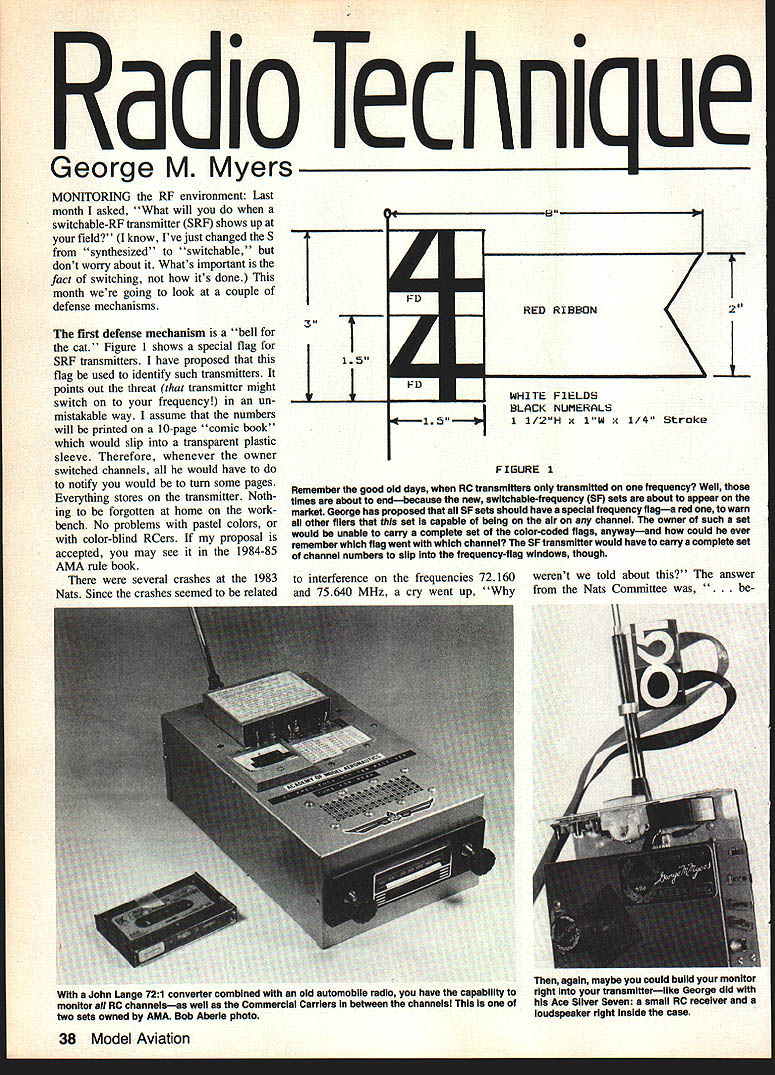
The first defense mechanism is a "bell for the cat." Figure 1 shows a special flag for SRF transmitters. I have proposed that this flag be used to identify such transmitters. It points out the threat (that a transmitter might switch on to your frequency!) in an unmistakable way. I assume the numbers would be printed in a 10-page "comic book" that would slip into a transparent plastic sleeve. Therefore, whenever the owner switched channels, he would have to turn pages to display the new channel — a clear notification to others. Everything stores on the transmitter. Nothing to be forgotten at home on the workbench. No problems with pastel colors, or with color-blind RCers. If my proposal is accepted, you may see it in the 1984–85 AMA rule book.
There were several crashes at the 1983 Nats. Since the crashes seemed to be related to interference on the frequencies 72.160 and 75.640 MHz, a cry went up, "Why weren't we told about this?" The answer from the Nats Committee was that new switchable-frequency (SF) sets were about to appear on the market. I proposed that all SF sets should have a special frequency flag — a red one, to warn all other fliers that this set is capable of being on the air on any channel. The owner of such a set would be unable to carry a complete set of the color-coded flags, anyway — and how could he ever remember which flag went with which channel? The SF transmitter would have to carry a complete set of channel numbers to slip into the frequency-flag windows, though.
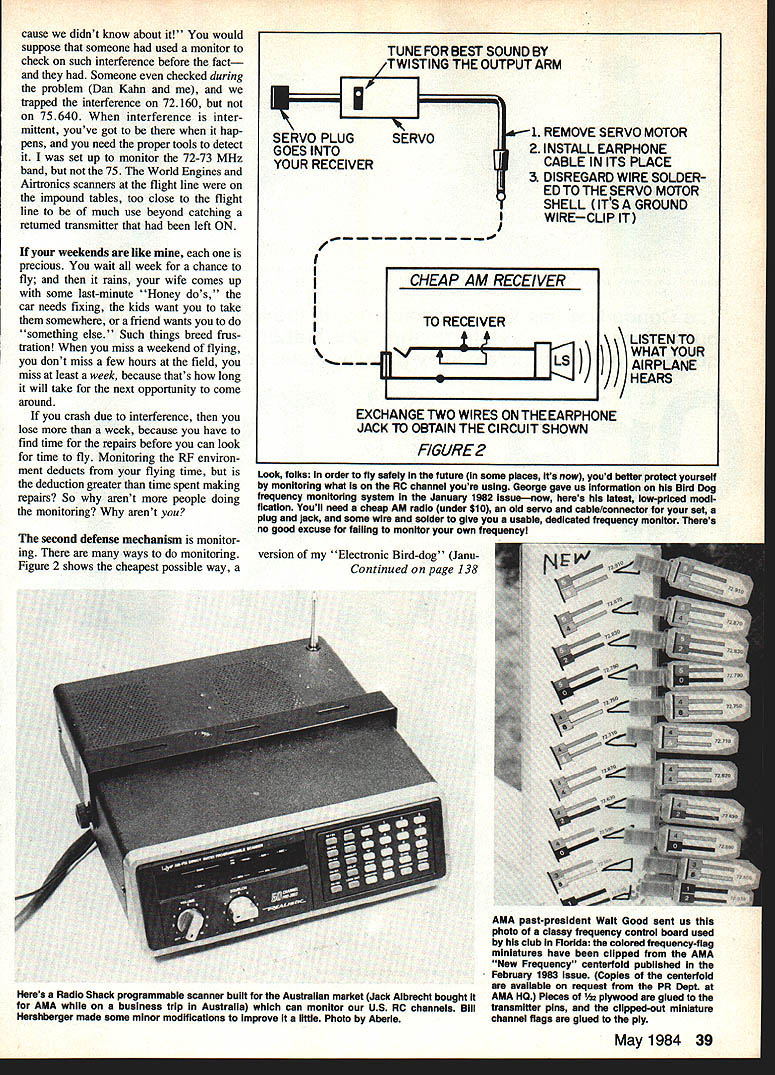
Figure 2 shows the cheapest possible way to monitor. If you want to fly safely in the future (in some places it's necessary now), you'd better protect yourself by monitoring what RC channel you're using. George gave information on the Bird-Dog frequency monitoring system in the January 1982 issue; now here's the latest low-priced modification. You'll need a cheap AM radio (under $10), an old servo cable/connector, a 1/8" plug, some wire and solder to give a usable dedicated frequency monitor. There's no good excuse for failing to monitor your own frequency.
Listen to What Your Airplane Hears
Tune for best sound by twisting the output arm.
- Remove servo motor/servo plug from servo.
- Install earphone/receiver cable in its place.
- Disregard wire soldered to the servo motor shell — it's the ground wire; clip it.
Because we didn't know about it, crashes occurred. You would suppose that someone had used a monitor to check on such interference before the fact — and they had. Someone even checked during the problem (Dan Kahn and me), and we trapped the interference on 72.160, but not on 75.640. When interference is intermittent, you've got to be there when it happens, and you need the proper tools to detect it. I was set up to monitor the 72–73 MHz band, but not the 75 MHz band. The World Engines and Airtronics scanners at the flight line were on the impound tables, too close to the flight line to be of much use beyond catching a returned transmitter that had been left ON.
If your weekends are like mine, each one is precious. You wait all week for a chance to fly; then it rains, your wife comes up with some last-minute "honey do's," the car needs fixing, the kids want you to take them somewhere, or a friend wants you to do "something else." Such things breed frustration. When you miss a weekend of flying, you don't miss a few hours at the field — you miss at least a week, because that's how long it will take for the next opportunity to come around.
If you crash due to interference, then you lose more than a week, because you have to find time for the repairs before you can look for time to fly. Monitoring the RF environment deducts from your flying time, but is the deduction greater than time spent making repairs? So why aren't more people monitoring? Why aren't you?
When you aren't flying, you can go off the flight line by about 500 feet, plug the Bird-Dog into your airplane, turn it ON, and try to find out what's happening on "your" channel. This unit draws quite a bit from your flight pack (about 300 mA), so use an Ace Fast Field Charger (34K40) or a similar device to put back what you take out before flying.
If you're not too thrilled with the idea of running down your flight pack, here's another approach. Figure 3 shows my Ace Silver Seven transmitter, modified by the addition of a small RC receiver and loudspeaker inside the set. You could do likewise. Since I have an SR900 battery pack in this transmitter and an expanded-scale voltmeter on the front panel, the small current drawn while monitoring is of no concern. A switch on the back of the transmitter selects either the Monitor or the Transmitter function.
The thought I was playing with here is that you might plug your receiver crystal into the monitor (to check the channel) before plugging it into your airplane (to fly). Of course, you'd need a system with interchangeable receiver crystals to do this. Besides, your flying buddies might not like the thought that you'll have your transmitter out of the impound area when you're not using it to fly. That could lead you to the next solution, which is still more expensive.
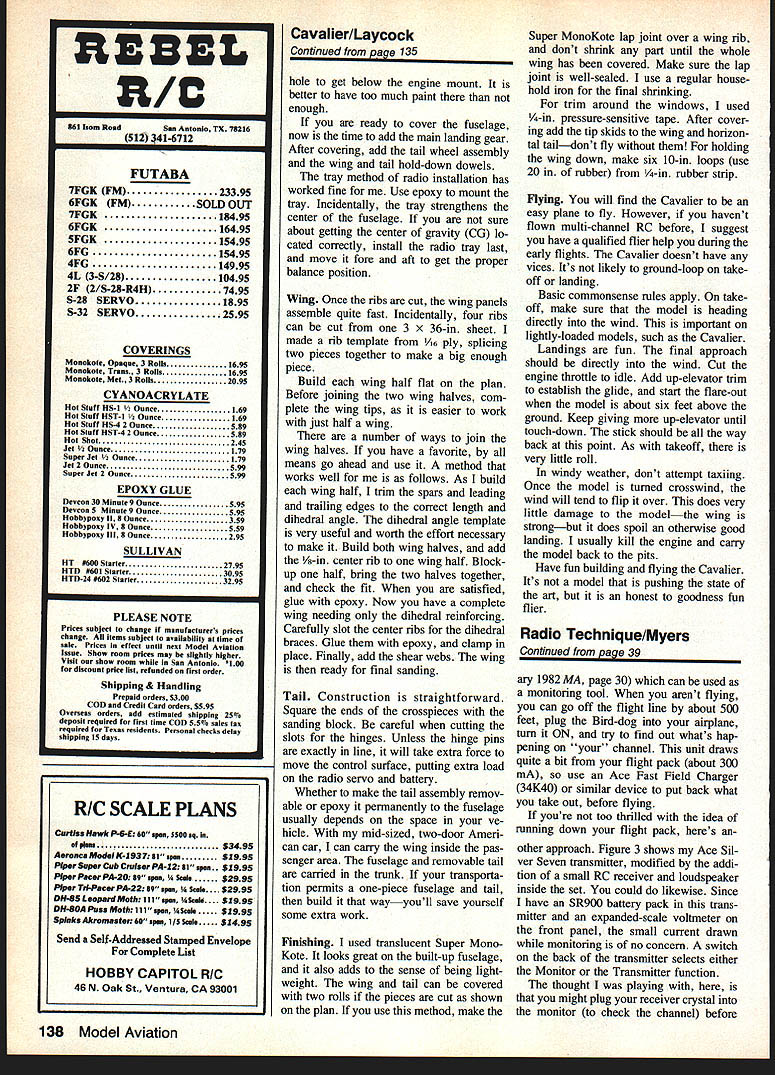
Figure 4 shows the 72:1 converter sold by John Lange. This was fully described in a construction article, "Receiving Converters for RC Frequencies" (Model Aviation, February 1982, page 36 et seq.). John has several versions of this item available, and you might want to contact him at 1700 N. 37th Ave., Stone Park, IL 60165. As you know, I have one attached to a discarded automobile radio and use it a lot. The advantage of this rig is that you can tune between the RC channels, thereby letting you hear the commercial carrier stations which live there. This is a great help in identifying interference sources.
John Lange is our DFC-at-large, and he has donated a couple of built-up units to the AMA for use at AMA-sponsored contests. I have added some tape recordings which explain how to use them and which give examples of the kinds of things you might hear, for rapid education of the persons who might use them.
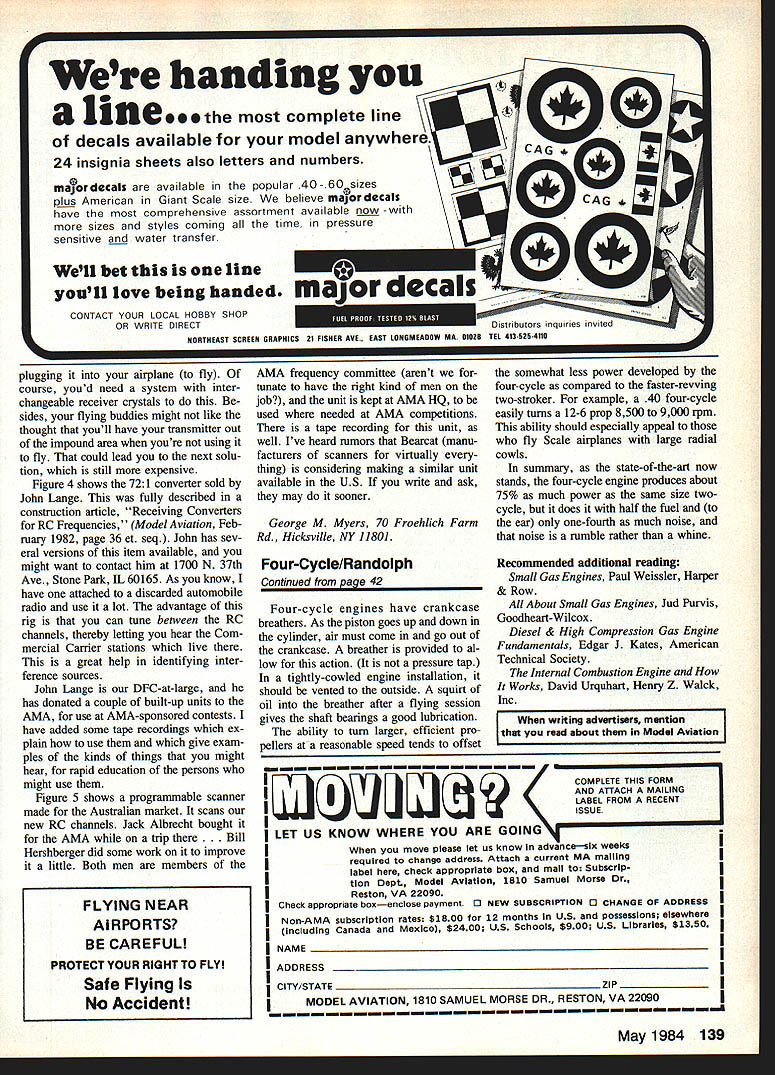
Figure 5 shows a programmable scanner made for the Australian market. It scans our new RC channels. Jack Albrecht bought it for the AMA while on a trip there; Bill Hershberger did some work on it to improve it a little. Both men are members of the AMA frequency committee, and the unit is kept at AMA HQ to be used where needed at AMA competitions. There is a tape recording for this unit, as well. I've heard rumors that Bearcat (manufacturers of scanners for virtually everything) is considering making a similar unit available in the U.S. If you write and ask, they may do it sooner.
George M. Myers 70 Froehlich Farm Rd., Hicksville, NY 11801.
Transcribed from original scans by AI. Minor OCR errors may remain.

