
Radio Technique
George M. Myers
WHAT WE NEED is a basic Helicopter radio! Based on a sample of three observations (the Nats, the Long Island Hover Lovers, and the 8th Annual East Coast Helicopter Championships), I got the impression that the preferred Helicopter radio going into the 1983 Contest Season was the Circus Apollo D6C-4SHM system ("Radio Technique," October 1982 MA). That system literally defined the term "Basic Helicopter Radio," since it offered linear electronic tail-rotor mixing and a trimmable, mixed (fifth-servo) collective control, the price was right, and it entered the market at the same time as the Kraft gyro. Many were sold to beginners, who enjoyed early success when they used them with well-developed modern Helicopter kits. I credit better Helicopter kits, the Apollo radio system, and the Kraft gyro for much of the recent growth of RC Helicopter activity.
Unfortunately, the Apollo system went out of production at the end of 1982. As a result, the more complex Futaba G-series and the Circus VII and VIII Unlimited captured most of the customers during 1983 because they were available and because they offered many additional features (among them were FM on the new RC channels and an "invert" switch). The additional features are extremely valuable to those who can use them, but it is inescapable that they add to the burden of the beginner—because what can be adjusted on these sets must be adjusted correctly. I think that the market still needs a Basic Helicopter radio, too.
The Airtronics Championship Series (CS5H)
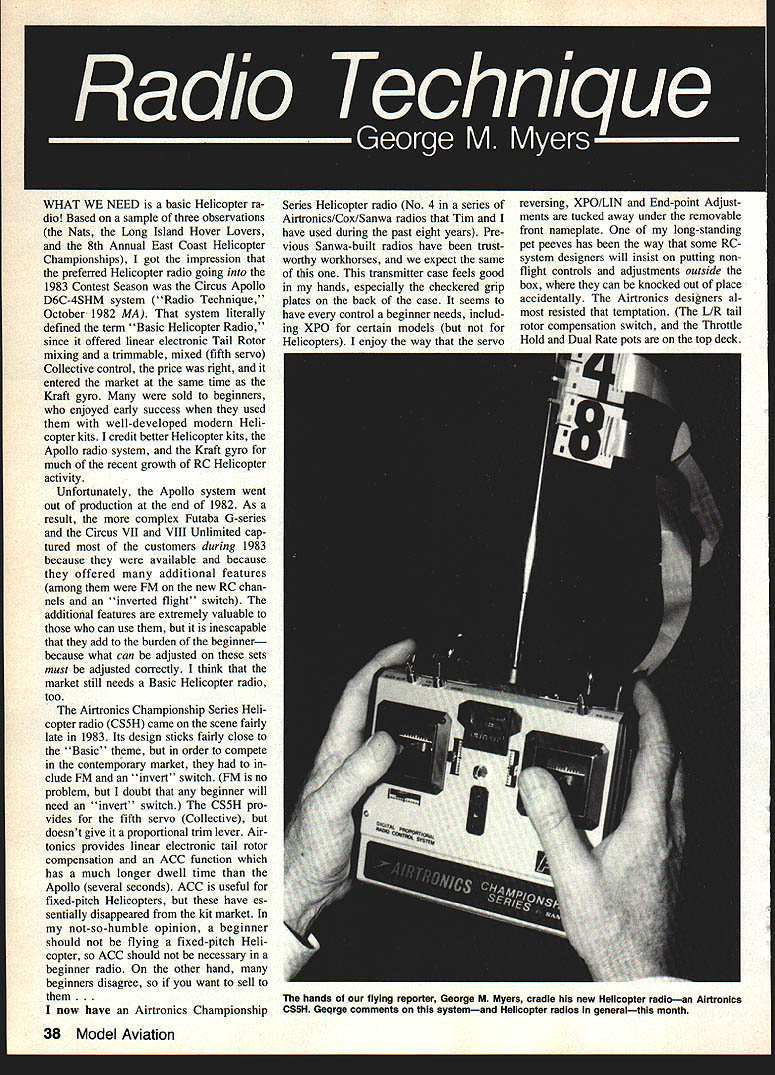
The Airtronics Championship Series Helicopter radio (CS5H) came on the scene fairly late in 1983. Its design sticks fairly close to the "Basic" theme, but in order to compete in the contemporary market, they had to include FM and an "invert" switch. (FM is no problem, but I doubt that any beginner will need an "invert" switch.) The CS5H provides for the fifth servo (collective), but doesn't give it a proportional trim lever. Airtronics provides linear electronic tail-rotor compensation and an ACC function which has a much longer dwell time than the Apollo (several seconds). ACC is useful for fixed-pitch Helicopters, but these have essentially disappeared from the kit market. In my not-so-humble opinion, a beginner should not be flying a fixed-pitch Helicopter, so ACC should not be necessary in a beginner radio. On the other hand, many beginners disagree, so if you want to sell to them...
I now have an Airtronics Championship Series Helicopter radio (No. 4 in a series of Airtronics/Cox/Sanwa radios that Tim and I have used during the past eight years). Previous Sanwa-built radios have been trustworthy workhorses, and we expect the same of this one. This transmitter case feels good in my hands, especially the checkered grip plates on the back of the case. It seems to have every control a beginner needs, including XPO for certain models (but not for Helicopters). I enjoy the way that the servo reversing, XPO/LIN and end-point adjustments are tucked away under the removable front nameplate. One of my long-standing pet peeves has been the way that some RC-system designers will insist on putting nonflight controls and adjustments outside the box, where they can be knocked out of place accidentally. The Airtronics designers also resisted that temptation. The L/R tail-rotor compensation switch, the throttle-hold and dual-rate pots are on the top deck.
The flight controls are placed where I'm accustomed to finding them. I think Helicopter radio has reached the point where control locations should be standardized. Airtronics has arranged and spaced their controls in a manner similar to the Apollo, which suits me fine. I'd prefer to have the throttle-hold and dual-rate pots relocated under the front cover; but they are well guarded, so I really don't mind them where they are. All the special Helicopter controls are reasonably protected by the transmitter's carrying handle, and by the fact that the switches themselves have short handles. I find that everything is easily accessible to me, even though I have smaller hands than some folks. I fly with my thumbs, so I like the fact that stick height is adjustable—and that stiffer springs are available for centering the sticks.
Performance and range
When I tested a prototype of the Airtronics transmitter FM module and receiver about a year ago (using RC50), the performance was beyond any Helicopter need. At one point, I tossed my sailplane into a "ground-range check" glide that took it nearly 1/8 mile away at an altitude of about eight feet all the way. It was one of those lucky "ground effect" glides, and I had perfect control right down to touchdown. So, the transmitter antenna was completely collapsed at the time.
I also put that sailplane nearly out of sight overhead, then flew it under perfect control with the transmitter antenna collapsed to three inches exposed. No interference was encountered from Empire Paging (10 kHz away), and no problems were had with other fliers on the field who were using most of the available RC channels/frequencies. You don't need that kind of sensitivity, but it's nice to know that you've got it.
Antennas and FM sensitivity
I'll tell you a little secret that the manufacturers keep to themselves. With many of these new FM systems, it's possible to fly your Helicopter with the transmitter antenna collapsed to only one section—and with the FM receiver antenna shortened considerably. Precisely which minimum lengths of these antennas can be used is a matter for you to decide (based on tests), because the results will be strongly influenced by the amount of metallic clutter your chopper makes. But the performance is there, if (for instance) you want to hide the receiver antenna inside a scale Helicopter.
The Airtronics system features a plug-in FM module for the transmitter and a plug-in crystal for the receiver, to facilitate RC channel changes (which I like). The transmitter has a front-panel meter that measures RF output (current supplied to the output stages) and also monitors flight-pack battery voltage (using a ground-test cable). If you fly with a gyro and use only one battery pack, that battery-monitoring function is essential.
Ground-test features and DSC/ESV
Two sockets are provided for the ground-test cable (not labeled). The DSC socket gives you a direct-servo-control function. After you've used this a while, you'll wonder how you ever got along without it. The DSC function permits you to tinker with the Helicopter whenever and wherever you like, without turning on the transmitter. Beginners do a lot of tinkering with controls. With DSC, you can adjust controls any time, and for as long as you like, without spoiling TV4 or TV5 for the family at home or interfering with someone's flight (depending on where you are).
The ESV socket measures flight-pack battery voltage under a load of about 280 mA, which is fine for aircraft and for Helicopters using a two-pack system with their gyro installation. If you have your gyro running off a single, large flight battery, then it should be running when you make the test. You make connection by way of the airplane charging jack. (Both the transmitter and receiver must be OFF to make this measurement.)
Channels, servos and gyro installation
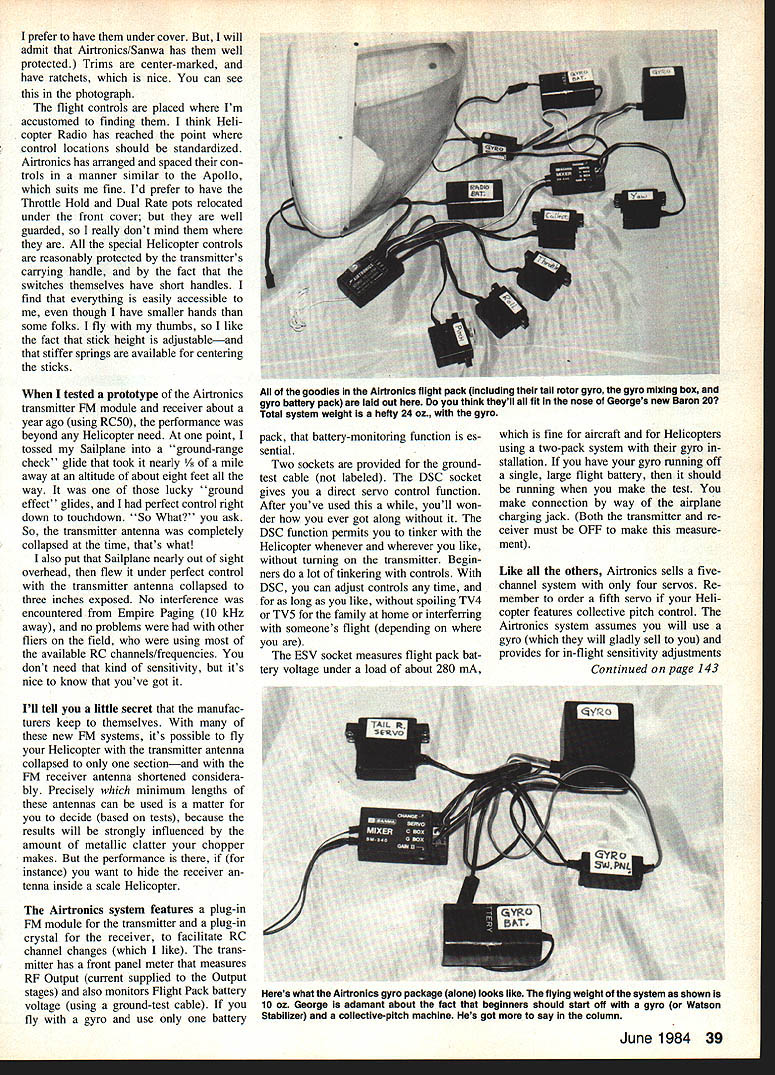
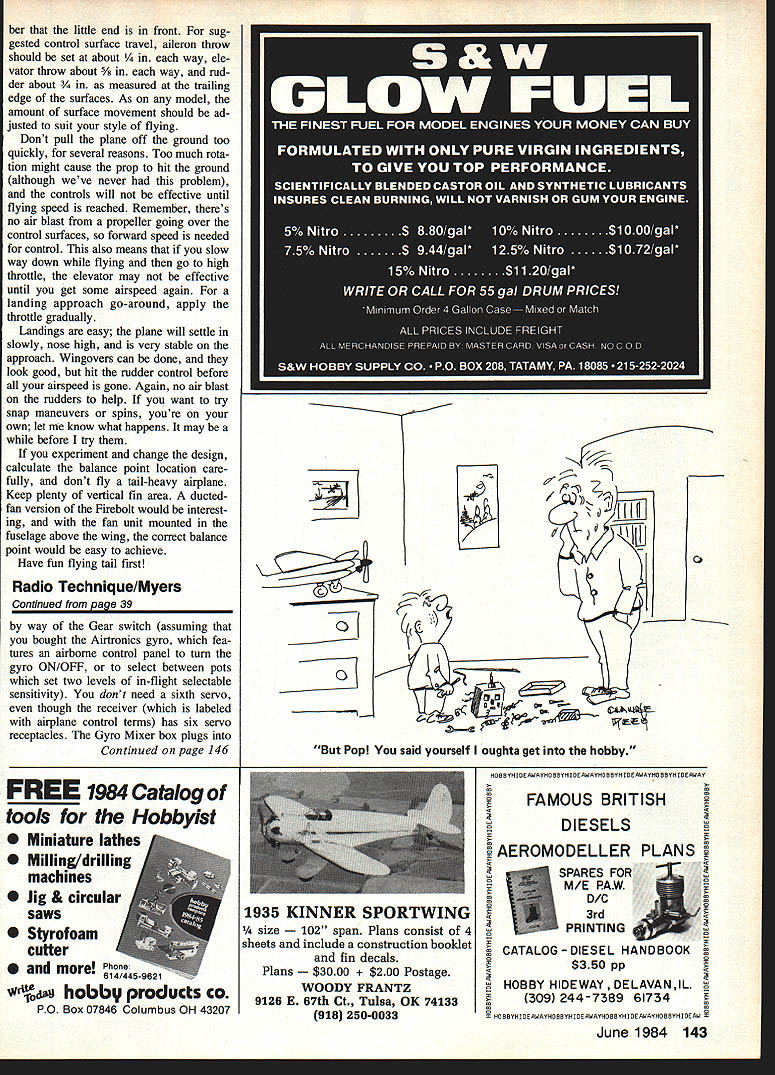
Like all the others, Airtronics sells a five-channel system with only four servos. Remember to order a fifth servo if your Helicopter features collective pitch control. The Airtronics system assumes you will use a gyro (which they will gladly sell to you) and provides for in-flight sensitivity adjustments by way of the gear switch (assuming that you bought the Airtronics gyro, which features an airborne control panel to turn the gyro ON/OFF, or to select between pots which set two levels of in-flight selectable sensitivity). You don't need a sixth servo, even though the receiver (which is labeled with airplane-control terms) has six servo receptacles. The gyro mixer box plugs into two receptacles, RUDDER and AUX, and the collective servo plugs into the GEAR receptacle. It sounds confusing, but you only have to do it once. Read the instruction manual; it is in English! The Airtronics gyro resembles the Circus gyro in its setup and its actions.
My system arrived with 94554 servos, which are zero-slop, ball-bearing, isolated-potentiometer, coreless-motor, high-torque, waterproof servos. Because Helicopters seem to eat servos (I've encountered failures in as little as one hour of service, but seven to ten hours to the first failure is more normal), some folks will argue that a main-bearing, isolated-potentiometer, standard-motor servo is the sensible choice. Such plain servos usually have some degree of gear slop. Experienced chopper pilots will tell you that the tighter, stronger, quicker, and more precise your control system is, the better you will fly. No argument about that. Most Helicopter troubles come from sloppy controls and bad adjustments. So, "You pays your money and you takes your choice!" on this one. You might choose to fly with cheaper servos until you've got everything under control, then put in the expensive servos for advanced training (when you will need the advantages of real precision).
I wish I had a quantitative way to assess good/bad Helicopter servo installations. So far, I use just the rubber appliances that come with the servo, then screw them down with the supplied screws into the output-shaft disc. If you've proven that there's a better way, I'd really like to hear about it. I believe (but can't prove) that pushrods should be as short and stiff as possible, and that the ball joints should fit into all bellcranks, servo wheels, etc. with as snug a fit as possible. From a vibration standpoint, an arrowshaft pushrod should be better than a bicycle spoke, but I use a lot of spokes just because I'm as lazy as the next guy.
Why I sought another radio
The main reason for my seeking another radio was my desire to try inverted flying with a Wankel-powered Baron 20. Sure, I could easily put an "invert" switch in the Apollo, but I'm obeying the wise, old sage who once said, "Don't mess around with a working system." Last year's OS .28H / Apollo / Kraft gyro / SR900 pack / ACE Silver Seven / KPS-24-equipped Baron 20 with the camera on its back is doing just fine, so I'm leaving it alone.
I've long had the idea that the Wankel could be a natural for the Baron 20. The way the installation works out, the carburetor and crankcase pressure fittings fall right on the Baron's fuel tank centerline, which should be ideal for all kinds of flying. The Wankel offers a better power/weight ratio than the reciprocating .28, less vibration, and it runs smoother, which I thought might make it spin the main rotor faster (I never have attained the 1,300 to 1,500 rpm which the manual says is correct for this machine). Spinning the main rotor faster might permit flight at a smaller main-rotor pitch angle. If so, reversing the pitch for inverted flying should require less rework, right?
So what happened? Tune in next month to find out.
George M. Myers 70 Froehlich Farm Rd. Hicksville, NY 11801
Transcribed from original scans by AI. Minor OCR errors may remain.

