
Radio Technique
George M. Myers
BUILD ME. I'll bet that the worst RFI (radio‑frequency interference) comes from the source you consider least. Letters I've received, and conversations I've had with other modelers, lead me to suggest that the most devastating interference comes from transmitters left turned ON when they should be turned OFF. If that is true, then what every impound operator really needs is a simple, reliable tool for discovering such oversights.
Enter John Lange, AMA's DFC (District Frequency Coordinator)-at-large, bearing his "RF Wand," a copy of which he has donated to the AMA along with permission to publish the following description and instructions. Its value and use were demonstrated at the LSF tournament and at the FAI Sailplane trials in the summer of 1983, where John used it to catch a few mistakes and to show that a man who was crying "interference" actually was suffering the effects of his own loose transmitter antenna! (When John had the man shake his transmitter, both of them could hear his signal cutting in and out.)
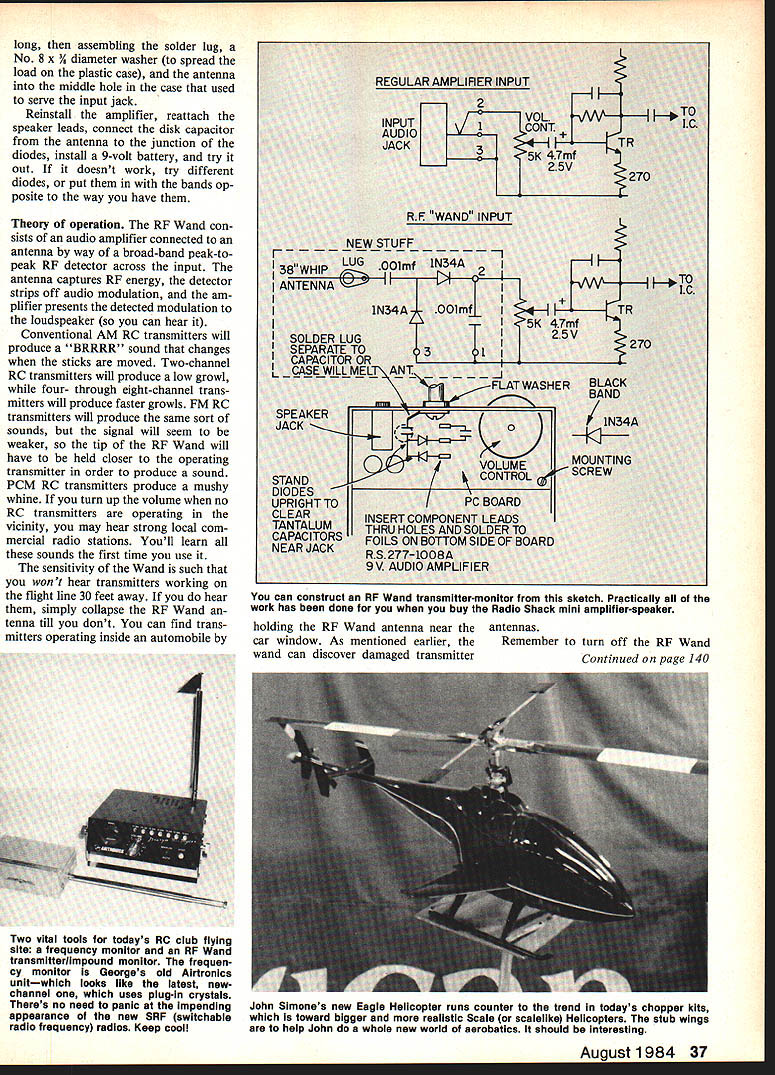
The RF Wand can be waved over the impounded transmitters (AM, FM, or PCM). If something is left on, a "BR‑RRR" sound comes from the wand. No tuning is needed, and no sound comes from the RF Wand unless a transmitter is operating in the vicinity. Checking transmitters into an impound area becomes simple, a bit like an airport "frisk" operation. Overall sensitivity is such that transmitters on the flight line won't be heard. If they are heard, you simply collapse the RF Wand antenna a little, until you don't hear them. As a practical matter, you can do most RF Wand activities with its antenna completely collapsed, reserving the extended antenna for special cases.
What more can you ask? Oh, you want it to be cheap! How does "under $20" strike you?
Any person who knows which end of the soldering iron to grab should be able to build one of these in less than an hour. Here are John's instructions.
Materials for RF Wand
Buy the following at your local Radio Shack store:
- Part No. 277‑1008A Mini Amplifier‑Speaker (in case) — 1
- Part No. 15‑232 38" Replacement TV Antenna — 1
- Part No. 276‑1123 1N34A Diodes — 2
- Part No. 272‑126 .001 µF Ceramic Disk Capacitors — 2
Construction
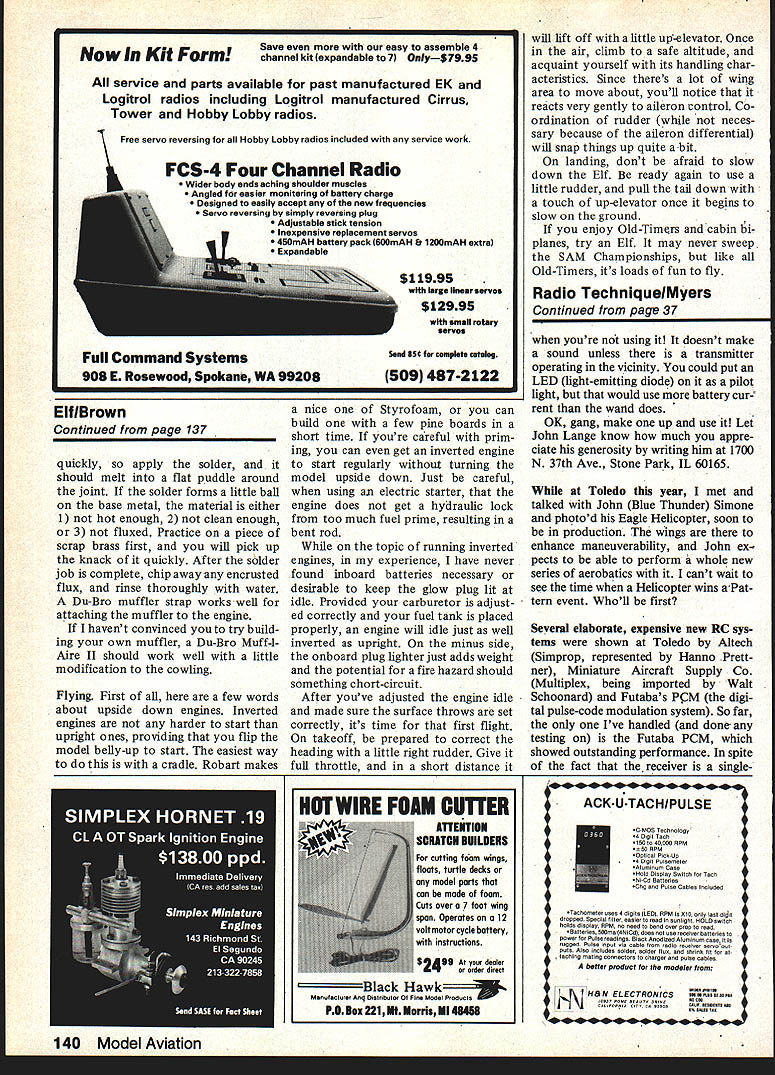
- Open the amplifier case (it snaps together), and remove the amplifier board by unsoldering the speaker leads, and unscrewing the knurled ring nuts on the input and output jacks and one mounting screw on the board.
- Remove the input jack (the one in the middle of the board) using a soldering iron and solder wick. Remove the solder lug from the antenna and solder on a .001 disk capacitor (see sketch).
- Install two diodes and one .001 disk capacitor on the amplifier board as shown in the sketch.
- Mount the antenna by retapping its base for a Binder Head No. 8 screw and a 1/2‑in. diameter washer to spread the load on the plastic case.
- Reinstall the amplifier, reattach the speaker leads, and connect the disk capacitor to the antenna junction.
- Install a 9‑volt battery and try it out. If it doesn't work, try the diodes the other way around.
Theory of operation
The RF Wand consists of an audio amplifier connected to an antenna with a broad‑band peak‑to‑peak RF detector across the input. The antenna captures RF energy; the detector strips off the audio modulation; the amplifier presents the detected modulation to the loudspeaker so you can hear it.
Conventional AM RC transmitters will produce a "BR‑RRR" sound which changes when sticks are moved. Two‑channel RC transmitters will produce a low growl; four‑ through eight‑channel transmitters will produce faster growls. FM RC transmitters will produce the same sort of sounds, but the signal will seem weaker. The RF Wand will have to be held closer to an operating transmitter in order to produce sound. PCM RC transmitters produce a mushy whine. If you turn up the volume and no RC transmitters are operating in the vicinity, you may hear strong local commercial radio stations. You'll learn the sounds the first time you use the unit.
Sensitivity of the Wand is such that you won't hear transmitters working on the flight line 30 feet away. If you do hear them, simply collapse the RF Wand antenna until you don't. You can find transmitters operating inside an automobile by holding the RF Wand antenna near the car window. As mentioned earlier, the wand can discover damaged transmitter antennas.
Remember to turn off the RF Wand when impounding transmitters or when you're not using it! It doesn't make a sound unless there is a transmitter operating in the vicinity. You could put an LED (light‑emitting diode) on it as a pilot light, but that would use more battery current than the wand does.
You can construct an RF Wand transmitter‑monitor from this sketch. Practically all of the work has been done for you when you buy the Radio Shack mini amplifier‑speaker.
OK, gang, make one up and use it! Let John Lange know how much you appreciate his generosity by writing him at: 1700 N. 37th Ave., Stone Park, IL 60165.
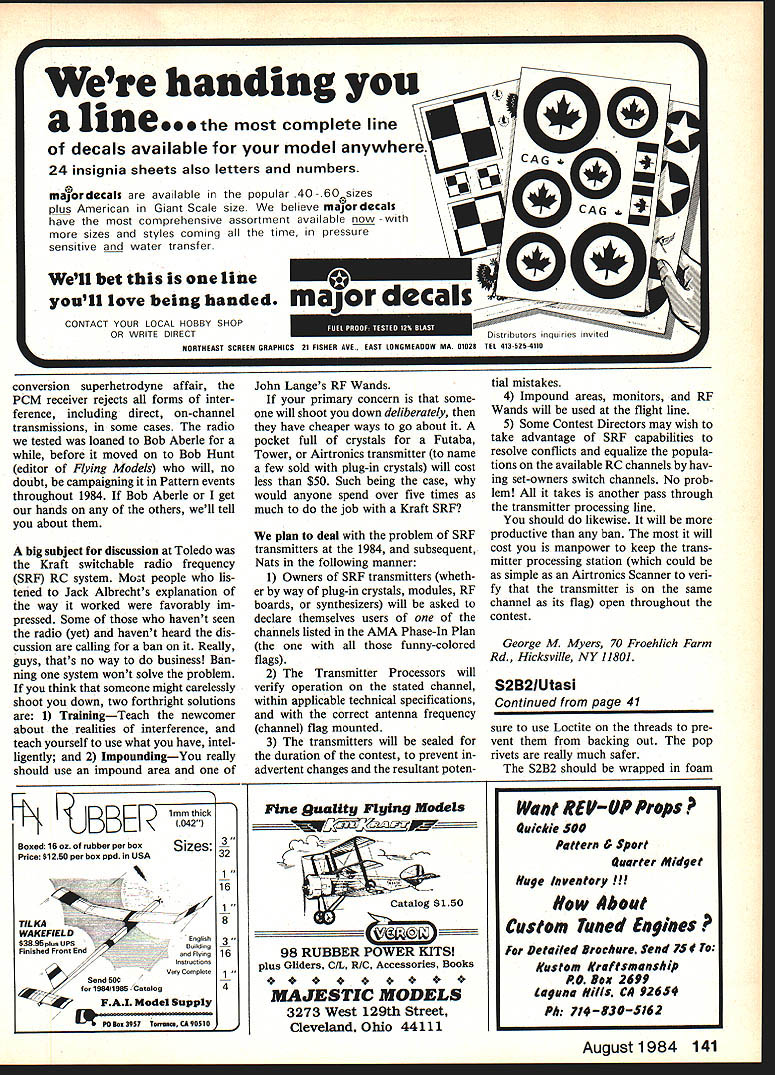
While at Toledo this year, I met and talked with John (Blue Thunder) Simone and photographed his Eagle Helicopter, soon to be in production. The wings are there to enhance maneuverability, and John expects to be able to perform a whole new series of aerobatics with it. I can't wait to see the time when a helicopter wins a Pattern event. Who'll be first?
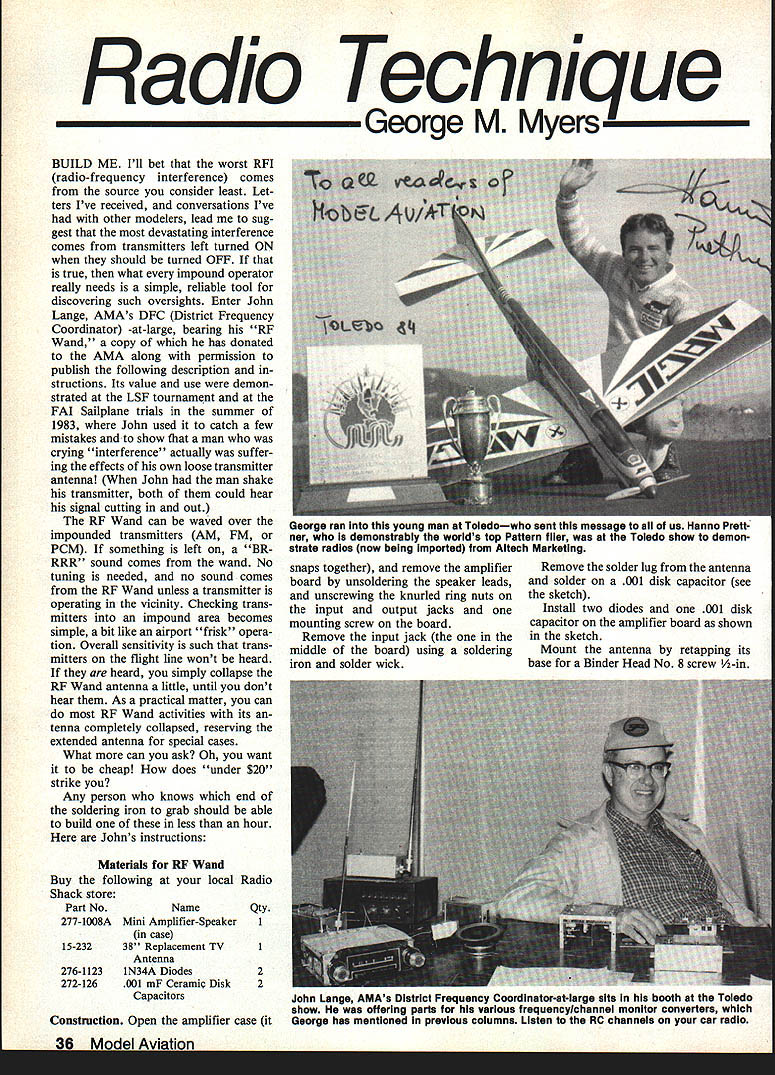
Several elaborate, expensive new RC systems were shown at Toledo by Altech (Simprop, represented by Hanno Prettner), Miniature Aircraft Supply Co. (Multiplex, being imported by Walt Schoonard) and Futaba's PCM (the digital pulse‑code modulation system). So far, the only one I've handled (and done any testing on) is the Futaba PCM, which showed outstanding performance. In spite of the fact that the receiver is a single‑conversion superheterodyne affair, the PCM receiver rejects all forms of interference, including direct, on‑channel transmissions, in some cases. The radio we tested was loaned to Bob Aberle for a while, before it moved on to Bob Hunt (editor of Flying Models) who will, no doubt, be campaigning it in Pattern events throughout 1984. If Bob Aberle or I get our hands on any of the others, we'll tell you about them.
A big subject for discussion at Toledo was the Kraft switchable radio frequency (SRF) RC system. Most people who listened to Jack Alberche's explanation of the way it worked were favorably impressed. Some of those who haven't seen the radio (yet) and haven't heard the discussion are calling for a ban on it. Really, guys, that's no way to do business! Banning one system won't solve the problem. If you think that someone might carelessly shoot you down, two forthright solutions are:
- Training — Teach the newcomer about the realities of interference, and teach yourself to use what you have, intelligently.
- Impounding — You really should use an impound area and one of John Lange's RF Wands.
If your primary concern is that someone will shoot you down deliberately, then they have cheaper ways to go about it. A pocket full of crystals for a Futaba, Tower, or Airtronics transmitter (to name a few sold with plug‑in crystals) will cost less than $50. Such being the case, why would anyone spend over five times as much to do the job with a Kraft SRF?
We plan to deal with the problem of SRF transmitters at the 1984, and subsequent, Nats in the following manner:
- Owners of SRF transmitters (whether by way of plug‑in crystals, modules, RF boards, or synthesizers) will be asked to declare themselves users of one of the channels listed in the AMA Phase‑In Plan (the one with all those funny‑colored flags).
- The Transmitter Processors will verify operation on the stated channel, with applicable technical specifications, and with the correct antenna frequency (channel) flag mounted.
- The transmitters will be sealed for the duration of the contest, to prevent inadvertent changes and the resultant potential mistakes.
- Impound areas, monitors, and RF Wands will be used at the flight line.
- Some Contest Directors may wish to take advantage of SRF capabilities to resolve conflicts and equalize the populations on the available RC channels by having set‑owners switch channels. No problem! All it takes is another pass through the transmitter processing line.
You should do likewise. It will be more productive than any ban. The most it will cost you is manpower to keep the transmitter processing station (which could be as simple as an Airtronics Scanner to verify that the transmitter is on the same channel as its flag) open throughout the contest.
George M. Myers 70 Froehlich Farm Rd., Hicksville, NY 11801.
Transcribed from original scans by AI. Minor OCR errors may remain.

