
Radio Technique
George M. Myers
SRF. SRF. Study those letters—you'll be hearing a lot about them in the future! They stand for Switchable Radio Frequency. This month, I'm going to address the subject: What about Kraft's synthesized RF system?
Who needs a synthesized RF generator? Mainly, the RC manufacturers need it, to keep prices down. The synthesizer uses one universal crystal and a simple computer to replace 160 unique crystals (80 for transmitters, 80 for receivers). Soon, everyone will be making SRF radios. Look at the economics.
Right now, you can buy a pair of Kraft SRF transmitter and receiver modules (which tune 50 RC channels) for $120 over the price of the receiver alone (and you can bet that price will go down when other manufacturers start producing synthesizers). Compare that price to the equivalent price of 79 extra sets of modules for a modular radio (at least $2,800), or 79 sets of RF decks with the necessary plugs and receiver crystals (at least $2,000), or just the cost of 79 pairs of plug-in crystals ($800). Then figure out where you'll find the space needed to store them. (Editor's note: In 1991, there will be 50 "aircraft-only" RC channels and 30 non-aircraft channels available—a total of 80 channels. Since an RC system would normally come with crystals/modules for one channel, you'd need 79 more crystals/modules to get all 80 channels. RMcM.)
The Kraft SRF module looks big, sticking up out of your transmitter, until you compare it with the size of 50 crystals and a switch to access them. Next, it will get smaller and go inside the transmitter.
Sure, you (as an individual) can get by with only one RC channel, but the economics described above must be supported by stocks on your dealer's shelves—and by your manufacturer's inventory. That ties up money, and money costs money, too! The closer we get to 1991 and those 80 channels, the more that economic pressure will push our manufacturers toward use of the synthesizer. Watch and see.
Testing RC equipment
Recently, Bob Aberle and 48 other people around the United States (including me) received prototype Kraft synthesized-RF transmitter modules and receivers for test and evaluation. What we actually received were test tools that no reviewer can do without from this time forward, if his or her equipment reviews are to be taken seriously. At the same time, we accepted the responsibility to do comprehensive testing of the SRF equipment and to report the results honestly.
There may be a few readers who know that Bob Aberle and I cooperate, from time to time, in testing new radio systems. Our approach emphasizes use of equipment available to the average weekend flier, on the assumption that anyone who wants to duplicate our tests should be able to do so, as long as he or she is willing to do a little work and (sometimes) buy a little inexpensive test equipment. When we need more sophisticated test equipment, we depend on Dan Kahn (who has a bunch of expensive HP equipment). You won't need any of that.
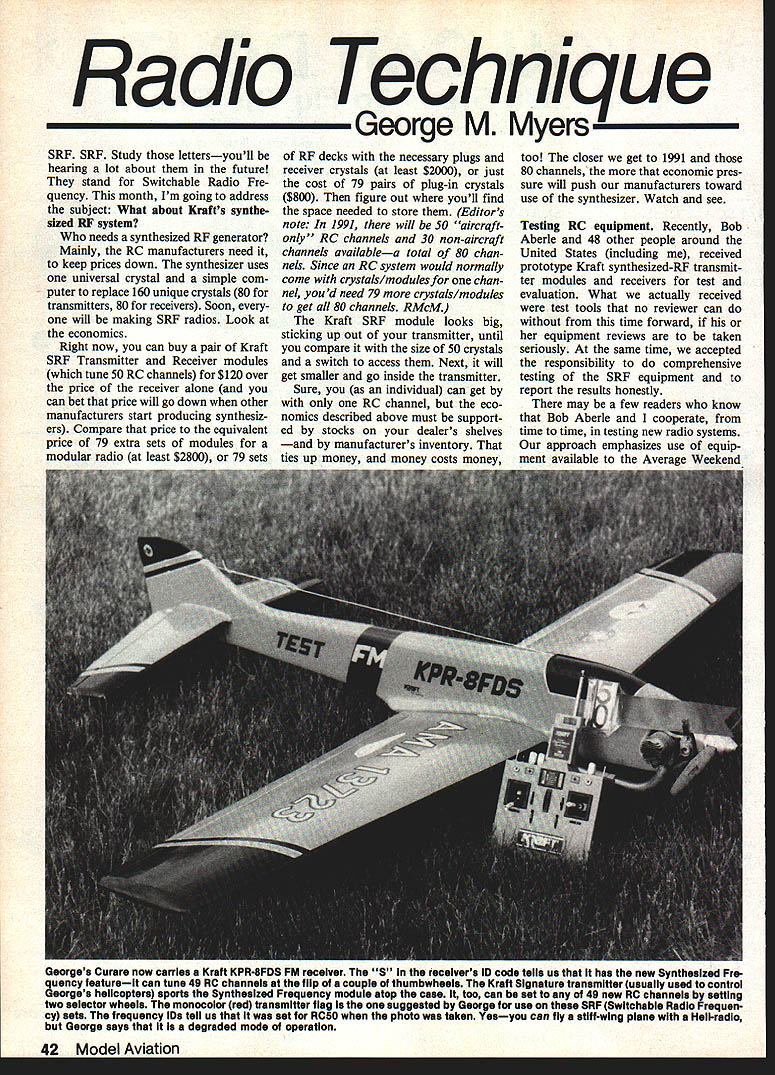
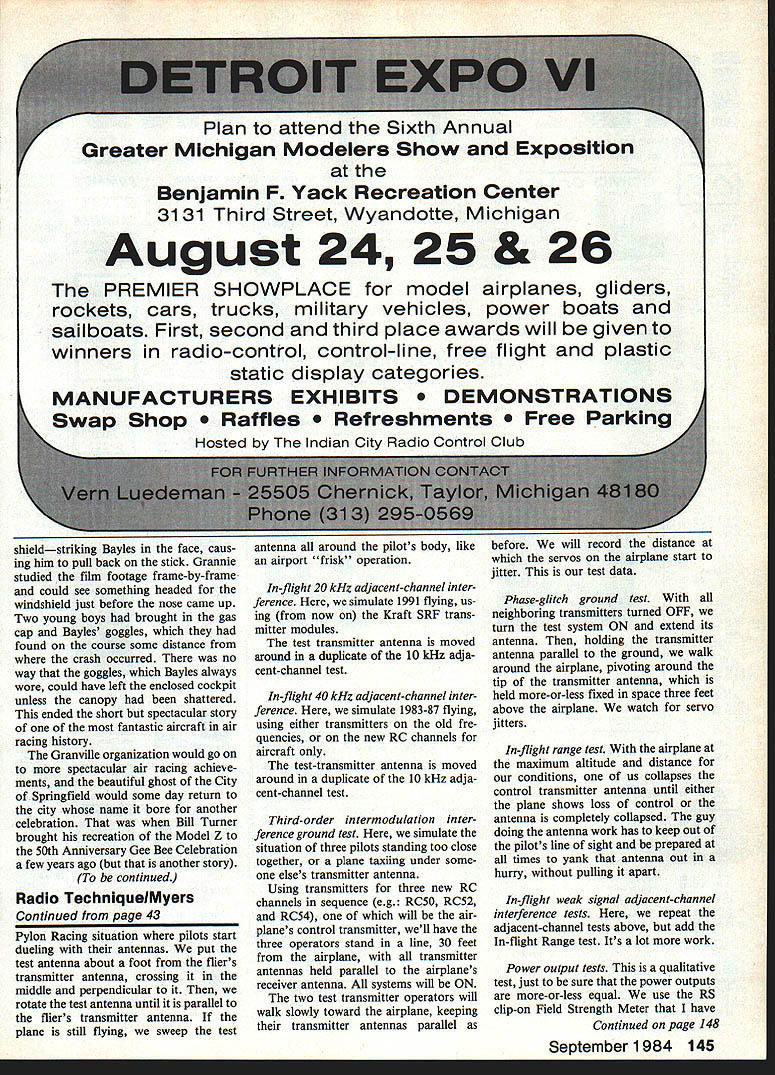
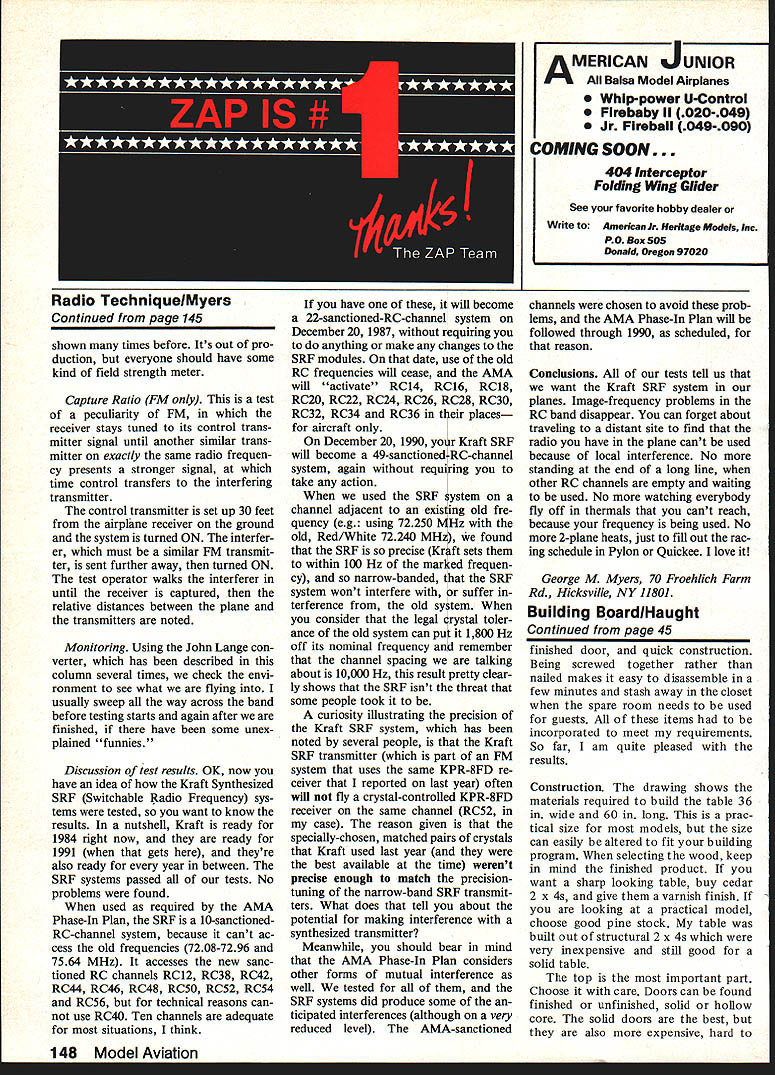
The typical gear we used includes the Kraft KPR-8FDS FM receiver. The "S" in the receiver's ID code tells us that it has the new Synthesized Frequency feature — it can tune 49 RC channels at the flip of a couple of thumbwheels. The Kraft Signature transmitter (usually used to control my helicopters) sports the Synthesized Frequency module atop the case. It, too, can be set to any of 49 new RC channels by setting two selector wheels. The mono-color (red) transmitter flag is the one suggested for use on these SRF (Switchable Radio Frequency) sets. The frequency IDs tell us that it was set for RC50 when the photo was taken. Yes—you can fly a stiff-wing plane with a heli-radio, but it is a degraded mode of operation.
Nobody asked for the information, but here are the tests we usually perform, with explanations of why and how we do them. Some of the tests are our inventions, others were given to us by people who know more about radio systems than we do. The tests are not listed in proper sequence.
In-flight direct interference test
Here, we simulate the "careless modeler" everybody worries about, in what we believe represents a normal set of field conditions.
One of us flies the test plane around at 50 to 100 feet altitude, while the other one (keeping his eyes on the plane and his finger on the transmitter switch at all times) turns ON a transmitter on the same channel. At the first sign of trouble, the interference is turned OFF. You have to trust one another to do things like this. We do.
We try to assemble enough transmitters so we can test:
- AM vs AM
- AM vs FM
- AM vs PCM
- FM vs PCM
- FM vs FM
That requires a lot of borrowing. Bob has some special test modules for his Kraft Signature transmitter, and I have some special test RF decks for my Ace RC Silver Seven. Between us, we are able to assemble or borrow enough AM and FM transmitters on the necessary channels to get the work done. Since neither of us has a Futaba PCM, that test is a sometime thing. The point is: we get this stuff done with a lot of help from our friends.
In-flight 10 kHz adjacent-channel interference test
Here, we simulate the interference that can appear on the new RC channels when someone uses a "Canadian" set of crystals, or when someone tries to fly too close to a Common Carrier antenna field (within a mile or so). We also simulate interference that will occur when some cheapskate decides to continue using his old crystals beyond the FCC-mandated cutoff date.
Our test-equipment operator stands about 30 feet away at first, then moves up alongside the flier to simulate the Pylon Racing situation where pilots start dueling with their antennas. We put the test antenna about a foot from the flier's transmitter antenna, crossing it in the middle and perpendicular to it. Then we rotate the test antenna until it is parallel to the flier's transmitter antenna. If the plane is still flying, we sweep the test antenna all around the pilot's body, like an airport "frisk" operation.
In-flight 20 kHz adjacent-channel interference
Here, we simulate 1991 flying, using (from now on) the Kraft SRF transmitter modules.
The test-transmitter antenna is moved around in a duplicate of the 10 kHz adjacent-channel test.
In-flight 40 kHz adjacent-channel interference
Here, we simulate 1983–87 flying, using either transmitters on the old frequencies, or on the new RC channels for aircraft only.
Third-order intermodulation interference ground test
Here, we simulate the situation of three pilots standing too close together, or a plane taxiing under someone else's transmitter antenna.
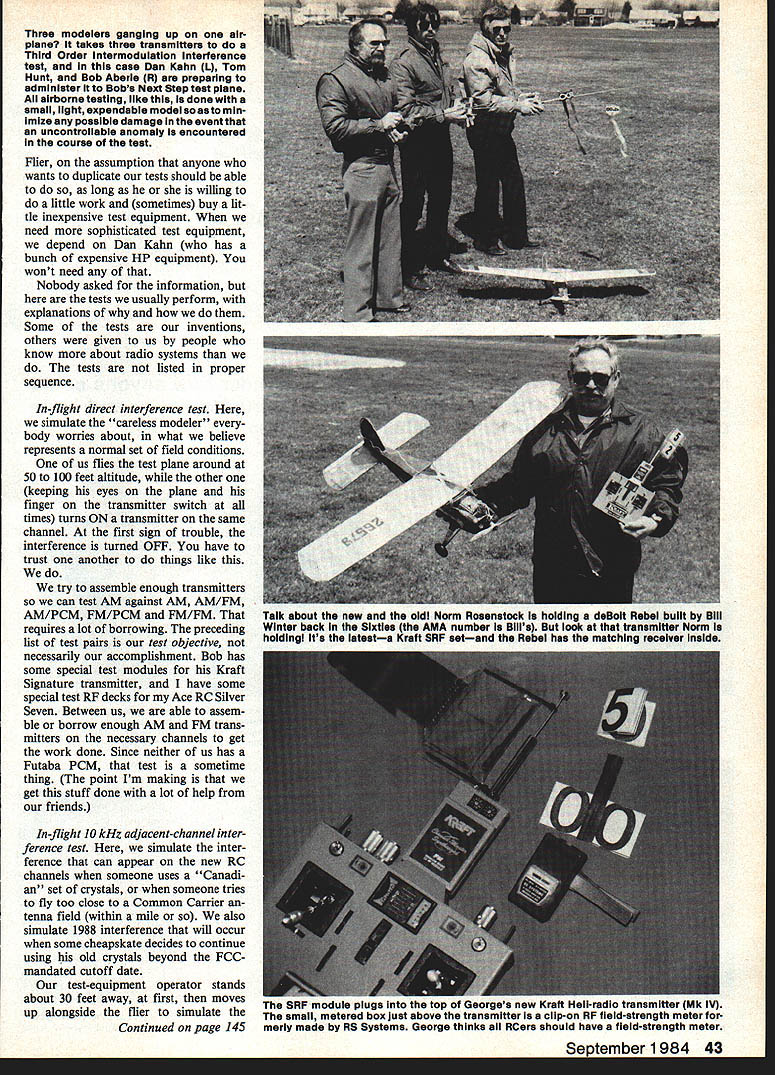
Using transmitters for the new RC channels in sequence (e.g., RC50, RC52, and RC54), one of which will be the airplane's control transmitter, while the other two operators stand in a line, 30 feet from the airplane, with all transmitter antennas held parallel to the airplane's receiver antenna. All systems will be ON.
The two test-transmitter operators will walk slowly toward the airplane, keeping their transmitter antennas parallel as before. We record the distance at which the servos on the airplane start to jitter. This is our test data.
Phase-glitch ground test
With all neighboring transmitters turned OFF, we turn the test system ON and extend its antenna. Then, holding the transmitter antenna parallel to the ground, we walk around the airplane, pivoting around the tip of the transmitter antenna, which is held more-or-less fixed in space three feet above the airplane. We watch for servo jitters.
In-flight range test
With the airplane at the maximum altitude and distance for our conditions, one of us collapses the control transmitter antenna until either the plane shows loss of control or the antenna is completely collapsed. The guy doing the antenna work has to keep out of the pilot's line of sight and be prepared at all times to yank that antenna out in a hurry, without pulling it apart.
In-flight weak-signal adjacent-channel interference tests
Here, we repeat the adjacent-channel tests above, but add the In-flight Range test. It's a lot more work.
Power output tests
This is a qualitative check, just to be sure that the power outputs are more-or-less equal. We use the RS clip-on Field Strength Meter that I have shown many times before. It's out of production, but everyone should have some kind of field strength meter.
Capture Ratio (FM only)
This is a test of a peculiarity of FM in which the receiver stays tuned to its control-transmitter signal until another similar transmitter on exactly the same radio frequency presents a stronger signal; at that time control transfers to the interfering transmitter.
The control transmitter is set up 30 feet from the airplane receiver on the ground and the system is turned ON. The interferer, which must be a similar FM transmitter, is sent further away, then turned ON. The test operator walks the interferer in until the receiver is captured, then the relative distances between the plane and the transmitters are noted.
Monitoring
Using the John Lange converter, which has been described in this column several times, we check the environment to see what we are flying into. I usually sweep all the way across the band before testing starts and again after we are finished, if there have been some unexplained "funnies."
Discussion of test results
OK, now you have an idea of how the Kraft Synthesized SRF (Switchable Radio Frequency) systems were tested, so you want to know the results. In a nutshell, Kraft is ready for 1984 right now, and they are ready for 1991 (when that gets here), and they're also ready for every year in between. The SRF systems passed all of our tests. No problems were found.
When used as required by the AMA Phase-In Plan, the SRF is a 10-sanctioned RC-channel system, because it can't access the old frequencies (72.08–72.96 and 75.64 MHz). It accesses the new sanctioned RC channels RC12, RC38, RC42, RC44, RC46, RC48, RC50, RC52, RC54 and RC56, but for technical reasons cannot use RC40. Ten channels are adequate for most situations, I think.
If you have one of these, it will become a 22-sanctioned-RC-channel system on December 20, 1987, without requiring you to do anything or make any changes to the SRF modules. On that date, use of the old RC frequencies will cease, and the AMA will "activate" RC14, RC16, RC18, RC20, RC22, RC24, RC26, RC28, RC30, RC32, RC34 and RC36 in their place—for aircraft only.
On December 20, 1990, your Kraft SRF will become a 49-sanctioned-RC-channel system, again without requiring you to take any action.
When we used the SRF system on a channel adjacent to an existing old frequency (e.g., using 72.250 MHz with the old, red/white 72.240 MHz), we found that the SRF is so precise (Kraft sets them to within 100 Hz of the marked frequency), and so narrow-banded, that the SRF system won't interfere with, or suffer interference from, the old system. When you consider that the legal crystal tolerance of the old system can put it 1,800 Hz off its nominal frequency and remember that the channel spacing we are talking about is 10,000 Hz, this result pretty clearly shows that the SRF isn't the threat that some people took it to be.
A curiosity illustrating the precision of the Kraft SRF system, which has been noted by several people, is that the Kraft SRF transmitter (which is part of an FM system that uses the same KPR-8FD receiver that I reported on last year) often will not fly a crystal-controlled KPR-8FD receiver on the same channel (RC32, in my case). The reason given is that the specially chosen, matched pairs of crystals that Kraft used last year (and they were the best available at the time) weren't precise enough to match the precision-tuning of the narrow-band SRF transmitters. What does that tell you about the potential for making interference with a synthesized transmitter?
Meanwhile, you should bear in mind that the AMA Phase-In Plan considers other forms of mutual interference as well. We tested for all of them, and the SRF systems did produce some of the anticipated interferences (although on a very reduced level). The AMA-sanctioned channels were chosen to avoid these problems, and the AMA Phase-In Plan will be followed through 1990, as scheduled, for that reason.
Conclusions
All of our tests tell us that we want the Kraft SRF system in our planes. Image-frequency problems in the RC band disappear. You can forget about traveling to a distant site to find that the radio you have in the plane can't be used because of local interference. No more standing at the end of a long line, when other RC channels are empty and waiting to be used. Nor more watching everybody fly off in thermals that you can't reach, because your frequency is being used. No more 2-plane heats, just to fill out the racing schedule in Pylon or Quickie. I love it!
George M. Myers 70 Froehlich Farm Rd. Hicksville, NY 11801
Transcribed from original scans by AI. Minor OCR errors may remain.

