
Radio Technique
George M. Myers
I want to report a new, top-of-the-line transmitter. I'm going to kill two birds with one stone, too, because I'll also comment on its features as a helicopter radio while looking at its tuneable-frequency feature.
The Kraft Mk IV Helicopter Radio
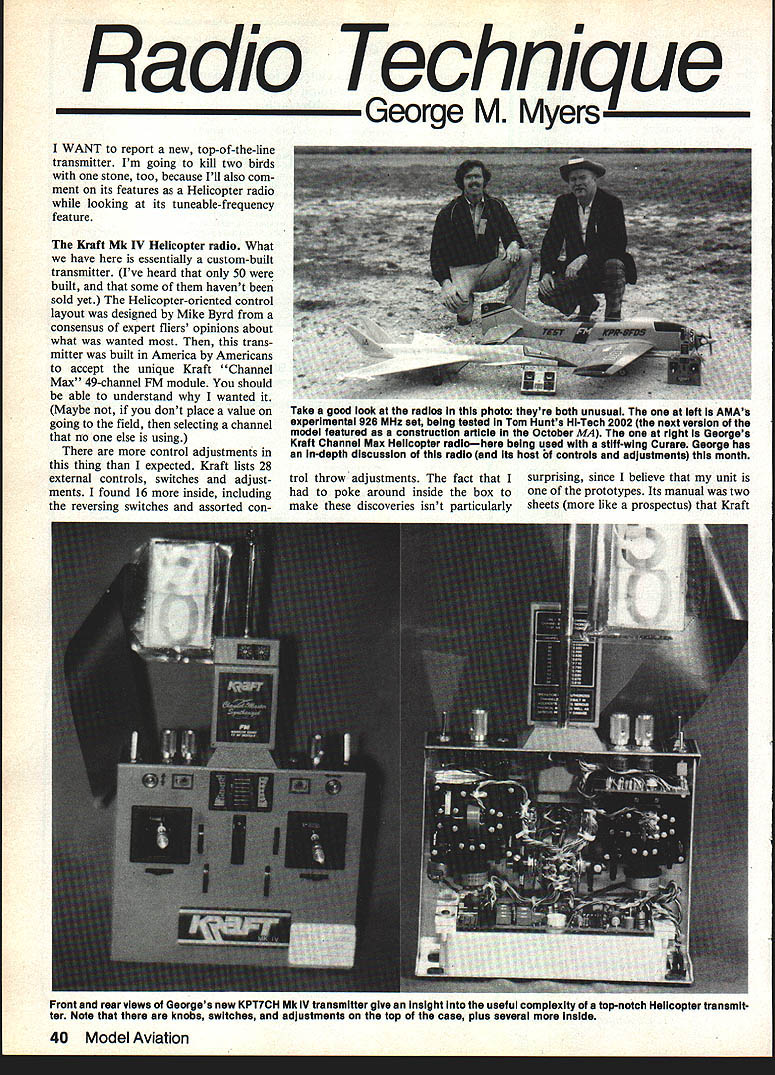
The Kraft Mk IV Helicopter radio is essentially a custom-built transmitter. (I've heard that only 50 were built, and that some of them haven't been sold yet.) The helicopter-oriented control layout was designed by Mike Byrd from a consensus of expert fliers' opinions about what was wanted most. Then, this transmitter was built in America by Americans to accept the unique Kraft "Channel Max" 49-channel FM module. You should be able to understand why I wanted it (maybe not, if you don't place a value on going to the field and then selecting a channel that no one else is using).
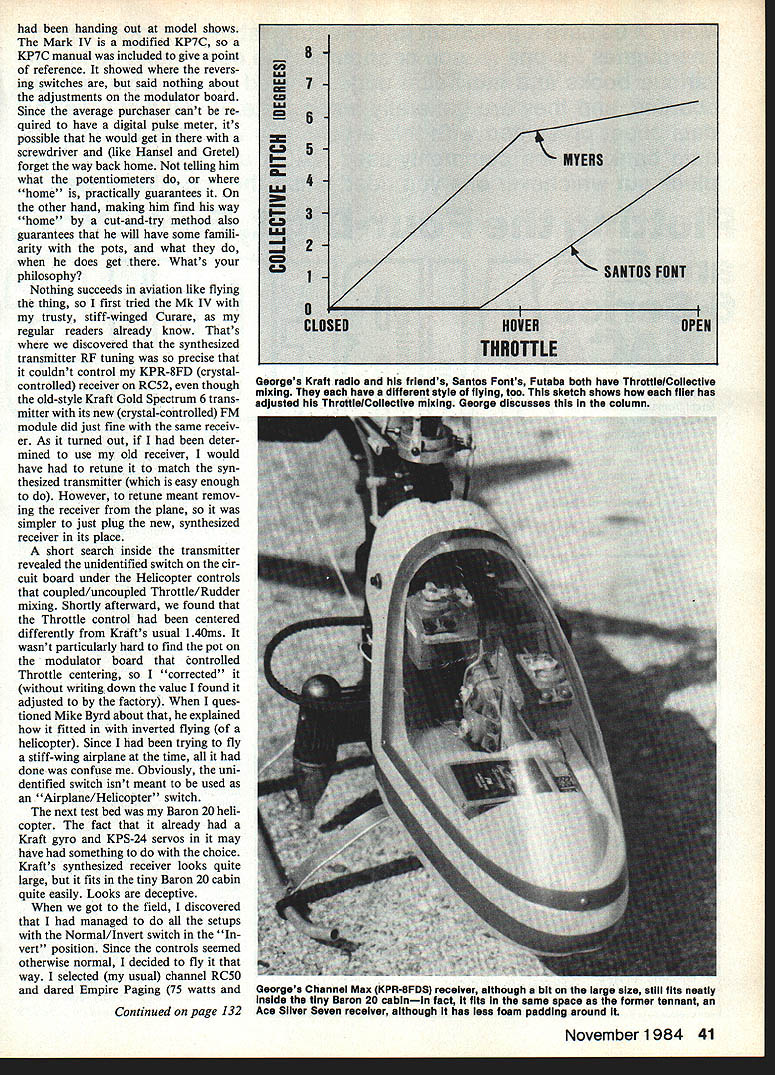
Kraft lists 28 external controls, switches and adjustments. I found 16 more inside, including the reversing switches and assorted control-throw adjustments. The fact that I had to poke around inside the box to make these discoveries isn't particularly surprising, since I believe my unit is one of the prototypes. Its manual was two sheets (more like a prospectus) that showed the reversing switches but said nothing about adjustments on the modulator board. Since the average purchaser can't be expected to have a digital pulse meter, it's possible he would get a screwdriver like Hansel and Gretel and forget his way back home. Telling him what potentiometers do practically guarantees, on the other hand, that making him find his way home by cut-and-try will at least give him some familiarity with the pots.
First Field Tests and Tuning
What does he get? What's the philosophy? Nothing succeeds aviation like flying things, so first I tried the Mk IV with my trusty stiff-winged Curare. Regular readers already know that's the aircraft I use to discover synthesized transmitter/receiver RF tuning precision. I couldn't control the KPR-8FD crystal-controlled receiver in the RC52, though the old-style Kraft Gold Spectrum 6 transmitter's new crystal-controlled FM module did just fine with the same receiver. As it turned out, determined use of the old receiver would have required a retune to match the synthesized transmitter, which would have been easy enough. However, retuning meant removing the receiver from the plane; simpler was to just plug a new synthesized receiver in its place.
A short search inside the transmitter revealed an unidentified switch and a circuit board under the helicopter controls labeled "coupled/uncoupled Throttle/Rudder mixing." Shortly afterward I found the Throttle control centered differently from Kraft's usual 140 ms. It wasn't particularly hard to find the pot on the modulator board that controlled throttle centering, correct it, write down the value and have it adjusted at the factory. I questioned Mike Byrd about this; he explained it was fitted for inverted flying helicopters. Since trying to fly a stiff-wing airplane inverted is something I try not to do, this could confuse.
Testing on the Baron 20
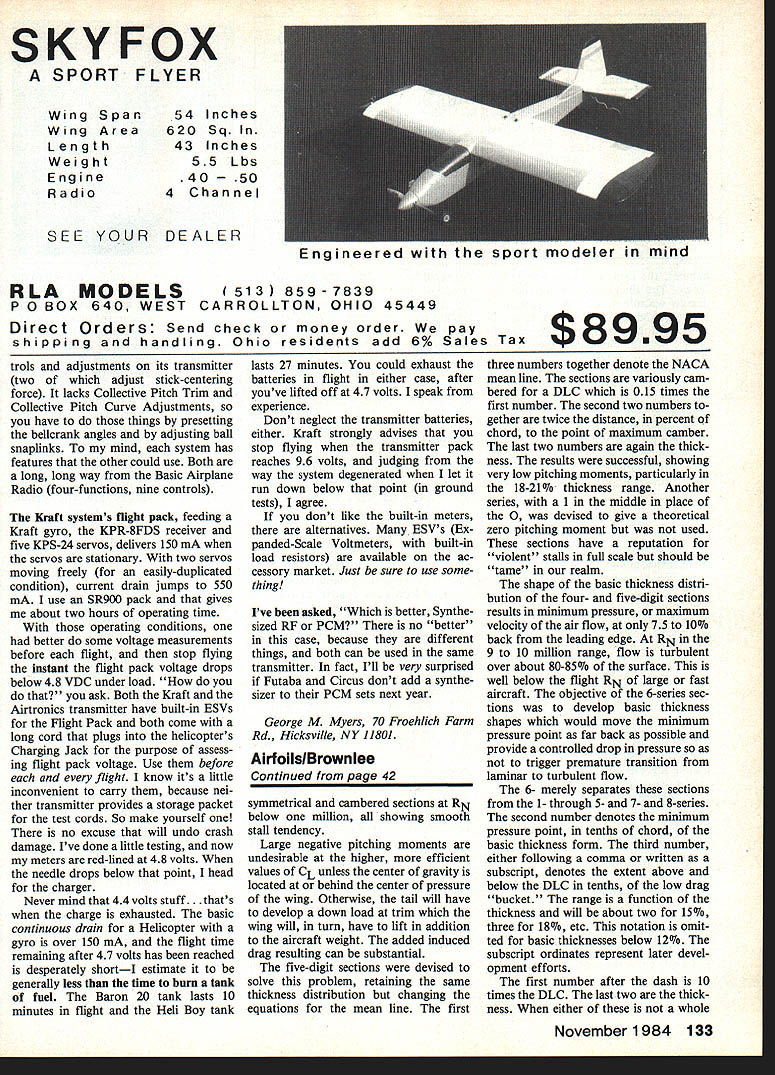
Obviously the unidentified switch isn't meant to be used as an Airplane/Helicopter switch. The next test bed was the Baron 20 helicopter; in fact, the Baron already had Kraft gyro KPS-24 servos, which may have had something to do with the choice. Kraft's synthesized receiver looks quite large but fits the tiny Baron 20 cabin quite easily. It looks deceptive until you get it in the field and discover how the setups are managed.
The Normal/Invert switch was in the "vert" (vertical) position. Since controls seemed otherwise normal, I decided to fly it on the usual channel RC50 and dared Empire Paging (75 watts and only 12 miles and 10 kHz away) to interfere. It didn't, even when I flew with the transmitter antenna totally collapsed (but not unscrewed).
A test hop showed that the machine was flyable, so I offered it to one of my friends, Santos Font, to fly. Santos was very cautious, and while checking the machine out he complained about insufficient "forward stick." I could see that Santos had moved the elevator trim to full forward and, when a couple of quick adjustments to the snaplinks failed to satisfy him, I took the machine back to the tailgate of my Ford for further investigation. That's when we discovered that the elevator trim worked opposite to the stick.
Further investigation revealed:
- Rudder, Rudder Trim, Collective, and Elevator could be reversed by the Invert switch.
- Elevator Trim and Collective Trim were not reversed by the Invert switch.
File that away in the memory banks for a change notice.
Setup Procedure and Pilot Preferences
I had followed my standard setup procedure for the Baron 20 and had:
- blocked the teeter arm and swash plate perpendicular to the main rotor mast,
- set up all the links so things were parallel or perpendicular to one another as appropriate when the servos were energized by the transmitter,
- centered both sticks in Hover Mode and set all trims to Neutral (except for Throttle Trim High).
The main rotor pitch was set at 5/8 degrees, and the tail rotor tip difference was 1.5 inches (blades folded parallel), settings I had obtained from previous flying. Using the above procedure, the machine was trimmed to my liking from the first liftoff. When Santos tried to improve on the trim, he discovered the problem I had missed.
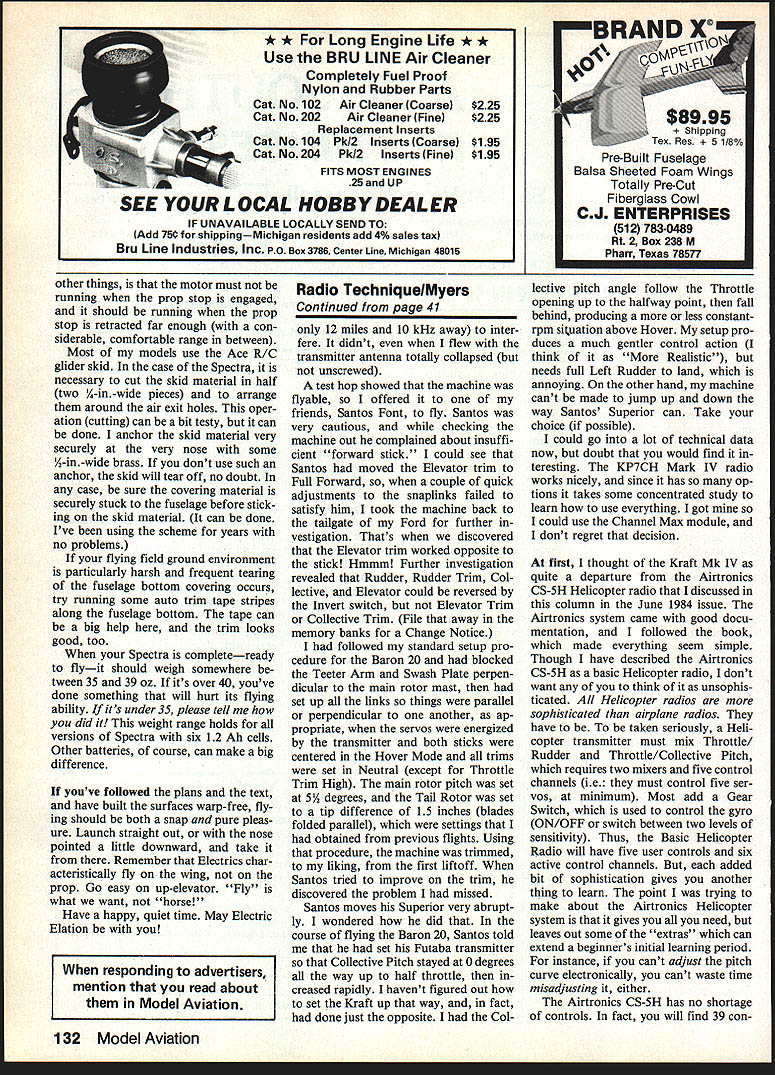
Santos moves his Superior very abruptly. In the course of flying the Baron 20, he told me that he had set his Futaba transmitter so that collective pitch stayed at 0 degrees all the way up to half throttle, then increased rapidly. I haven't figured out how to set the Kraft up that way, and, in fact, had done just the opposite. I had the collective pitch angle follow the throttle opening up to the halfway point, then fall behind, producing a more-or-less constant-rpm situation above hover. My setup produces a much gentler control action (I think of it as "more realistic"), but needs full left rudder to land, which is annoying. On the other hand, my machine can't be made to jump up and down the way Santos' Superior can. Take your choice (if possible).
General Impressions
I could go into a lot of technical data now, but doubt that you would find it interesting. The Kraft Mk IV radio works nicely, and since it has so many options it takes some concentrated study to learn how to use everything. I got mine so I could use the Channel Max module, and I don't regret that decision.
At first, I thought of the Kraft Mk IV as quite a departure from the Airtronics CS-SH helicopter radio that I discussed in this column in the June 1984 issue. The Airtronics system came with good documentation, and I followed the book, which made everything seem simple. Though I have described the Airtronics CS-SH as a basic helicopter radio, I don't want any of you to think of it as unsophisticated. All helicopter radios are more sophisticated than airplane radios. They have to be.
To be taken seriously, a helicopter transmitter must mix Throttle/Rudder and Throttle/Collective Pitch, which means a whole series of channels (i.e., the ones that control flaps or motors will not be necessary). Most add a Gear switch, which is used to control the gyro (ON/OFF or switch between two levels of sensitivity). The basic helicopter radio will have five controls and five active control channels. Beyond that, each added bit of sophistication gives you another thing to learn. The point is trying to make the Airtronics helicopter system as simple as possible, but that doesn't mean that a beginner couldn't use it; a beginner can and does learn the system quickly, and I think it's an excellent way to start flying helicopters.
The Airtronics CS-SH has no shortage of controls. In fact, you will find 39 controls and adjustments on its transmitter (two of which adjust stick-centering force). It lacks collective pitch trim and collective pitch curve adjustments, so you have to do those things by presetting the bellcrank angles and by adjusting ball snaplinks. To my mind, each system has features that the other could use. Both are a long, long way from the basic airplane radio (four functions, nine controls).
Power and Battery Advice
The Kraft system's flight pack, feeding a Kraft gyro, the KPR-8FDS receiver and five KPS-24 servos, delivers 150 mA when the servos are stationary. With two servos moving freely (an easily-duplicated condition), current drain jumps to 550 mA. I use an SR900 pack and that gives me about two hours of operating time.
With those operating conditions, one had better do some voltage measurements before each flight, and then stop flying the instant the flight pack voltage drops below 4.8 VDC under load. "How do you do that?" you ask. Both the Kraft and the Airtronics transmitters have built-in ESVs for the flight pack and both come with a long cord that plugs into the helicopter's charging jack for the purpose of assessing flight pack voltage. Use them before each and every flight.
I know it's a little inconvenient to carry the test cords, because neither transmitter provides a storage packet for them. So make yourself one! There is no excuse that will undo crash damage. I've done a little testing, and now my meters are red-lined at 4.8 volts. When the needle drops below that point, I head for the charger.
Never mind that 4.4 volts stuff—that's when the charge is exhausted. The basic continuous drain for a helicopter with a gyro is over 150 mA, and the flight time remaining after 4.7 volts has been reached is desperately short — I estimate it to be generally less than the time to burn a tank of fuel. The Baron 20 tank lasts about 10 minutes in flight and the Heli Boy tank lasts about 27 minutes. You could exhaust the batteries in flight in either case after you've lifted off at 4.7 volts. I speak from experience.
Don't neglect the transmitter batteries, either. Kraft strongly advises that you stop flying when the transmitter pack reaches 9.6 volts, and judging from the way the system degenerated when I let it run down below that point (in ground tests), I agree.
If you don't like the built-in meters, there are alternatives. Many ESVs (expanded-scale voltmeters, with built-in load resistors) are available on the accessory market. Just be sure to use something!
Synthesized RF vs. PCM
I've been asked, "Which is better, synthesized RF or PCM?" There is no "better" in this case, because they are different things, and both can be used in the same transmitter. In fact, I'll be very surprised if Futaba and Cirrus don't add a synthesizer to their PCM sets next year.
George M. Myers 70 Froehlich Farm Rd. Hicksville, NY 11801
Transcribed from original scans by AI. Minor OCR errors may remain.

