
Radio Technique
George M. Myers
Electric Things
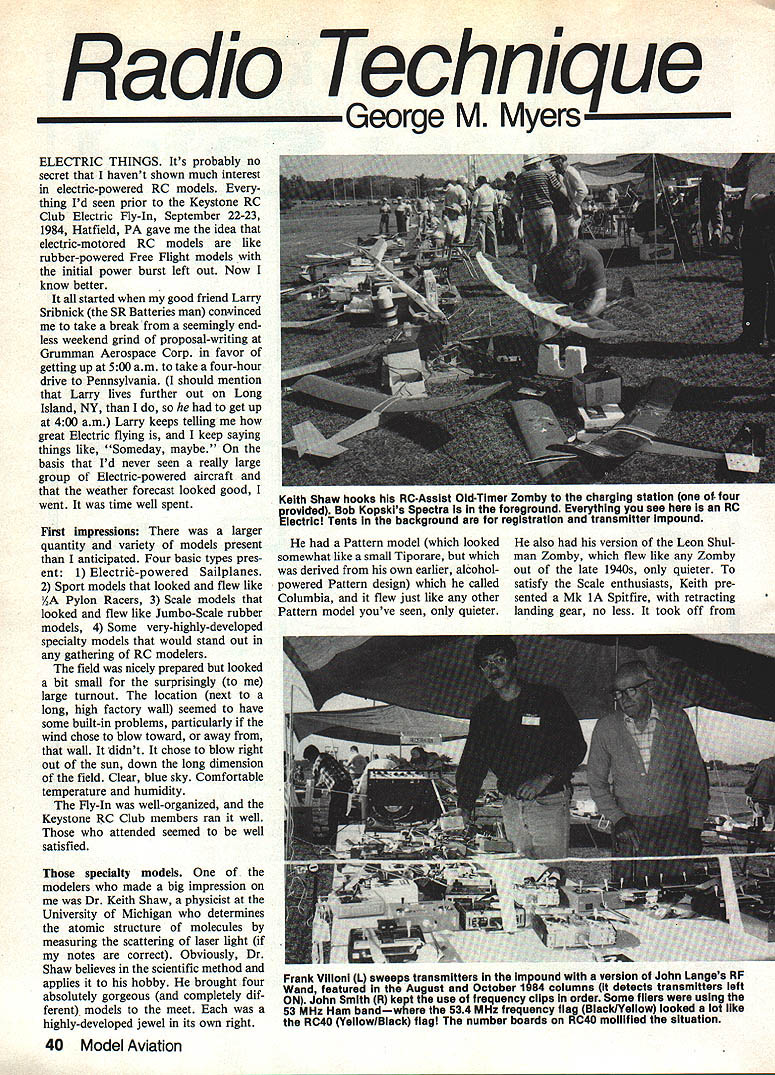
It's probably no secret I haven't shown much interest in electric-powered RC models. Everything I'd seen prior to the Keystone RC Club Electric Fly-In, September 22–23, 1984, Hatfield, PA, gave me the idea that electric-motored RC models were like rubber-powered Free Flight models with the initial power burst left out. Now I know better.
It all started when my good friend Larry Sribnick (the SR Batteries man) convinced me to take a break from a seemingly endless weekend grind of proposal writing at Grumman Aerospace Corp. in favor of getting up at 5:00 a.m. to take a four-hour drive to Pennsylvania. (I should mention that Larry lives further out on Long Island, NY, so he had to get up at 4:00 a.m.) Larry keeps telling me how great electric flying is, and I kept saying things like, "Someday, maybe." On the basis that I'd never seen a really large group of electric-powered aircraft and that the weather forecast looked good, I thought this time well spent.
First impressions: there was a larger quantity and variety of models present than I anticipated. Four basic types were present:
- Electric-powered sailplanes
- Sport models that looked and flew like .40 pylon racers
- Scale models that looked and flew like jumbo-scale rubber models
- Very highly developed specialty models that would stand out at any gathering of RC modelers
The field was nicely prepared but looked a bit small for the surprisingly large turnout. The location (next to a long, high factory wall) seemed to have some built-in problems, particularly if the wind chose to blow toward or away from that wall. It didn't — it chose to blow right out of the sun, down the long dimension of the field. Clear blue sky. Comfortable temperature and humidity. The Fly-In was well organized, and the Keystone RC Club members ran it well. Those who attended seemed satisfied.
Specialty Models
One of the modelers who made a big impression on me was Dr. Keith Shaw, a physicist at the University of Michigan who determines the atomic structure of molecules by measuring the scattering of laser light (if my notes are correct). Obviously, Dr. Shaw believes in the scientific method and applies it to his hobby. He brought four absolutely gorgeous (and completely different) models to the meet. Each was a highly developed jewel in its own right.
- A Pattern model (which looked somewhat like a small Tiporare, derived from his own earlier alcohol-powered Pattern design) called Columbia — it flew like any Pattern model you've seen, only quieter.
- His version of the Leon Shulman Zomby — it flew like any Zomby out of the late 1940s, only quieter.
- A Mk IA Spitfire with retracting landing gear to satisfy the scale enthusiasts.
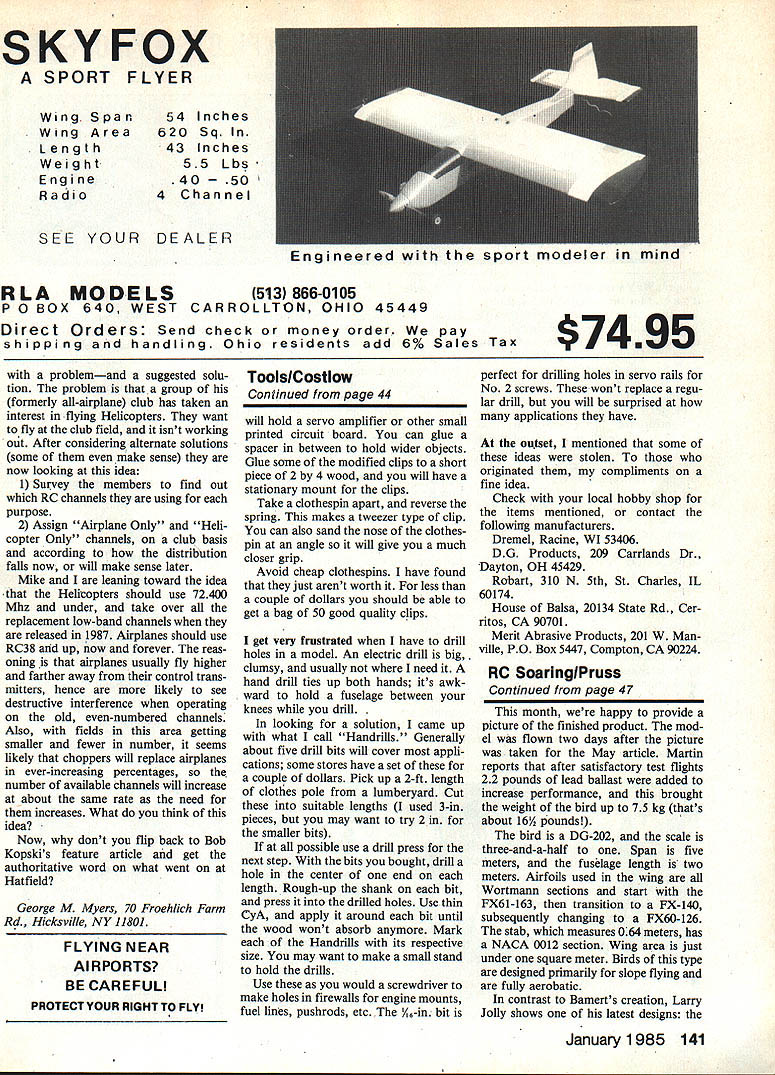
- A Horten B-2 Flying Wing — in developing this model, Dr. Shaw and a friend cut out over 150 blue-foam models to get the parameters right. The plane handles beautifully; he claims to have clocked 85 mph through a speed trap.
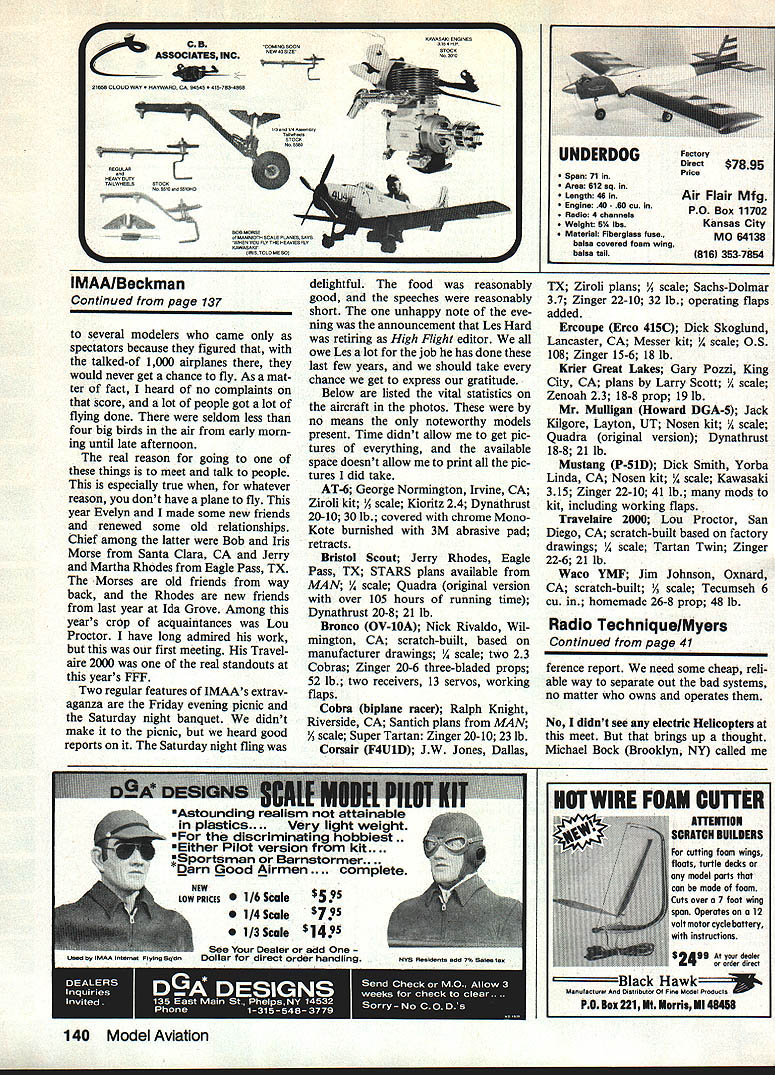
I didn't expect to see amphibians or seaplanes flying off a grass field, but Nelson Whitman (Simsbury, CT) had three hydros, one of them in 1/2A size. Several folks told me Nelson created quite a stir at the Brimfield, CT hydro meet this year when he challenged the alcohol-burners on their own turf. Apparently Nelson doesn't give up easily — he spent some contest time telling me the history of these models, which traces back to 1975. One thing I'm learning is that these electric aficionados are persistent.
Interference and Frequencies
While walking about the pits and talking to people, I put on my AMA Frequency Committee Chairman hat (figuratively) and asked about problems with the new RC channels, flags, SRF radios and flags, interference problems, etc.
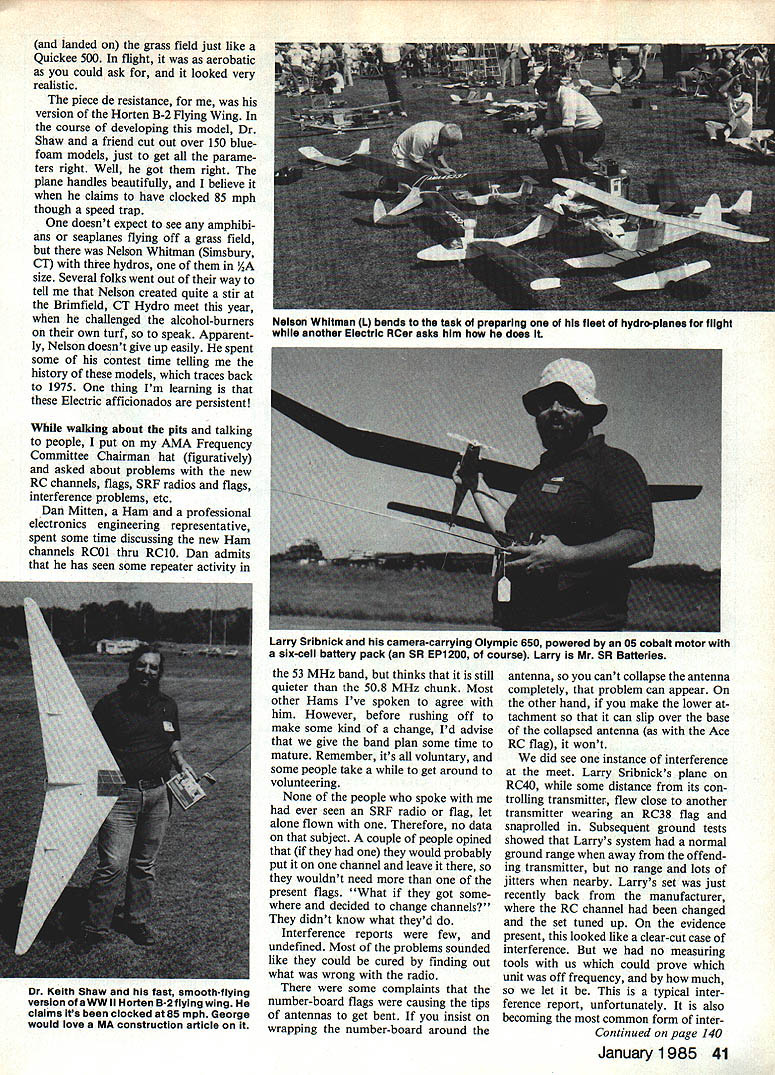
Dan Mitten, a ham and a professional electronics engineer, spent some time discussing the new ham channels RC01 through RC10. Dan admits that he has seen some repeater activity in the 53 MHz band, but thinks that it is still quieter than the 50.8 MHz chunk. Most other hams I've spoken to agree with him. However, before rushing off to make some kind of change, I'd advise that we give the band plan some time to mature. Remember, it's all voluntary, and some people take a while to get around to volunteering.
None of the people who spoke with me had ever seen an SRF radio or flag, let alone flown with one, so there was no data on that subject. A couple of people opined that (if they had one) they would probably put it on one channel and leave it there, so they wouldn't need more than one of the present flags. "What if they go someplace and decide to change channels?" They didn't know what they'd get into.
Interference reports were few and undefined. Most of the problems sounded like they could be cured by finding out what was wrong with the radio.
There were some complaints that the number-board flags were causing the tips of antennas to get bent. If you insist on wrapping the number board around the antenna so you can't collapse the antenna completely, that problem can appear. On the other hand, if you make the lower attachment so that it can slip over the base of the collapsed antenna (as with the Ace RC flag), it won't.
We did see one instance of interference at the meet. Larry Sribnick's plane on RC40, while some distance from its controlling transmitter, flew close to another transmitter wearing an RC38 flag and snap-rolled in. Subsequent ground tests showed that Larry's system had a normal signal, but when near the offending transmitter there was no range and lots of jitter. Larry's set had just recently returned from the manufacturer, where the RC channel had been changed and the set tuned up. On the evidence present, this looked like a clear-cut case of interference. But we had no solid tools to prove which unit was off frequency, and by how much, so we let it be. This is a typical interference report, unfortunately. It is also becoming the most common form of interference report. We need some cheap, reliable way to separate out the bad systems, no matter who owns and operates them.
Helicopters at Club Fields
A club president asked me about a problem — and a suggested solution. A group of his (formerly all-airplane) club members has taken an interest in flying helicopters. They want to fly at the club field, and it isn't working out. After considering alternate solutions (some of them even make sense), they are now looking at this idea:
- Survey the members to find out which RC channels they are using for each purpose.
- Assign "Airplane Only" and "Helicopter Only" channels, on a club basis and according to how the distribution falls now or will make sense later.
Mike and I are leaning toward the idea that the helicopters should use 72.400 MHz and under, and take over all the replacement low-band channels when they are released (the text referenced a 1987 release). Airplanes should use RC38 and up, now and forever. The reason is that airplanes usually fly higher and farther away from their control transmitters, hence are more likely to see destructive interference when operating on the old, even-numbered channels. Also, with fields in this area getting smaller and fewer, it is likely that choppers will replace airplanes in ever-increasing percentages, so the number of available channels will increase at about the same rate as the need for them increases. What do you think of this idea?
Conclusion
Now, why don't you flip back to Bob Kopskis' feature article and get the authoritative word on what went on at Hatfield!
George M. Myers 70 Froehlich Farm Rd. Hicksville, NY 11801
FLYING NEAR AIRPORTS?
BE CAREFUL! PROTECT YOUR RIGHT TO FLY!
Transcribed from original scans by AI. Minor OCR errors may remain.

