
Radio Technique
George M. Myers
Two for Twelve
I didn't do much flying in 1984, due either to the press of business or because I had "something else" to do. When I finally took a look at the 12 VDC motorcycle battery I use for my field-box power panel, starter, etc., I found that it had boiled itself dry after being left unattended for two months on a constant-voltage charger that was supposed to drop down to a "safe trickle charge" automatically. I know the battery was left on charge for two months because the previous time I looked at it was the day the tail rotor unscrewed itself (in flight) from the shaft on my last serviceable helicopter. That made an impression on my mind!
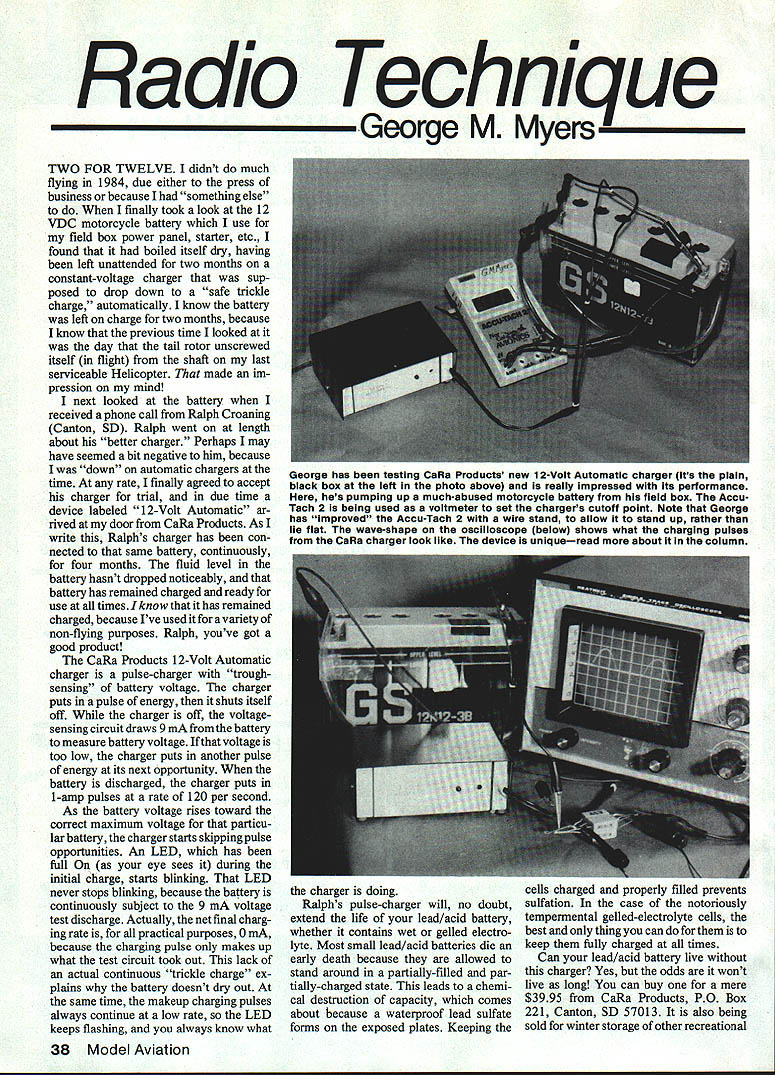
I next looked at the battery when I received a phone call from Ralph Groaning (Canton, SD). Ralph went on at length about his "better charger." Perhaps I seemed a bit negative to him, because I was down on automatic chargers at the time. At any rate, I finally agreed to accept his charger for trial, and in due time a device labeled "12-Volt Automatic" arrived at my door from CaRa Products. As I write this, Ralph's charger has been connected to that same battery continuously for four months. The fluid level in the battery hasn't dropped noticeably, and the battery has remained charged and ready for use at all times. I know it has remained charged because I've used it for a variety of non-flying purposes. Ralph, you've got a good product!
CaRa 12-Volt Automatic Charger
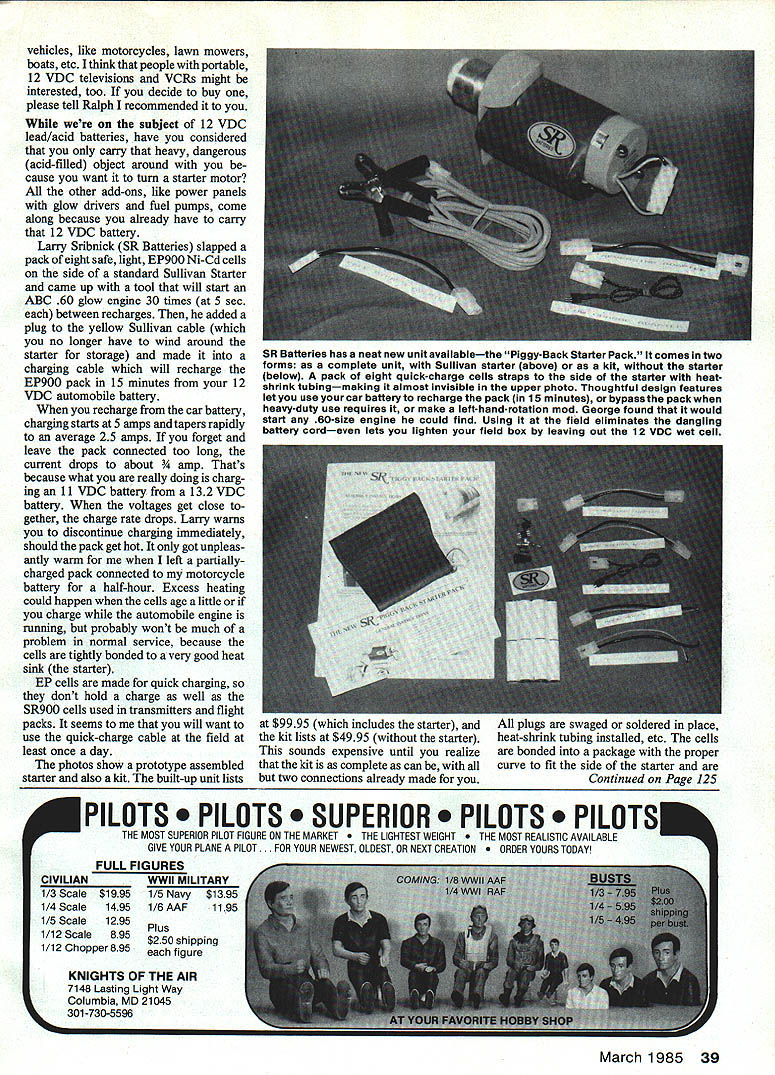
The CaRa Products 12-Volt Automatic charger is a pulse charger with "trough-sensing" of battery voltage. The charger puts in a pulse of energy, then shuts itself off. While the charger is off, the voltage-sensing circuit draws 9 mA from the battery to measure battery voltage. If that voltage is too low, the charger puts in another pulse of energy at its next opportunity. When the battery is discharged, the charger puts in 1-amp pulses at a rate of 120 per second.
As the battery voltage rises toward the correct maximum voltage for that particular battery, the charger starts skipping pulse opportunities. An LED, which is full on during the initial charge, starts blinking. That LED never stops blinking because the battery is continuously subject to the 9 mA voltage-test discharge. Actually, the net final charging rate is, for all practical purposes, 0 mA, because the charging pulse only makes up what the test circuit took out. This lack of an actual continuous "trickle charge" explains why the battery doesn't dry out. At the same time, the makeup charging pulses always continue at a low rate, so the LED keeps flashing and you always know what the charger is doing.
Ralph's pulse charger will, no doubt, extend the life of your lead/acid battery, whether it contains wet or gelled electrolyte. Most small lead/acid batteries die an early death because they are allowed to stand around in a partially filled and partially charged state. This leads to chemical destruction of capacity because a waterproof lead sulfate forms on the exposed plates. Keeping the cells charged and properly filled prevents sulfation. In the case of the notoriously temperamental gelled-electrolyte cells, the best and only thing you can do for them is to keep them fully charged at all times.
Can your lead/acid battery live without this charger? Yes, but the odds are it won't live as long. You can buy one for $39.95 from CaRa Products:
- CaRa Products, P.O. Box 221, Canton, SD 57013.
It is also being sold for winter storage of other recreational vehicles like motorcycles, lawn mowers, boats, etc. People with portable 12 VDC televisions and VCRs might be interested, too. If you decide to buy one, please tell Ralph I recommended it to you.
Piggy Back Starter Pack (EP900 Ni-Cd)
While we're on the subject of 12 VDC lead/acid batteries, consider that you only carry that heavy, dangerous (acid-filled) object around because you want it to turn a starter motor. All the other add-ons, like power panels with glow drivers and fuel pumps, come along because you already have to carry that 12 VDC battery.
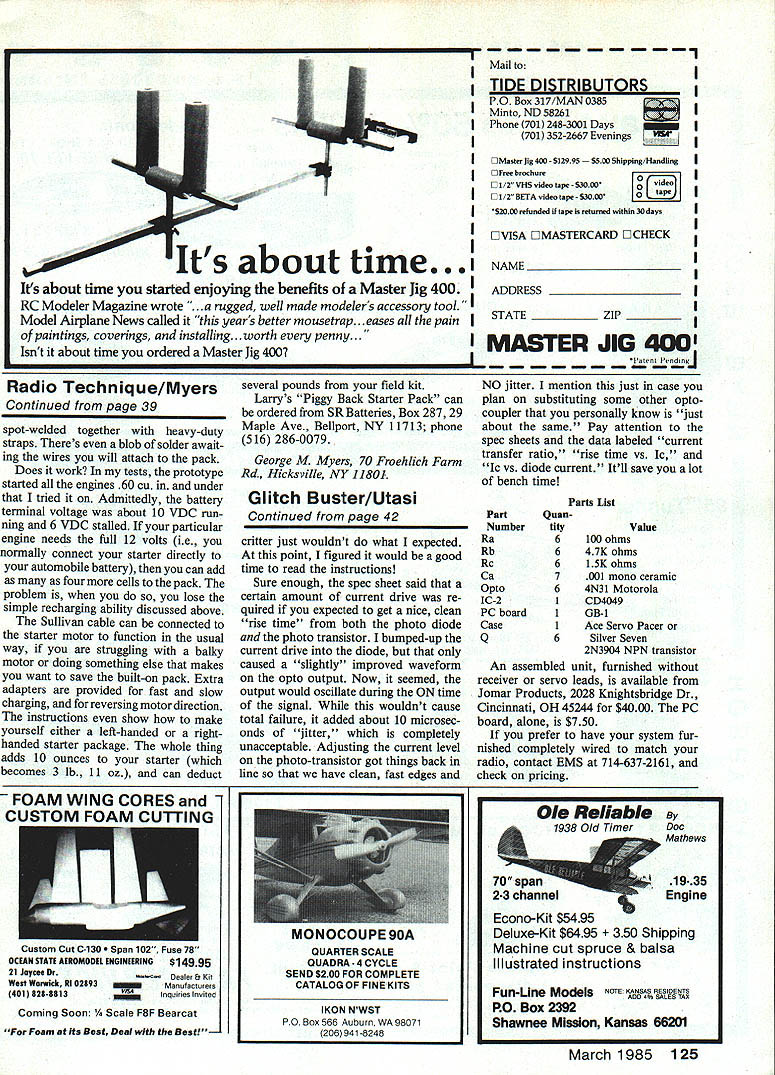
Larry Sribnick (SR Batteries) slapped a pack of eight safe, light EP900 Ni-Cd cells on the side of a standard Sullivan starter and came up with a tool that will start an ABC .60 glow engine 30 times (at 5 seconds each) between recharges. He then added a plug to the yellow Sullivan cable (which you no longer have to wind around the starter for storage) and made it into a charging cable that will recharge the EP900 pack in 15 minutes from your 12 VDC automobile battery.
When you recharge from the car battery, charging starts at 5 amps and tapers rapidly to an average 2.5 amps. If you forget and leave the pack connected too long, the current drops to about 3/4 amp. That's because what you are really doing is charging an 11 VDC battery from a 13.2 VDC battery. When the voltages get close together, the charge rate drops. Larry warns you should discontinue charging immediately should the pack get hot. It only got unpleasantly warm for me when I left a partially charged pack connected to my motorcycle battery for a half-hour. Excess heating could happen when the cells are low or if you charge while the automobile engine is running, but it probably won't be much of a problem in normal service because the cells are tightly bonded to a very good heat sink (the starter).
EP cells are made for quick charging, so they don't hold a charge as well as the SR900 cells used in transmitters and flight packs. It seems to me you will want to use the quick-charge cable at the field at least once a day.
The photos show a prototype assembled starter and also a kit. The built-up unit lists at $99.95 (which includes the starter), and the kit lists at $49.95 (without the starter).
This sounds expensive until you realize the kit is as complete as can be, with all but two connections already made for you:
- All plugs are swaged or soldered in place and heat-shrink tubing is installed.
- The cells are bonded into a package with the proper curve to fit the side of the starter and are spot-welded together with heavy-duty straps.
- There's even a blob of solder awaiting the wires you will attach to the pack.
Does it work? In my tests, the prototype started all the engines .60 cu. in. and under that I tried it on. Admittedly, the battery terminal voltage was about 10 VDC running and 6 VDC stalled. If your particular engine needs the full 12 volts (i.e., you normally connect your starter directly to your automobile battery), you can add as many as four more cells to the pack. The problem is, when you do so, you lose the simple recharging ability discussed above.
The Sullivan cable can be connected to the starter motor to function in the usual way if you are struggling with a balky motor or want to save the built-in pack. Extra adapters are provided for fast and slow charging, and for reversing motor direction. The instructions even show how to make either a left-handed or a right-handed starter package. The whole thing adds 10 ounces to your starter (which becomes 3 lb., 11 oz.), and can deduct several pounds from your field kit.
Larry's "Piggy Back Starter Pack" can be ordered from:
- SR Batteries, Box 287, 29 Maple Ave., Bellport, NY 11713; phone (516) 286-0079.
George M. Myers 70 Froehlich Farm Rd. Hicksville, NY 11801
Transcribed from original scans by AI. Minor OCR errors may remain.

