
Radio Technique
George M. Myers
REMEMBER that radio frequency interference (RFI) strikes without warning, and the results can be catastrophic. I receive letters and phone calls from all over the United States—either because I am chairman of the AMA Frequency Committee or because I write this column. Most complaints fall into three categories:
- Poor performance — new radios perform worse than expected.
- Interference with operations on the new RC channels.
- Unexplained interferences between radios on the new RC channels.
Let us deal with these in order.
1. Poor performance
We all expect an expensive, complicated new RC system to work “better” than an old, cheap, simple one. Unfortunately, “better” rarely means improved RFI resistance. Most of the price differential in expensive systems goes to added control capability and cosmetics; price usually has little to do with RFI resistance.
There are exceptions (for example, the Kraft KPR-8FD and some Futaba DPM systems), but the next complaint is often, “It’s too expensive!” Perhaps so — but what will your next crash cost?
Even after spending extra for better performance, you will sometimes crash anyway. That’s why I wait to form judgments until I’ve used equipment for a few months: electronic devices have an “infant mortality” period when abrupt failures occur more frequently. After that period, failures become less likely. Testing is hard work, but after a system has been through a test program you can better judge whether to trust it.
One thing that makes me shudder is the person who shows up at the field with a brand-new airplane, engine, and RC system. I regard that as equivalent to a hand grenade with the pin out. If he survives the first flight, I often hide in my car for the second!
2. Interference with the new RC channels
When the FCC allocated channels it did not grant the full number of exclusive channels requested; part of the reason was the expectation that some channels might suffer interference given the state of the art at the time. The AMA Phase-In Plan was designed to avoid predictable modeler-to-modeler interferences among RC radio designs and to free additional channels as system design improves. Another reason for the FCC’s decision was the expectation that some channels in some locations would be interfered with by licensed Primary Users.
We cannot eliminate interference from properly operating Primary Users; as Secondary Users we cannot complain about their normal operations (although we can complain about improperly operated Primary systems).
A common factor in many recent complaints is that new single-conversion FM receivers are being interfered with by old AM transmitters. I discussed the basics of how and why this happens in February 1984. The problem will persist while manufacturers continue to use the old single-conversion 455 kHz IF superheterodyne design for new FM receivers and while modelers continue to use old AM transmitters. In most cases the operator with an old AM set has an advantage relative to FM operators on adjacent channels.
If everyone abandoned AM and switched to narrow-band FM, testing indicates you would be able to operate more FM sets simultaneously and on closer-spaced channels. FM sets can operate with only 4–5 kHz deviation, whereas AM requires much more bandwidth. But you only get those advantages if all sets in a group are FM narrow-band sets (for example, Kraft KPR-8FD-like designs).
DPM (digital pulse-code modulation), properly termed FSK for our purposes, offers advantages because the receiver’s digital processing can sort valid signals from noise and respond only to valid signals. In my experience, DPM resists interference better than AM or old-style pulse-width–modulated FM receivers. Spread-spectrum has also been suggested as a way to avoid interference; I hope it proves practical.
For background reading, review past Model Aviation issues covering this topic (many issues from 1979–1985 addressed these subjects).
3. Modeler-to-modeler interference
One interference type common to all RC systems is third-order intermodulation (3IM). It occurs whenever three sequentially numbered RC channels operate simultaneously (for example, RC46, RC48, and RC50). It doesn’t matter whether the systems are AM, FM, or DPM: under certain conditions two transmitters will combine to interfere with the third. The only new channel free from 3IM is RC12.
The 3IM condition typically appears when the interfering pair of transmitters is approximately halfway between the third transmitter and the airplane it controls. Dual-conversion, narrow-band FM (DCnbFM) does not absolutely prevent 3IM, but it makes the interfering transmitters have to be much closer to your airplane before interference occurs.
There is no magic cure; we must learn to live with and manage interference.
Practical advice — be the wary cat
Observe the cat: it checks the neighborhood before it moves. The overconfident cat gets hurt. If you would emulate the wary cat:
- Get a monitor and learn to use it properly.
- Perform ground tests when faced with a new or unusual situation; find out what you are flying into before you fly.
- Keep a sailplane or expendable trainer to test new systems and to probe the air for turbulence, wind shear, RF interference, etc., before risking something expensive. There are advantages to letting someone else fly first.
- Use an impound area and insist others do likewise. Enforce frequency control with clothespins or other systems. Use frequency lags. Frequency flags are the AMA control scheme—use them, but don’t rely on them alone. Pastel or ambiguous flags and rebels who use their own flags make flags imperfect protection. Crystal-swapping (now legal) and module-swapping without proper frequency control can further confuse matters.
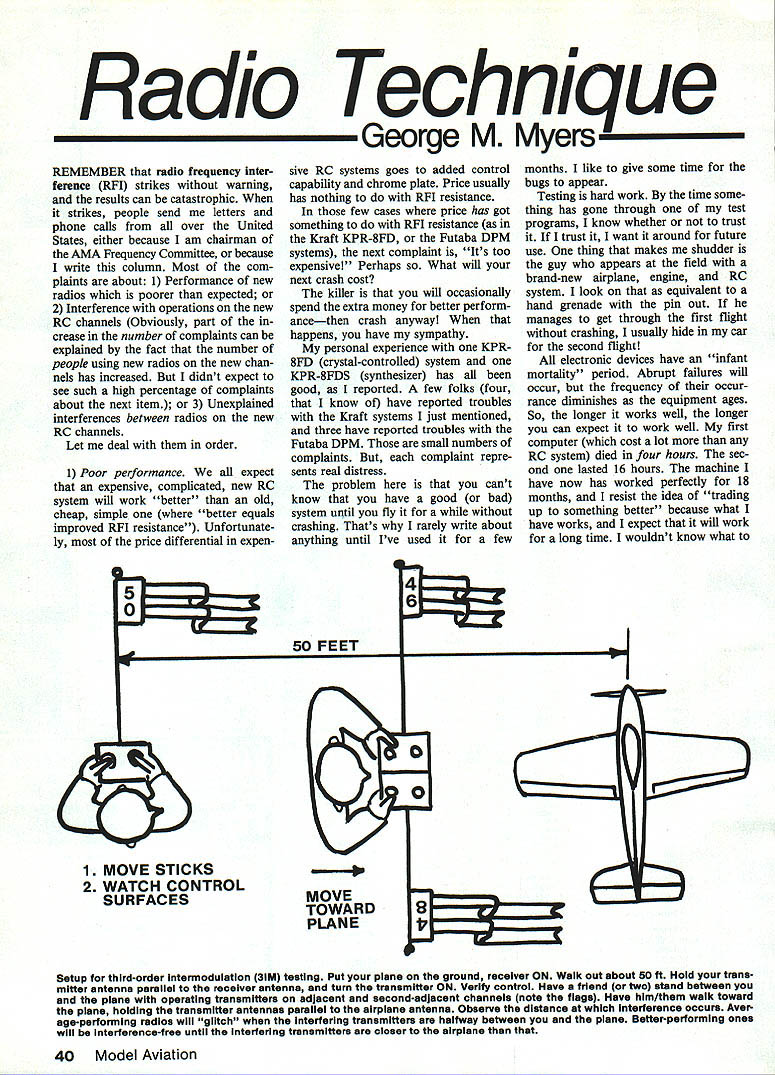
Setup — third-order intermodulation (3IM) testing:
- Put the plane and ground receiver ON.
- Walk out about 50 ft. from the receiver.
- Hold the transmitter antenna parallel to the receiver antenna.
- Turn the transmitter ON and verify control of the plane.
- Have a friend or two stand between the plane and any operating transmitters (adjacent or second-adjacent channels) and note their frequency flags.
- Have them walk toward the plane holding their transmitter antennas parallel to the airplane antenna.
- Observe the distance at which interference occurs.
Average-performing radios will glitch when the interfering transmitters are roughly halfway between the plane and the third transmitter. Better-performing radios will remain interference-free until the interfering transmitters are much closer.
In short: be cautious, test thoroughly, enforce frequency control at the field, and choose equipment and operating practices that reduce your exposure to RFI.
Transcribed from original scans by AI. Minor OCR errors may remain.

