
Radio Technique-George Myers
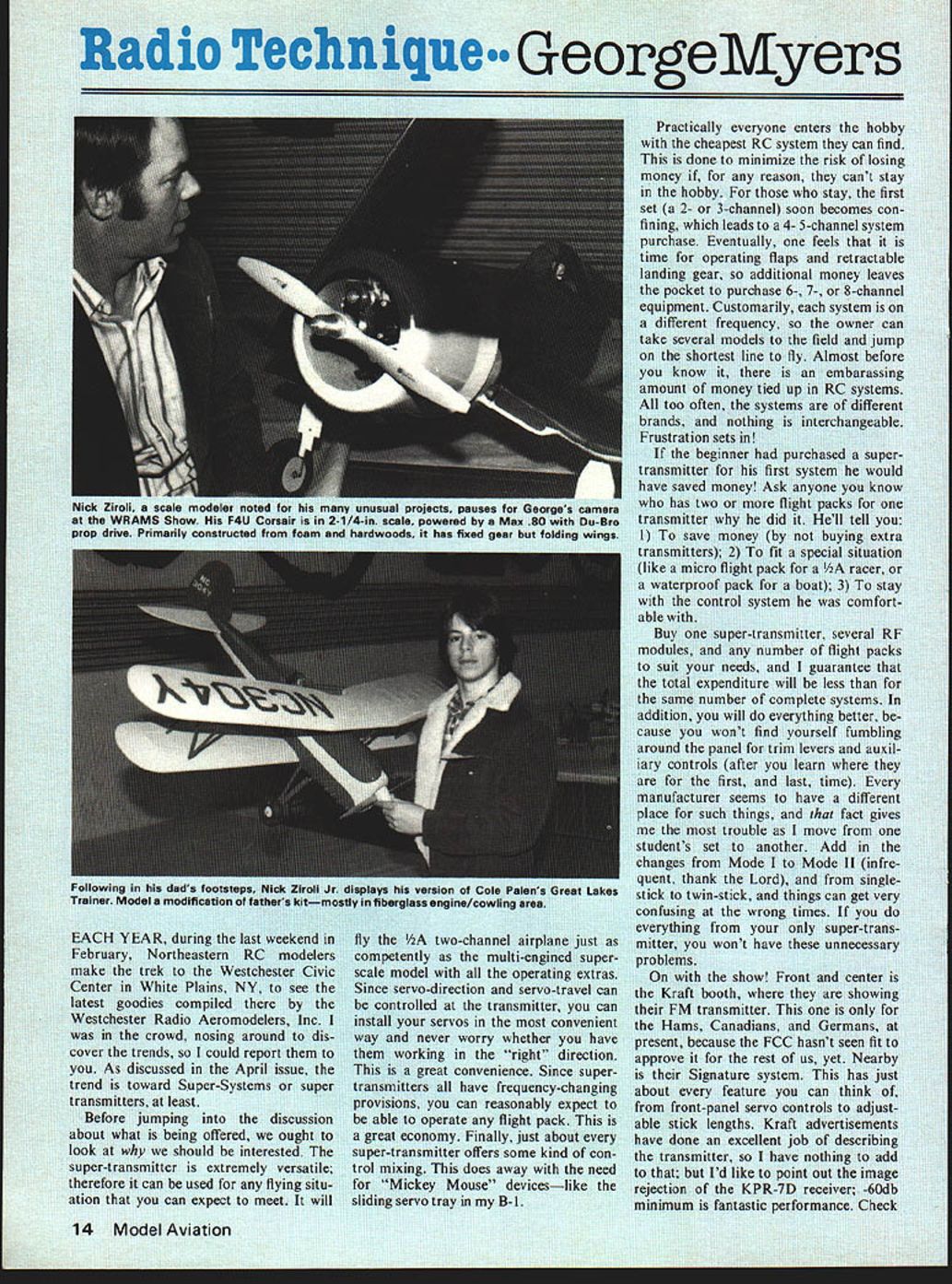
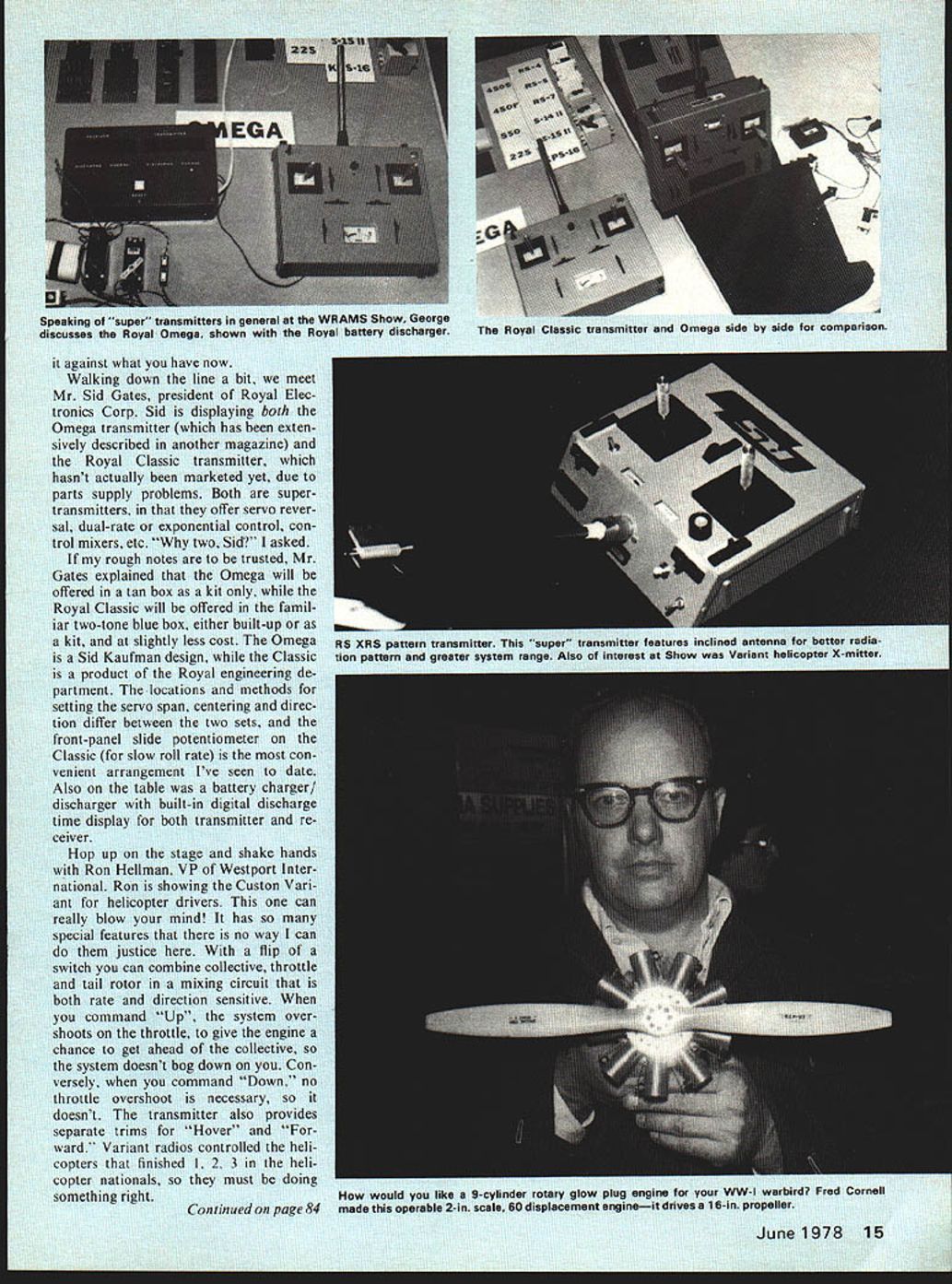
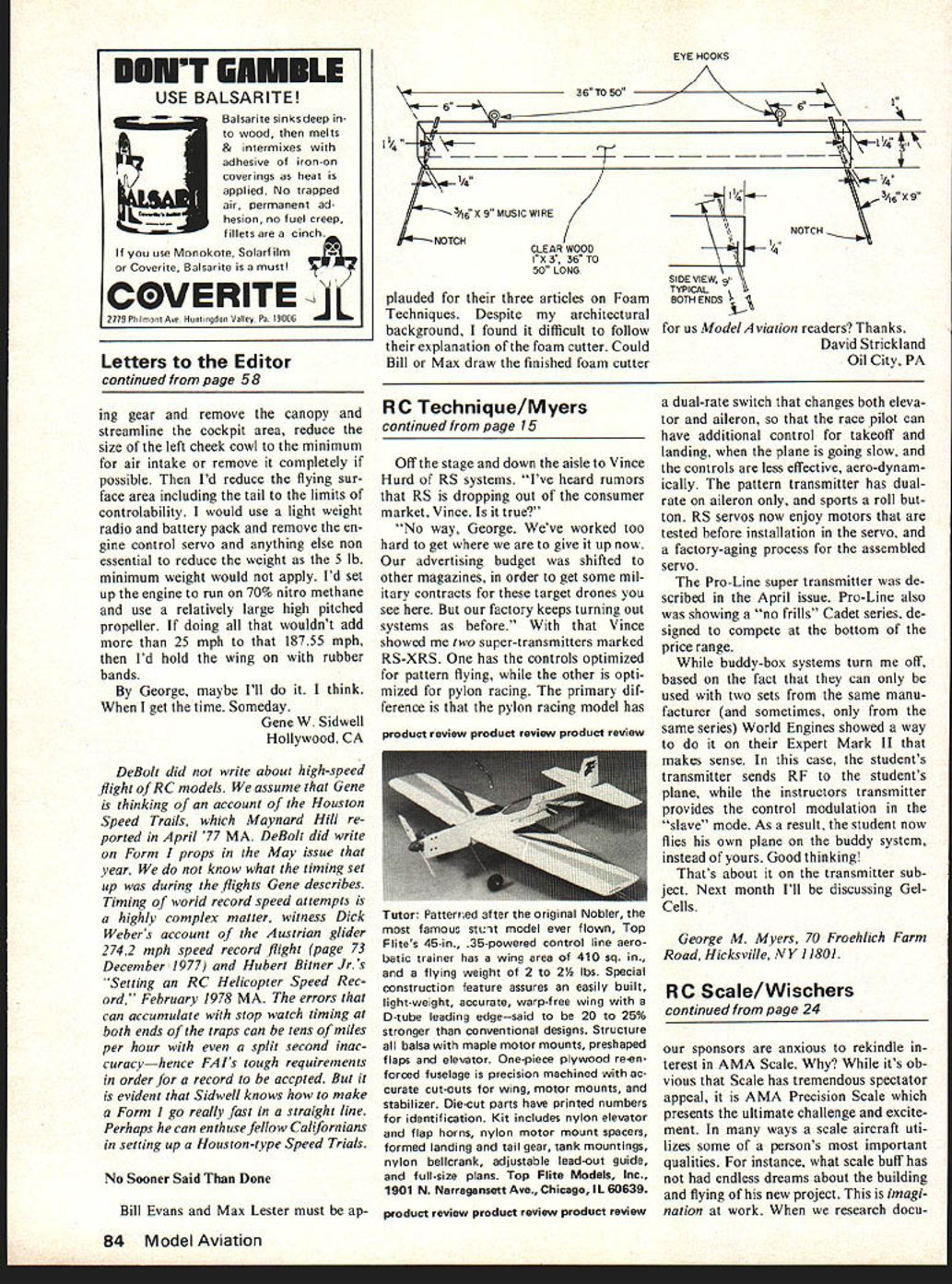
EACH YEAR, during the last weekend in February, Northeastern RC modelers make the trek to the Westchester Civic Center in White Plains, NY, to see the latest goodies compiled there by the Westchester Radio Aeromodelers, Inc. I was in the crowd, nosing around to discover the trends, so I could report them to you. As discussed in the April issue, the trend is toward Super-Systems or super transmitters, at least.
Before jumping into the discussion about what is being offered, we ought to look at why we should be interested. The super-transmitter is extremely versatile; therefore it can be used for any flying situation that you can expect to meet. It will fly the 1/4A two-channel airplane just as competently as the multi-engined super-scale model with all the operating extras. Since servo-direction and servo-travel can be controlled at the transmitter, you can install your servos in the most convenient way and never worry whether you have them working in the "right" direction. This is a great convenience. Since super-transmitters all have frequency-changing provisions, you can reasonably expect to be able to operate any flight pack. This is a great economy. Finally, just about every super-transmitter offers some kind of control mixing. This does away with the need for "Mickey Mouse" devices—like the sliding servo tray in my B-1.
Practically everyone enters the hobby with the cheapest RC system they can find. This is done to minimize the risk of losing money if, for any reason, they can't stay in the hobby. For those who stay, the first set (a 2- or 3-channel) soon becomes confining, which leads to a 4-5-channel system purchase. Eventually, one feels that it is time for operating flaps and retractable landing gear, so additional money leaves the pocket to purchase 6-, 7-, or 8-channel equipment. Customarily, each system is on a different frequency, so the owner can take several models to the field and jump on the shortest line to fly. Almost before you know it, there is an embarrassing amount of money tied up in RC systems. All too often, the systems are of different brands, and nothing is interchangeable. Frustration sets in!
If the beginner had purchased a super-transmitter for his first system he would have saved money! Ask anyone you know who has two or more flight packs for one transmitter why he did it. He'll tell you: 1) To save money (by not buying extra transmitters); 2) To fit a special situation (like a micro flight pack for a 1/2A racer, or a waterproof pack for a boat); 3) To stay with the control system he was comfortable with.
Buy one super-transmitter, several RF modules, and any number of flight packs to suit your needs, and I guarantee that the total expenditure will be less than for the same number of complete systems. In addition, you will do everything better, because you won't find yourself fumbling around the panel for trim levers and auxiliary controls (after you learn where they are for the first, and last, time). Every manufacturer seems to have a different place for such things, and that fact gives me the most trouble as I move from one student's set to another. Add in the changes from Mode I to Mode II (infrequent, thank the Lord), and from single-stick to twin-stick, and things can get very confusing at the wrong times. If you do everything from your only super-transmitter, you won't have these unnecessary problems.
On with the show! Front and center is the Kraft booth, where they are showing their FM transmitter. This one is only for the Hams, Canadians, and Germans, at present, because the FCC hasn't seen fit to approve it for the rest of us yet. Nearby is their Signature system. This has just about every feature you can think of from front-panel servo controls to adjustable stick lengths. Kraft advertisements have done an excellent job of describing the transmitter, so I have nothing to add to that; but I'd like to point out the image rejection of the KPR-7D receiver: -60db minimum is fantastic performance. Check it against what you have now.
Walking down the line a bit, we meet Mr. Sid Gates, president of Royal Electronics Corp. Sid is displaying both the Omega transmitter (which has been extensively described in another magazine) and the Royal Classic transmitter, which hasn't actually been marketed yet, due to parts supply problems. Both are super-transmitters, in that they offer servo reversal, dual-rate or exponential control, control mixers, etc. "Why two, Sid?" I asked.
If my rough notes are to be trusted, Mr. Gates explained that the Omega will be offered in a tan box as a kit only, while the Royal Classic will be offered in the familiar two-tone blue box, either built-up or as a kit, and at slightly less cost. The Omega is a Sid Kaufman design, while the Classic is a product of the Royal engineering department. The locations and methods for setting the servo span, centering and direction differ between the two sets, and the front-panel slide potentiometer on the Classic (for slow roll rate) is the most convenient arrangement I've seen to date. Also on the table was a battery charger/discharger with built-in digital discharge time display for both transmitter and receiver.
Hop up on the stage and shake hands with Ron Hellman, VP of Westport International. Ron is showing the Custom Variant for helicopter drivers. This one can really blow your mind! It has so many special features that there is no way I can do them justice here. With a flip of a switch you can combine collective, throttle and tail rotor in a mixing circuit that is both rate and direction sensitive. When you command "Up," the system overshoots on the throttle, to give the engine a chance to get ahead of the collective, so the system doesn't bog down on you. Conversely, when you command "Down," no throttle overshoot is necessary, so it doesn't. The transmitter also provides separate trims for "Hover" and "Forward." Variant radios controlled the helicopters that finished 1, 2, 3 in the helicopter nationals, so they must be doing something right.
Radio Technique-George Myers
Off the stage and down the aisle to Vince Hurd of RS systems. "I've heard rumors that RS is dropping out of the consumer market, Vince, is it true?"
"No way, George. We've worked too hard to get where we are to give it up now. Our advertising budget was shifted to other magazines, in order to get some military contracts for these target drones you see here. But our factory keeps turning out systems as before." With that Vince showed me two super-transmitters marked RS-XRS. One has the controls optimized for pattern flying, while the other is optimized for pylon racing. The primary difference is that the pylon racing model has a dual-rate switch that changes both elevator and aileron, so that the race pilot can have additional control for takeoff and landing, when the plane is going slow, and the controls are less effective, aerodynamically. The pattern transmitter has dual-rate on aileron only, and sports a roll button. RS servos now enjoy motors that are tested before installation in the servo, and a factory-aging process for the assembled servo.
The Pro-Line super transmitter was described in the April issue. Pro-Line also was showing a "no frills" Cadet series, designed to compete at the bottom of the price range.
While buddy-box systems turn me off, based on the fact that they can only be used with two sets from the same manufacturer (and sometimes, only from the same series) World Engines showed a way to do it on their Expert Mark II that makes sense. In this case, the student's transmitter sends RF to the instructor's transmitter, while the instructor's transmitter provides the control modulation in the "slave" mode. As a result, the student now flies his own plane on the buddy system, instead of yours. Good thinking!
That's about it on the transmitter subject. Next month I'll be discussing Gel-Cells.
George M. Myers, 70 Froehlich Farm Road, Hicksville, NY 11801.
Transcribed from original scans by AI. Minor OCR errors may remain.

