
Rams Club: Field of Dreams
SO MANY of us who belong to a model club have experienced the trauma associated with the loss of a flying site. We know all too well that it can result in a very long and frustrating search to locate a new one. Very few clubs in the country make any effort to reduce the chances of this happening to them. Those clubs that are taking bold steps toward protecting the interests of their members are at the same time casting the benchmark of protecting our hobby at large. Think about it: do nothing now, and someone else will determine your club's destiny later. So then, why do nothing now?
In the December issue of MA I read a very interesting and timely article with a story of the dreamer, Joe Beshar, and the efforts of many that resulted in the development of the Bergen County Model Aerodrome in New Jersey. I do not call Joe a dreamer out of disrespect, because I too believe in the power of the dream.
Every possession, thing, item, achievement, or whatever that we enjoy today began somewhere with a dream. Edison, Bell, Goddard, Lindbergh, and NASA all dreamed, and because their dreams came true we have all benefited.
Joe realized that something had to be done not only to preserve the enjoyment of flying RC in New Jersey but to ensure that those coming up the ranks would also be able to pursue and enjoy our hobby in the future.
What you have just read, in a nutshell, sums up the purpose of this article. There are several ways to reduce the chances of losing your place to fly. I am going to take you through the procedures necessary to own your own flying site and tell you how a progressive club succeeded in accomplishing just that.
Before we begin, it's necessary to point out that there are no guarantees in life. We all know that. Nothing is forever, but owning your own field can place your club in a rather unique position that can be not only beneficial but also very long-term. It is also important to note that the politics of each community are unique and different. In some communities, governmental assistance may be possible, so if your club does not fit the requirements to own a site, then the county may be a good alternative. We'll talk about the requirements later.
RAMS background
I came to Rochester, New York, in the early seventies, and not too long after that I joined one of two clubs in the area called the Rochester Aero Modeling Society (RAMS). They had a nice field that they were renting, and the club was made up of approximately 60 members. I flew there for a few years, until about 1976, when one day the entrance road was blocked and a sign placed there by the owner said, "Field closed, no flying permitted."
We were all shocked. However, the shock soon wore off, and a committee was appointed to quickly locate another field. Three years slipped past peppered by a series of successes and failures. The membership had dropped to 18, and things were not looking very good.
Finally, members located an attorney and brothers who owned some land and the club succeeded in leasing a parcel smaller than the club would have liked. By continuing to fly the parcel, the club will be moving to its new site during 1992. At this point you might want to know how the club bought the new site, how much area we now have to fly, who holds the ownership, and the number of years.
Early proposal and reaction
The club decided to introduce the concept of field ownership at a club meeting around 1982. I was surprised at the response. An individual stood up and expounded on the ridiculous idea — he thought owning expensive land to fly model airplanes was foolish. Others jumped down and went after the proposal; they felt the proposer should be tarred and feathered. It didn't seem anyone cared. Going back over the evening's events shed light on why the great idea went down in flames: trying to convince members and the board to look into raising and spending money the club had never seen.
The board, trying to come to grips with having enough money to cut the grass at the present field, began to detect a greater degree of difficulty in renewing the field lease. At one point repeated phone calls to the owner went unanswered. Finally, after much effort, a lease was signed for a few years less and at a cost — the handwriting was on the wall. Others felt another field loss could occur soon.
A friendly club member, impressed with clear thinking and positive judgment, had the necessary ingredients to assist in making the field purchase proposal. I asked Stan Gutowski if he would join me to develop a proposal that would ultimately give the club its own field. Stan agreed, and as a result an excellent friendship developed. We knew we would be working together.
Months passed and we decided to gather as much information on the subject as possible and contacted AMA Headquarters. Headquarters sent a very large packet of material documenting the efforts of other clubs. Headquarters continues to be very helpful.
Prior to our joining forces, one of our former presidents, John Mitchell, developed a response form for the membership. It would determine if there would be any support for a project aimed at field ownership. The members were briefed on where the club stood with the present field owners, and then the forms were mailed. Stan and I were surprised to see that almost every member responded.
John scored the results on his computer. They were better than two-thirds in favor of owning our own field. We were off and running!
The form was made up of six statements with five possible responses. Responses were numbered 1 through 5. Circling a "5" meant that you strongly agreed with the statement, and a "1" meant you didn't.
Knowing that the members were ready to move forward, the board asked Stan and me to prepare a plan and timetable for identifying, evaluating, and funding the purchase of a flying site. At the same time, and at the request of several club members, the board asked the current field owners to develop a proposal for the club to buy the present 12-acre site. We received the proposal at $3,500 per acre — or $42,000 for just 12 acres. Not a very good deal!
Stan and I began a regular series of meetings to structure the proposal. We broke the project into sections, feeling that this would help the membership better understand what had to be done and at the same time make it easier for Stan and me to regularly brief the members. This is an extremely important aspect of the overall effort. The members must know where the project stands at all times and must be asked to vote on each portion of it. There can't be any surprises for the members. Here, it is vitally important that the members be given a very complete and clear presentation.
Project sections
We divided the overall project into five sections and then divided each section into subsections. The five sections are as follows:
- A. Approval of the proposal by the organization
- B. Site evaluation and selection
- C. Financing
- D. Legal
- E. Communications
Section A required that Stan and I develop a workable proposal that would emphasize the fact that the viability of our club depended on access to an adequate flying site. First we put together an organizational chart with the board of directors being responsible for project management, and with Stan and me as their advisors. The chart shows Legal, Financial, Site, and Communications committees. (The chart is reproduced elsewhere in the article.) A member had to be appointed to lead and a committee assembled for each of those functions. We set a date when each committee must be up and running and placed that date on the chart.
At a special meeting, with almost every member present (the board did an excellent job to ensure that every member knew how important this night was), Stan and I provided the members with a very comprehensive overview, using flip charts, of what we were all going to be involved in for the next three years. This was a big undertaking, and we knew we would not have a chance if the members didn't buy into it.
We time-lined every action that needed to occur and were prepared to answer every question that arose (and many did).
At this point the club had about two years of its three-year lease left. We were concerned that the lease might not be renewed. We needed to have the first committee working by May 1, 1988, and we expected we would be ready to make an offer by January 1, 1990. However, we had a safety margin that went to July 1, 1990.
We walked the members through the search, the financing, how we proposed to raise the funds, and where and when we would seek legal advice. We promised that, with the help of the board, we would let them know where we were every step of the way. We were nervous but apparently it didn't show, because the vote that evening was almost unanimous to proceed. We were elated!
At this point we required that every committee member maintain absolute confidentiality, as we didn't want any rumors or false hopes to develop within the club. Even more important, we did not want some town board to learn prematurely that the model airplane club might be coming to their community before we had a chance to show them how wonderful we were.
Stan and I decided to co-chair the site-selection committee, as this was clearly one of the most important aspects of the program — and we had to show results quickly. We also nurtured the other committees to ensure that each got up and running and achieved its objective. We left the communications function to the board, because they were responsible for the club newsletter. We simply gave them the information as it developed.
Site selection
In order for the site selection committee to move quickly, we developed site evaluation criteria. The criteria we chose for Rochester may be different from the criteria for your area, but they must be established. The committee has to know what it is looking for. We chose the following criteria:
- Flat site
- Minimal number of trees
- No houses in all directions
- Minimum 25 acres
- Maximum price of $2,500 per acre. Higher priced candidates may, under certain circumstances, be reviewed.
- No power lines. (Note: we found that power lines can be of benefit if they end up on your property but are far enough away. They devalue the property and reduce potential future development.) We have power lines that have been checked to ensure that they are free of radio interference.
- Not too close to main roads
- No utilities (less chance of development in the area)
We obtained the services of John Ferrari, a qualified realtor. Because of his personality, caring, and professionalism he became a very good friend of the club. (You need to find a person like John.) He attended committee and board meetings and would purge the Multiple Listing Service and give us all the new properties that had come on the market.
At this point, the next committee responsibility came into play, and that was to identify good candidates out of the listings we received from John. This way the committee was always looking at viable candidates. John would call us periodically to see how things were going.
You need to carefully choose the site committee, as its members need to not only be dedicated but must have time available to look at properties. Every member of our committee contributed something. One member even contributed his shoes. Bob Herden spent so much time looking at parcels that I'm sure he wore holes in them. Bob was one of the members who ultimately found the site we purchased.
When a possible site was found, it was necessary to evaluate it. This was done by having several committee members visit it together and virtually look under every rock, the theory being that what one may not see, another will. It had to meet our needs, and we had to be comfortable that we were ready to advise the board when we found an ideal site.
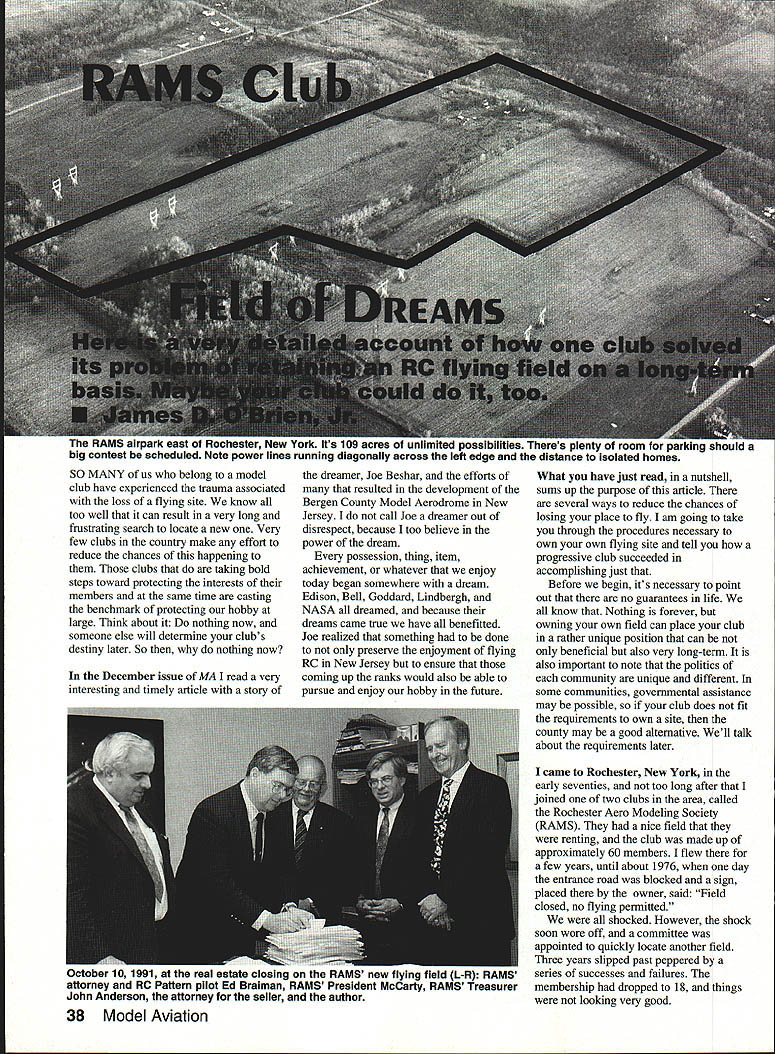
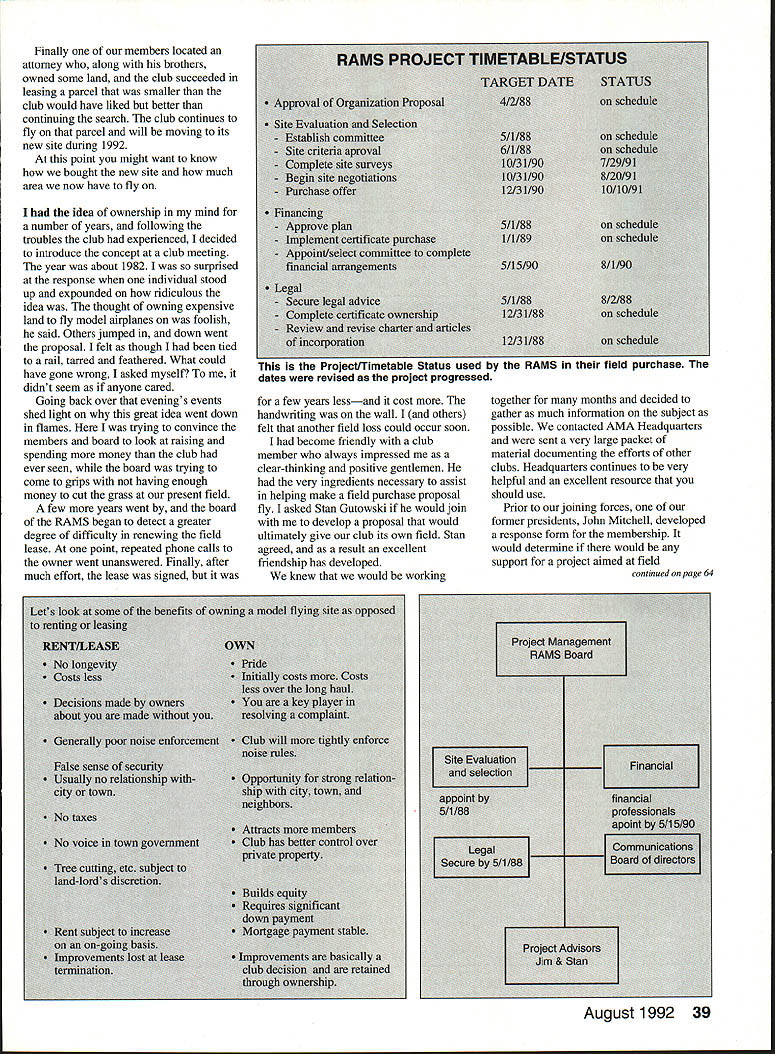
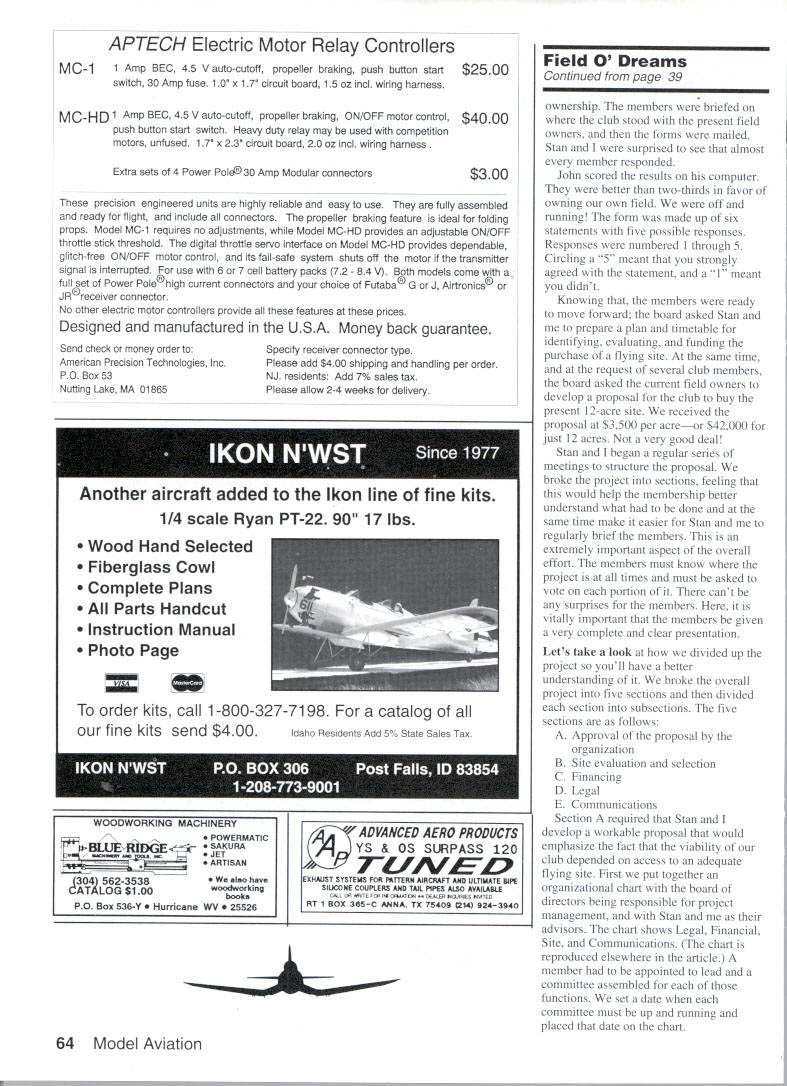
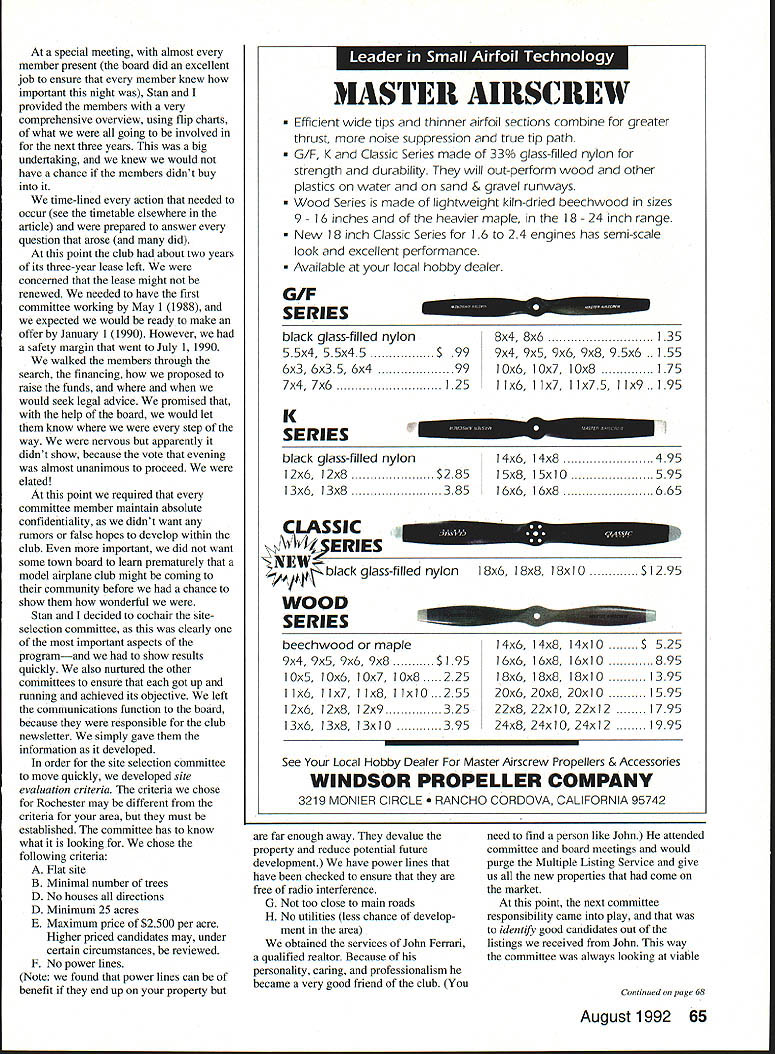
You may remember that our plan called for us to have a viable site candidate on which to make an offer by January 1, 1990 (with a safety margin of July 1, 1990). Even with all our effort, we didn't find the ideal site until July of 1991. (You must factor this into your planning, as there can be delays.) Our board made an offer on this site that was accepted. On October 10, 1991, we closed the deal on our 109-acre flying site. As a result of some very innovative financing, every member owns a portion of his club's new flying site. Needless to say, the excitement builds every day.
Financing
The finance aspect of the project is the next phase to examine. I chose to put the good part first by telling you that we not only developed a project/procedure to locate and purchase a site, but tested it and proved it successful. I do not mean to imply that finance is the difficult part; but as you know, any time we must part with more greenbacks it can be painful.
Stan and I discussed this point longer than any other aspect of the project. We of course knew what the dues were, and we needed to fix in our minds just what number a club member would accept. This is why we made several presentations to the members so they could adjust to the fact that there was going to be additional expense associated with owning our own flying site.
We felt that it was necessary to develop a certificate program, with each certificate having a specific value. This way, as members paid into the new fund through certificates, they would have valid documentation that they were, in fact, field partners. We set the value of one certificate at $75 and established that it would be necessary for every member to purchase five certificates at the rate of one per year for five years.
We also gave members the option of buying all five at once at a reduced cost of $50 per certificate. This would give the club an immediate injection of cash, as we were concerned that we should have a substantial nest egg to permit us to make an offer should a good candidate site become quickly available.
At this point, let's take a look at how much capital can be generated from a certificate program. Use your imagination here. How many members are in your club? If you don't have many members, are there other clubs in your area that would be willing to join with you in a common effort? At what value would your club set the certificate? How many certificates would you require your members to own? Would you offer a discount?
We chose the number of certificates at 150, because the RAMS enjoy membership of about 130. You can play with the numbers here. Don't be intimidated if your club is smaller. We all must start somewhere.
Certificate sale yield examples:
- 150 members x $250 = $37,500
- 150 members x $75 = $11,250
- 150 members x $75 x 5 yrs = $56,250
Estimated participation scenario:
- Est. 60 members x $250 = $15,000
- Est. 90 members x $75 (yr. #1) = $6,750
- Est. 90 members x $75 x 5 yrs = $33,750
As you can see, while the search is ongoing, many dollars can be accumulating to support the down payment and purchase. What would we do if we didn't have enough money from the certificates when we found the right site? Well, that is exactly what happened, and we were ready.
We had talked about this probability each time we made a presentation to the membership and had mentioned the need for "innovative financing." As soon as it was known how much additional money was needed, President McCarty personally called several members offering them the chance to participate in a mortgage that would earn them a reasonable interest on their investment. Over a dozen members stepped forward to be counted.
The mortgage is held by the board. As dues increase, which was unanimously approved by the membership, the dues fully cover the yearly mortgage payment to the investors. Additionally, it was felt that some individuals in the club might want to do more, so we developed a $1,000 Gold and $500 Silver certificate program. The purpose here was to encourage a larger contribution by recognizing the member in a special way.
The Gold certificate program provided:
- Five certificates
- Life membership / no dues
- Specially designed gold-lettered jacket
- Gift certificate for $50 or a quality field box
The Silver certificate offered all of the above less the life membership and field box. The Gold and Silver program requires payment in full up front with cash, check, Visa, or MasterCard. (As you can see, we even obtained credit card capability from a local bank to make it easier for members to pay for certificates!) The club absorbed the bank fee, but that point could be reviewed by your board.
The club board decided to refund money paid toward certificates to any member who made a request in writing prior to the time the club had an offer that was accepted. This refund procedure has since been modified, and the club will now place any member on a waiting list for a refund. A refund will be issued when a new member joins.
Leadership, bylaws, and legal
To make the entire field purchase program work, it was necessary to have some very capable, forward-thinking individuals on the board and at the executive level. We are fortunate to have good leadership. The presidents who held office during the time that the project was under way — John Mitchell, Warren Boudrie, Moe Jacobs, and Jim McCarty — all made their mark.
Our president for 1990 was an executive with Xerox Corporation and had a strong accounting background. Jim McCarty was clearly responsible for keeping everything on track as we approached the end. The more time that went by, the more intense things got. We knew that continuity at the leadership level was very important. One of our senior members, Vic Mazura, succeeded in talking Jim into running for reelection in 1991. Jim won, and the advantage of having the same person as president, doing all the same things that he had been doing so well, made the whole project go a lot smoother. Thank you, Jim.
It became necessary to modify the club's bylaws and articles of incorporation. In the process of modifying the club's bylaws, Stan and I found it advisable to redraft sections of the field proposal. We felt as if this were like two different gears that had never seen one another and now had to mesh perfectly. We were willing to do whatever was necessary to make that happen.
I won't bore you with the bylaw changes and field proposal changes that we made, as your club's bylaws are probably different from ours. You will do whatever is necessary as the need arises. It's important to point out here that there are many differences between various areas of the country and between cities. Land costs and availability can be major obstacles.
I fully realize that, because of what I have just mentioned, this project may be cost-prohibitive in your community. Other alternatives may be more appropriate, and I wish you much success in the direction you and your club elect to go if this project is not for you.
Regardless of your circumstances, do something to help ensure you have a place to fly for the future. Talk to the people at AMA Headquarters, as they are your greatest resource. If your community is situated within 30 to 45 minutes of farm country or open spaces, and land (farm or open spaces) can be found for $2,500 or less an acre, your club could be a good candidate for site ownership. Rochester, New York, fell into this category, and we took advantage of it.
Neighbor relations and closing
Prior to the October 10 closing date for our new site, I personally went to the neighbors (even though they were quite far away) and introduced myself. I explained to them the fine organization I represented and told them that we were planning to purchase a parcel of land nearby. My concern was that they knew right up front what we would be doing and that we would be good neighbors. I asked each of the people that I spoke with to sign a letter for the town board indicating that we had spoken to them regarding the RAMS objectives. Everyone signed, and one person even volunteered to go with us to visit the town fathers.
I also gave each neighbor our phone number and asked that they call us first should there ever be a problem. It is my opinion that when neighbors learn of your club's activities after the fact, they are on the defensive, and it will be very difficult if not impossible to turn them around.
I have found that the farther you go out into the countryside, the better chance of success you will have at keeping a site. Once the site is found, choose the club's best ambassador and begin making friends with the new neighbors. Your club must never forget that a promise made to your neighbor must be a promise kept, or your flying site won't be.
There is no better time than the present to begin tightening up the rules in your club, such as on mufflers, propellers, and noise. Practice now, so that later it will be not only perfect but routine.
I've tried to bring a human touch to this article, because clearly there are real people involved who make it all happen. I hope that you will dream as Stan and I and the RAMS did, because all dreams eventually do come true. They did for us, and they can for you.
Ironically, as I complete this article, I find myself relocating to Fairfax, Virginia, and will not have the opportunity to fly at the new field. But Stan will, and I'm sure that he and the RAMS membership will enjoy every minute of it.
Should you have any questions, I can be reached through the AMA and will be happy to assist if I can. Good luck and good health to you.
Field O' Dreams / O'Brien (continued)
(Continued from page 69)
The points above summarize our experience and the steps we took to achieve field ownership. If you have questions or would like clarification on any part of the process, contact AMA Headquarters or reach out through AMA for assistance. Good luck, and I hope your club's dream becomes reality.
Transcribed from original scans by AI. Minor OCR errors may remain.

