

Raunchy
George Perryman
The word "nostalgia" means fond memories from the past. Some of these I'd like to share with you.
A few years ago Harry Murphy of the Central Indiana Aeromodelers and Ralph Prey of the San Valerians began a new model contest event. They were the guiding force in establishing the Nostalgia class. Many others have publicized Nostalgia as well—drum beater Bob Larsh, for one. Bob and Ralph are the team who certify designs and engines eligible for competition. The Nostalgia event is now under sponsorship of the National Free Flight Society.
Many great gas model fliers of the 1940–1950 era contributed designs that are outstanding even today. Perhaps many of you don't know that our editor and publisher is among those who did. Carl Wheeley was FAI Power World Champion, flying on our U.S. team in 1954. His Senator design was one of the fine gas ships of that time and had an outstanding contest record. Perhaps Carl might build another Senator and have some fun flying Nostalgia again with those of us who enjoy gas.
Nostalgia models eligible for competition are limited to gas free-flight designs dating from January 1, 1943 through December 31, 1956. These designs must have been kitted, or have had plans published in commercial magazines or books. This period saw the phasing out of ignition engines along with the introduction of glow plugs—a boon for those, like me, who were poor at getting a good solder joint on wiring.
I remember cranking an ignition McCoy Red Head .60 mounted in an 850-sq.-in. "C" job. I was braver back then in the 1946–48 era, and lucky to have escaped not being cut too badly. Those big Smith coils put out 20,000 volts, and I can remember long blue electric sparks snaking out my dismal wiring joints and running up my arm, singeing hair clear to the elbow.
Most magazine articles are slanted toward advancing the state of the art in our great hobby of modeling. Since Nostalgia is my topic, I'll diverge somewhat and delve into past happenings. I'd like to share the events of one contest day, many years ago—a nostalgia tale that is, quite literally, electrifying and may sound unbelievable.
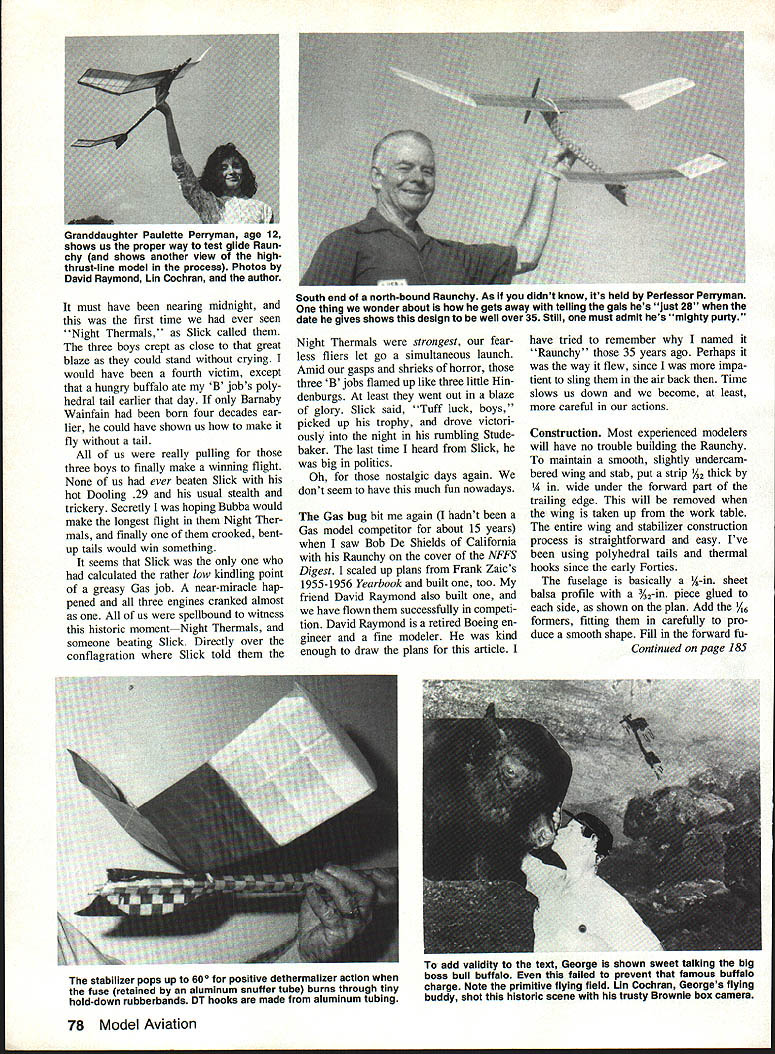
Occasionally, some good comes even from bad situations. My modeling club, the Atlanta Aero Engineers, flew on a rather primitive field. We shared this open area with a herd of wild buffalo that roamed at will through our flying site. Not many of you city boys have personally witnessed a buffalo's taste for a model airplane, but a model is a tasty treat to a buffalo.
We were holding a record trials on this historic day. I had just hand-cranked the mighty McCoy Red Head .60, and before I could launch it the big old boss bull buffalo edged in close to get a good bite of my model. Like a bolt of lightning, great blue sparks flew out of my messy wiring and set fire to the shaggy tuft of hair between that buffalo's eyes. You could have driven a Sherman tank in the daylight between his feet and the ground when he made the first of many mighty leaps. Some of his gyrations even Mary Lou Retton couldn't duplicate.
About a half-dozen fellow fliers were sitting nearby in the grass. They were enjoying lunch and drawing in some "scientific" books. A couple of them were letting the blood dry from their prop-cut fingers. They had spread before them what passed for a full seven-course Southern banquet feast—six RC Colas and a barbecued possum.
Immediately after seeing the buffalo's gymnastic proficiency, they held up their coloring books with a big "10" written on them. Good fortune for me, but not so for the Southern Railroad, whose track bed lay about 100 yards away. Not many of you have personally witnessed the charge of a mad bull buffalo. It is less exciting when he runs away from, instead of toward, you, but it gives you better odds at someday drawing Social Security.
That buffalo lowered his still-smoldering head, threw his tail straight up like one of those now-fangled antennas, and thundered toward the railroad track. With each snort he raised a big cloud of dirt and sticks, which looked exactly like a dust devil at Taft.
A passing freight train was the unlucky victim of his wrath. He hit that train broadside and derailed about 50 cars. Our luck held again: the boxcars piled up in the next field, so it didn't slow down our contest. Seemingly undamaged except for that big spot on his forehead, the bull gathered up his herd and was never seen again. A couple of the wrecked tank cars caught fire and burned so brightly that we got to extend our contest till nearly midnight.
Always alert, our contest director, Cousin Buford, punched his stopwatch on when the buffalo races began. And, being astute, he clicked it off when the last boxcar fell into a great, splintered pile. His watch read 52.95 seconds. We were flying a record trial that day, but our flying had been rather pitiful. With his usual craftiness Cousin Buford had turned our record book attempt disaster into a triumph of sorts. He sent the buffalo episode details to the Guinness Book of Records. The nice Guinness folks sent him a pretty certificate with a gold border to proclaim that Cousin Buford witnessed this epic. It read, in part, "Never in History has a Buffalo Derailed 50 Train Cars in the Space of Just 52.95 Seconds." To this day, people from all over come by to see it hanging proudly on his combination feed store and buggy repair shop.
Usually, this much excitement was all that one could stand in one day—but wait, the best part was yet to come.
"Slick" Sam, our cleverest modeler, was in the big bucks selling "choice" mail-order building lots to Yankees in the Great Dismal Smyrna Swamp. In fact, that hot night about 40-odd years ago—when the tank cars were blazing—Slick aced the boys' Class B Gas event. Slick had finished three pretty good flights to lead Bubba, Brutus and Jethro into the last flight.
Bubba would have finished his flights several hours earlier except for one thing: he couldn't get his engine running. He had trouble with soldered wiring, and I was sweet on his sister, Big Bertha. As an excuse to see her I went over to his house regularly and offered to wire up Bubba's Torp .29 ship. Bubba was busy building a new wing and tail, so I talked him into letting me put some bent-up kinks in the tail and some thermal hooks on the wings so it wouldn't be the only funny-looking plane at the contest.
Slick demonstrated his usual cunning. I can hear him exclaim excitedly to the three remaining threats to his victory, "Look—night thermals rising, burning tank cars!" It must have been nearing midnight, and this was the first time we had ever seen "night thermals," as Slick called them.
The three boys crept as close to that great blaze as they could stand without crying. I would have been a fourth victim, except that a hungry buffalo had eaten my 'B' job's polyhedral tail earlier that day. All of us were really pulling for those three boys to finally make a winning flight. None of us had ever beaten Slick with his hot Dooling .29 and his usual stealth and trickery. Secretly I was hoping Bubba would make the longest flight in those night thermals, and that one of those crooked, bent-up tails would win something.
Slick was the only one who had calculated the rather low kindling point of a greasy gas job. A near miracle happened and all three engines cranked almost as one. Directly over the conflagration where Slick said the night thermals were strongest, our fearless fliers let go a simultaneous launch.
Amid our gasps and shrieks of horror, those three little jobs flamed up like three little Hindenburgs. At least they went out in a blaze of glory. Slick said, "Tough luck, boys," picked up his trophy, and drove victoriously into the night in his rumbling Studebaker. The last time I heard from Slick, he was big in politics.
Oh, for those nostalgic days again. We don't seem to have this much fun nowadays.
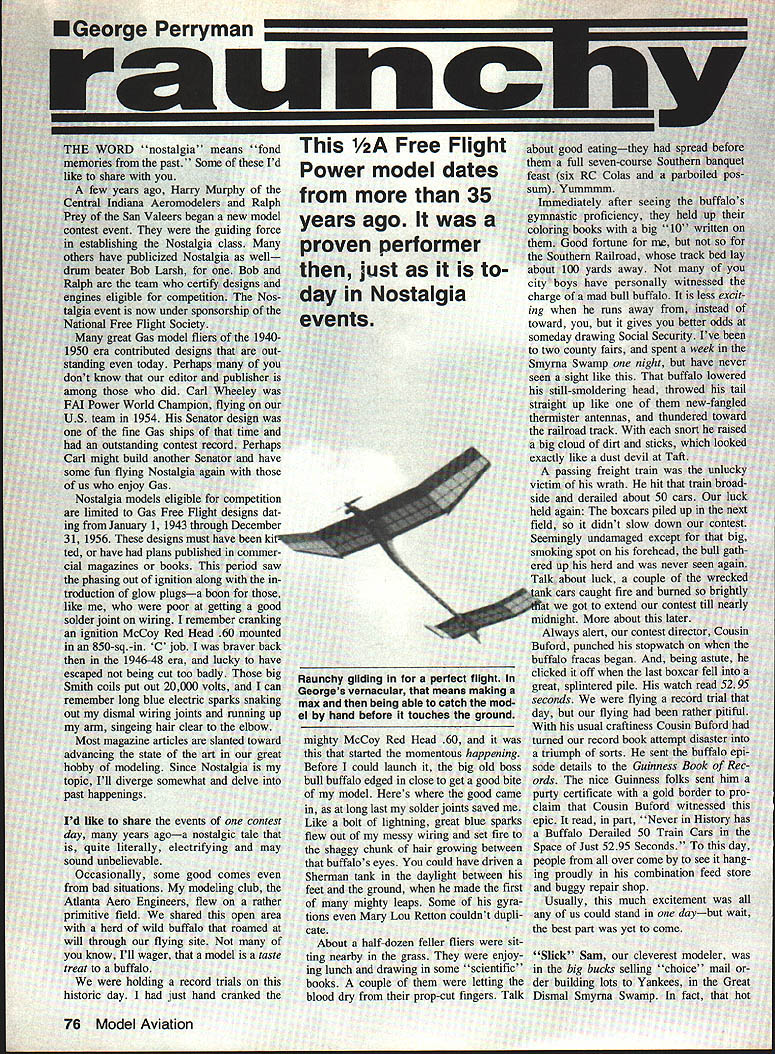
The gas bug bit me again (I hadn't been a gas model competitor for about 15 years) when I saw Bob De Shields of California with his Raunchy on the cover of the NFFS Digest. I scaled up plans from Frank Zaic's 1955–1956 Yearbook and built one, too. My friend David Raymond also built one, and we have flown them successfully in competition. David Raymond is a retired Boeing engineer and a fine modeler. He was kind enough to draw the plans for this article.
I have tried to remember why I named it "Raunchy" those 35 years ago. Perhaps it was the way it flew, since I was more impatient to sling them in the air back then. Time slows us down and we become, at least, more careful in our actions.
Construction
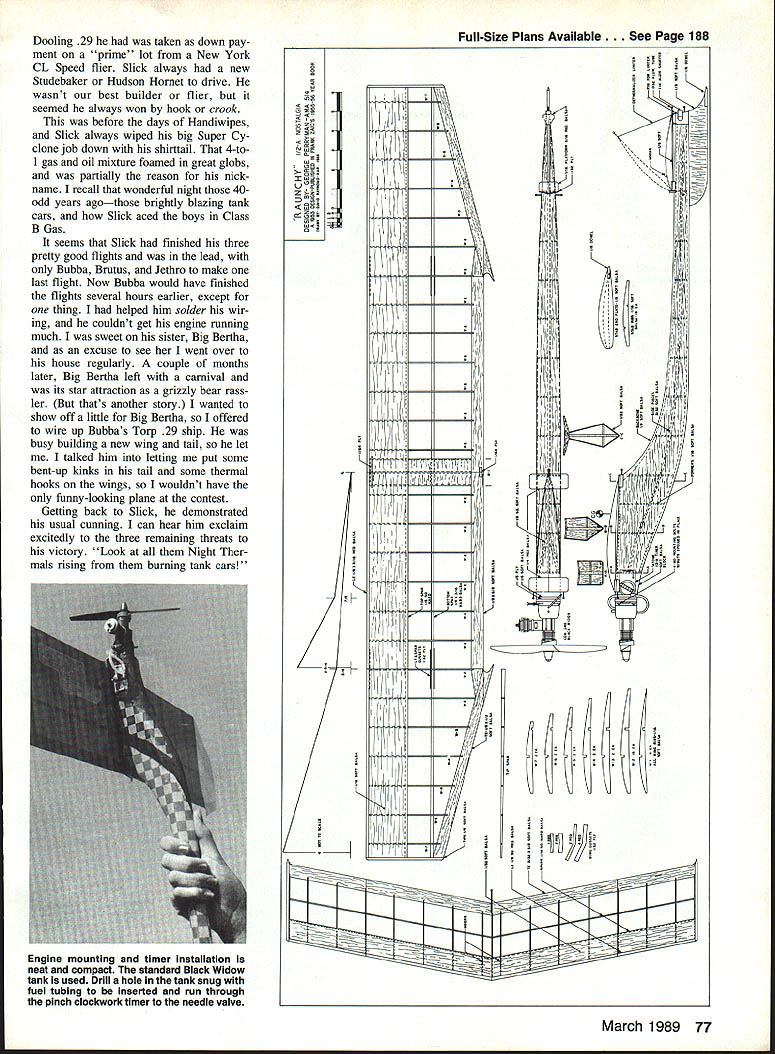
Most experienced modelers will have no trouble building the Raunchy. To maintain a smooth, slightly undercambered wing and stabilizer, put a strip 1/32" thick by 1/4" wide under the forward part of the trailing edge. The wing is taken up from the lower spar to the main spar. The entire wing and stabilizer construction process is straightforward and easy. I've been using polyhedral tails and thermal hooks since the early Forties.
The fuselage is basically 3/16" sheet balsa profile with a 3/16" piece glued to each side, as shown on the plan. Add the fillet former, fitting them in carefully to produce a smooth shape. Fill in the forward fuselage for about 2 in. with soft balsa blocks. Cover the fuselage with 1/32" soft balsa. Add the wing and stabilizer mounts and the sub-rudder.
Cover the entire model with Japanese tissue, and brush on four thin coats of butyrate dope. For hot-fuel proofing, I spray the entire model with a light coat of polyurethane. Most hardware or paint stores carry polyurethane in spray cans. Caution: spray only out of doors, since the fumes are somewhat toxic.
Flying
My completed Raunchy weighed 6½ oz. With a wing area of only 212 sq. in., and despite the thin wing and stabilizer airfoil sections, it climbs well and does pretty good gliding. I've gotten used to flying rubber ships and am out of practice with noisy and fast-moving airplanes, so I had to be careful testing Raunchy.
The conventional theory is that high-thrust-line ships should fly to the left under power, but Raunchy showed a mind of its own. It flew easily with right climb and left glide. I am so tickled it hasn't crashed yet that I'm going to leave it that way. It might, however, require more downthrust than shown on the plan.
I won't elaborate much on flying gas ships, because most of us have our own testing methods. With gas models I can't wind those magic 35 turns that I use on all my rubber ships for the first flights. With the engine running rich and the prop on backwards, this makes for a sort of safe first flight. Doing it this way, and as a five- or six-second engine run, is safer than going full bore for the first time out. Locate the balance point shown on the plan as a good starting place. Models are like girls, in that no matter how hard you try they do pretty much what they want to, anyway.
If you build a Raunchy, I hope you'll have as much fun with it as I've had with mine.
I believe that God has particularly blessed modelers with dreams, even though most of them never become reality. We dream of our next model or competition, which is as successful as in our fantasies.
Now, Nostalgia rules permit the scaling up or down of a design. Hmmm—if I could come by an ignition McCoy Red Head .60, and Sal Taibi would send me a trunk load of balsa, and Bob Hunter would send me a gallon of Hot Stuff, and George Schroeder would send me four or five yards of that fine Esaki silk, I could build a real big Raunchy. (Maybe I can even find my old soldering iron, and that ancient roll of frayed and brittle ignition wire.)
I know Ralph Prey will be enthusiastic about holding a commemorative, historic event in the interest of Nostalgia promotion. With his enterprise, Ralph should easily locate a prairie out West where the buffalo still roam and a train track runs nearby. There's no telling how many Nostalgia pilots would show up for a reenactment of air thrills from long ago.
In my dreams I can clearly see the veiled, misty curtain rising, and forms from the past emerging. Look! Here come Bubba, Brutus, and Jethro carrying their greasy "B" jobs.
Full-size plans available. See page 188.
Transcribed from original scans by AI. Minor OCR errors may remain.

