
RC AEROBATICS WORLD CHAMPIONSHIPS
Held on Sept. 10-13 at Berne, Switzerland, the championships saw great flying in spite of generally bad weather. Wolfgang Matt, Liechtenstein, was the individual champion while the United States took top team honors.
Sally Brown Photos by Ed Keck
THE 1975 WORLD CHAMPIONSHIPS is over with all its excitement, trials and joy now just very precious memories, of which I have many (good ones).
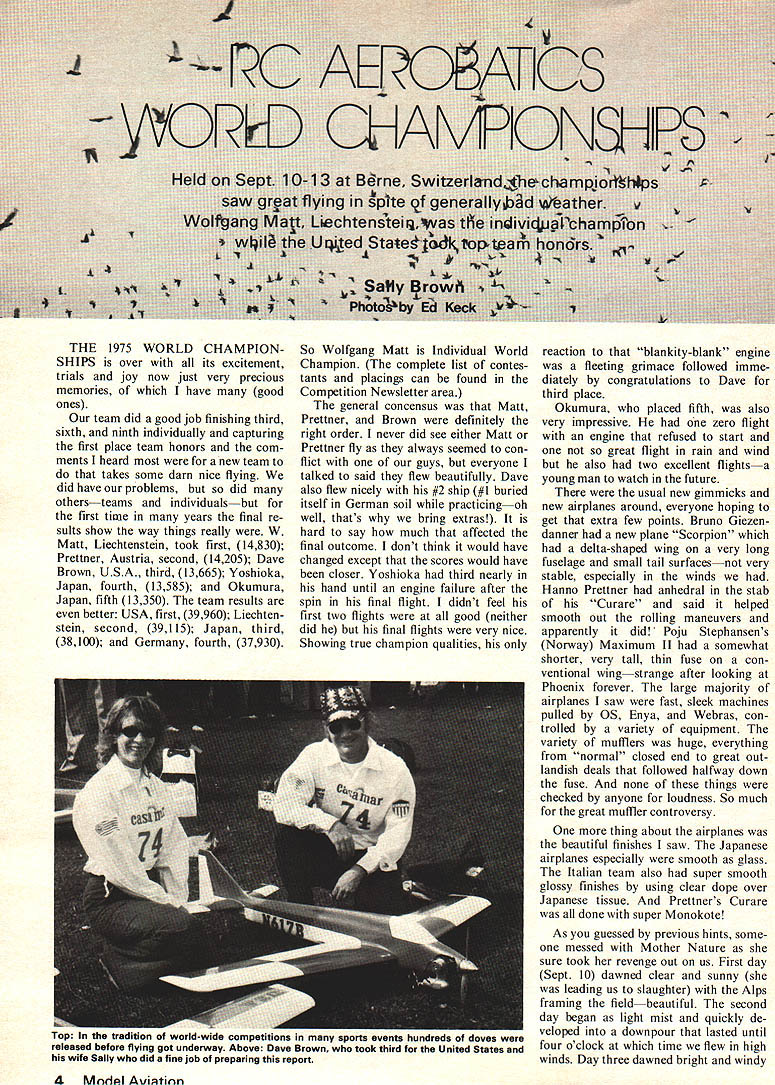
Our team did a good job finishing third, sixth, and ninth individually and capturing the first place team honors and the comments I heard most were for a new team to do that takes some darn nice flying. We did have our problems, but so did many others—teams and individuals—but for the first time in many years the final results show the way things really were. W. Matt, Liechtenstein, took first, (14,830); Prettner, Austria, second, (14,205); Dave Brown, U.S.A., third, (13,665); Yoshioka, Japan, fourth, (13,585); and Okumura, Japan, fifth, (13,350). The team results are even better: USA, first, (39,960); Liechtenstein, second, (39,115); Japan, third, (38,100); and Germany, fourth, (37,930).
So Wolfgang Matt is Individual World Champion. (The complete list of contestants and placings can be found in the Competition Newsletter area.)
The general concensus was that Matt, Prettner, and Brown were definitely the right order. I never did see either Matt or Prettner fly as they always seemed to conflict with one of our guys, but everyone I talked to said they flew beautifully. Dave also flew nicely with his #2 ship (#1 buried itself in German soil while practicing—oh well, that's why we bring extras!). It is hard to say how much that affected the final outcome. I don't think it would have changed except that the scores would have been closer. Yoshioka had third nearly in his hand until an engine failure after the spin in his final flight. I didn't feel his first two flights were at all good (neither did he) but his final flights were very nice. Showing true champion qualities, his only reaction to that "blankity-blank" engine was a fleeting grimace followed immediately by congratulations to Dave for third place.
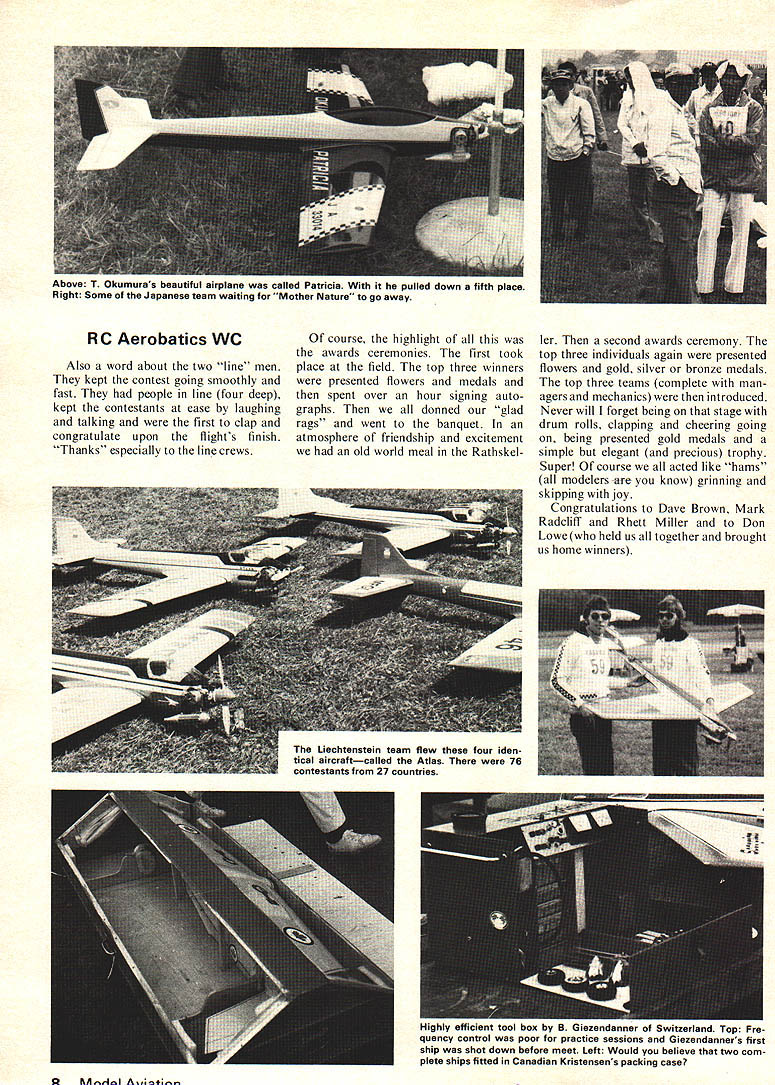
Okumura, who placed fifth, was also very impressive. He had one zero flight with an engine that refused to start and yet he had two excellent flights—a young man to watch in the future.
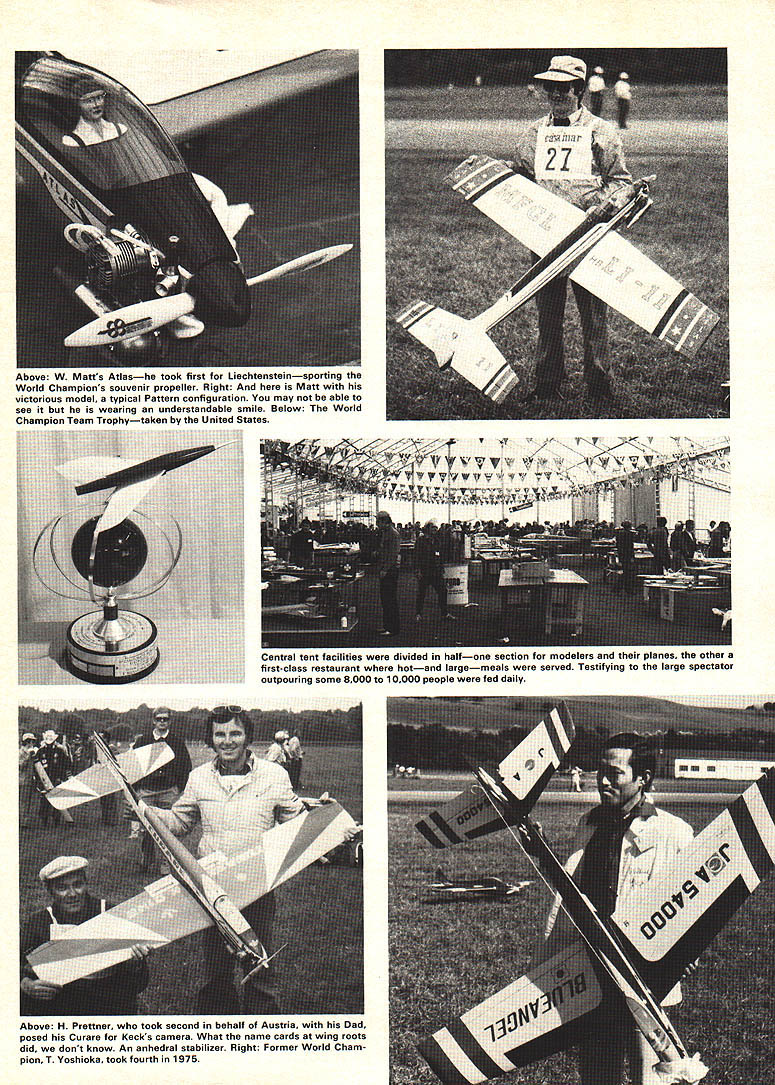
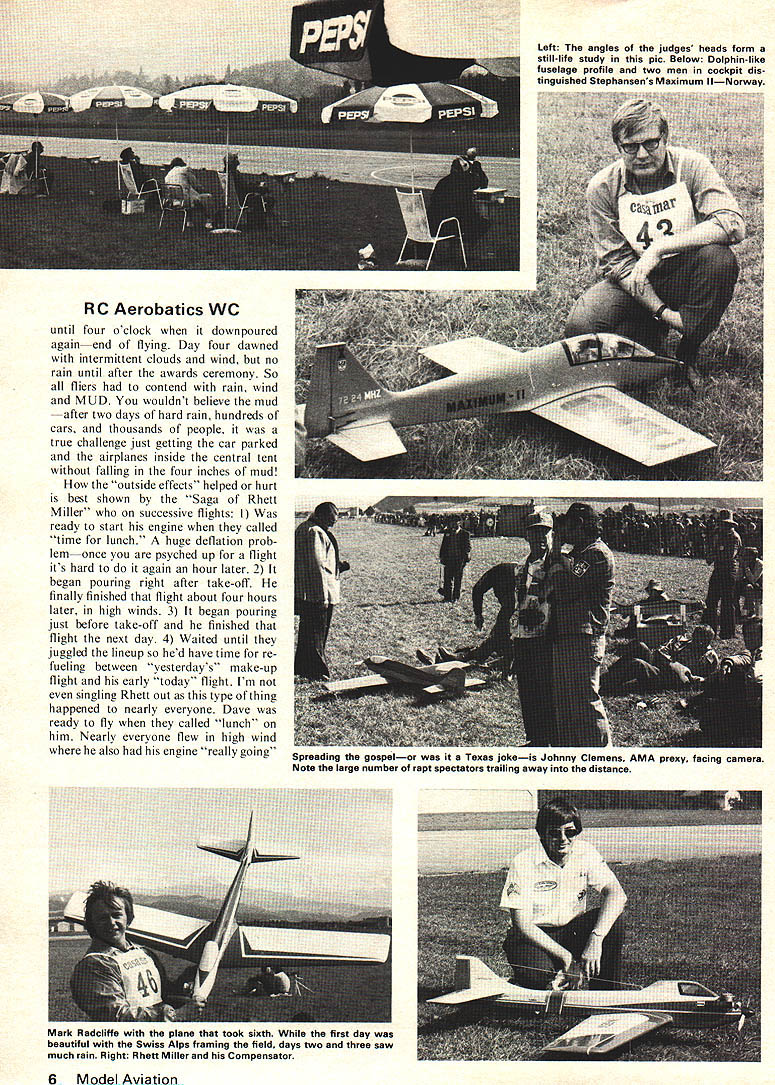
There were the usual new gimmicks and new airplanes around, everyone hoping to get that extra few points. Bruno Giezendanner had a new plane "Scorpion" which had a delta-shaped wing on a very long fuselage and small tail surfaces—not very stable, especially in the winds we had. Hanno Prettner had anhedral in the stab; his "Curare" said it helped smooth out the rolling maneuvers and apparently did it! Poju Stephansens' (Norway) Maximum II had a somewhat shorter, very tall thin fuse conventional wing—strange after looking at Phoenix forever. The large majority of airplanes were fast, sleek machines pulled by OS, Enya, and Webra, controlled by a variety of equipment. The variety of mufflers was huge, everything from "normal" closed end to great outlandish deals that followed halfway down the fuse. And none of these things were checked by anyone for loudness. So much for the great muffler controversy.
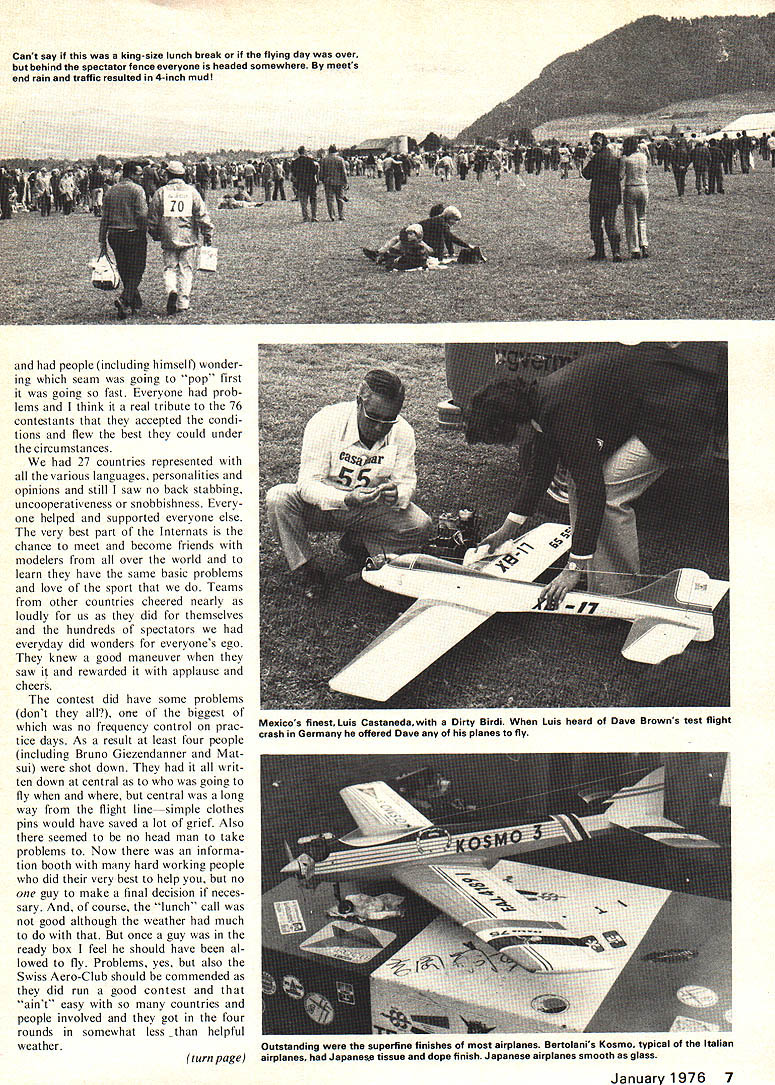
One more thing about the airplanes was the beautiful finishes I saw. The Japanese airplanes especially were smooth as glass. The Italian team also had super smooth glossy finishes by using clear dope over Japanese tissue. And Prettner's Curare was all done with super Monokote!
As you guessed by previous hints, someone messed with Mother Nature as she sure took her revenge out on us. First day (Sept. 10) dawned clear and sunny (she was leading us to slaughter) with the Alps framing the field—beautiful. The second day began as light mist and quickly developed into a downpour that lasted until four o'clock at which time we flew in high winds. Day three dawned bright and windy. The 1975 World Championships — over — its excitement, trials, joy now just very precious memories. We had some good ones. The team did a good job finishing third, sixth, ninth individually and capturing first-place team honors. Comments heard: "New team takes some darn nice flying." We did have problems; so did other teams and individuals. But, for the first time in years, final results show the way things really were.
W. Matt Liechtenstein took first, 14,830. Prettner, Austria, second, 14,205. Dave Brown, USA, third, 13,665. Yoshioka, Japan, fourth, 13,585. Okumura, Japan, fifth, 13,350.
Team results: USA first, 39,960. Liechtenstein second, 39,115. Japan third, 38,100. Germany fourth, 37,930.
So Wolfgang Matt, Individual World Champion. A complete list of contestants' placings can be found in the Competition Newsletter.
The general consensus: Matt, Prettner, Brown — definitely the right order. I never did see either Matt or Prettner fly; everyone talked — said they flew beautifully. Dave also flew nicely. The #2 ship/#1 buried itself in German soil practicing — oh well, that’s bringing extras. Hard to say how much it affected the final outcome; I don't think it would have changed things except that scores would have been closer.
Yoshioka had third nearly in hand until engine failure after a spin on the final flight. He didn't feel his first two flights were good, neither did his final flight — very nice showing true champion qualities. His reaction to the engine fleeting was a grimace followed immediately by congratulations. Dave's third place. Okumura placed fifth, also very impressive — a zero flight when his engine refused to start, a great flight in rain and wind, and two excellent flights.
A young man to watch for the future: the usual new gimmicks and new airplanes were around, everyone hoping to get an extra few points. Bruno Giezen-Danner's new plane, Scorpion, had a delta-shaped wing, very long fuselage and small tail surfaces — not very stable in strong winds. Hanno Prettner's anhedral stabilizer on Curare was said to help smooth out rolling maneuvers — apparently it did. Poju Stephansen's (Norway) Maximum II was somewhat shorter, with a very tall, thin fuselage and a conventional wing — strange after looking at Phoenix forever.
The large majority of airplanes were fast, sleek machines pulled by OS, Enya and Webra, controlled by a variety of equipment. The variety of mufflers was huge — everything from "normal" closed end to outlandish deals that followed halfway down the fuse. And none of these things were checked by anyone for loudness. So much for the great muffler controversy.
One more thing about the airplanes was the beautiful finishes. The Japanese airplanes especially were smooth as glass. The Italian team also had super-smooth glossy finishes using clear dope over Japanese tissue. Prettner's Curare was done with super Monokote!
As you guessed by previous hints, Mother Nature sure took her revenge on us. First day (Sept. 10) dawned clear and sunny (she was leading us to slaughter) with the Alps framing the field — beautiful. The second day began as light mist and quickly developed into a downpour that lasted until four o'clock at which time we flew in high winds. Day three dawned bright and windy until four o'clock when it downpoured again and ended flying. Day four dawned with intermittent clouds and wind, no rain until after the awards ceremony. So fliers contend with rain, wind, and mud — you wouldn't believe the mud after two days of hard rain. Hundreds of cars and thousands of people made the true challenge getting cars parked and airplanes inside.
RC Aerobatics WC
How the "outside effects" helped or hurt is best shown by the "Saga of Rhett Miller" who on successive flights: 1) Was ready to start his engine when they called "time for lunch." A huge deflation problem — once you are psyched up for a flight it's hard to do it again an hour later. 2) It began pouring right after take-off. He finally finished that flight about four hours later, in high winds. 3) It began pouring just before take-off and he finished that flight the next day. 4) Waited until they juggled the lineup so he'd have time for refueling between "yesterday's" make-up flight and his early "today" flight. I'm not even singling Rhett out as this type of thing happened to nearly everyone. Dave was ready to fly when they called "lunch" on him. Nearly everyone flew in high wind where he also had his engine "really going." and had people (including himself) wondering which seam was going to "pop" first — it was going so fast. Everyone had problems and I think it is a real tribute to the 76 contestants that they accepted the conditions and flew the best they could under the circumstances.
We had 27 countries represented with all the various languages, personalities and opinions and still I saw no back stabbing, uncooperativeness or snobbishness. Everyone helped and supported everyone else. The very best part of the Internats is the chance to meet and become friends with modelers from all over the world and to learn they have the same basic problems and love of the sport that we do. Teams from other countries cheered nearly as loudly for us as they did for themselves and the hundreds of spectators we had every day did wonders for everyone's ego. They knew a good maneuver when they saw it and rewarded it with applause and cheers.
The contest did have some problems (don't they all?), one of the biggest of which was no frequency control on practice days. As a result at least four people (including Bruno Giezendanner and Matsui) were shot down. They had it all written down at central as to who was going to fly when and where, but central was a long way from the flight line — simple clothes pins would have saved a lot of grief. Also there seemed to be no head man to take problems to. Now there was an information booth with many hard working people who did their very best to help you, but no one guy to make a final decision if necessary. And, of course, the "lunch" call was not good although the weather had much to do with that. But once a guy was in the ready box I feel he should have been allowed to fly. Problems, yes, but also the Swiss Aero-Club should be commended as they did run a good contest and that "ain't" easy with so many countries and people involved and they got in the four rounds in somewhat less than helpful weather.
RC Aerobatics WC
Also a word about the two "line" men. They kept the contest going smoothly and fast. They had people in line (four deep), kept the contestants at ease by laughing and talking and were the first to clap and congratulate upon the flight's finish. "Thanks" especially to the line crews.
Of course, the highlight of all this was the awards ceremonies. The first took place at the field. The top three winners were presented flowers and medals and then spent over an hour signing autographs. Then we all donned our "gladrags" and went to the banquet. In an atmosphere of friendship and excitement we had an old world meal in the Rathskeller. Then a second awards ceremony. The top three individuals again were presented flowers and gold, silver or bronze medals. The top three teams (complete with managers and mechanics) were then introduced. Never will I forget being on that stage with drum rolls, clapping and cheering going on, being presented gold medals and a simple but elegant (and precious) trophy. Super! Of course we all acted like "hams" (all modelers are you know) grinning and skipping with joy.
Congratulations to Dave Brown, Mark Radcliff and Rhett Miller and to Don Lowe (who held us all together and brought us home winners).
Transcribed from original scans by AI. Minor OCR errors may remain.

