
RC Aerobatics World Championships
Summary
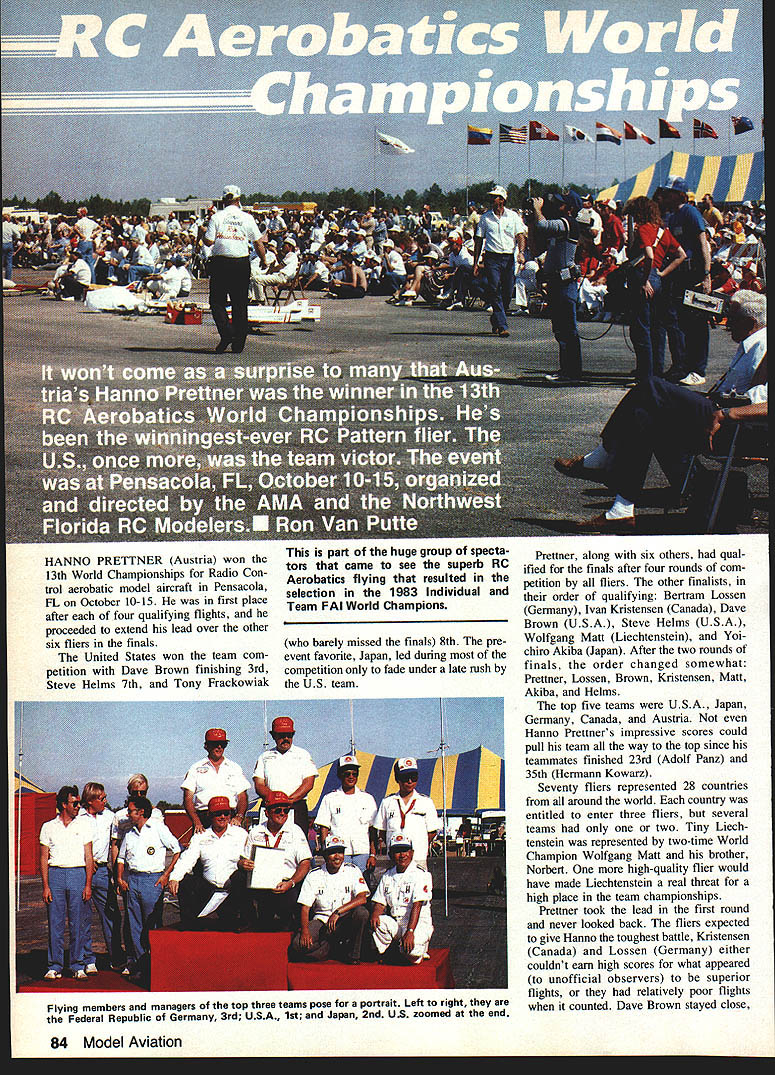
Hanno Prettner (Austria) won the 13th RC Aerobatics World Championships, held in Pensacola, Florida, October 10–15. The United States captured the team title. The event was organized and directed by the AMA and the Northwest Florida RC Modelers.
Key facts
- Individual champion: Hanno Prettner (Austria)
- Team champion: United States
- Dates: October 10–15
- Venue: Bronson Field (former Navy airfield), west of Pensacola near Perdido Bay
- Competitors: 70 fliers from 28 countries
- Noise limit: engines and propellers were required to be under 105 dB measured 1 meter from the propeller disk at maximum RPM
Results
Finalists (qualified after four rounds)
In order of qualifying:
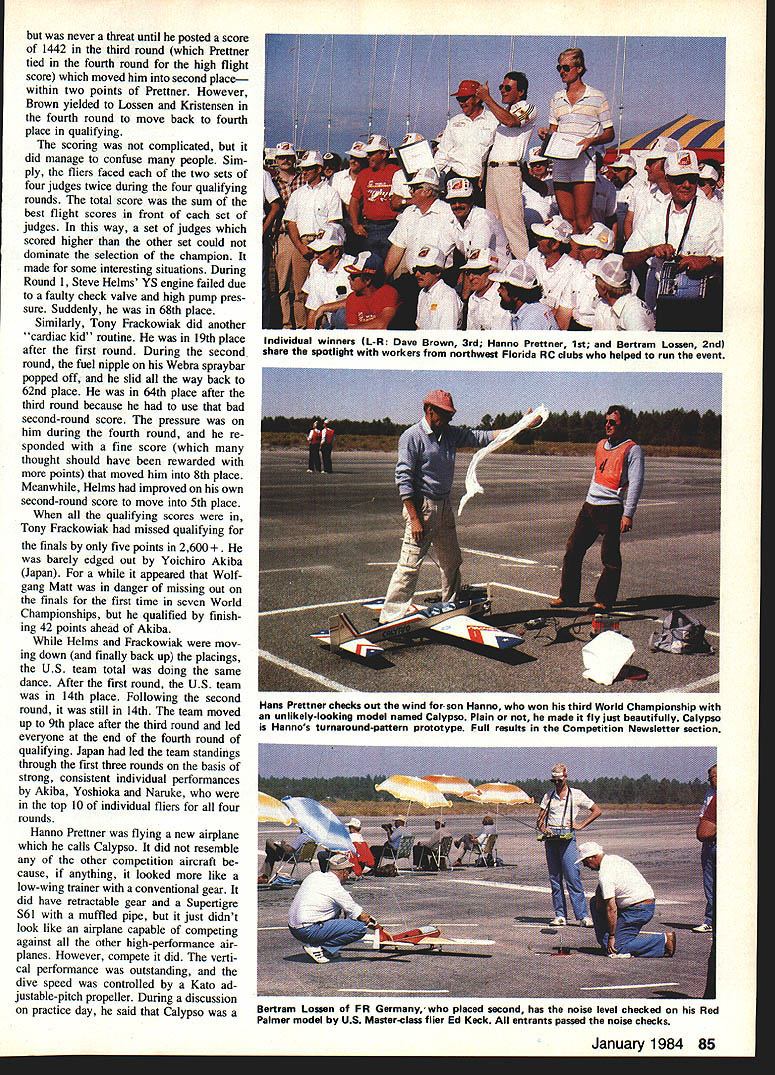
- Hanno Prettner (Austria)
- Bertram Lossen (Germany)
- Ivan Kristensen (Canada)
- Dave Brown (USA)
- Steve Helms (USA)
- Wolfgang Matt (Liechtenstein)
- Yoichiro Akiba (Japan)
After two final flights the finishing order among the finalists was:
- Hanno Prettner
- Bertram Lossen
- Dave Brown
- Ivan Kristensen
- Wolfgang Matt
- Yoichiro Akiba
- Steve Helms
Team standings (top five)
- 1. USA
- 2. Japan
- 3. Germany
- 4. Canada
- 5. Austria
Note: Austria’s team placing was limited despite Prettner’s top performance because his teammates finished well down the list (Adolf Panz 23rd, Hermann Kowarz 35th).
Competition narrative
Qualifying and finals
Prettner led from the first round and maintained his advantage through the finals. Dave Brown stayed close and posted a notable 1,442 in the third round that put him in serious contention. Bertram Lossen and Ivan Kristensen were expected to challenge Prettner but did not always receive high scores when judged.
Qualifying used two sets of four judges flown twice over four rounds; the total qualifying score was the sum of the best flight scores from the primary judge set. Because one judge panel tended to score higher, that panel could dominate selections and created some confusing situations for competitors and spectators.
Final scoring used all eight judges on a single line. The overall total combined qualifying scores and the best of the two final flights, so the finals accounted for half of the final score.
Team fluctuation
The U.S. team standings fluctuated dramatically during qualifying:
- After round 1: 14th
- After round 2: 14th
- After round 3: 9th
- After round 4: moved to the lead and ultimately won the team title
Japan led the team standings through the first three rounds on the strength of consistent performances by Akiba, Yoshioka, and Naruke.
Equipment failures and recoveries
Several top fliers suffered mechanical problems that affected standings:
- Steve Helms experienced a YS engine failure caused by a faulty check valve/high pump pressure in round 1 and dropped to 68th; he later improved and recovered into the top qualifying positions.
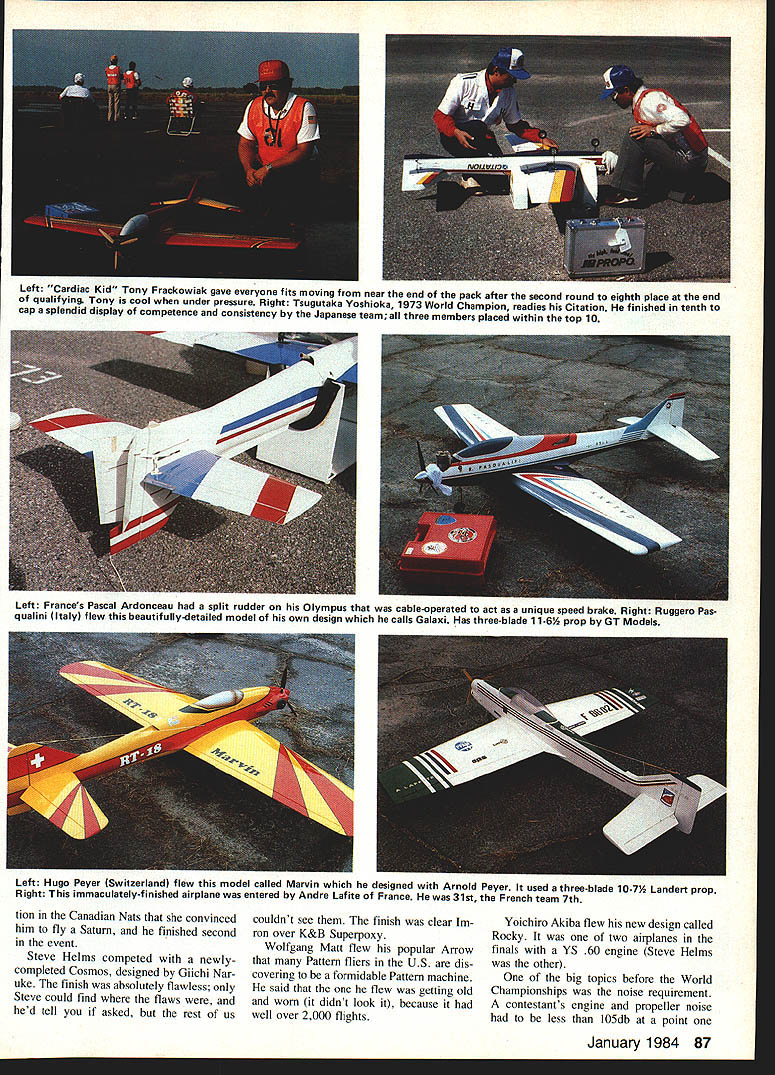
- Tony Frackowiak had a Webra spraybar fuel nipple pop off in round 2 and fell into the 60s before improving later in the contest.
- Other competitors also faced misfortunes that altered the qualifying order.
Aircraft and equipment
Notable airplanes
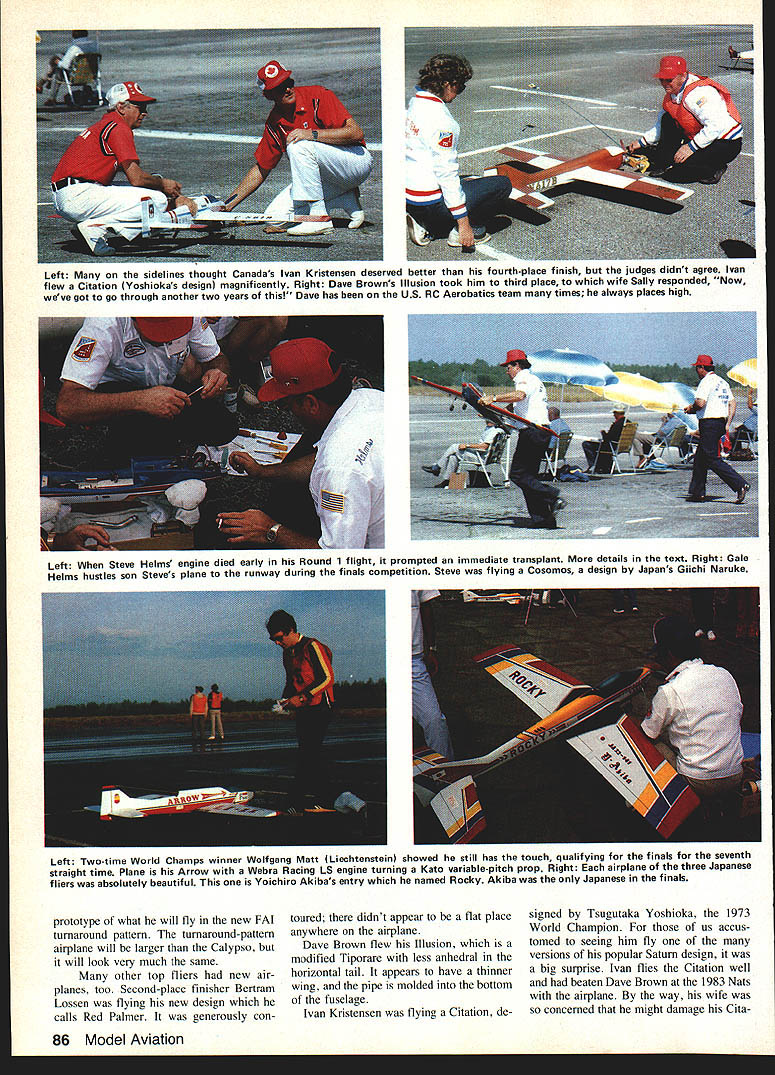
- Hanno Prettner — Calypso: a prototype turnaround-pattern design that resembled a low-wing trainer with conventional gear (it did have retractable gear). Powered by a Super Tigre S61 with a muffled pipe and using a Kato adjustable-pitch propeller. Vertical performance and dive control were outstanding.
- Bertram Lossen — Red Palmer: a new, highly contoured design with very smooth lines.
- Dave Brown — Illusion: a modified Tiporare with less anhedral in the horizontal tail, a thinner wing and a molded-in exhaust pipe.
- Ivan Kristensen — Citation: designed by Tsugutaka Yoshioka (1973 World Champion); a departure from Kristensen’s usual Saturn variants.
- Steve Helms — Cosmos: newly completed, flawless finish (clear Imron over K&B Superpoxy).
- Wolfgang Matt — Arrow: a durable, proven pattern machine with many flights on the airframe.
- Yoichiro Akiba — Rocky: a new design flown with a YS .60.
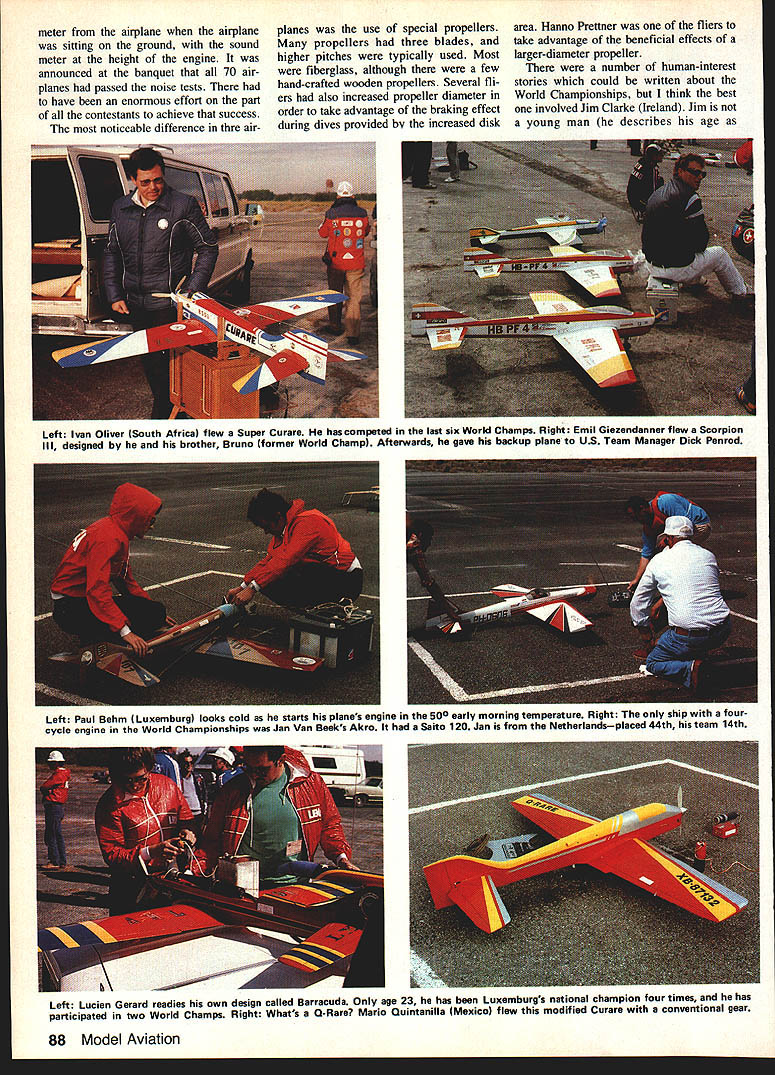
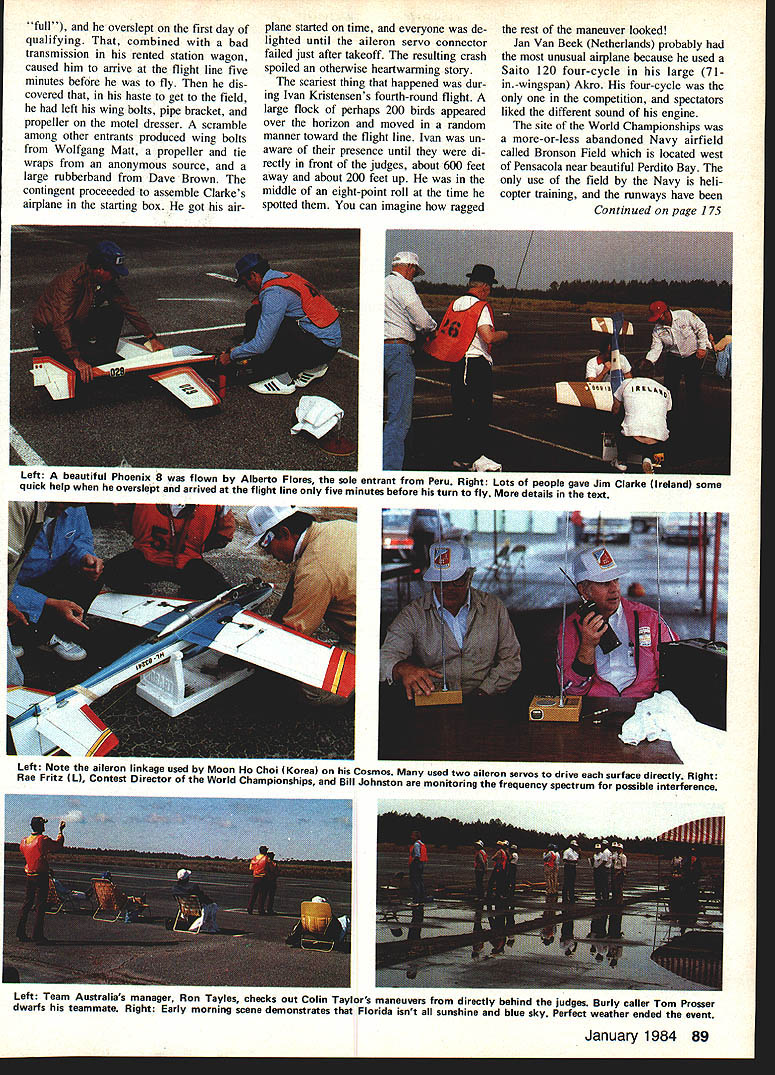
- Jan Van Beek (Netherlands) — large Akro powered by a Saito 120 four-cycle (unique sound and the only four-cycle in the competition).
Propellers and noise control
- Many competitors used special propellers: three-blade props and higher pitch settings were common.
- Fiberglass props were prevalent, though some hand-crafted wooden props were used.
- Several fliers increased propeller diameter to gain braking effect during dives via larger disk area; Prettner was among those using a larger-diameter prop.
- The event enforced a noise limit of 105 dB at 1 meter from the propeller disk at max rpm.
Venue, weather, and logistics
Venue
Bronson Field was an underused former Navy airfield with cracked runways and grass sprouting through the pavement. Organizers worked for weeks to cut and clear the tall grass and prepare the site.
Weather
- Monday (check-in): misty rain
- Tuesday (official practice): heavy rain and wind in the morning, clearing by evening
- Wednesday (first competition day): thunderstorms before start; competition delayed only 15 minutes
- Thursday: cold (about 50°F), low overcast and strong wind delayed the start two hours; some flights extended into extra time to catch up
- Friday: cold, cloudy and windy; additional catch-up hour completed Friday’s schedule
- Saturday: fourth qualifying round finished in bright sunshine and balmy temperatures; finals enjoyed continued good weather
Scoring and tabulation
- Scores were posted promptly after each flight thanks to a dedicated crew who hand-carried score sheets from the flight lines to the tabulation center.
- A computer program written by David H. Knowles processed scores quickly, eliminating many hand calculations and speeding distribution of individual and team standings.
Notable incidents and human interest
- Aileron servo connector failure: Prettner’s Calypso reportedly had an aileron servo connector fail just after takeoff during the event, resulting in a crash that spoiled an otherwise promising story for the prototype.
- Bird interference: During Ivan Kristensen’s fourth-round flight a large flock of roughly 200 birds suddenly appeared about 600 feet from the judges and about 200 feet high, arriving in front of the flight line while Kristensen was mid-maneuver. The roll that followed was understandably ragged.
- Human interest: Tiny Liechtenstein was represented by two-time World Champion Wolfgang Matt and his brother Norbert; with one more high-quality flier they might have been a serious contender for the team title. Jim Clarke (Ireland) and other veteran competitors also contributed memorable stories and spirit to the event.
Awards, banquet, and acknowledgments
- After the finals there was a four-hour break followed by a banquet and awards ceremony at the Pensacola Country Club.
- A slide show of competition photographs (160 selected slides) was presented before the banquet and was well received.
- Special recognition is given to the contest organizers and core volunteers. Two individuals singled out for their role in making the event a world-class competition were Rae Fritz (contest director) and Ron Chidgey, who assembled the organizing team.
Transcribed from original scans by AI. Minor OCR errors may remain.

