
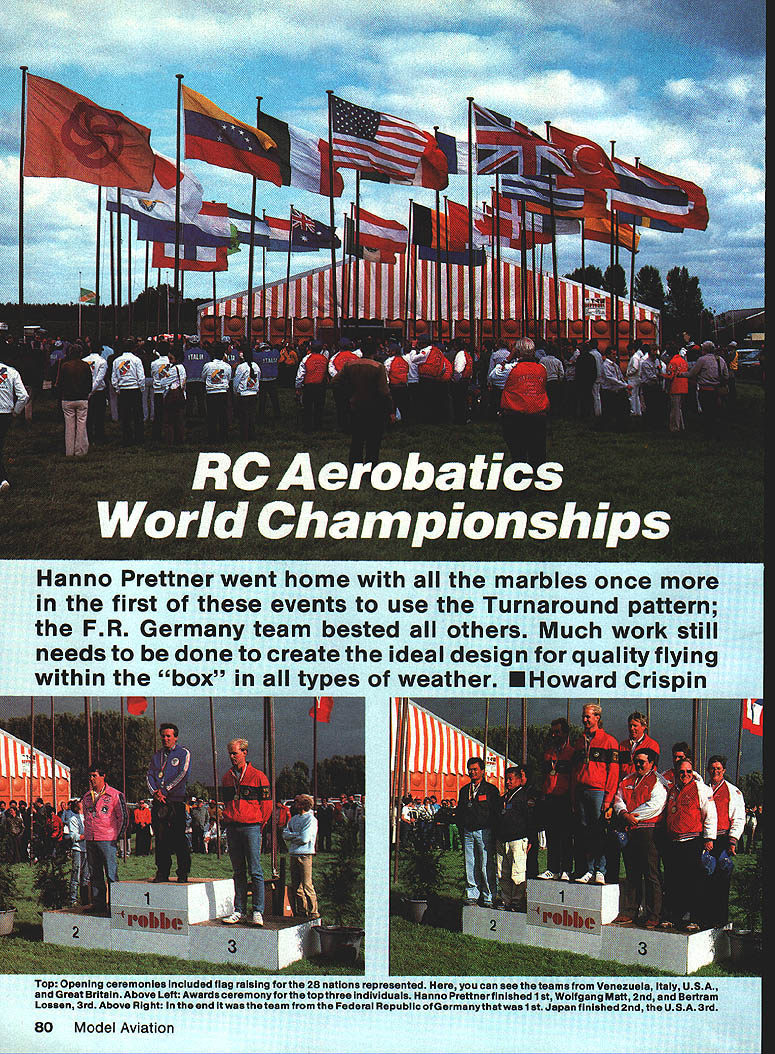

RC Aerobatics World Championships
Hanno Prettner went home with all the marbles once more in the first of these events to use the Turnaround pattern. The F.R. Germany team bested all others. Much work still needs to be done to create the ideal design for quality flying within the "box" in all types of weather.
Event overview
- 14th F3A RC Aerobatics World Championships, Flevohof, The Netherlands.
- 78 fliers from 28 countries participated.
- New nation attending: Thailand.
- More countries brought full three-member teams than at the previous World Championships.
Site and organization
Flying field and runways
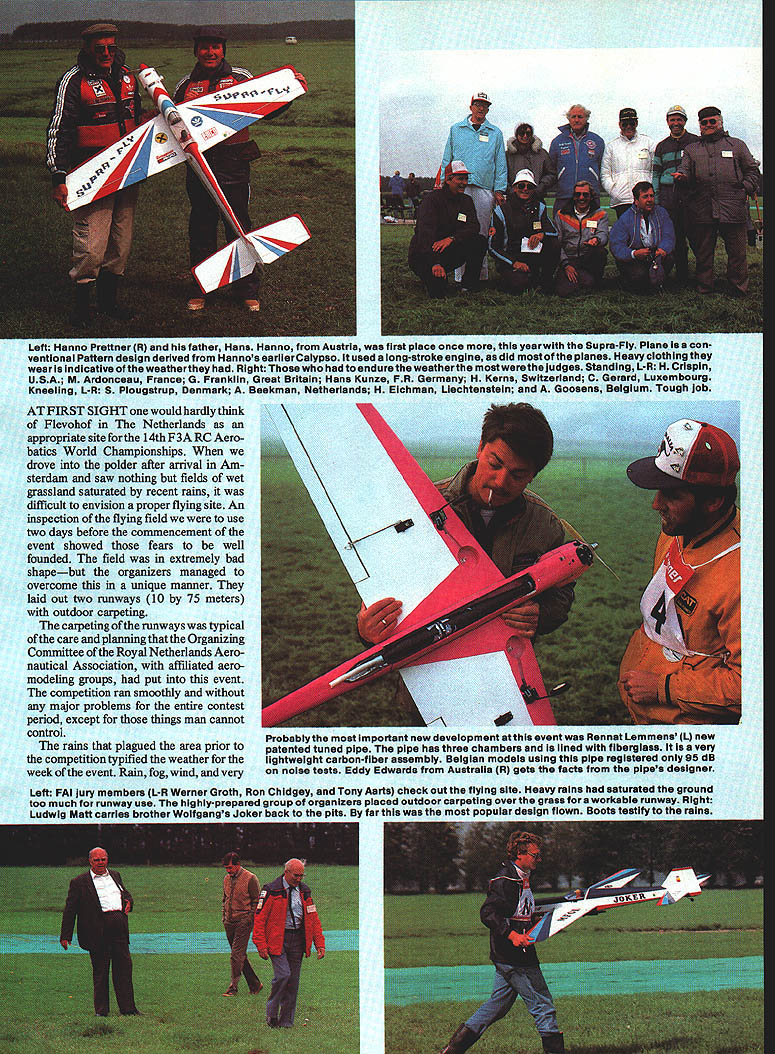
At first sight Flevohof did not look like a suitable site — the surrounding polder and saturated grassland made a proper flying site hard to envision. Two days before the event the field was in very poor condition, but the Organizing Committee of the Royal Netherlands Aeronautical Association and affiliated clubs overcame the problems by laying out two carpeted runways (10 × 75 m) using outdoor carpeting. The carpeted runways were a key factor in making normal operations possible.
Flight lines, judges and safety
- Two flight lines were used, separated by about 800 meters to prevent crossover interference.
- There was a line of trees approximately 300 meters in front of Line A and another about 250 meters in front of Line B; both were parallel to the flight lines.
- Ten judges who would otherwise have been standing in the wet, muddy area were provided raised platforms built of plywood and bracing.
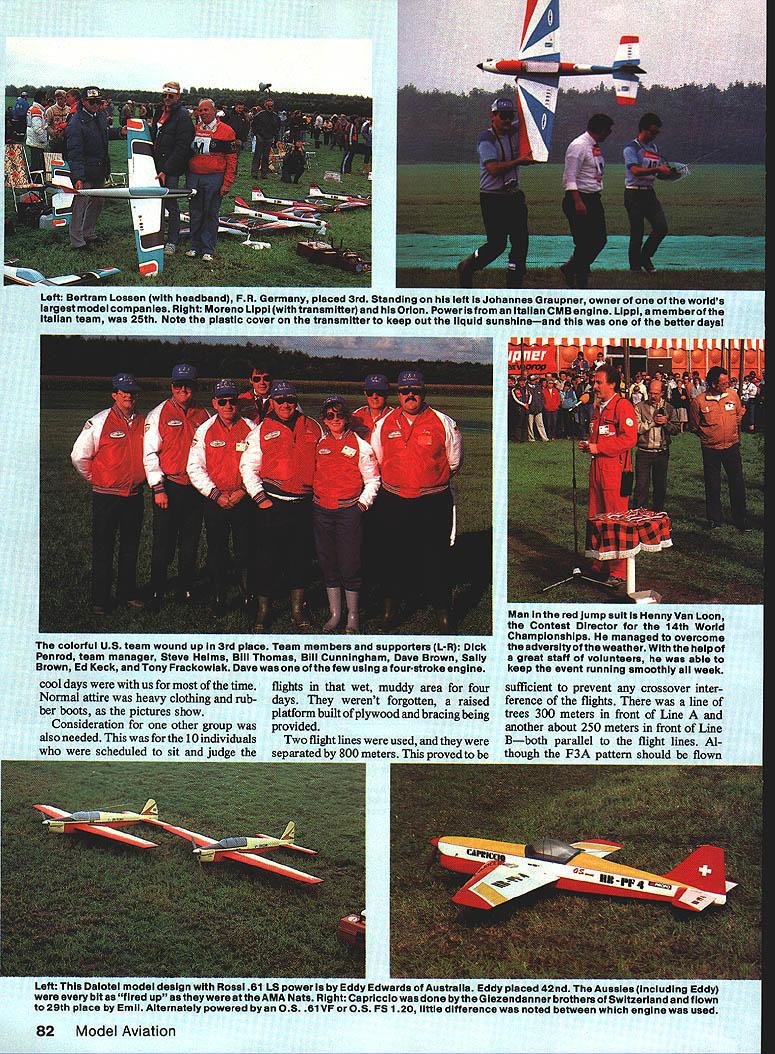
- Henny Van Loon was Contest Director, supported by a large volunteer staff; the event ran smoothly despite adverse weather.
Weather and conditions
- The competition week featured rain, fog, wind, and generally cold conditions requiring very heavy clothing.
- Fog delayed flying on Thursday until after 10:00 a.m.
- Strong crosswinds on two days created particular difficulty for many competitors, especially during the flyoff finals.
Competitors and equipment
Competitors
- The field contained a mix of long-time world-class fliers and many newcomers from areas with less competitive experience.
- Notably missing were South African entrants, a result of international politics impacting participation.
Engines and aircraft trends
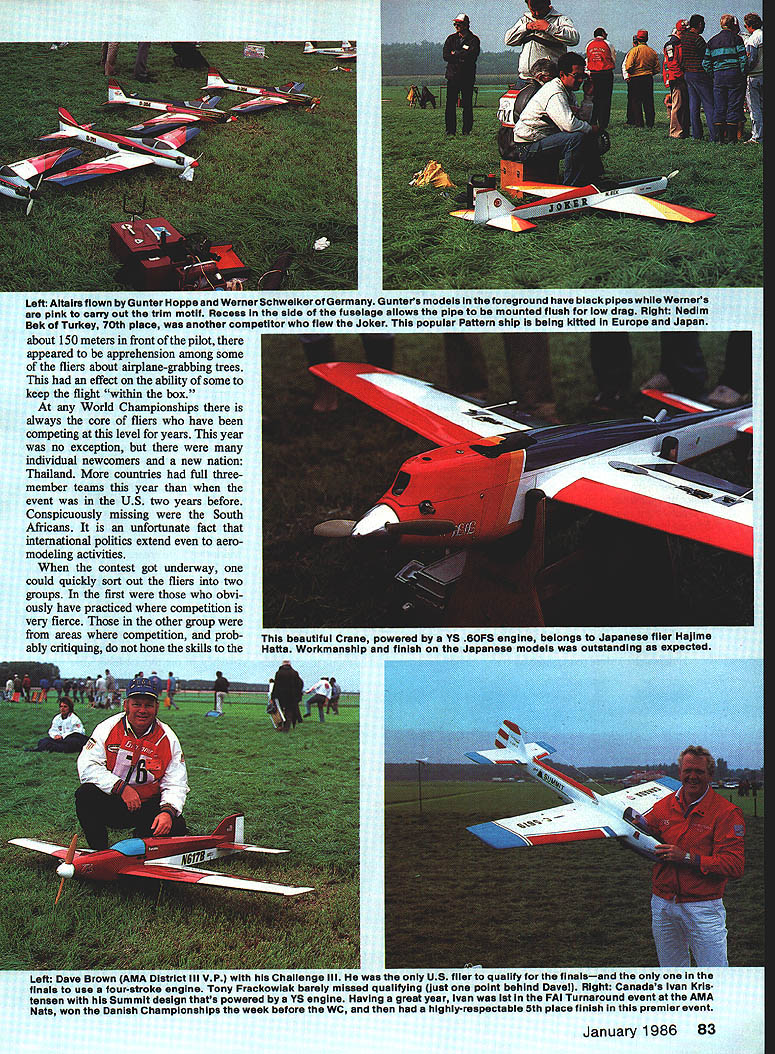
- Two-stroke engines remained the preferred choice; four-stroke engines had not gained wide acceptance due to concerns about maintainability, reliability, and lack of noise or power advantage.
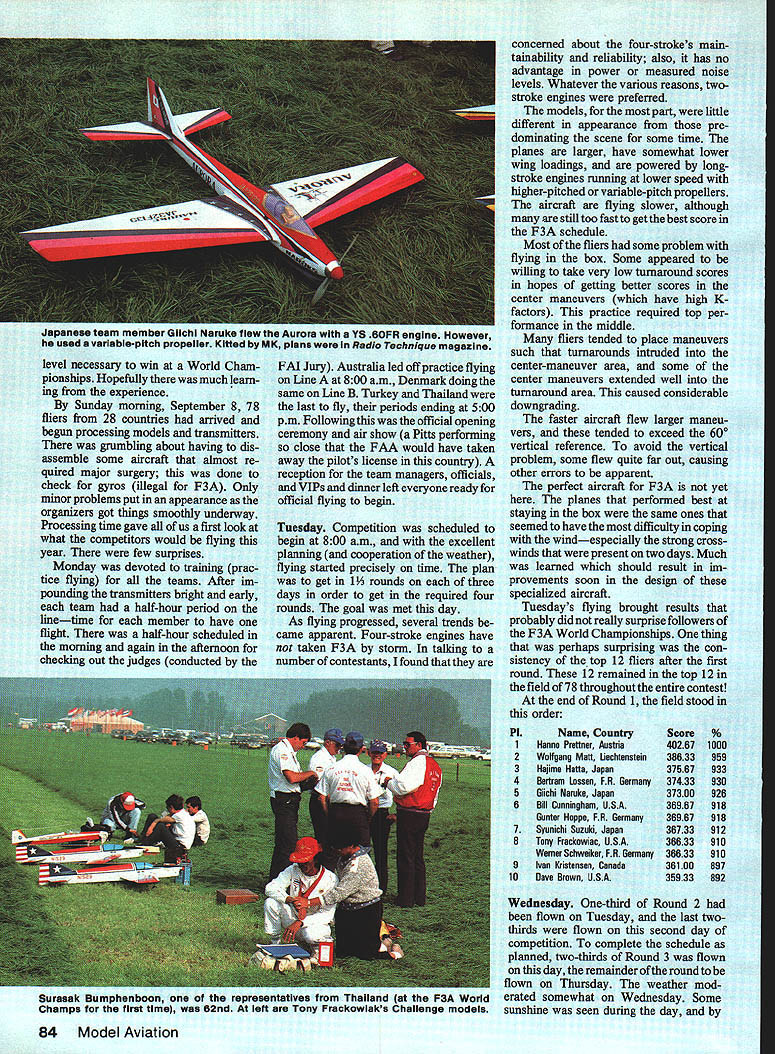
- Models tended to be larger with lower wing loadings, powered by long-stroke engines at lower RPMs with higher-pitched or variable-pitch propellers. Aircraft were generally flying slower than in the past, though many were still too fast for optimal F3A scoring.
- A key equipment development at the event was Renaat Lemmens' patented tuned pipe: a lightweight, three-chamber, fiberglass-lined carbon-fiber assembly. Belgian modelers using the pipe recorded only 95 dB on noise tests; the pipe was singled out as the most outstanding new piece of equipment at Flevohof.
Processing, practice and judging
- By Sunday morning, September 8, 78 fliers had arrived and began processing models and transmitters.
- Some competitors had to disassemble aircraft for inspection (to check for grobs — illegal for F3A).
- Monday was devoted to practice: transmitters were impounded early and each team received two half-hour practice periods (one in the morning, one in the afternoon). Australia led off practice on Line A at 8:00 a.m.; Denmark led off on Line B. Turkey and Thailand were the last to fly, finishing at 5:00 p.m.
- The FAI Jury conducted a judges' checkout before practice flights.
- An opening ceremony, air show, and receptions followed the practice day.
Competition summary by day
Tuesday
- Competition began promptly at 8:00 a.m.
- The plan was to fly 1½ rounds per day across three days to complete four qualifying rounds; the goal for Day 1 was met.
- Early trends:
- Two-stroke engines dominated.
- Many pilots struggled to keep models inside the box; some accepted low turnaround scores in hopes of excelling on high K-factor center maneuvers.
- Faster aircraft tended to fly larger maneuver sets that exceeded the 60° vertical reference; some pilots flew farther out to avoid vertical errors, causing other penalties.
- The ideal F3A aircraft had not yet emerged: those best at staying in the box often had difficulty with crosswinds.
- At the end of Round 1 the standings were:
- Hanno Prettner, Austria — 402.67 — 1000
- Wolfgang Matt, Liechtenstein — 386.33 — 959
- Hajime Hata, Japan — 376.07 — 933
- Bertram Lossen, F.R. Germany — 374.33 — 930
- Gilchi Naruke, Japan — 373.00 — 926
- Bill Cunningham, U.S.A. — 369.67 — 918
- Gunter Hoppe, F.R. Germany — 369.07 — 917
- Sunichi Suzuki, Japan — 367.33 — 914
- Tony Frackowiak, U.S.A. — 366.33 — 911
- Werner Schweiker, F.R. Germany — 365.33 — 910
- Ivan Kristensen, Canada — 361.00 — 897
- Dave Brown, U.S.A. — 359.33 — 892
Wednesday
- The final two-thirds of Round 2 and two-thirds of Round 3 were flown.
- Weather improved somewhat with some sun and lighter wind by late afternoon, producing noticeably better scores.
- The top 12 after Round 1 remained the same names in the top positions, with some positional shifts: Lossen, Schweiker, and Kristensen improved; Hata and Suzuki slipped. Hata experienced a mishap when his mechanic tripped over pipe used for the sound check and damaged his fin; he reflew Wednesday with a second airplane.
Thursday
- Fog until after 10:00 a.m. delayed flying; skies remained low and gloomy.
- The late start required finishing about one-third of Round 4 on Friday.
- After three qualifying rounds it was clear that Hanno Prettner had clinched first place in the qualifying rounds, having maximum percentages in each of the first three rounds.
Friday (final qualifying flights and flyoff)
- Conditions turned cold and windy with a stiff crosswind blowing toward the fliers — the worst direction for final flights.
- After completion of Round 4, FAI procedure called for the top 10% to advance to finals: with 78 contestants, the top eight qualified for the flyoff finals.
- Standings near the top at the end of Round 4 (selection for flyoff):
- Wolfgang Matt — 413.67 — 1000 — Sum 2958
- Hanno Prettner — 409.67 — 990 — Sum 3000
- Gilchi Naruke — 397.61 — 969 — Sum 2817
- Only one point prevented Tony Frackowiak from advancing to the finals; Bill Cunningham was 45 points further back.
Flyoff finals and final standings
- Two flyoff flights were flown; the higher-scoring flyoff round counted toward final placement.
- Crosswinds and the need to stay in the box affected scores in the finals; overall flyoff scores were lower than qualifying.
- Final top placements and flyoff details (best flyoff score counts):
- Hanno Prettner — Fl.1 394.00, Fl.2 397.00, F/O 1998, Tot. 4998
- Wolfgang Matt — Fl.1 399.88, Fl.2 397.00, F/O 2000, Tot. 4958
- Bertram Lossen — Fl.1 386.50, Fl.2 393.00, F/O 1978, Tot. 4838
- Gilchi Naruke — Fl.1 385.50, Fl.2 384.75, F/O 1936, Tot. 4753
- Ivan Kristensen — Fl.1 388.00, Fl.2 378.31, F/O 1904, Tot. 4731
- Werner Schweiker — Fl.1 382.25, Fl.2 383.50, F/O 1930, Tot. 4730
- Gunter Hoppe — Fl.1 373.25, Fl.2 363.13, F/O 1828, Tot. 4659
- Dave Brown — Fl.1 372.38, Fl.2 360.25, F/O 1830, Tot. 4629
- Tony Frackowiak — Tot. 2766
- Sunichi Suzuki — Tot. 2731
- Bill Cunningham — Tot. 2721
- Hajime Hata — Tot. 2708
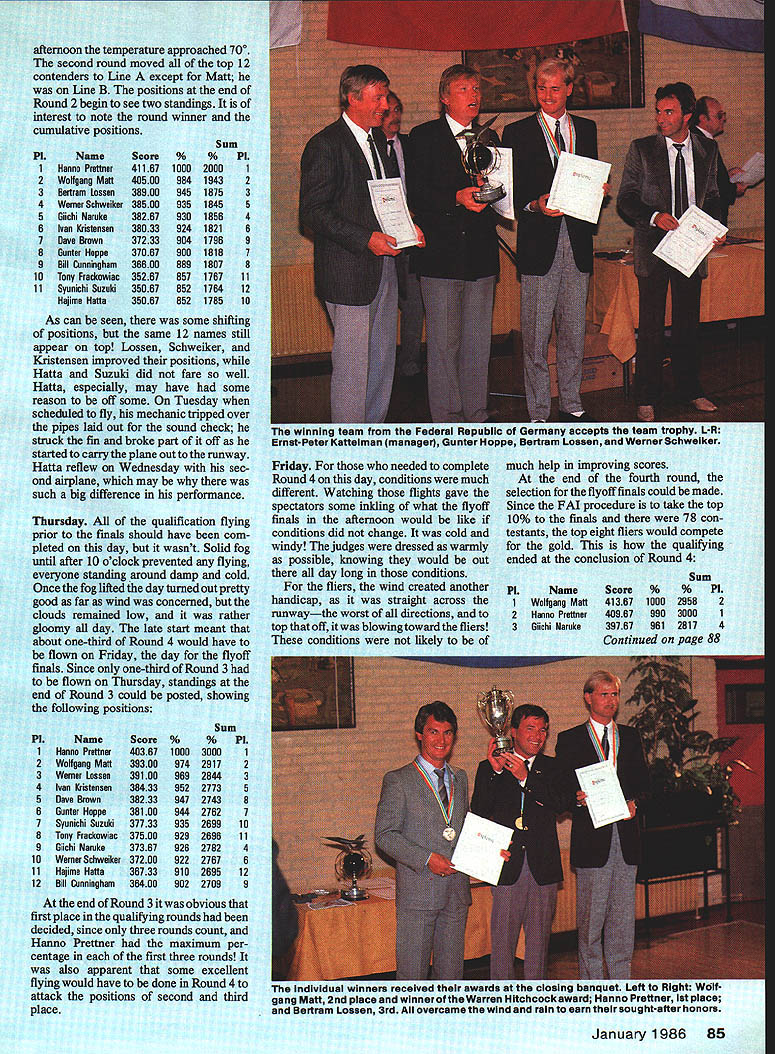
- Medalists: Gold — Hanno Prettner; Silver — Wolfgang Matt; Bronze — Bertram Lossen.
- Wolfgang Matt recorded the highest single flight score (Round 4) and received the Warren Hitchcock Award at the banquet (the award was mistakenly presented to Prettner initially, but the error was corrected during the evening).
Team results and observations
- Team winners: 1st F.R. Germany; 2nd Japan; 3rd United States.
- Notably, all three team members from F.R. Germany, Japan, and the United States were in the top 12 — a strong testimony to the teams' consistency and depth.
- The perfect F3A aircraft had not yet been realized; much was learned about design trade-offs between staying in the box and handling crosswinds that should drive improvements.
Sidelights and remarks
- The organizing committee and volunteers from the Royal Netherlands Aeronautical Association and local clubs deserve high praise for a smoothly run event under difficult weather conditions. The Netherlands' aeromodeling division celebrated its 50th anniversary during the championships.
- Two flight lines proved sufficient to prevent crossover interference.
- Alternate engine choices (.06, .61, VF, OS, PS 120, etc.) showed little practical performance difference for many of the models flown.
Transcribed from original scans by AI. Minor OCR errors may remain.

