
RC Air Show 2000
DOGS and US Air Force Museum unite for great event
by Joe Balmer
Overview
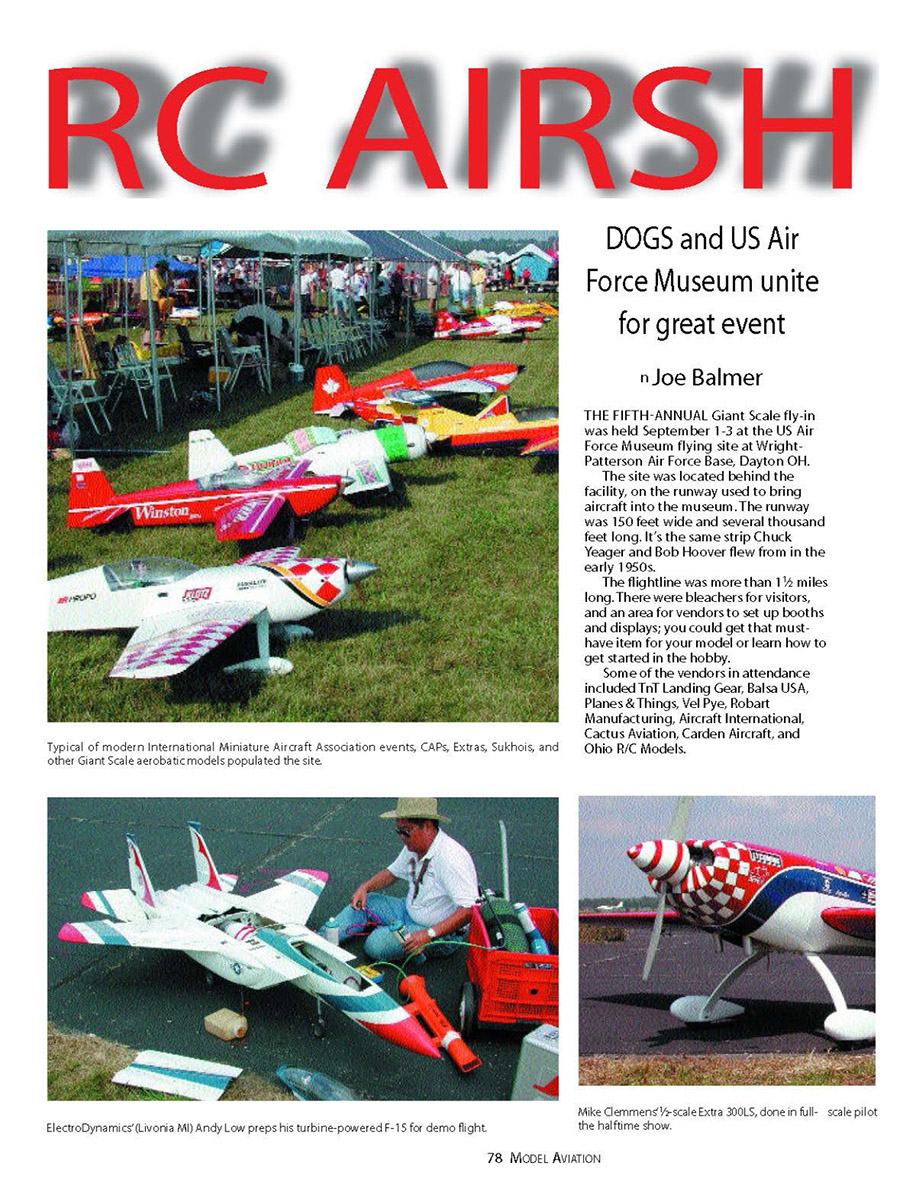
The fifth-annual Giant Scale fly-in was held September 1–3 at the U.S. Air Force Museum flying site at Wright-Patterson Air Force Base, Dayton, OH. The site sits behind the museum on the runway used to bring aircraft into the facility. The runway was 150 feet wide and several thousand feet long — the same strip Chuck Yeager and Bob Hoover flew from in the early 1950s. The flightline was more than 1½ miles long.
The event was free and open to the public, with bleachers for visitors and an area for vendors to set up booths and displays.
Vendors
Some of the vendors in attendance included:
- TnT Landing Gear
- Balsa USA
- Planes & Things
- Vel Pye
- Robart Manufacturing
- Aircraft International
- Cactus Aviation
- Carden Aircraft
- Ohio R/C Models
Pre-event display
Approximately two weeks before the fly-in, four Dayton Ohio Giant Scalers (DOGS) members put models on display in Kettering Hall of the museum to promote the event. The aircraft displayed were:
- Dennis Kirby’s aerobatic biplane — The Illusion
- Bud Edgel’s model of the Winnie Mae
- Jim De Winter’s S.E.5a World War I biplane
- Gary Webb’s F-16 Fighting Falcon ducted-fan jet and a 1/4-scale P-51D Mustang
These models were featured in a segment promoting the event on the local ABC television station.
Setup and registration
Thursday, August 31 was setup day. U.S. Air Force Museum personnel readied the site, several motor homes, campers, and aircraft trailers were parked in place, and roughly 40 pilots arrived with sun shelters. The flightline took shape quickly.
Friday morning pilots swarmed the registration and impound tent, anxious to fly. All went smoothly and most models were airborne in short order. Key volunteers and staff included:
- Dwight Doench (DOGS treasurer) — collected fees, completed paperwork, dispensed pilot ID tags and forms
- Jim Martin (DOGS president) — managed the impound area
- Jeff Holsinger (Contest Director) — called the 9 a.m. pilots’ meeting
- Frank Noll Jr. (Event Coordinator) — welcomed pilots and explained rules
- Gary Webb (Flightline Director) — managed six flightlines
Pilots were limited to 15 minutes of airtime per flight to allow everyone a chance to fly. Aircraft ranged from 1/2-scale aerobatic models to warbirds to turbine jets. Visitors filled the bleachers, walked along the fence, and talked to pilots. Friday’s turnout exceeded expectations.
Friday halftime and flying highlights
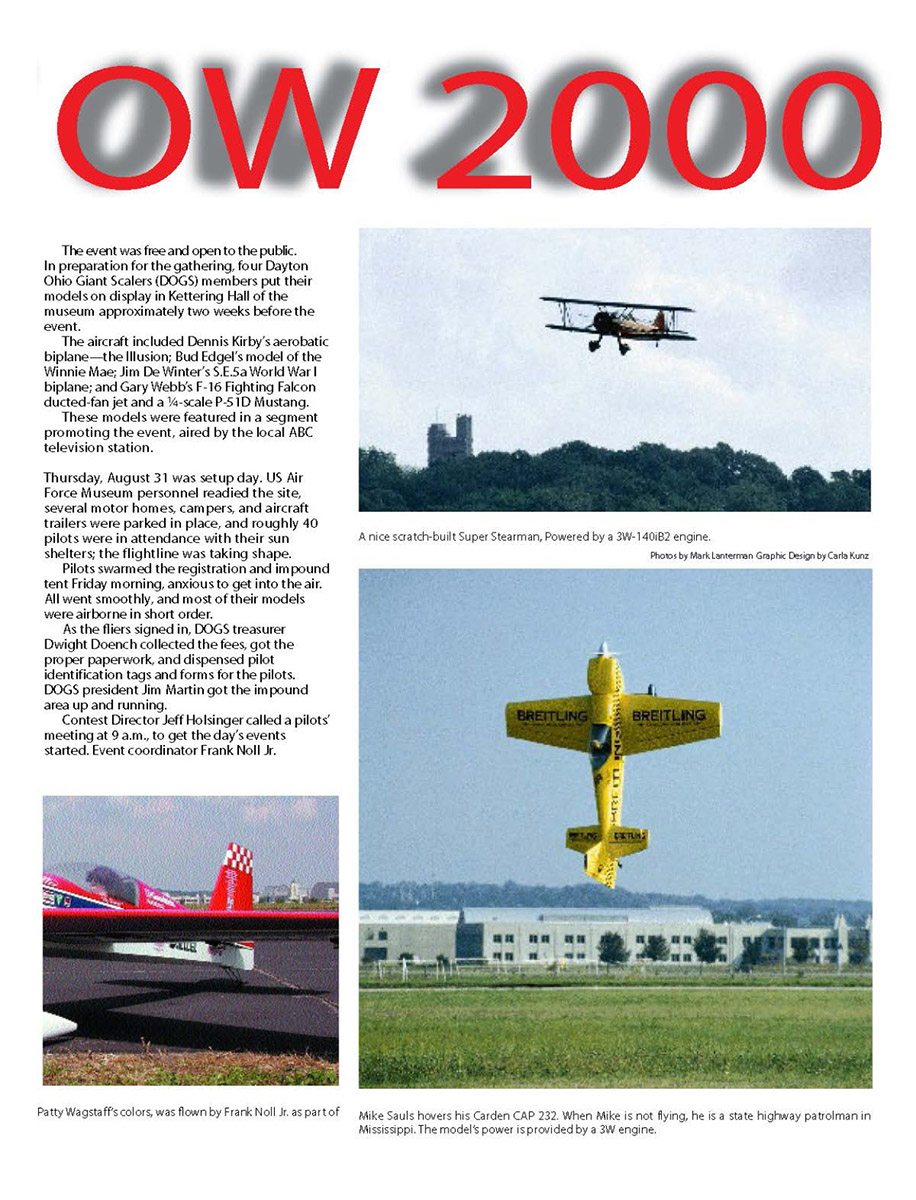
Friday’s halftime airshow featured 1/2-scale aerobatic models. Frank Noll Jr. flew the Patty Wagstaff Extra 300LS built by Mike Clemmens of Canada — a model that looked and flew like full-scale.
Turbine-powered jets were flown by George Thomas (Detroit, MI) and Louis Patton (Louisville, KY). Both were limited by AMA Safety Regulations for Model Aircraft Gas Turbines to under 200 mph, so they typically flew at roughly half throttle. When asked how he controlled speed, Louis said he went to full throttle for four seconds, then backed off.
Large aerobatic models put on a “hot dog” show, with at least four large models hanging by their propellers within a few feet of each other and banking down close to the runway. Jerry Smith (Paducah, KY) flew his Outlaw — a tiny, very aerobatic model that “goes like it’s on fire.” Warbirds performed strafing runs and victory rolls to the crowd’s delight.
After the halftime show it was back to open flying. The show closed for the day at 5 p.m., but open flying continued until it was almost too dark to see.
Gary Webb’s P-51D Mustang and Tuskegee pilot
Frank Noll Jr. test-flew Gary Webb’s (Troy, OH) P-51D Mustang, built from a highly modified Bud Nosen kit and finished in Tuskegee Airmen colors. Tuskegee pilot Clifford Brown attended Sunday and posed for a photo with the model.
Clifford, 78, is one of the surviving Tuskegee pilots from World War II. He flew in the European Theater with the 332nd Tuskegee group and saw action in the later stages of the war. “The conditions and treatment was bad, but we overlooked that because we wanted the chance to fly and luckily, we got to fly fighters,” Clifford said. He continued to fly in civilian life and now lives in the Dayton area.
P-51D specifications and notes:
- 104-inch wingspan with removable wingtips
- Weight: 36 pounds
- Robart retracts, panel lines, and rivet detail
- Power: G-62 on alcohol, using a 22 x 12 propeller
- All-wood construction, fiberglassed and painted with automotive paint
- Project took Gary two years to complete
The Mustang flew very well, but one landing gear would not come down. Frank belly-landed the model in tall grass; it survived to fly another day.
Saturday — the heavies and evening events
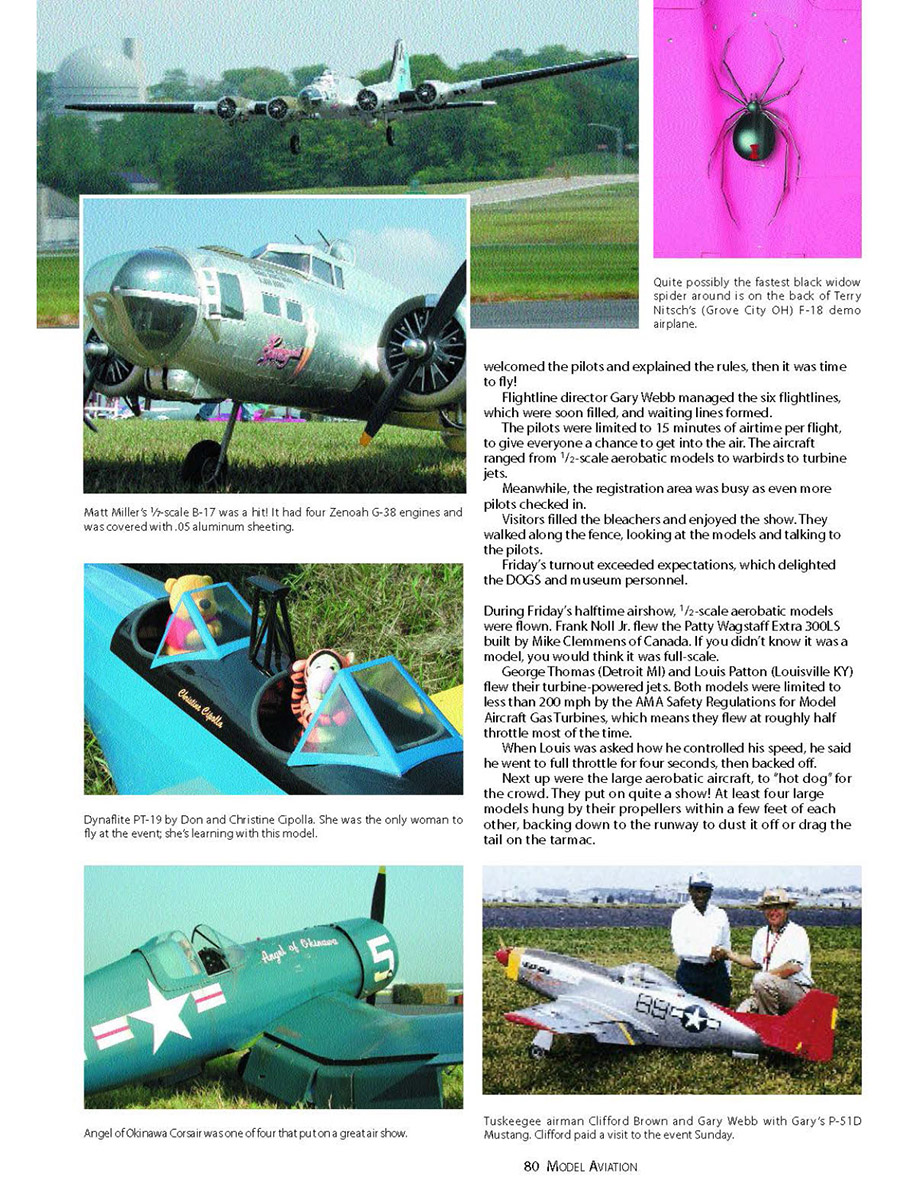
More pilots and a much larger crowd arrived Saturday. The “heavys” arrived by the halftime show: a B-32, a B-17, and a B-29 flew together. Acting as cover were several F4U Corsairs, a couple of P-51s, a Tigercat, and an “enemy” Me 109. An OV-2 also joined the show. The backdrop of the World War II Wright Field buildings made the sight inspiring.
The F4Us from Indiana have been regulars at past shows and performed admirably. Terry Nitsch flew his F-18A show turbine with smooth excellence. All models that flew on Friday flew again Saturday and did well.
After the show, models were lined up on the runway and visitors were allowed out to view them. An estimated 180 models were on display, with at least that many more not taken out to the runway. The sky remained filled with models until roughly 4:30 p.m., when a thunderstorm moved through and halted flying.
Saturday evening the U.S. Air Force Museum opened for pilots to view aircraft up close. While that was happening, the DOGS sold IMAX tickets; more than 200 pilots, wives, and friends attended a showing of “Storm Chasers.” A raffle of vendor-donated items was held before the movie; many nice items were given away. Hobbico donated an Almost Ready to Fly trainer kit, and the DOGS held a special drawing using only tickets from the Boy Scouts as a way to thank them for parking cars. More special drawings are planned for next year.
Sunday and closing
Sunday was wind-down time: modelers got in one last flight and then packed up. The halftime show was smaller but still very good and included some pyrotechnics. The Buckeye Aero Squadron — an AMA Air Show Team — performed aerobatic, scale, rocket, and novelty model routines.
Special thanks go to the DOGS members and their wives who worked food and ice cream — the food and service were excellent and essential to the show’s success.
Sponsors, support, and charity
Thanks to:
- Rand Associates
- Z-93 radio
- WING FM 102.9 radio
- WING 1410 radio
- Jack Huesman Auto Mall
- Federal Flooring Co.
- P&R Communications
- R/C Hobby Center (donated special T-shirts for the event)
Thanks also to the U.S. Air Force Museum and its personnel. A portion of the proceeds benefits the Special Olympics of Greater Dayton and the Air Force Museum Foundation.
Attendance and future plans
The U.S. Air Force Museum estimates more than 20,000 visitors attended this year’s event, greatly increasing museum patronage and exposing the public to the hobby and U.S. air power history. Approximately 200 pilots were registered for the event.
The museum is already planning the sixth fly-in for Labor Day weekend 2001. Make plans now for a great ending to the summer flying season!
Joe Balmer 200 Wilson Rd. Troy, OH 45373
Transcribed from original scans by AI. Minor OCR errors may remain.

