
RC BOSTON: An Ambition Fulfilled
By Group Captain James Pelly-Fry, RAF
In January 1942 I returned to England from war in the Middle East. In the Sudan (the biggest country in Africa — 1,000,000 square miles) we flew the remarkable Vickers Wellesley single-engine long-range bomber against Mussolini's forces in Ethiopia. At the RAF Habbaniya air base, near Baghdad, we flew missions day and night with rapidly converted trainers against Iraqi forces led by the rebel Rashid Ali. In the deserts of Egypt and Libya we were still fighting that desert fox, General Erwin Rommel, and his Africa Corps.
It was nice to get back to London after two and a half years of living in the desert like a Bedouin. It was apparent, though, that we had a long way to go before it would be possible to get back into occupied Europe. This would be a different kind of air war from those in the Middle East. From all accounts, flying over Europe was tougher, more exacting, and more hazardous. I wondered about some aeromodelling, assuming that materials were available. Well, the prospects looked slim.
After commanding No. 47 Squadron in the Sudan (the squadron, by the way, flew regular 26-hour air-refuelled flights to the Falkland Islands in Lockheed C-130 Hercules aircraft), I had thoughts of a Mosquito squadron. This De Havilland twin-engine aeroplane was having spectacular successes, particularly in its bomber version, but the queue was too long. Disappointment was tempered by a summons to the headquarters of No. 2 (Light Bomber) Group of RAF Bomber Command; there the Air Vice Marshal said he would give me command of No. 88 Squadron. This squadron had recently been equipped with the new Douglas A-20 attack bomber, called the Boston in the RAF.
It's not uncommon for a wartime pilot to develop special feelings for the "steed" that served him so well. In this case it was the Douglas A-20 which, in Royal Air Force service, was known as the Boston. Forty years later I resurrected the Boston in the form of an RC model.
Crewing and first impressions
There was then a requirement to find a Boston and try it on for size. Fortunately, my prewar radio operator showed up unexpectedly. He was then a navigator and wanted to get back to a squadron from his job of training new crews. Crewing up in wartime needs great care to get the right mixture of expertise and compatibility; no problems or qualms with Jock. Similarly, a little later, Buster showed up as radio operator/air gunner; he had also completed one tour of operations in Bomber Command. We were in business.
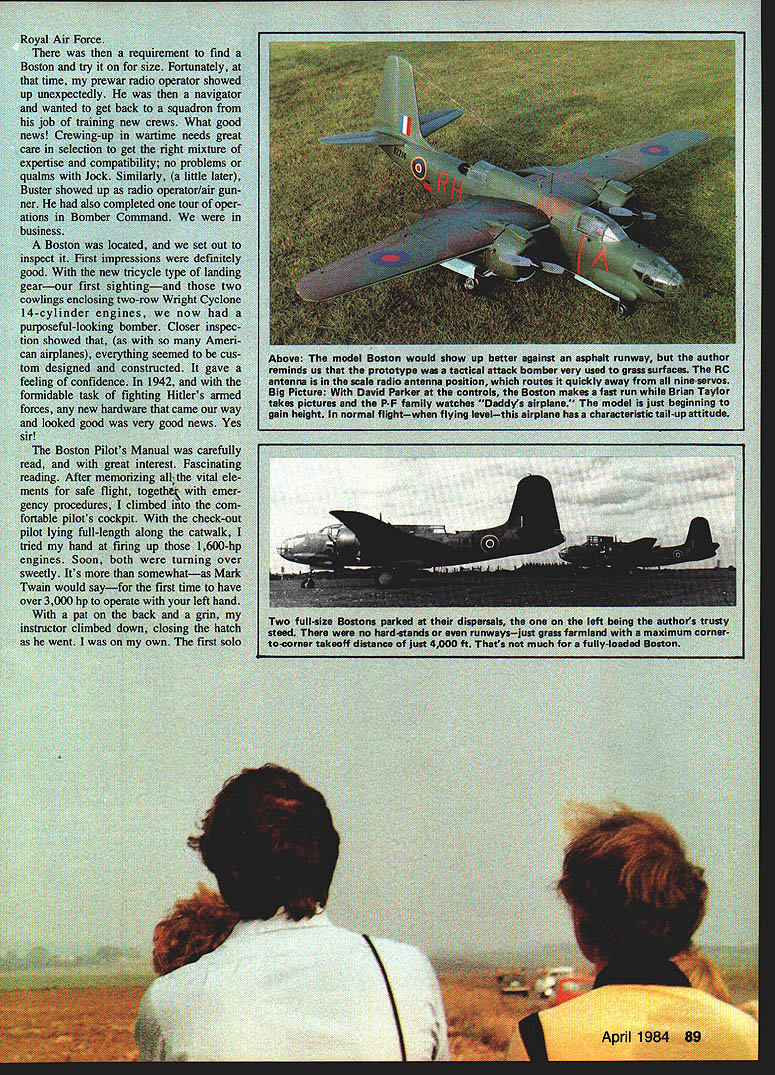
A Boston was located, and we set out to inspect it. First impressions were definitely good. With the new tricycle type of landing gear—our first sighting—and those two cowlings enclosing two-row Wright Cyclone 14-cylinder engines, we now had a purposeful-looking bomber. Closer inspection showed that, as with so many American aeroplanes, everything seemed to be well designed and constructed. It gave a feeling of confidence. In 1942, with the formidable task of fighting Hitler's armed forces, any new hardware that looked good was very good news.
The Boston Pilot's Manual was carefully read. After memorising all the vital elements for safe flight, together with emergency procedures, I climbed into the comfortable pilot's cockpit. With the check-out pilot lying full-length along the catwalk, I tried my hand at firing up those 1,600-hp engines. Soon both were turning over sweetly. It's more than somewhat—for the first time to have over 3,000 hp to operate with your left hand.
My instructor gave a pat on the back and climbed down, closing the hatch as he went. I was on my own. The first solo: I moved off gingerly, trying out foot-operated brake pedals and throttle responses. The first thing I noticed about the aeroplane was the tricycle gear—very new in 1942 and much easier than the old way; one can see exactly where one is going and can position the ship safely and accurately. Full marks to the brilliant man who first thought up a milestone in aviation development.
Takeoff was dead straight down the dotted line and pronto. No hanging about. Wheels came up quickly—flying dream. The engines purred like pussycats. I felt like a king, particularly with the airspeed indicator showing cruising along easily at 275 mph. A hot ship—go to war 100 mph faster than anything previously experienced. Return to the runway and touchdown followed fast and fair. Clearly I needed to learn new tricks.
Operational flying with 88 Squadron
Almost the first thing that happened on joining 88 Squadron, apart from an attack by the Luftwaffe upon arrival, was to arrange to fly somewhere back in the formations to learn what the game was about. As I became proficient, I moved up, by easy stages, closer to the front. Excellent training: you cannot lead anything properly until you have first started at the bottom of the ladder. Finally we promoted ourselves to being a lead aircraft. Easy commanding officer but also carrying heavy responsibility—no short cuts in operations.
Spitfire pilots were happy because, escorting a fast bomber force, they could fly efficient speeds without fear of being jumped by Luftwaffe Me109s and FW190s. Meeting up correctly with the escorting Spitfire squadrons still had its problems. In order to get a smooth rendezvous, and under 200 ft altitude to keep out of the enemy radar system, we aimed to arrive precisely over the designated meeting point en route to the target; timing error not more than 15 seconds. Jock, the navigator, never missed a trick; everybody was happy.
However, one day a message came through from Fighter Command HQ asking the Boston force to slow down on the outward journey across the English Channel because Spitfires were burning too much fuel. Quite a change from earlier times. We settled to a nice easy 240 mph at sea level until just short of the enemy coast—fine, everybody. On some missions the formation would be 12 Bostons—sometimes many more—and up to 150 Spitfires. Quite an armada. We used to call it a "Balbo," after the prewar Italian air leader who clearly thought that big was beautiful.
One fascinating impression, when outward bound at wave-top height, was seeing the close-escort Spitfires looking for all the world like model aeroplanes. Thank heaven they were for real; this was definitely not aeromodelling time.
Bostons by then were making a notable contribution to the war effort; at last losses were beginning to come down. We began completing missions, mostly in daylight, with all aircraft returning—maybe with holes, but they got back. Things were looking up.
Later wartime service
In 1943 No. 88 Squadron moved to France to support the Allied armies; the job for which the A-20 was designed. I then moved into the heavy bomber business. From Yorkshire we operated the four-engine Handley Page Halifax, a good, tough, reliable aeroplane. Although it was a night bomber, supporting the complementing U.S. 8th Air Force by day, in practice it was not long before we ran a 24-hour service. I missed my Bostons and their crews. I also missed the historic stately home called Blickling Hall in Norfolk that accommodated us in style. The big house, with a moat around it and some 3,000 acres of parkland, together with good fishing on the lake, was once the home of Anne Boleyn, who married King Henry VIII—one of his eight wives!
Eventually the Allies won the war in Europe; and things began to get better. Could I resume aeromodelling? Not yet. Overseas assignments followed: Australia, East Africa, Iran, NATO in France. However, I managed a couple of free-flight planes in Australia and later a nice power job with a small diesel engine in Tehran when air-attaché commitments allowed. It flew well despite the 5,000-ft altitude and summer heat.
The seed of an RC Boston
About that time my thoughts began to turn to radio control, then the new look for aeromodelling. Apart from a trainer, I had visions of an RC Boston. Pure dreaming, maybe, but what was the harm of that? Clearly, that Douglas aeroplane had left its mark on my memory. With some 70 different kinds of flying machines recorded in my pilot's log books, I rated the Boston as one of the top three.
As much as I wanted to begin the model, it took time and opportunity before any practical action could be taken. After all, around 1958 (and even some years later), who had heard of a twin-engine bomber of scale form operated by remote control from the ground? The best thing for me to do was to collect data from the model publishers and, if possible, go to contests to see what others were doing—the look, listen, and learn formula.
What would be a practical starting point? With no scale experience (and very little powered flight experience—zero radio know-how) the best way was to collect data on the Boston and relate it to such theoretical knowledge as I could acquire. By 1978 I had succeeded in making a powered sailplane of just over 9-ft wingspan that flew well. The model publishers in London came up with excellent drawings; and the bush telegraph told me that Bob Wischer in Wisconsin had constructed and flown a Douglas A-20G. He and John Alcorn from California (John had drawn up the original A-20 drawings) sent fat envelopes across the Atlantic full of plan copies and drawings. Even helpful people from Douglas Aircraft came up with material. Darn—John Alcorn's drawings even specified No. 88 Squadron.
Scale and initial decisions
The first step was to examine the factors from available materials. For various reasons—probably more guesswork than calculation—it seemed that a scale of one-tenth was a starting point. It was easy to work out conversions, and at this scale the wingspan would be just over 73 in. This was a good size for construction, equipment accommodation, transportation, and handling.
One curious fact emerged upon reading all the data: there were an awful lot of technical design items of the Boston that I knew nothing about. Is this common to most pilots? I wonder how many of us know such essentials to an aeromodeler as the wing section, wing washout (if any), location of the centre of gravity, wing loading, thrust line, rigging angle of the wing and stabiliser, control throws, and so on. I concluded that scale modelers need to be much better informed than the pilots.
Coupled with the starting point of one-tenth scale, two important decisions awaited solution:
- Choice of engines.
- Choice of landing gear.
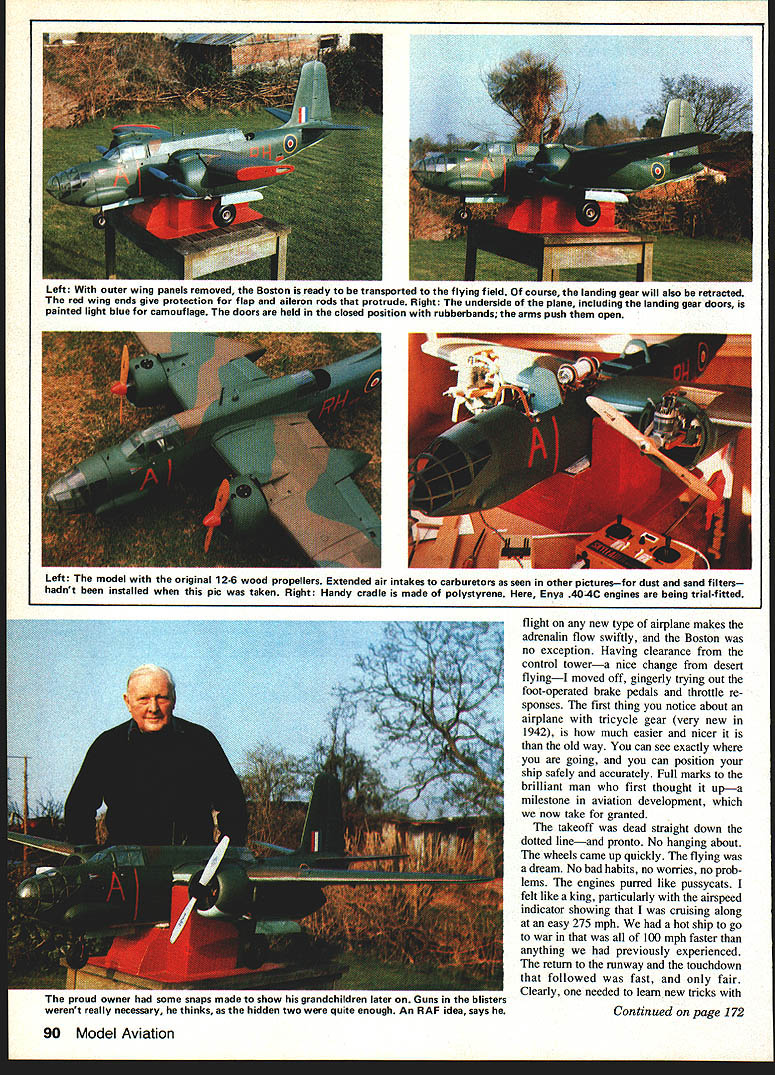
Having decided to use four-stroke engines I settled on the new Enya .40-AC. This well-made, compact engine with a power output of close to 1/2 hp would almost fit inside the 6-in. cowlings of the Boston IIIA (A-20C) model; this version, having the forward-extended carburettor ram-air intakes, would accommodate the Enya rocker gear with vertical engine mounting. Provided these engines delivered the power, and even with an all-up weight as high as 13 lb., the choice seemed sound. For the landing gear, the best choice seemed to be the use of Rom-Air units from Brooklyn—an American-made product for an American aeroplane.
Then came a run of snags. No Enya .40-AC engines had become available in the United Kingdom at the time, and the Rom-Air folks did not make a main gear that retracts backward into an engine nacelle. I guess twin-engine scale models with aft-retracting main gear are rare birds.
Fortunately, both snags were sorted out fairly quickly. I was able to get the engines through the valuable help of Bud Voss in Tokyo. (The only disappointment happened at this end: the British Post Office decided to send the precious package all the way back to Tokyo, saying it was insufficiently stamped!)
The second time round the world, like an astronaut, the engines showed up. They were taken in hand by David Parker, a great engine expert who lives nearby. After breaking in, the Enyas ran sweetly and quietly, producing 8,000 rpm on the bench with a 12 x 6 propeller. It's wonderful to hear them turning over so realistically.
Construction: drawings, airframe and systems
Work began on the RC Boston in earnest. First, the working drawings were scaled up from John Alcorn's. With the hardware in hand (the Rom-Air tracts were modified to suit the Boston and operated beautifully), one could physically relate the paper design to the components. For example, the lower part of the nacelles would have to be made removable for access and maintenance. It was a pleasure to draw up the design to full model size. Even so, great care had to be taken to get those subtle curves just right. If the final product is to be really true to the full-size, you just have to work at it.
Once the drawings were complete in elevation to my satisfaction, three basic requirements needed to be examined:
- Transportation considerations.
- Airframe design and type of structure to employ.
- Installation of all hardware.
You would think these three factors would be easy to satisfy. They are, but it seemed to take weeks of getting it wrong before everything clicked into place. The operative word is compromise; you have to reconcile what you want with what is possible. Every solution introduces fresh problems unconnected to the first one.
The plan for transportation was to make the outer sections of the wing removable, leaving the main part of the model completely in one piece. This gave a main unit that was manageable and avoided the hassle of complete assembly and disassembly at the flying field. The outer panels were joined just where the ailerons begin, using the steel-strip-in-sleeve method. Once the wing panel is slid into position, it is simple to connect the clevis (for aileron) and fit restraining rubber loops. This simple assembly is all that is needed at the flying field, thus keeping errors to a minimum.
For airframe design and materials I settled on proven methods: marine three-ply, spruce, balsa, nylon, and thin fibreglass mouldings for engine cowlings. The basic fuselage structure was a box: an inner wall of 1/4" three-ply from Finland and a soft balsa outer skin glued on in thick planks and shaped afterwards. As the centre part of the fuselage was of constant section, one female template sufficed. The wing and tail units were standard spar-and-rib construction, mostly balsa, with a thin balsa skin and nylon covering.
Hardware installation proved more complex than expected. The landing gear had to be positioned so the main wheels, when lowered, were correctly located. The only way was to extend some part of the wing downward and forward, find the right spot "in space," and beef up the structure to take the load. When the job was finished it looked smart and functional, but the darn thing collapsed during taxi trials—back to the stress department.
The landing gear doors (not symmetrical) worked out fine. The nacelles were built like the hull of a planked boat and split in half like a chocolate Easter egg, the lower part being removable.
Provision was made for each engine to have its servo just behind the carburettor, with access for tuning. The type and size of fuel tank was tricky. To get the tanks correctly positioned and with short fuel lines they had to be in the space immediately behind the front wing spar and as far back as the main spar. I wanted a tank size of six fluid ounces (170 cc). After trying a commercial product (just a little too long), I put together a pair of metal tanks. Hatch covers with quick-release 1/4-turn pins completed the setup.
One surprising element was positioning the radio gear. Bearing in mind the need to put it all as far forward as possible for balance, too many items clashed or had to be repositioned because pushrods lacked unobstructed lines of travel or access for adjusting control throws was insufficient. With six channels and nine servos to locate, it was a fascinating jigsaw puzzle that took time to solve.
Completion and ground trials
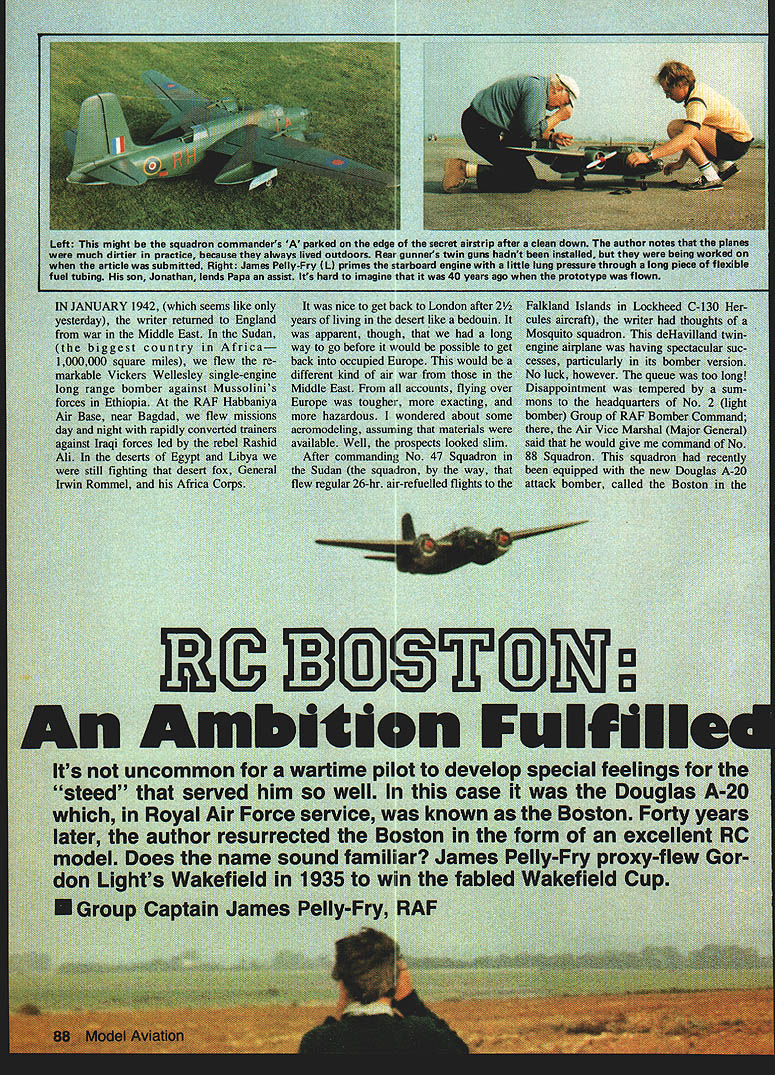
In due course—which is a simplistic way of saying two-and-a-half years and 2,000 man-hours later, give or take the odd hundred—I had a twin-engined, radio-controlled, one-tenth-scale flying model of a Douglas A-20C, the Boston IIIA of the RAF. It was in the colours and insignia of No. 88 Squadron and carried the wartime identity letters RH-A of the commanding officer's personal aeroplane. Additionally, the emblem of a wing commander's pennant showed just by the pilot's cockpit, port side only. Even to a critical eye, she looked great!
The flying weight had crept up to 12 lb. 12 oz. It would be a hot ship with a wing loading of 44 oz./sq. ft. After careful engine checks for throttle response, synchronization, and peak rpm—and then a thorough check of all radio and associated functions—the model was taken to the sports ground for ground handling and taxi trials to obtain the correct balance position.
Model flying a new type of aeroplane makes the adrenalin flow swiftly—the Boston was no exception. Having clearance from the control tower—a nice change from desert flying—I moved off gingerly, trying out the foot-operated brake pedals and throttle responses. The tricycle undercarriage made handling much easier. Takeoff was dead straight down the dotted line and pronto. No hanging about—the wheels came up quickly. Flying was a dream. The engines purred like pussycats and I felt like a king, particularly with the airspeed indicator showing cruising along at 275 mph—a hot ship, 100 mph faster than anything I had previously experienced. The return to the runway and touchdown followed fast and fair. Clearly I needed to learn new tricks.
Maiden flight
The next time out, using the big playing fields at the Navy base at Yeovilton—where the Sea Harriers come from—I had my expert test pilot, David Parker, on the transmitter. The runways were not available for model aircraft because the Harriers were flying seven days per week, but we managed some fast runs on the playing field, some producing small lift-offs. The final run started me when I saw the Boston 20 feet above ground, not 20 inches!
Soon after those "Wright brothers" hops we were able to use the other Navy field at nearby Merryfield. Present were David Parker with his Handley Page Harrow twin-engined bomber and the U.K. champion Brian Taylor with his Mosquito. The weather was suitable, and we were all set for the maiden flight. Was it a good omen that the USAF had used Merryfield in WWII? The Boston was soon made ready, fuelled up, checked out, and checked out again. No silly mistakes today! The date was August 7, 1982.
After a short flight with the Harrow (David said it was to get his reflexes working) the Boston was fired up. The engines responded well. She moved off impressively into the wind along the runway. Throttles opened, engines at full rev; the acceleration was brisk—no swing, no hesitation, no problem. After about 250 feet of run we had a slight rotation and the undercarriage showed under three wheels. It was airborne. The Boston climbed to around 150 feet, the engines were throttled back a little, and the gear disappeared. Magic! At about 70% power she was travelling fast downwind while looking and sounding tremendous—so realistic it was breathtaking.
The usual test-flight procedures were carried out: control response, stability, general handling, slow flying at safe height, and flap operation. The flaps had been set to give a maximum of 35 degrees down; more than that only gave unwanted drag. Lowering the flaps gave a slight nose-up change of trim, as on the full-size aeroplane.
From the test pilot's comments there were no problems of consequence. The only minor ones were that, with the gear up, the centre of gravity was just a little too far back, and the aileron response could be improved—what the pundits call "authority." The general flying on 50–60% power seemed so unexpectedly good that David made a couple of passes for visual inspection and picture-taking. When I eventually called "15 minutes" he positioned it for a landing. With a light breeze blowing he settled for a flaps-up configuration for the first touchdown, throttling back for a nice approach. He landed right opposite the three of us. It was fast and positive, just like the prototype. Nose-wheel steering worked well as the Boston taxied back to the parking apron. It had been a memorable and exciting first flight.
Aftermath and reflection
From 1942 to 1982 is 40 years. As far as I was concerned, time had stood still. I was back with 88 Squadron, and climbing out of my fine Boston, soon to get back to Blickling Hall for delicious bacon and eggs, coffee, and maybe a cigarette. Thank you, Mr Donald Douglas! Who makes ’em better?
Transcribed from original scans by AI. Minor OCR errors may remain.

