
RC Combat is Here!
Introduction
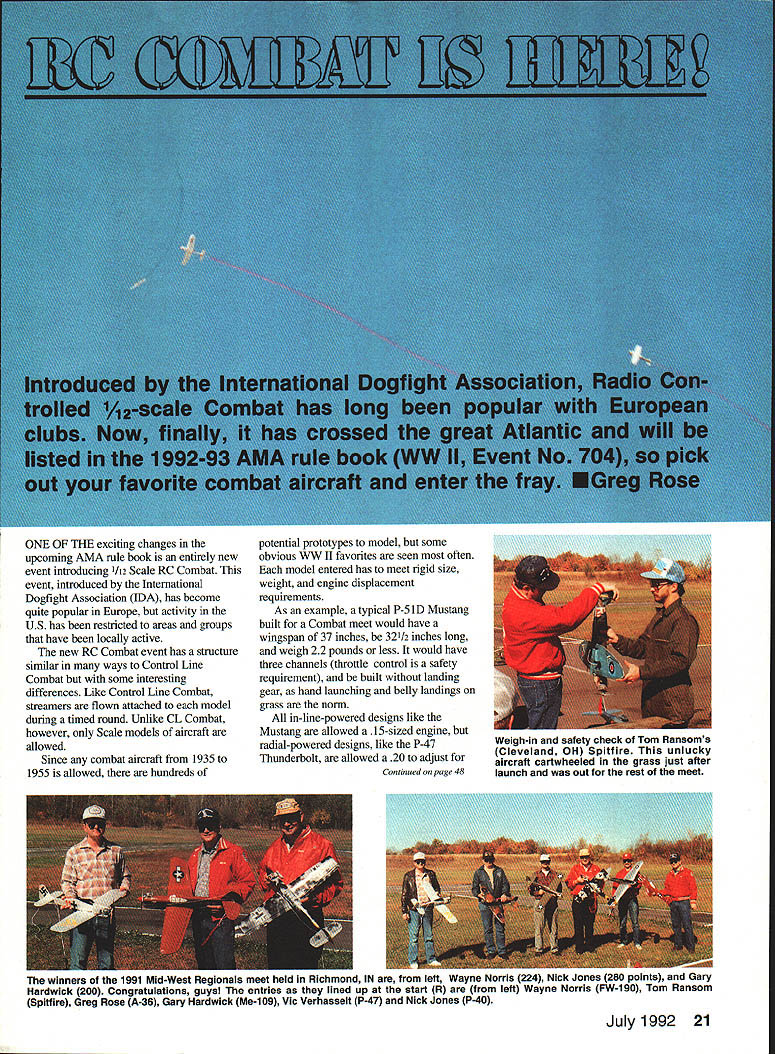
Introduced by the International Dogfight Association (IDA), Radio Controlled 1/12-scale Combat has long been popular with European clubs. Now, finally, it has crossed the Atlantic and will be listed in the 1992–93 AMA rule book (WW II, Event No. 704). Pick out your favorite combat aircraft and enter the fray. ■ Greg Rose
One of the exciting changes in the upcoming AMA rule book is an entirely new event: 1/12 Scale RC Combat. This event, introduced by the IDA, has become quite popular in Europe, but activity in the U.S. has been restricted to areas and groups that have been locally active.
The new RC Combat event has a structure similar in many ways to Control Line (CL) Combat but with some important differences. Like CL Combat, streamers are flown attached to each model during a timed round. Unlike CL Combat, however, only scale models of aircraft are allowed.
Rules and aircraft
- Allowed prototypes: any combat aircraft from 1935 to 1955.
- Model requirements: rigid size, weight, and engine displacement limits apply.
- Typical example (P-51D Mustang built for a Combat meet):
- Wingspan: ~37 inches
- Length: ~32.5 inches
- Weight: 2.2 pounds or less
- Radio: three channels (throttle control is a safety requirement)
- Landing gear: omitted; hand launching and belly landings on grass are the norm
- Engine allowances:
- Inline-powered designs (e.g., Mustang): up to .15-sized engines
- Radial-powered designs (e.g., P-47 Thunderbolt): up to .20-sized engines (to adjust for larger frontal area)
- Airspace: as many as six models may be in the air at the same time.
- Dimension: unlike CL Combat, the three-dimensional nature of RC flying adds depth perception, making collisions rare even with multiple planes airborne.
Events and scoring
Two different events are covered in the rules:
- Individual free-for-all: up to six fliers in the air; highest total score wins (non-elimination rounds possible).
- Team competition: three-against-three; scoring differs from the Individual event, but all other requirements remain the same.
Scoring notes from the Richmond preview:
- There is a 10-point bonus for each minute aloft during the round.
- Streamer cuts are counted in feet (example: a 21-foot streamer cut was noted in a match).
- Being first in the air can earn quick points (example: a 20-point early bonus).
Mid-West Regional — Richmond preview
Since the rules were slated for inclusion in the 1992–93 AMA rule book, a preview event was held in Richmond, Indiana. The Richmond Area Flyers hold Combat meets all summer at Fork Creek Reservoir flying site just outside Richmond. On October 22 the Richmond Area Flyers held the Mid-West Regionals—an Individual Combat event with three non-elimination rounds; the highest total score wins.
Round 1
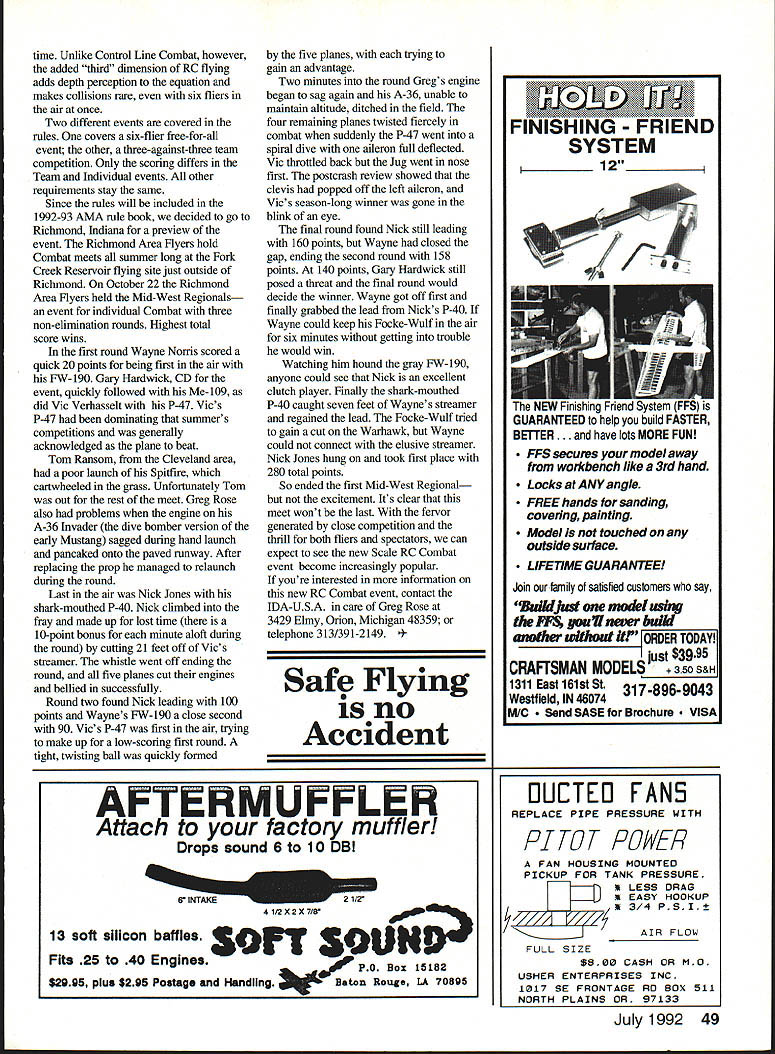
- Wayne Norris scored a quick 20 points for being first in the air with his FW-190.
- Gary Hardwick (contest director) followed with his Me-109, and Vic Verhasselt with his P-47 joined the fray.
- Vic's P-47 had been dominating that summer's competitions and was generally acknowledged as the plane to beat.
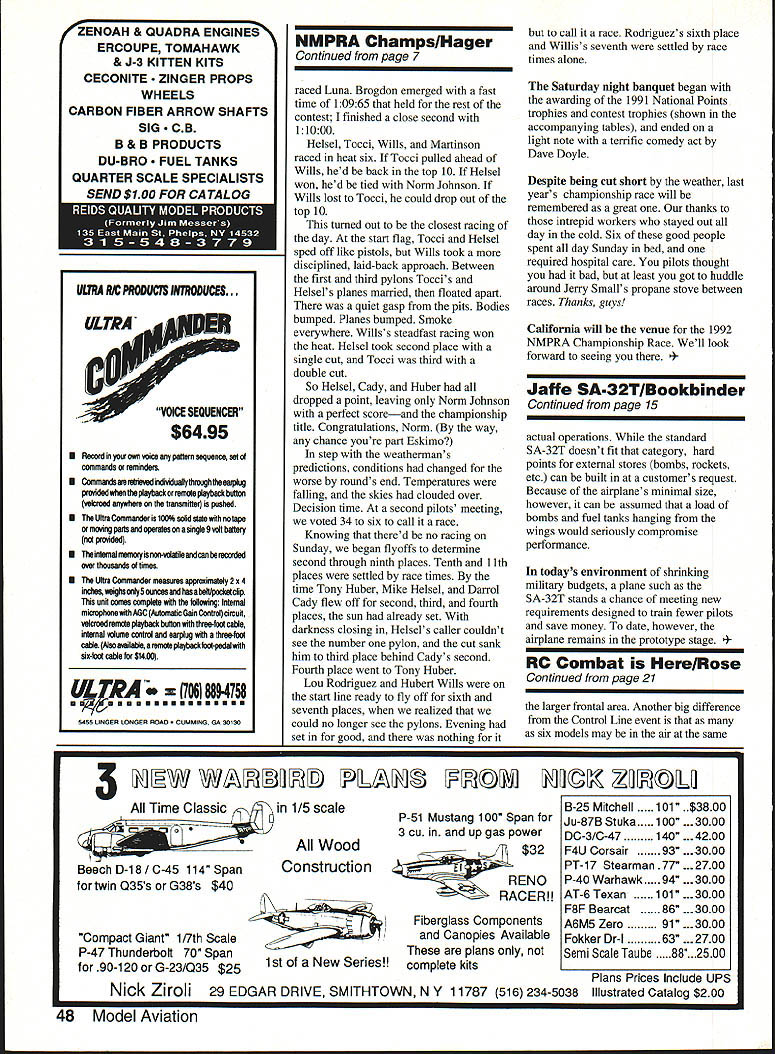
- Tom Ransom (from Cleveland) had a poor launch of his Spitfire, which cartwheeled in the grass; he was out for the rest of the meet.
- Greg Rose experienced an engine snag on his A-36 Invader during hand launch and pancaked onto the paved runway. After replacing the prop he relaunched during the round.
- Last to launch was Nick Jones with his shark-mouthed P-40. Nick climbed into the fray and made up for lost time, cutting 21 feet off Vic's streamer. The whistle ended the round; the five planes cut engines and bellied in successfully.
Round 2
- Nick led with 100 points and Wayne had 90. Vic's P-47 was first off the ground and tried to make up for a low first round.
- A tight, twisting dogfight formed among the five planes.
- Two minutes into the round Greg's engine began to sag and his A-36, unable to maintain altitude, ditched in a field.
- The remaining four planes fought fiercely when Vic's P-47 suddenly entered a spiral dive with one aileron fully deflected. Vic throttled back but the Jug hit nose-first.
- Post-crash inspection showed the clevis had popped off the left aileron; Vic's season-long winner was gone in an instant.
Round 3 and finish
- Nick still led with 160 points; Wayne had closed to 158 points. Gary Hardwick had 140 points and still posed a threat.
- Wayne launched first in the final round and temporarily grabbed the lead from Nick.
- Nick demonstrated excellent clutch flying and managed to catch seven feet of Wayne's streamer, regaining the lead. Wayne tried to retaliate but could not connect.
- Nick Jones won first place with 280 total points.
Conclusion
The first Mid-West Regional was hot and exciting. With close competition and new thrills for fliers and spectators, Scale RC Combat is likely to grow in popularity. Expect more meets and interest as the event becomes established under the AMA rules.
Contact
For more information on this RC Combat event, contact:
- IDA-U.S.A., c/o Greg Rose
- 3429 Elm, Orion, Michigan 48359
- Telephone: 313/391-2149
Transcribed from original scans by AI. Minor OCR errors may remain.

