
RC Electric Grand Championships
Larry Jolly
Background
On January 9, 1982 a revolution began. There were no shots fired, no explosions, no riots; quite to the contrary. This revolution was quiet, the only sounds being a gentle whirr as the majestic electric-powered sailplanes raced to altitude.
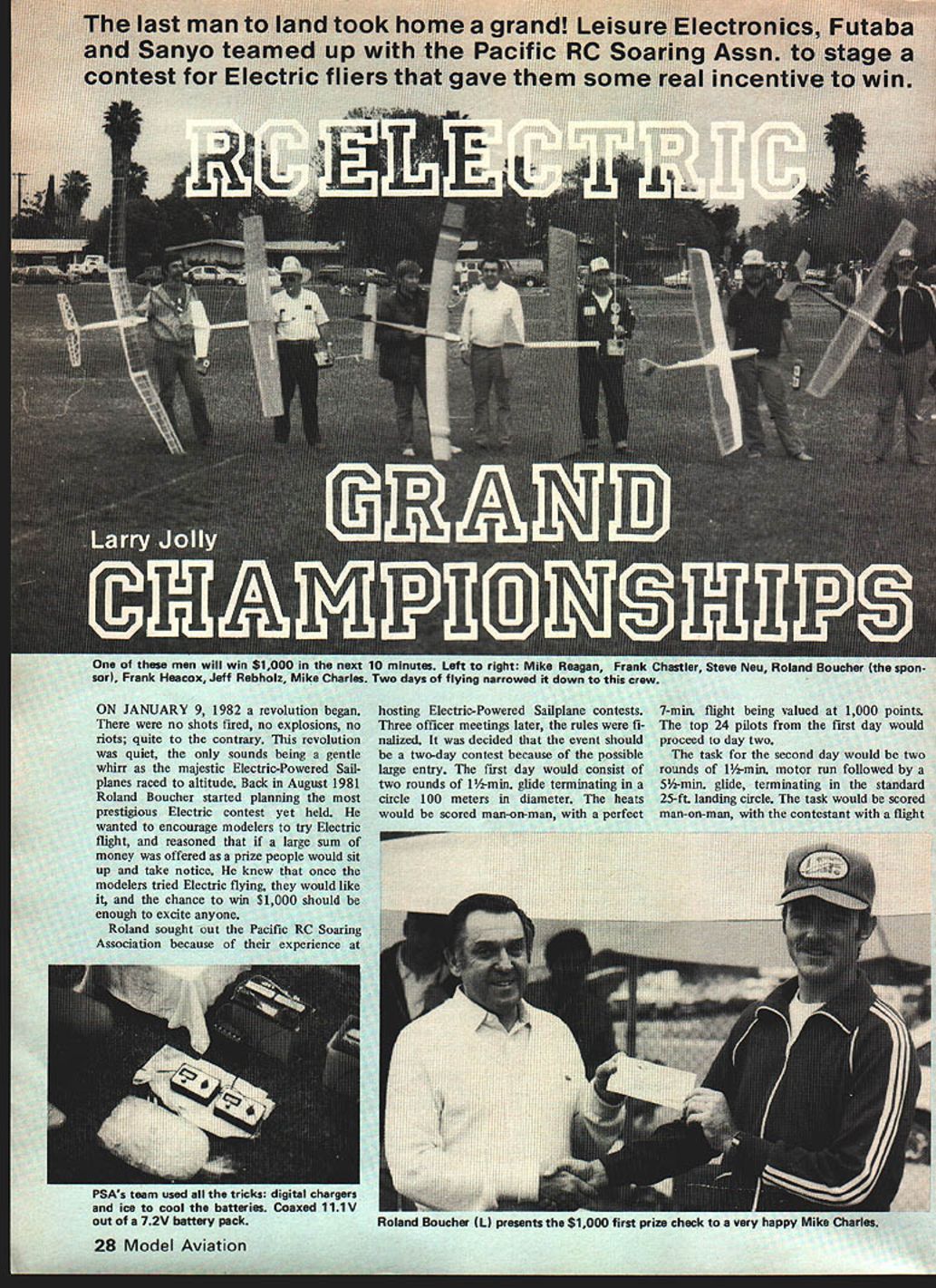
Back in August 1981 Roland Boucher started planning the most prestigious electric contest yet held. He wanted to encourage modelers to try electric flight and reasoned that if a large sum of money was offered as a prize people would sit up and take notice. He knew that once modelers tried electric flying they would like it, and the chance to win $1,000 should be enough to excite anyone.
Roland sought out the Pacific RC Soaring Association because of their experience at hosting electric-powered sailplane contests. Three officer meetings later, the rules were finalized.
Contest format and rules
It was decided the event would be a two-day contest to accommodate a potentially large entry. The tasks were:
- Day One — Two rounds of 1 1/2-minute glide, terminating in a circle 100 meters in diameter. Heats would be scored man-on-man, with a perfect 7-minute flight valued at 1,000 points. The top 24 pilots from the first day would proceed to day two.
- Day Two — Two rounds of 1 1/2-minute motor run followed by a 5 1/2-minute glide, terminating in the standard 25-foot landing circle. Scored man-on-man, with the contestant whose flight was closest to seven minutes receiving 900 points; an additional 100 points awarded per perfect landing. The top six pilots would proceed to the final round.
- Finals — A 1/2-minute motor run followed by unlimited-duration glide; last down would win $1,000.
Model regulations were kept to a minimum to encourage new designs. The only stringent rule concerned the power plant: the stock Astro Flight .05 motor and its corresponding battery pack were required. Organizers reasoned that stock systems would keep "mad-scientist" types from dominating the contest. Airplanes were otherwise left wide open; Roland wanted to encourage originality and offered cash prizes for best direct drive, gear drive, and Old-Timer designs.
Contest day — Saturday (static judging and qualifying rounds)
Contest day dawned a cool, clear winter morning. Pacific Soaring Association was running the competition, so participants arrived at Magnolia High School early. To everyone’s amazement, people were already out test-flying.
It should be noted that the residents 100 feet across the street from the contest site continued their Saturday morning sleep uninterrupted. While the neighbors slept, 50 of the best electric pilots in the U.S. prepared to do battle in the school's athletic field.
At 9:00 Roland Boucher announced that static judging for the $100 cash prizes would take place first and would be contestant-judged. There were 22 direct-drive models, 24 gear-drive models, and four Old-Timers entered. Each model was given a number and placed in the static judging area. Contestants viewed the models, made their choices, and recorded them at the registration desk.
Static judging results:
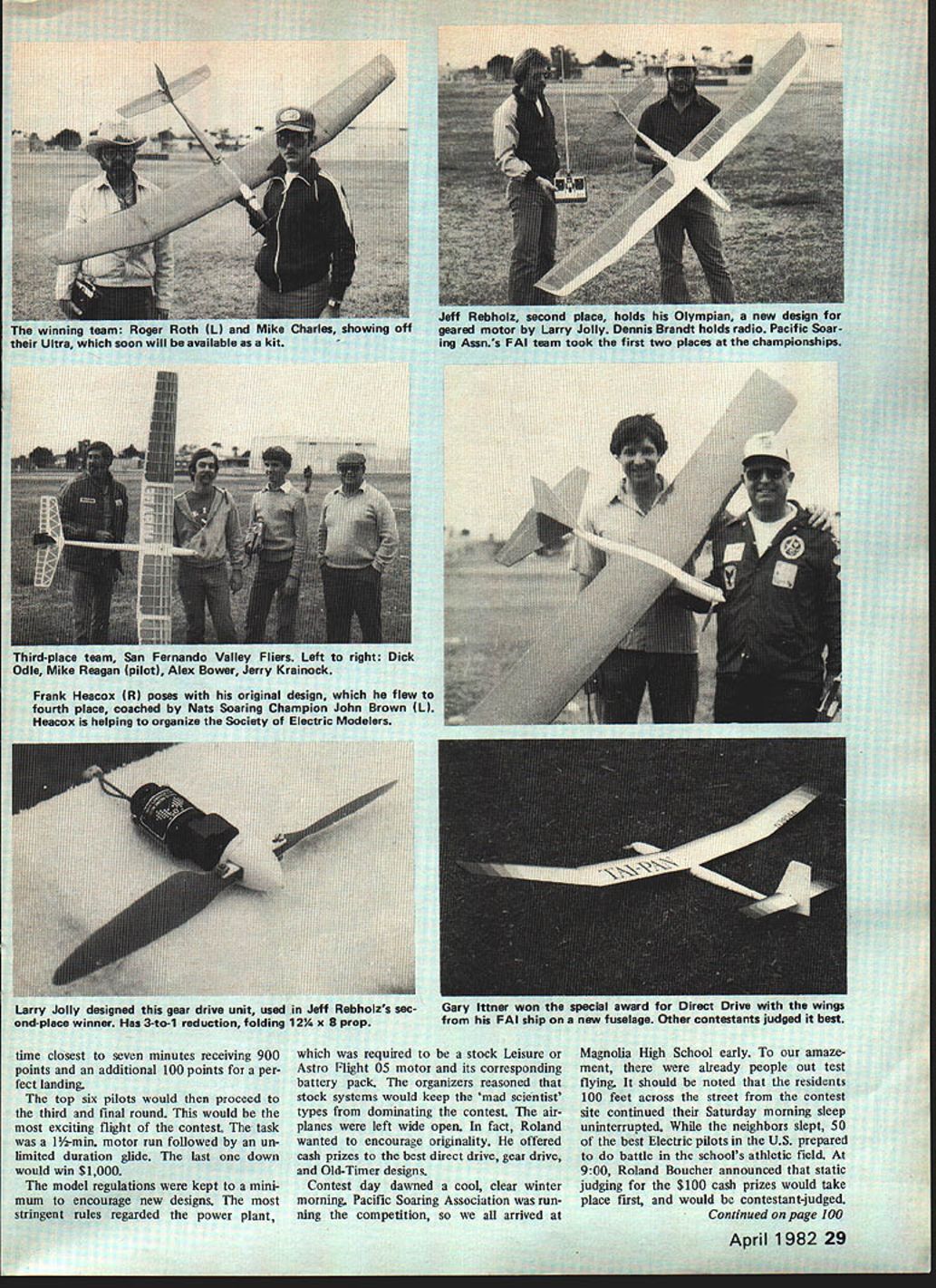
- 1st place, Direct Drive: Gary Ittner. His model featured a 13% semi-symmetrical section, a glass fuselage, and built-up tail surfaces. Utilizing a Leisure racing system, the all-up weight was 50 oz.
- 1st place, Gear Drive: Larry Jolly. Entered his .05 version of his F3E Olympian — all-wood construction, 87.5 in. wingspan, 750 sq. in. wing area, Eppler 205 airfoil, 43 oz. all-up weight. The model used Larry's own 3-to-1 gear drive and a 12-1/8" fiberglass prop.
- 1st place, Old-Timer: Ross Thomas. Entered a Leisure 67-in. Playboy (a reduction of the Playboy Sr., kitted by Cleveland). His model used a Leisure motor unit coupled to an Astro gear reduction unit and an 11-7 Rev-Up prop.
Immediately following static judging, Round One began. There were 50 contestants broken into 25 five-man heats. Unfortunately the weather did not cooperate: Santa Ana wind conditions prevailed all day Saturday, damaging many models. Because of the bad winds, the man-on-man scoring system helped even out the scores. At the end of Round Two, Roland announced the top 24 who would proceed to day two. As an extra surprise, all 24 finalists received a free Sanyo battery pack valued at $35.
Day Two — Semi-finals
Sunday dawned a rare California day: cold, overcast, with low ceilings and a constant threat of rain. The top 24 were broken into four six-man heats. The two rounds ran smoothly and were uneventful as the weather remained constant. The ships that got high enough to "max" on Saturday continued through Sunday.
By noon the semi-finals were over. Mike Harper and Chuck Welchman, Pacific RC Soaring Assn. computer operators, calculated the results. There was much excitement as contestants gathered around Roland while he announced the top six qualifiers for the finals:
- Mike Charles
- Jeff Rebholz
- Mike Reagan
- Frank Heacox
- Frank Chasteler
- Steve Neu
Field Director Larry Jolly announced that finals would launch at 1:00. The field was busy as contestants helped the finalists prepare their models for the long last flight.
Finals — the last-down contest
At 1:00 six finalists and their timers stood in the middle of the field. The sky was flat gray and the wind cold—definitely poor soaring conditions. Larry asked each competitor to check his model and for timers to clear their watches. All nodded, and the six models were positioned in the launch zone.
On the count, all launched together: "5-4-3-2-1—launch." All models were away. Steve Neu experienced radio trouble and was in difficulty; the others climbed away into the bleak sky.
Mike Charles and Jeff Rebholz battled for the highest climb. At 1 minute 25 seconds Larry began the countdown: "5-4-3-2-1, shut them off! Gentlemen, good luck!"
Mike Charles was high man, maybe 100 feet higher than Jeff Rebholz, who was about the same height over Mike Reagan and Frank Heacox. It was obvious all models were trimmed for minimum sink and were sinking slowly to the ground.
Frank Chasteler was first down, at just over four minutes. Frank Heacox managed six minutes in the flat-air conditions. All was for naught as they all fell out of the decaying ground riser. Reagan landed at just over seven minutes.
Charles and Rebholz were now fighting a losing battle, as both models clawed for each precious foot of altitude. Charles had done a better job in the weak thermal and held an advantage of maybe 10 feet over Jeff. At eight minutes, Jeff's Olympian gracefully touched down on the athletic field. Mike Charles was right behind and caught his model at 8:19. The contest was over.
Final standings:
- Mike Charles — 1st place ($1,000)
- Jeff Rebholz — 2nd place (received a Futaba 7G radio)
- Mike Reagan — 3rd place (received a Leisure digital charger valued at $100)
- Frank Heacox — 4th place
- Frank Chasteler — 5th place
- Steve Neu — 6th place
Mike Charles graciously thanked Roland and announced that his victory was the result of Roger Roth, his team manager, who did the coaching and preparation for Mike and Jeff.
Aftermath and outlook
Congratulations to all the winners and to Roland Boucher and the Pacific RC Soaring Association for putting on a fine event.
What are the long-range effects of this test? Expect major growth in electric-powered craft in the near future. The sport flier will benefit from these developments. Mike Charles' Ultra, Jeff Rebholz' Olympian .05, and Larry Jolly's gear drive are all being manufactured by Midnite Models. Both models feature a maximum engine run of five to six minutes per charge that yield flight times of half an hour in dead air. The sport flier doesn't need a winch or a hi-start to launch a sailplane; the local schoolyard can be a flying site.
Yes, a revolution began on January 9th. As flying fields are lost, fuel becomes more expensive, and noise-abatement groups tighten restrictions, aeromodelers will be forced to alternate power sources. Thank goodness we have the Boucher brothers who continually improve their products. Gentlemen, now is the time to try electrics. Like Mike Charles, you could be the big winner.
Transcribed from original scans by AI. Minor OCR errors may remain.

