
RC Electrics
Bob Kopski 25 West End Dr., Lansdale PA 19446
About the column
This column offers a club reference, updates information about chokes, shares some 12-volt bench-supply info, and continues the "beginners' topics" section.
Club reference
Charles Varvaro, Box 694, Norco CA 92860, wrote to tell me about his club, the La Sierra Slope Soarers. Although the name does not suggest this, electrics are part of the normal club activity. Charles invites you to visit the club website at www.lsss.homestead.com for varied information including a flying-site map.
You are invited to visit the club's field in Riverside, CA, where AMA members can fly as guests; see the website for details. And do tell ’em Bob sent you!
Chokes and interference
Chokes are electronic components made in a wide variety of physical and electrical forms, but nearly all are coils of wire. The basic electrical unit of inductance is the henry (H)—just as ohms describe resistor value. A fundamental property of chokes is their ability to impede the flow of AC signals, and that is what makes them of interest to the electric flier.
In the earlier days of electric flight, and especially with the advent of microprocessor-controlled electronic speed controls (ESCs), power-system noise interfering with the airborne radio was quite common. Although this (and many other aspects of electric flight) has improved greatly, there are still occasions when this culprit shows up. This problem can take the form of apparent "range reduction"—often with the motor running and most often at mid-throttle settings.
Power-system electrical noise can travel along the ESC-to-receiver cable, get into the receiver, then interfere with reception of the transmitter signal. Common signs are servo (surface) jitter, erratic motor speed, and sometimes even loss of control. These symptoms normally manifest with increasing distance from the transmitter.
There are other ways for interfering noise to get into the receiver, but the ESC-to-receiver cable is often the dominant pathway. Fortunately, chokes are an easy and effective solution. Properly selected chokes impede the unwanted AC noise while having little to no effect on normal DC and control pulses on the ESC-to-receiver cable. In other words, a choke appears as high impedance to noise but low impedance to the normal ESC-to-receiver interface. This applies to both BEC and non-BEC operation.
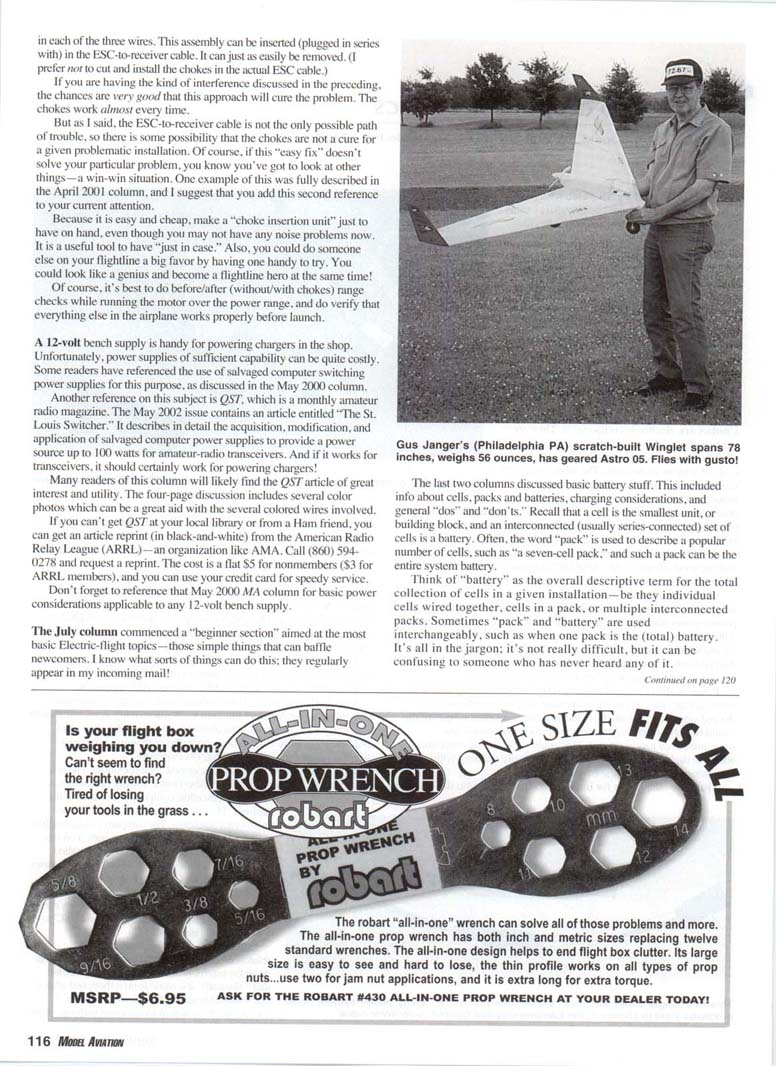
I normally use small 10 microhenry (µH) molded chokes that look slightly like resistors but are not. (A microhenry is one-millionth of a henry.) In years past I purchased them from ACE R/C, and more recently from RadioShack.com. Since both of those suppliers have ceased parts operations, my current source is Mouser Electronics. Mouser has no minimum order and no small-order surcharge. They can be reached at (800) 346-6873 or www.mouser.com. You can request a catalog or view it online.
The chokes I use are J.W. Miller Co. 77F series. The Mouser stock (catalog) number is 542-77F100; they cost approximately $0.55 each. You need three chokes for each installation: one for each of the three wires that make up a typical ESC-to-receiver interconnection.
If you want more detail on chokes and choke use, see the April 1995 column (reprints available from AMA Headquarters).
Choke insertion unit
I strongly suggest making a "choke insertion unit" to have on hand. It is easy and inexpensive and often cures noise problems.
Basic assembly:
- Obtain a short extension cable (e.g., aileron extension) to match your radio connectors.
- Cut the cable and reconnect it with one choke inserted in each of the three wires.
- Use this assembly in series with the ESC-to-receiver cable (plug it in between the ESC and receiver). It can easily be removed if desired.
I prefer not to cut the actual ESC cable; instead use the insertion unit as a removable adapter. If you have the interference described above, this approach will very often cure the problem. However, if chokes do not solve your particular issue, you will need to investigate other potential causes (see the April 2001 column for an example).
When testing, do before/after range checks (without/with chokes) while running the motor across the power range, and verify that everything in the airplane works properly before launch. Having a choke insertion unit on the flight line can help others and make you a flightline hero.
12-volt bench supply
A 12-volt bench supply is handy for powering chargers in the shop, but capable supplies can be costly. Many readers use salvaged computer switching power supplies for this purpose (see the May 2000 column).
Another useful reference is QST (the monthly amateur radio magazine). The May 2002 issue contains an article titled "The St. Louis Switcher," which describes acquisition, modification, and application of salvaged computer power supplies to provide up to 100 watts for amateur-radio transceivers. If it works for transceivers, it will work for powering chargers. The article includes several color photos that help identify the many colored wires involved.
If you cannot get QST at your library or from a ham friend, you can order a black-and-white reprint from the American Radio Relay League (ARRL). Call (860) 594-0278 to request a reprint. The cost is $5 for nonmembers ($3 for ARRL members); credit card payment is accepted.
Don’t forget to reference the May 2000 Model Aviation column for basic power considerations applicable to any 12-volt bench supply.
Beginner topics — batteries and storage
The July column began a beginner section covering basic electric-flight topics. The last two columns discussed basic battery matters: cells, packs, batteries, charging considerations, and general dos and don'ts.
Definitions and jargon:
- A cell is the smallest unit or building block.
- An interconnected set of cells (usually in series) is a battery.
- A "pack" often describes a popular number of cells (for example, a "seven-cell pack"). A pack can be the entire system battery.
- Sometimes "pack" and "battery" are used interchangeably when one pack is the total battery.
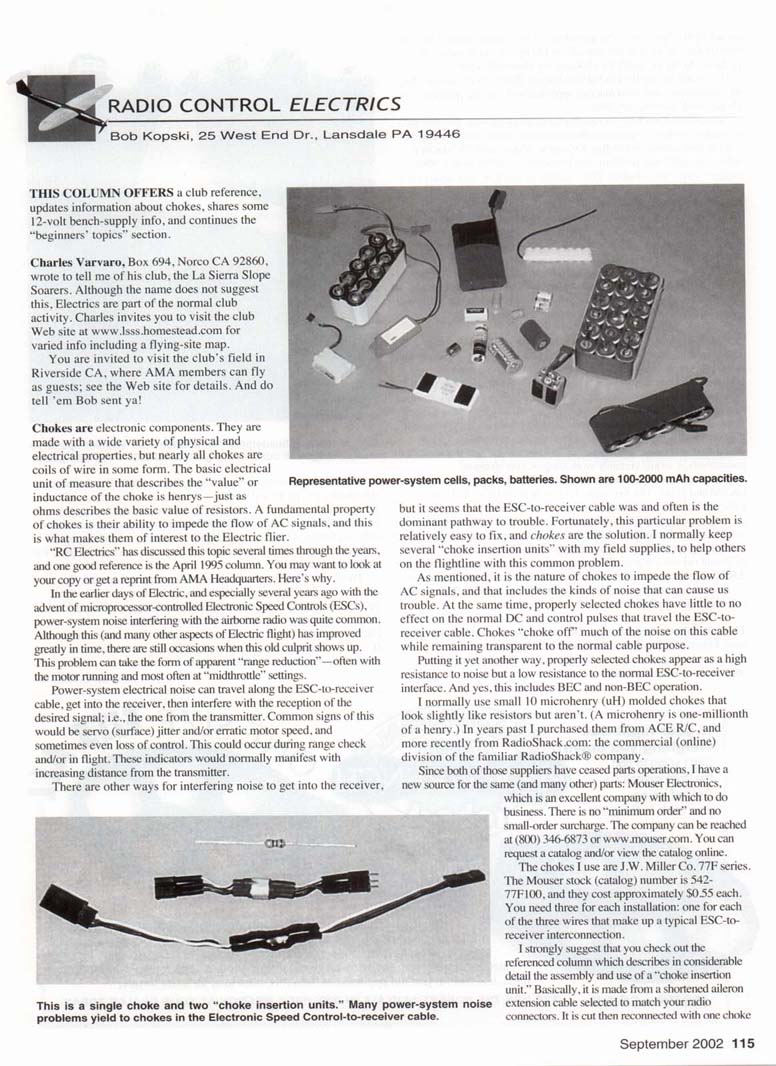
There is a bewildering array of battery products today—more than when I first flew in the early 1970s. Batteries come in many sizes and chemistries (Ni-Cd, NiMH, etc.), and appearance does not always reveal chemistry.
Storage practice:
- I usually store motor packs in a discharged state. In practice, I fly out the charge; when the battery is discharged, it is stored that way until the next flying opportunity.
- If I charge and cannot fly the same day but may fly the next day, I will "save" the partially used charge overnight and top it off with a quick fast-charge before flying (usually one or two minutes).
- If I cannot fly for more than a day or so after charging, I will use a slow charge for an hour or more (depending on elapsed days) before flying. Slow charging helps bring all cells up equally.
Rationale: cells in a battery can differ in charge retention (more so with longer storage time and higher temperature), which can lead to imbalance. Under these circumstances it is usually advisable not to fast charge or discharge the pack; instead use a slow charge to equalize the cells before flying.
Many readers report that the first flight of an outing is not as energetic as subsequent flights. This is common. Likewise, a slow-charged pack often fuels a less spirited flight than a fast-charged pack. These behaviors are normal and not necessarily signs of impaired batteries or chargers.
Closing
So concludes this beginning column of my 20th Model Aviation year. Please include a self-addressed stamped envelope (SASE) with any correspondence for which you'd like a reply. Everyone who does so receives a reply. MA
Transcribed from original scans by AI. Minor OCR errors may remain.

