
RC Electrics
Bob Kopski, 25 West End Dr., Lansdale PA 19446
THIS COLUMN LISTS one Electric-Connection Service (ECS), announces one meet, describes a new book, shares reader reaction to recent presentations, has parts update information about the Universal Slow Charger, and presents what might be the "Ultimate Conversion"—a story which more-senior readers should thoroughly enjoy!
Electric-Connection Service (ECS)
Bill Welch, an associate professor of pathology, tells me he's a novice in E-power and is seeking to connect with others of the E-persuasion.
- Weekday contact: 75 Francis St., Boston MA 02115; Tel.: (617) 732-4745; E-mail: wrwelch@bics.bwh.harvard.edu
- Weekend contact: Box 356, Woodstock VT 05091; Tel.: (802) 457-4549
I think this is a first for the ECS: an opportunity to connect with the same reader at two locations and share the joy that electric flight can bring. So do get in touch with Bill!
Meet announcement
The Dallas Electric Aircraft Fliers have announced their 16th Annual DEAF Fly-in, to be held at the club's field in Seagoville, Texas, October 5–6. There's a lot going on at this meet; for details contact:
- Jim Truitt, Contest Director, 1618 Mapleton, Dallas TX 75228; Tel.: (214) 327-4441; E-mail: JTr8436ama@aol.com
And do tell him Bob sent you!
Books
Bob Aberle has done it again. In 1995 he "wrote the book" on electric flight: Clean and Quiet — The Guide to Electric Powered Flight (commonly called Clean and Quiet). It was the go-to E-book of the time and remains valuable because the principles and basics continue to apply, even though the technology has advanced rapidly.
Bob has just released Getting Started in Backyard Flying, a new 126-page, 17-chapter book richly illustrated with photos, sketches, and tables. Although the title may sound confining, the book contains vast amounts of basic information applicable across electric flight. It’s published by AirAge (the Model Airplane News publisher) and lists for $24.95.
I strongly encourage you to consider both Getting Started in Backyard Flying and Clean and Quiet. Both books are also available from New Creations R/C:
- New Creations R/C, Box 496, Willis TX 77378; Tel.: (936) 856-4630
Request the company catalog; the people there will be very helpful with your electric needs.
Chargers: SPSC and LPSC
The "Small-Pack Slow Charger" (SPSC) construction feature in the June 2002 Model Aviation brought much reader reaction. The SPSC is becoming a reader favorite due to its low cost, simplicity, and applicability to park flyers and beyond. Many readers expressed interest but needed a larger version.
A larger version exists: the Large Pack Slow Charger (LPSC), presented in the July 1997 MA. The LPSC can charge at 50–200 mA and handle as many as 21 cells. It is similar in principle to the SPSC but different in detail. If you are missing the July 1997 issue, request an article reprint from AMA Headquarters.
Note: one LPSC part — the wall-wart power module — has a new RadioShack catalog number: 273-1631 (replaces 273-1610).
Universal Slow Charger (USC) update
The August 2002 column discussed supplier circumstances where many parts for the Universal Slow Charger (USC; 9/00 MA with follow-ups in 10/00 and 11/00 MAs) were no longer available. I promised a revised parts list to help readers who continue to build the USC.
I have that revision, but it is too long for easy inclusion in the magazine format. However, everyone interested may receive a copy of the several-page "USC Update" free. Send a written request along with a double-stamped, business-size envelope (an ordinary 4 1/8 x 9 1/2-inch or larger one), and it's yours.
The "Ultimate Conversion" — letter from Bill Smith (Hazleton, PA)
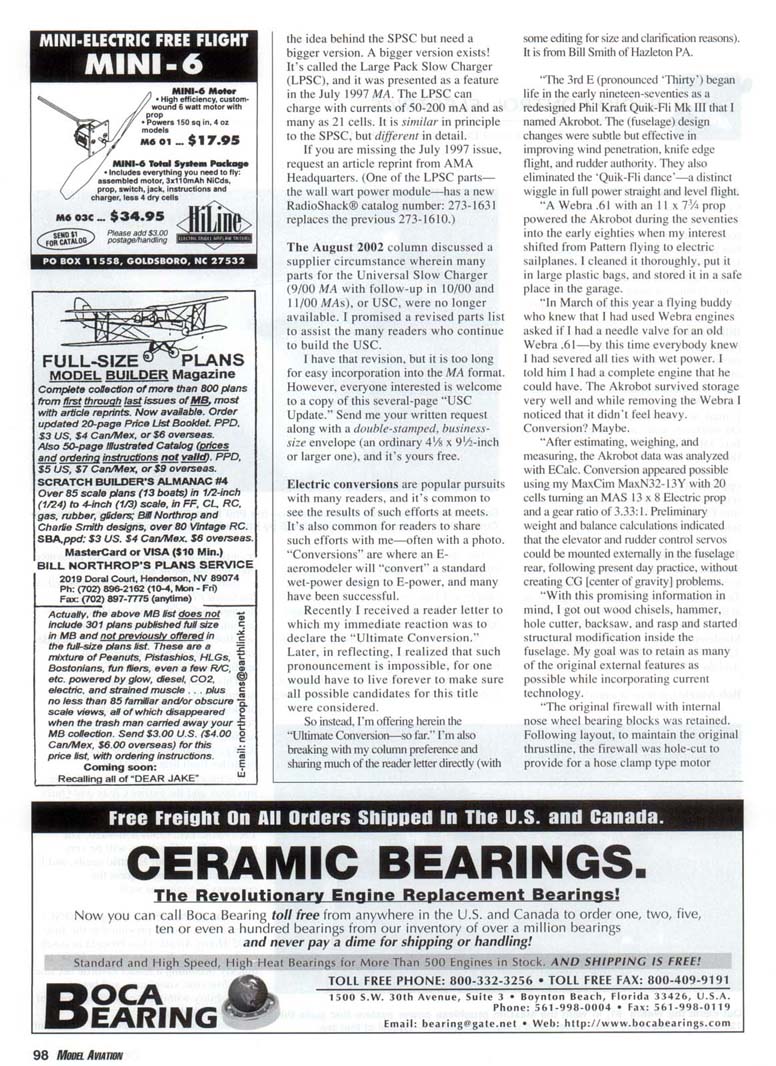
Electric conversions are popular and commonly seen at meets. A conversion is where an E-aeromodeler converts a standard glow (wet-power) design to electric power. Recently I received a reader letter that prompted me to offer what follows as the "Ultimate Conversion—so far." Much of the reader's letter is presented here, edited only for size and clarification. It is from Bill Smith of Hazleton, Pennsylvania.
The 3rd E (pronounced "Thirty") began life in the early 1970s as a redesigned Phil Kraft Quik-Fli Mk III that I named Akrobat. The fuselage design changes were subtle but effective in improving wind penetration, knife-edge flight, and rudder authority. They also eliminated the "Quik-Fli dance"—a distinct waggle in full-power straight-and-level flight.
A Webra .61 with an 11 x 7-1/4 prop powered the Akrobat during the 1970s into the early 1980s when my interest shifted from rallying to electric sailplanes. I cleaned it thoroughly, put it in large plastic bags, and stored it in a safe place in the garage.
In March of this year a flying buddy who knew I had used Webra engines asked if I had a needle valve for an old Webra .61—by this time everybody knew I had several of all sizes. I told him I had a complete engine that he could have. The Akrobat survived storage very well and while removing the Webra I noticed that it didn't feel heavy.
Conversion? Maybe.
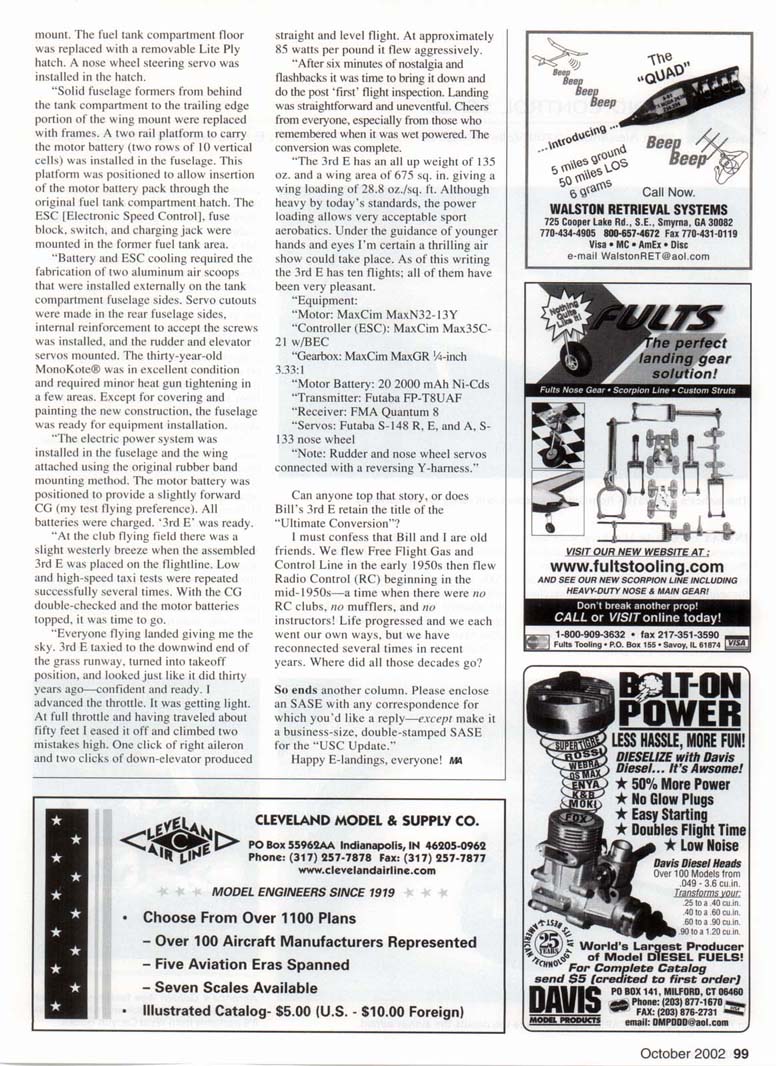
After estimating, weighing, and measuring, I analyzed the Akrobat data with ECalc. Conversion appeared possible using a MaxCim MaxN32-13Y motor with 20 cells turning an MAS 13.3 x 8 electric prop and a gear ratio of 3.33:1. Preliminary weight-and-balance calculations indicated that the elevator and rudder control servos could be mounted externally in the fuselage rear, following present-day practice, without creating center-of-gravity problems.
With the promising information in hand, I got out wood chisels, hammer, hole cutter, backsaw, and rasp and started structural modification inside the fuselage. My goal was to retain as many of the original external features as possible while incorporating current technology.
The original firewall with internal nosewheel bearing blocks was retained. To maintain the original thrustline, the firewall was hole-cut to provide for a horseshoe-clamp type motor mounting. The firewall was recessed 1/8 in. to create a motor box in which the motor was mounted on a balsa shelf and rubber-mounted. A small ply doubler was glued to the firewall and a 1/8-in. ply plate mounted to it to provide a solid mount for the engine box and landing gear. The motor is a MaxN32-13Y with a 3.33:1 gearbox turning an MAS 13.3 x 8 prop. Batteries are twenty Sanyo 1300 Sub-C cells in a long pack. The pack slides into the fuselage ahead of the wing and is retained with Velcro straps. The ESC is mounted in the nose with good ventilation.
After ground tests and initial trimming flights the results were encouraging. Takeoffs were short, climb was brisk, and cruise was satisfactory. The model handled beautifully in all axes and displayed the same aerobatic capability as before conversion. The only control modifications required were lengthening the rudder and elevator pushrods and installing heavier hinges.
There were, of course, a few problems. I had to beef up some internal truss members and reinforce the tailplane hinge points to eliminate a slight pitch oscillation at high power. Venting had to be improved to keep the batteries and ESC cool, and the landing gear mounts were strengthened to accept the different loads.
The conversion surprised me by how well an old design accepted modern electric power. Careful attention to weight distribution, solid motor mounting, and adequate ventilation produced a reliable, enjoyable airplane. It is light enough to land on grass fields and powerful enough for sport aerobatics and cross-country fun.
So maybe it is the Ultimate Conversion—for now.
Sincerely, Bill Smith
Closing and notes
I must confess that Bill and I are old friends. We flew Free Flight Gas and Control Line in the early 1950s, then began radio control in the mid-1950s—a time when there were no RC clubs, no mufflers, and no instructors. Life progressed and we each went our own ways, but we have reconnected several times in recent years. Where did all those decades go?
So ends another column. Please enclose a SASE with any correspondence for which you'd like a reply—except make it a business-size, double-stamped SASE for the "USC Update."
Happy E-landings, everyone!
Transcribed from original scans by AI. Minor OCR errors may remain.

