

RC Electrics in Europe
Peter Blommaert
There is a growing swell of interest in electric-powered models in the U.S., but for the most part they remain curiosities to many fliers. Europeans, however, have been heavily into electroflight for a decade. They have a lot of practical knowledge, do neat things, and a famous Belgian modeler tells us about them.
Yesterday a friend told me: "Model aircraft with electric motors will go up very slowly—at the edge of their performance. After the batteries are dead, the model will be at some 350 ft., and will come down after a couple of circles above our field." That had been my opinion about electric flight for quite some years. I thought it was all a matter of batteries.
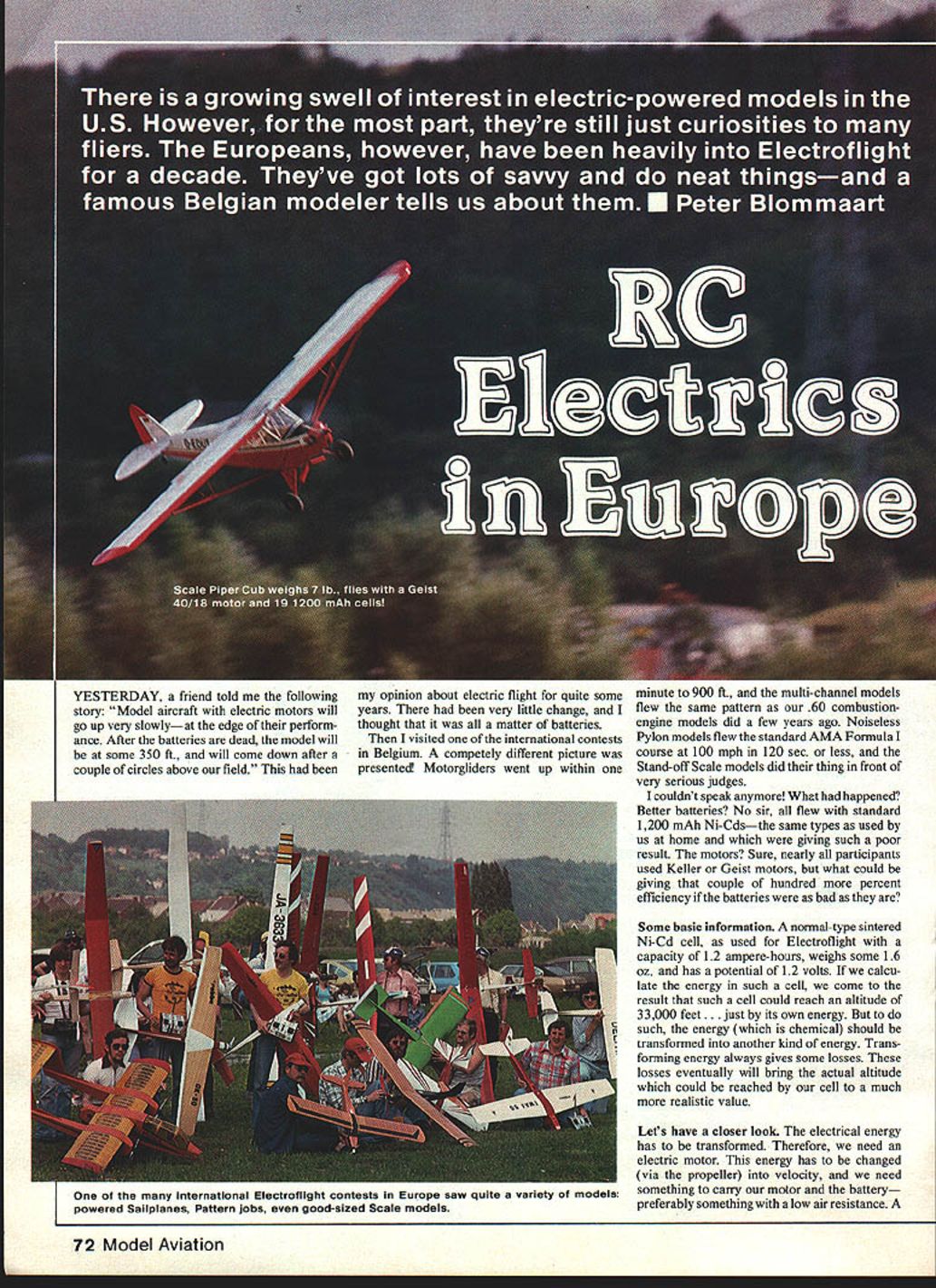
Then I visited one of the international contests in Belgium. A completely different picture was presented: motorgliders went up within one minute to 900 ft., and multi-channel models flew patterns comparable to our .60 combustion-engine models of a few years ago. Noiseless pylon models flew the standard AMA Formula 1 course at 100 mph in 120 sec. or less, and stand-off scale models performed before very serious judges.
I couldn't speak anymore. What had happened? Better batteries? No—most flew with standard 1,200 mAh Ni-Cd cells, the same types we used at home. The motors were familiar (Keller or Geist), but something was giving a couple of hundred percent more performance despite the same basic cells.
Some basic information: a sintered Ni-Cd cell used for electroflight, capacity 1.2 ampere-hours, weighs about 1.6 oz and has a nominal potential of 1.2 volts. If you calculate the chemical energy in such a cell, in theory it could lift a model very high (a naive calculation gives an altitude of ~33,000 ft). Of course, transforming chemical energy to mechanical energy incurs losses in the motor, propeller and airframe, so the realistic altitude is much lower.
Consider the whole system: electrical energy is transformed by an electric motor and propeller into velocity; the airframe must carry the motor and battery and should have low drag. Example: a glider may weigh 6 lb; a battery of 14 cells at 1.6 oz each weighs about 22.4 oz. That reduces the theoretical ceiling to about 9,000 ft. System efficiency (motor, propeller and airframe) may be around 30%, so achievable altitude could be about 2,700 ft (9,000 ft × 0.3).
Small changes matter: a 1% decrease in system efficiency reduces climbing height by ~1%; a weight change of only 3 oz may change altitude by roughly 100 ft. This illustrates the relationship between battery energy, weight and climb height, and the importance of low total weight and high system efficiency. Build aerodynamically clean models; fancy extras are less important than functionality.
Another major improvement in recent years is the use of samarium-cobalt magnets in motors. For the same weight these give nearly double the power output and at least ~10% higher efficiency compared with motors using classic magnet materials. This is important in contests. Weekend fliers can still achieve reasonable climb ceilings of about 1,500 ft with standard motors.
Typical contest electroflight gliders today climb using nearly all the energy in about 2.5 minutes, giving a climb speed around 17 ft/sec. From available electrical power of roughly 500 W, net useful energy might be about 150 W; electrical currents at these voltages are on the order of 30 A. With these figures you can compute the effect of changes in efficiency or weight on climb height.
Did you get the clue? It is very easy to waste energy in an electric-powered model by just using any prop on any number of cells on any fuselage. Understanding trade-offs between battery, motor, prop and airframe is essential.
The Present Status of Electric-Powered RC Models in Europe
The European electroflight scene is well developed. Local electroflight contests are held in every country, and there are well-attended international events (for example: Switzerland — 9th time; Belgium — 7th time; West Germany — 5th time). At these events one can learn a great deal about what works.
Propellers
Propellers for electric flight are not fundamentally different from those previously used, but certain types are popular for direct-driven and geared setups:
- Common direct-driven props: Top Flite, Taipan, Graupner — good efficiency for direct drive.
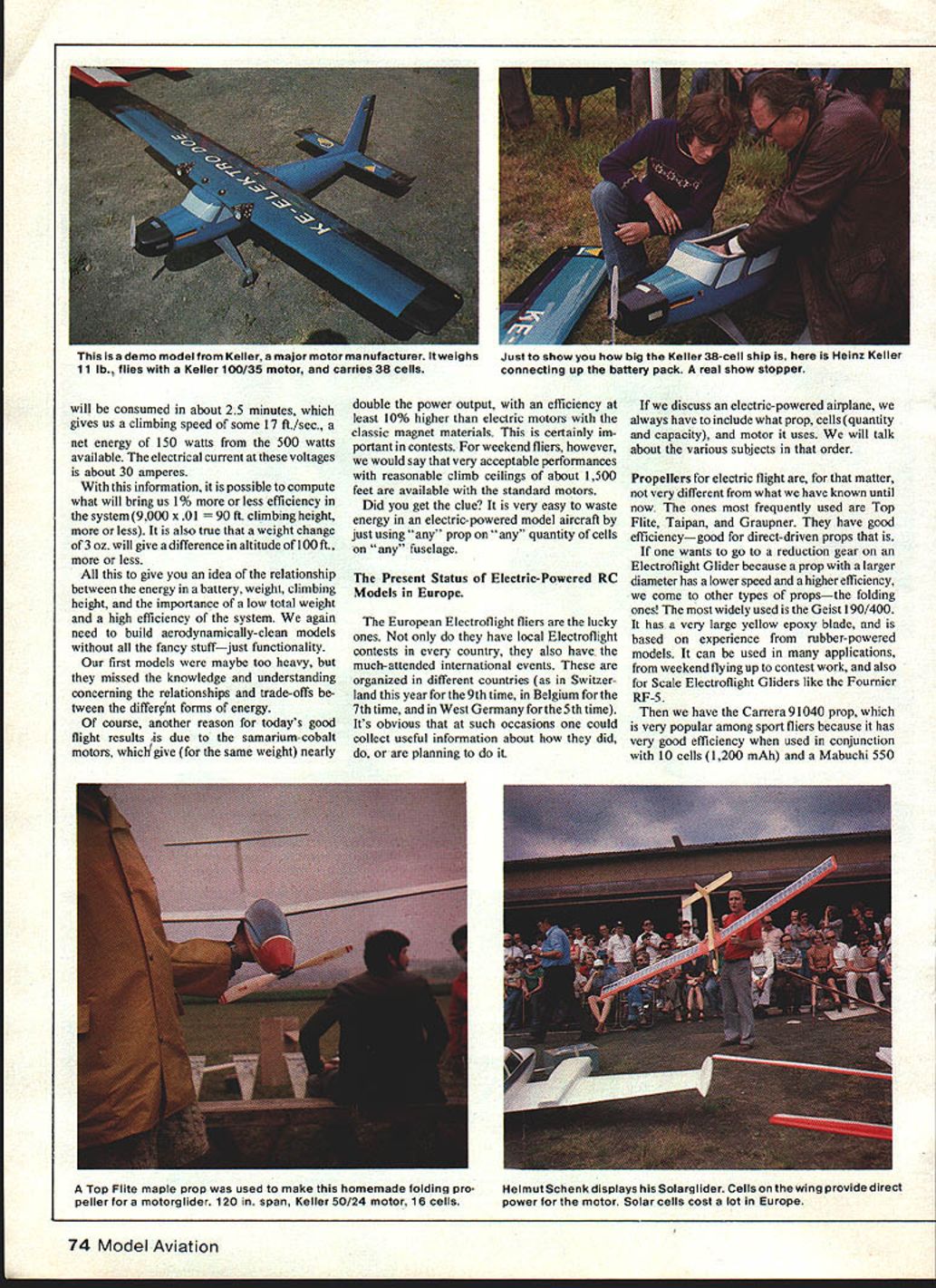
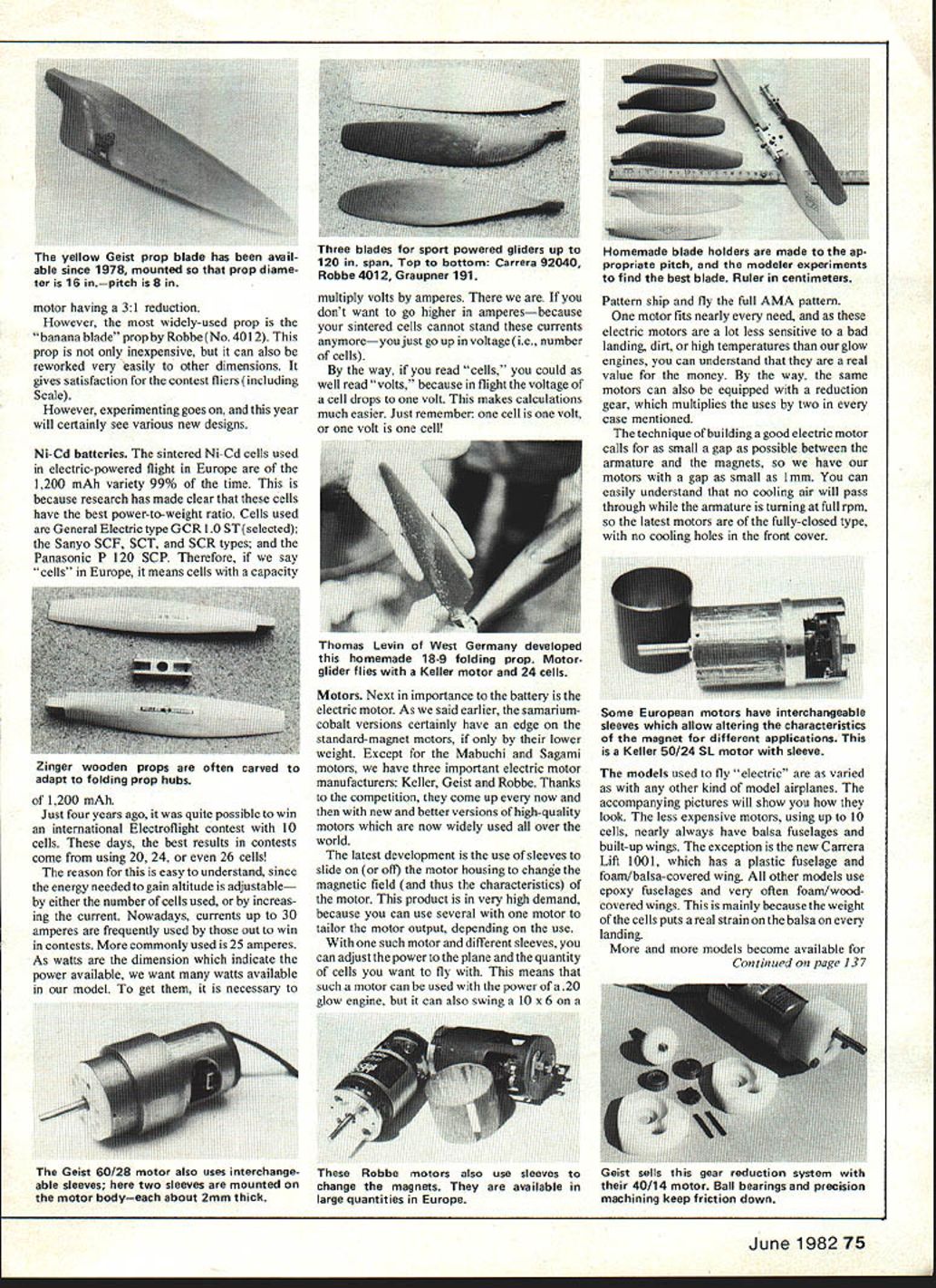
- Folding props (used with reduction gears for larger diameter, lower speed, higher efficiency): Geist 190/400 (large epoxy folding blade), Carrera 910/40 (popular among sport fliers with 10 cells and a Mabuchi 550 motor on 3:1 reduction).
- Widely used, inexpensive and easily reworked prop: Robbe "banana blade" (No. 4012).
Experimentation with new designs continues.
Ni-Cd batteries
In Europe, sintered Ni-Cd cells of 1,200 mAh capacity are used about 99% of the time—this capacity has the best power-to-weight ratio for model electroflight. Typical cell types: General Electric GCR 1.0 ST (selected), Sanyo SCF/SCT/SCR, Panasonic P 120 SCP.
Four years ago it was possible to win contests with 10 cells; nowadays the best contest results come from 20, 24 or even 26 cells. The required energy for altitude gain can be adjusted by the number of cells (voltage) or by increasing current (amperes). Watts = volts × amperes, so when you don't want to push cells to higher current, you can increase the number of cells (voltage). In flight the voltage of a cell often drops toward ~1 V, which simplifies calculations: think "one cell = one volt" for rough estimates.
Motors
Motors are next in importance after batteries. Samarium-cobalt magnets give a real advantage in weight-specific power and efficiency. Besides small Mabuchi and Sagami motors, three important European motor manufacturers are Keller, Geist and Robbe. Competition drives continual improvement and new high-quality versions worldwide.
Recent developments include interchangeable sleeves that slide over the motor housing to change the magnetic field and thus the motor characteristics. With one motor and several sleeves you can tailor motor output for different numbers of cells or aircraft types—allowing one motor to cover a wide range, from the power of a .20 glow engine up to pattern-ship power. Many motors can also be fitted with reduction gears to expand their usefulness.
Good electric motor construction uses a very small gap between armature and magnets (e.g., ~1 mm). Modern motors are often fully closed (no front cooling holes) because no cooling air passes through the motor at high rpm; closed designs can be more robust for model use.
Models and construction
Models for electric flight vary widely:
- Low-cost sport models using up to 10 cells often have balsa fuselages and built-up wings (exception: Carrera Lift 1001 with plastic fuselage and foam/balsa-covered wing).
- Higher-end contest models typically use epoxy fuselages and foam/wood-covered wings; battery weight places real strain on balsa in landings, so stronger materials are preferred.
- More models are being produced with dedicated battery and motor mounting provisions—battery pans fixed under the fuselage that can be removed quickly.
Examples seen at European meets (large-scale or semi-scale):
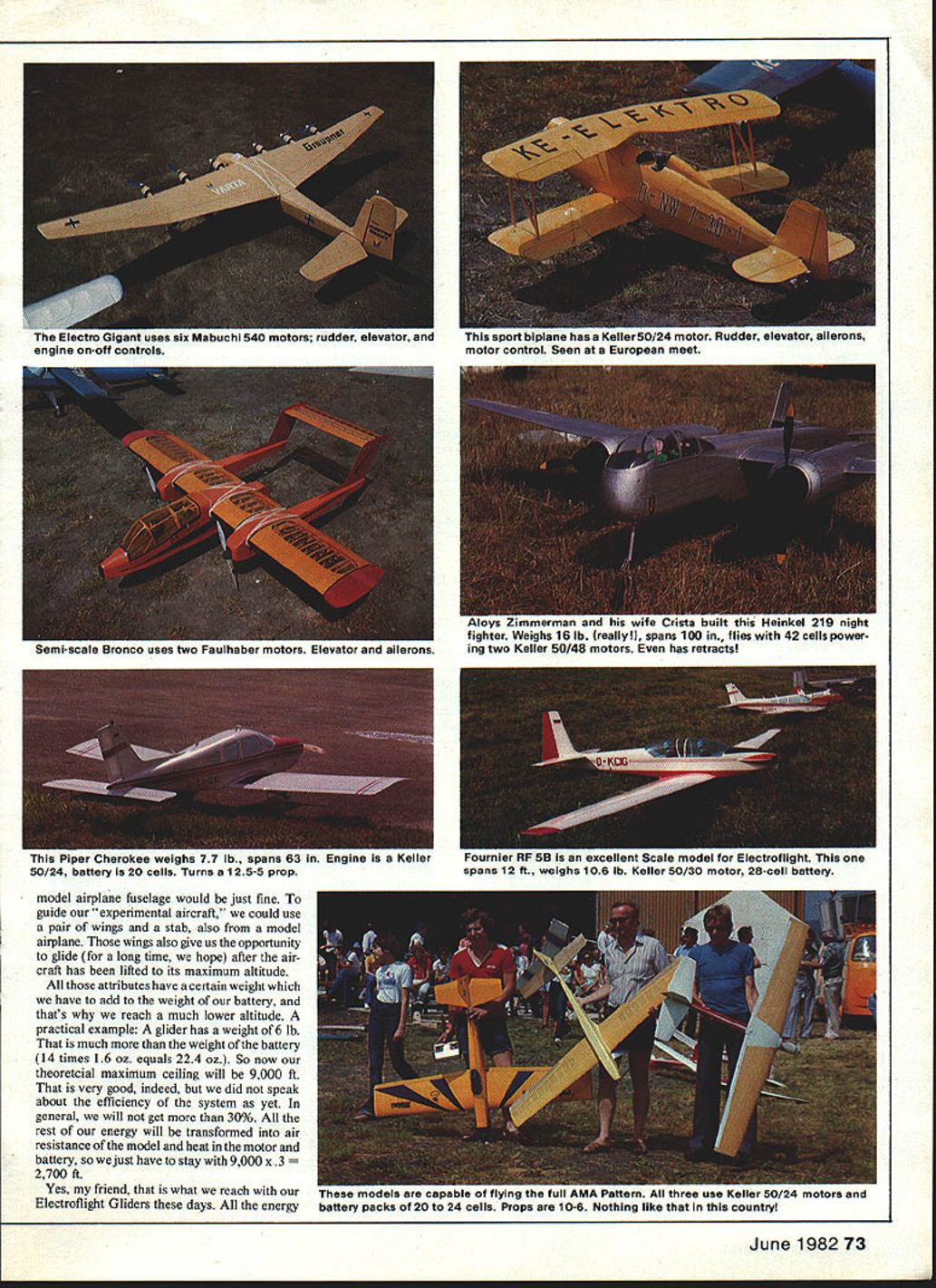
- A fighter: spans 100 in, weighs 16 lb, uses two Keller 50/48 motors on 42 cells and has retracts.
- A Piper Cherokee example: spans 63 in, uses a Keller 50/24 engine and a 20-cell battery; turns a 12.5 × 5 prop.
- A scale electroflight: spans 12 ft, weighs 10.6 lb, uses a Keller 50/30 motor with a 28-cell battery.
Many models are capable of flying on full packs of 20–24 cells; some use Keller 50/24 motors.
Cooling and ventilation
Early designs included ventilation holes in the fuselage for cooling air. Experience showed that battery heating is not primarily from external heating during flight but from internal heating of the cell core; the heat takes time to reach the outside. Pilots now increasingly remove batteries after each flight to aid cooling and improve charging. Modern models often omit front cooling holes. If you duct cooling air, aim it directly at the motor brushes—nowhere else.
Contest models
Average contest electroflight gliders have spans of 110–120 in. Training and casual flying can be done with 14 cells, but for contests 20 cells are common. In contest flying the motor run should be as short as possible—typically 20 to 40 seconds to reach 700–800 ft. FAI electroflight contests allow two motor runs, so all energy aboard should be used in about 80–100 sec; if power remains after that, add more cells.
Props used include standard Zinger, Top Flite and Graupner types (12 × 6 to 16 × 8) adapted to fold. Special designs are also common.
Motor throttling without wasting power is important. Volt controllers (electronic speed controllers) with efficiencies up to ~97% are increasingly used. They allow gradual control from 0 to full rpm, reducing stress on the power system compared with simple on/off switching and using battery energy more effectively. Level flight needs much less power than the initial climb, so throttling helps.
Aerobatic (Pattern) models
Pattern models are more classic than gliders. They typically carry 20–24 cells and use 10 × 6 or 10 × 7 props. Many (about 80%) use Keller 50/24 or 50/24X motors, which are powerful and reasonably priced. Geist 60/28 motors deliver similar power but at a higher price.
Fun models
Any electric motor can be used for fun models if the prop, cells and motor are properly matched to the model and the intended flying style. Expect to see all kinds of combinations in the field.
Upcoming events
The biggest gathering of electroflight models will take place in Amay, Belgium, for the European Championships for FAI class F3E. The first F3E World Championships was planned for 1984. Be prepared!
Transcribed from original scans by AI. Minor OCR errors may remain.

