
RC Flight Simulator
By Byron Levy
How about an RC trainer that can help you learn a lot about flying—without the model ever leaving the ground? The sketch explains it all.
While learning to fly RC, my instructor pilot, Jerry Kelly, warned me to keep oriented with the plane. However, when the plane was coming toward me and I was facing it, he told me to remember to move the rudder stick in the direction of the low wing in order to keep the wings level. Too often I got confused and pushed the stick in the wrong direction, causing the plane to spiral in.
I knew I needed more practice. Between weekend flights, I came up with the idea of an operable non-flying trainer—sort of like a Link Trainer.
Materials
- Broken wine bottle opener (cast frame)
- A cork
- Spare two-channel radio (transmitter and receiver)
- Two unused servos
- A solid model (I carved a model of my yellow Sig Kadet)
- Double-coated tape and a few chock blocks
- Music wire
Construction
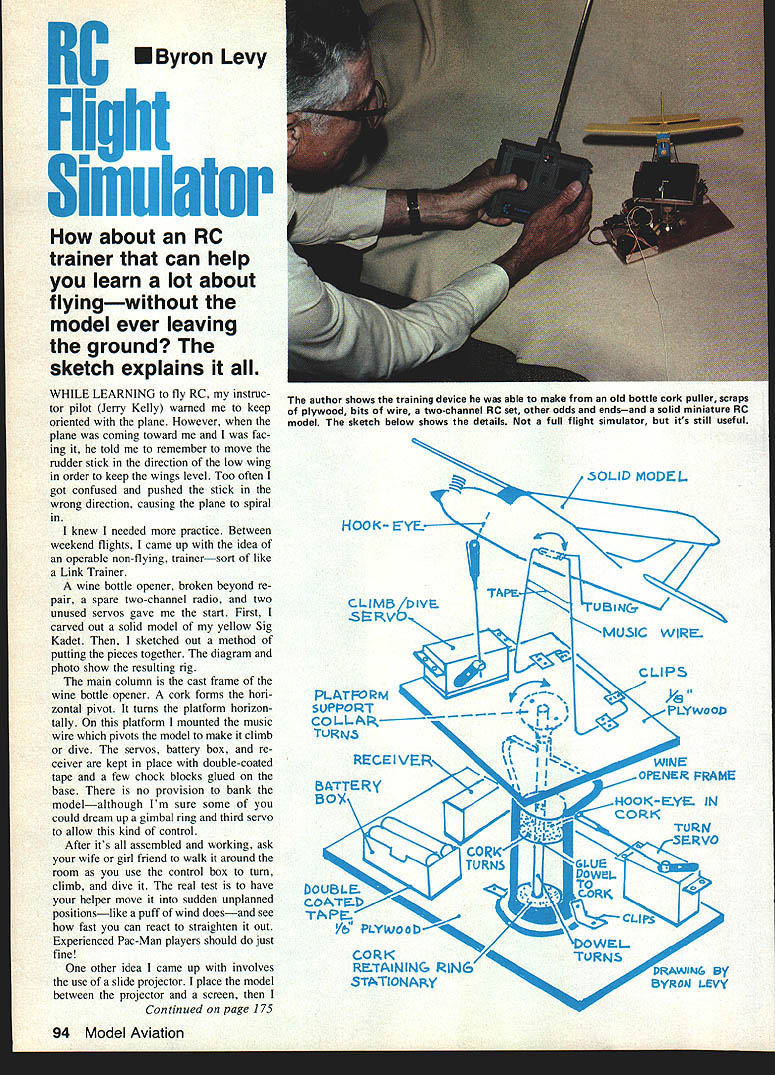
First, I carved out a solid model of my yellow Sig Kadet and sketched a method of assembling the pieces. The diagram and photo (not included here) show the resulting rig.
The main column is the cast frame from the wine bottle opener. A cork forms the horizontal pivot, allowing the platform to turn left and right. On this platform I mounted the music wire, which pivots the model to make it climb or dive. The servos, battery box, and receiver are kept in place with double-coated tape and a few chock blocks glued on the base.
There is no provision to bank the model—although you could add a gimbal ring and a third servo to allow banking if you want to expand the design.
Operation
After it's assembled and working, ask your wife or girlfriend to walk it around the room while you use the control box to turn, climb, and dive it. The real test is to have your helper move it into sudden, unplanned positions—like a puff of wind does—and see how fast you can react to straighten it out. Experienced Pac-Man players should do just fine!
Projector trick
One other idea involves using a slide projector. Place the model between the projector and a screen, move the plane into different positions, and watch the resulting profiles on the screen. These profiles have helped me learn to recognize whether the plane was flying toward me or away when it gets "way out there."
Notes and safety
It's a good training device for a rainy day. If you build one and take it to the flying field, be sure to show your colors and get the frequency pin off the board. That transmitter is really on even though your trainer isn't in the air!
Transcribed from original scans by AI. Minor OCR errors may remain.

