
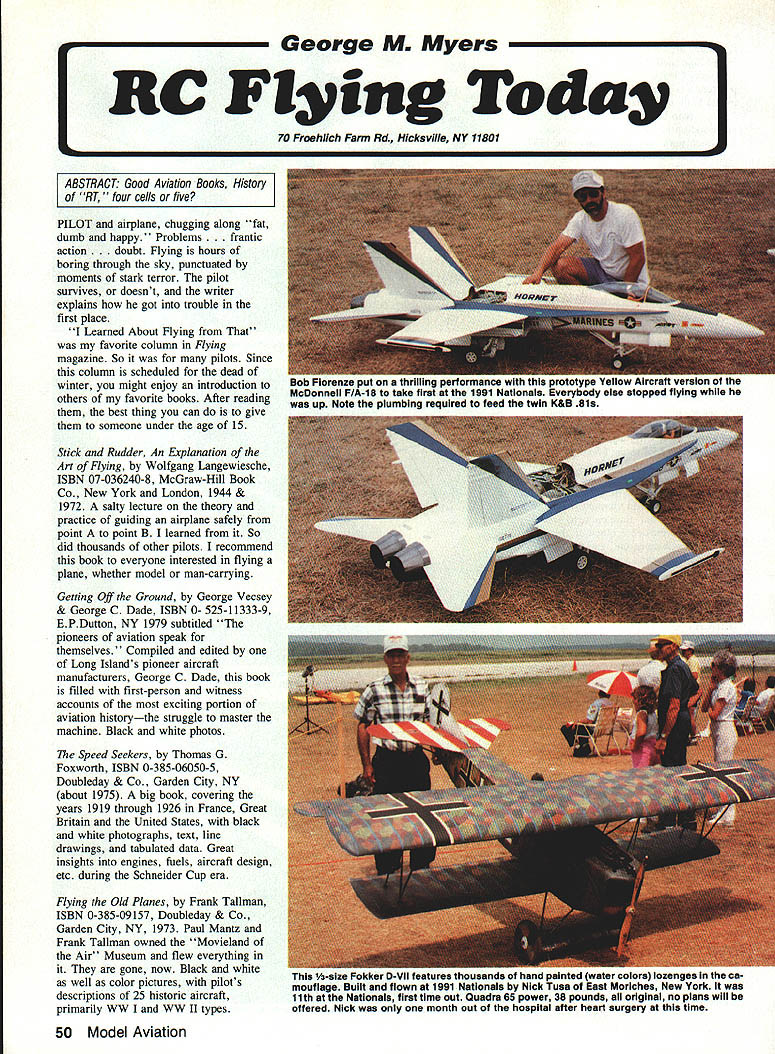
RC Flying Today
George M. Myers 70 Froehlich Farm Rd., Hicksville, NY 11801
Abstract
Good aviation books, history of "RT," four cells or five?
Pilot and airplane, chugging along "fat, dumb and happy." Problems . . . frantic action . . . doubt. Flying is hours of boring through the sky, punctuated by moments of stark terror. The pilot survives, or doesn't, and the writer explains how he got into trouble in the first place.
"I Learned About Flying from That" was my favorite column in Flying magazine. So it was for many pilots. Since this column is scheduled for the dead of winter, you might enjoy an introduction to some of my favorite books. After reading them, the best thing you can do is to give them to someone under the age of 15.
Recommended books
- Stick and Rudder, An Explanation of the Art of Flying, by Wolfgang Langewiesche. ISBN 07-036240-8. McGraw-Hill Book Co., New York and London, 1944 & 1972. A salty lecture on the theory and practice of guiding an airplane safely from point A to point B. I learned from it. So did thousands of other pilots. I recommend this book to everyone interested in flying a plane, whether model or man-carrying.
- Getting Off the Ground, by George Vecsey & George C. Dade. ISBN 0-525-11333-9. E. P. Dutton, NY, 1979. Subtitled "The pioneers of aviation speak for themselves." Compiled and edited by one of Long Island's pioneer aircraft manufacturers, George C. Dade, this book is filled with first-person and witness accounts of the most exciting portion of aviation history—the struggle to master the machine. Black and white photos.
- The Speed Seekers, by Thomas G. Foxworth. ISBN 0-385-06050-5. Doubleday & Co., Garden City, NY (about 1975). A big book, covering the years 1919 through 1926 in France, Great Britain and the United States, with black and white photographs, text, line drawings, and tabulated data. Great insights into engines, fuels, aircraft design, etc., during the Schneider Cup era.
- Flying the Old Planes, by Frank Tallman. ISBN 0-385-09157. Doubleday & Co., Garden City, NY, 1973. Paul Mantz and Frank Tallman owned the "Movieland of the Air" museum and flew everything in it. They are gone now. Black and white as well as color pictures, with pilots' descriptions of 25 historic aircraft, primarily WW I and WW II types.
- West with the Night, by Beryl Markham, 1942. Current edition published by North Point Press, San Francisco. ISBN 0-86547-118-5, 1983. Beryl Markham, born in England in 1902, moved with her father to East Africa in 1906, learned to fly, bought an airplane and flew over Africa beginning in the 1920s, continuing until she died in 1986. Read the beauty of her writing. Ernest Hemingway said, "She has written well, marvelously well; I am completely ashamed of myself as a writer."
- Tales of the Ancient Modeler, by Norm Rosenstock. ISBN 0-934575-10-X. ViP Publishers, P.O. Box 16103, Colorado Springs, CO 80935. Anecdotes of a lifetime spent aeromodeling: man built the first hand-held RC transmitter, established RC duration record. Bill Winter manufactured mufflers before they were required; pioneered Giant Scale. Norm—neighbor, years, friend—everyone, real mensch. Black and white photos.
- The History of the Academy of Model Aeronautics, including Part One, Part Two, From the Beginning to the Year 1966, Willis C. Brown, Dick Black. No publisher's data or ISBN number; privately printed for the benefit of AMA as a result of personal efforts of writers and contributors. Supporters should read a copy at the AMA/Renaud Research Library. Fascinating to learn how model aviation developed.
- Aerospace Heritage of Long Island, by Joshua Stoff. ISBN 1-55787-____. Heart Lakes Publishing, Interlaken, NY, 1989. Begins with balloon flight on Long Island in 1833 and traces the history of about 90 aircraft manufacturers once located on Long Island, ending with the status of aviation on Long Island in 1989. I was fortunate to be employed 1943–1986 by the sole surviving Long Island aircraft manufacturer, Grumman Aeronautical Engineering Corporation, which built such famous aircraft as the F4F Wildcat and the F-14 Tomcat, and the spacecraft that actually carried men to the moon, the Lunar Excursion Module (LEM), later LM. Black and white photos and drawings.
- Finally, a tiny must-read book for anyone who thinks man invented the future: Jules Verne, translated into English. Der Mann, der die Zukunft erfand.
HISTORY OF "RADIO TECHNIQUE"
Today's concentration of AMA members in the RC side of the hobby has been building for 55 years. The AMA was the division of NAA (National Aeronautic Association) that was devoted to improving the science of airplane models and to educating young people. The publication name Model Aviation extends back to Vol. 1, No. 1, dated August 1936. Radio control of model airplanes propelled by internal combustion engines has been a key concern of the AMA since 1934, when the Junior Birdmen of America, an organization sponsored by Hearst Newspapers, tried to ban gas engines from model airplanes.
"RC Flying Today" (formerly "Radio Technique") has been included in Model Aviation magazine since Vol. 1, No. 1, dated July 1975. This is No. 182 in the series. It has been an honor for me to be a member of this magazine staff. I have enjoyed writing "RT" and have appreciated the support of Editor Bill Winter, Publisher Carl Wheeler and Executive Director John Worth in the past, and of Terry Rossiter, Ross McMullen and Vince Mankowski who hold those positions today.
The name "Radio Technique" came from the first idea Bill Winter had for the column: a column that was to explain how a modeler could fix his RC systems. The march of technology quickly made RC systems unrepairable by the average modeler. Most modelers did not join the ARRL (Amateur Radio Relay League) and did not become amateur radio enthusiasts. They didn't have the special kit of tools, specialized knowledge and peculiar parts that are needed.
I tried to keep my suggestions within the scope of things reasonably available to a non-Ham AMA member. Above all, I've tried to keep "RT" interesting, entertaining and scientifically accurate.
As you may have noticed, "RT" isn't like the rest of the magazine in the sense that it is not about competition events (CL speed, RC Scale, Indoor Duration, etc.), nor is it about AMA (Muncie, rules changes, insurance, etc.). Instead, I have examined the philosophy of the hobby: the "how" and "why" of the most important things, such as the changes in the RC environment which began in 1982 with the FCC grant of the 50 channels we now enjoy. There are always new excursions into related subjects that can add to your enjoyment of the hobby, such as books, batteries, chargers and (recently) using LORAN and AUTOMAP™ to find flying sites.
I've tried to discover what has been going on, point out trends and examine their probable consequences. Some people consider the column bizarre, others have liked it, but no one can deny that, from the beginning of AMA, RC has been the most important form of the hobby. The most important concern in the hobby always has been flying sites.
When the last flying site is lost, the hobby will be lost, hence the change in name and in focus of the column. I am now embarked on an investigation of the question: "How do people obtain and hold flying sites?"
Charlie Williams' 1936-style plane
It looks as good in the air as the 1936 original. As for flight performance, he never had any doubts about that.
I like Charlie's bird. It would make an interesting sport flying project, and I'd like to see the plans made available. Rather than working from construction plans, Charlie built the plane from memory as he went along. But perhaps he and I can get together to work up some drawings.
If you're interested, drop Charlie a line: Charles Williams, 1601 Osprey Ct., Point Pleasant, NJ 08742. Also, if you happen to have flown at Hadley Airport as Charlie did back in the 1930s, I know he'd enjoy hearing about that as well.
FLOYD BENNETT FIELD AT GATEWAY NATIONAL PARK
A Cradle of Aviation site, Floyd Bennett Field was named for an aviator best known for piloting the first airplane to reach the North Pole. Floyd Bennett Field was the eastern terminus of cross-country airplanes bound for WW II in the 1930s, served as the primary trans-shipment point for Navy airplanes bound for WW II in the 1940s, was a major Coast Guard and Air National Guard terminal in the 50s and 60s, served as an important seaport staging area for Desert Storm aircraft, and is now mostly part of the National Parks system. Part of it is still an active Coast Guard helicopter base.
The Pennsylvania Avenue Radio Control Society (PARCS) has been flying from an abandoned runway on Floyd Bennett Field since 1969. They obtained the privilege as a result of Navy cooperation while the field was under Navy command, and have maintained it "by being nice to people." (Closed membership of 200 meets monthly in one of the buildings on the field.)
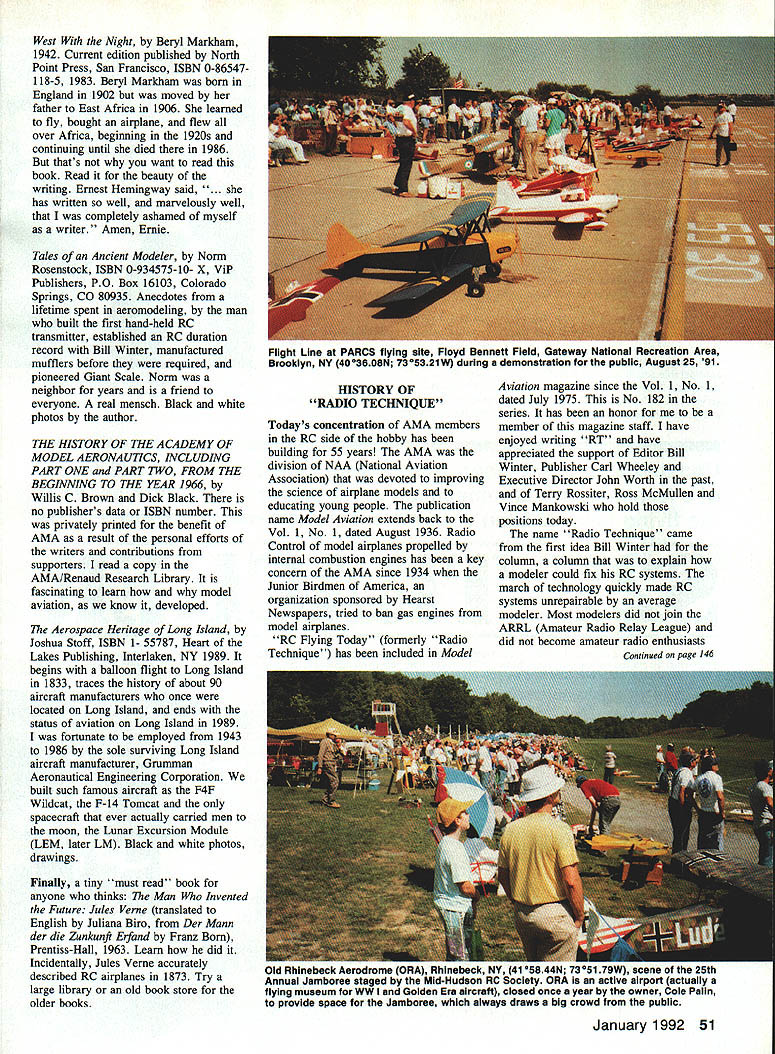
The PARCS staged a fly-in for the public on August 25, 1991. The Parks Administration questioned people as they entered the gate and found that more people came to Gateway Park to see the model airplanes than came for the fishing, motorcycling, RC cars or any other activity offered. The PARCS made a good effort to have the display advertised in newspapers, on radio, and on TV. That is how you sell model aviation to the public, make friends, and, ultimately, hold flying sites.
BRAIN TEASER: FOUR CELLS OR FIVE?
A friend asked: "What is the effect of using a five-cell Ni-Cd pack in place of a four-cell pack? Isn't the voltage the same as from four alkaline dry cells, and aren't most radios designed to work that way? Shouldn't you get more operating time with a five-cell pack?"
Let me make an important point: each cell has two ends that make contact with the circuit. Assuming four cells in a flight pack, there are eight places in the pack where a poor spring contact can destroy your plane. That's why Ni-Cd flight packs are welded together.
Let's look at test data, measured from one of my airplanes that has a Futaba receiver and four regular servos:
- Idle current, four-cell pack = 60 mA
- Idle current, five-cell pack = 80 mA
Same setup, but with two servos loaded to 30 in.-oz. (about 3/4 of maximum torque) by lead sinkers:
- Four-cell pack = 240 mA
- Five-cell pack = 260 mA
First, notice that the five-cell pack delivers an extra 20 mA to both the unloaded (idle) and loaded conditions. This is the most important fact. When you increase battery pack voltage, you increase the idle current and that increase applies all the time the system is on.
Second, notice that the current drawn by a servo which is under a constant mechanical load (but not stalled) isn't affected at all by the voltage. If you understand electric motors, you expect that result.
For the same constant load, we can calculate that:
- The four-cell pack will last 600/240 = 2.50 hours to an end point of 4.4 VDC.
- The five-cell pack will last 600/260 = 2.31 hours to an end point of 5.5 VDC (i.e., 1.1 VDC per cell in each case).
When doing the same work, the four-cell pack lasts longer.
Another factor is hidden: higher voltages cause hotter sparks, which will burn away motor brushes faster. When you look at the brushes on servo motors, you usually find that they are tiny wires crossed on the cylindrical commutator segments. As such, they only make point contact and their ability to dissipate heat is very limited. A five-cell pack will wear out your servo motors faster than a four-cell pack.
Given the disadvantages, why would anyone choose to use a five-cell pack? The most common reason is to get more work out of smaller servos, as is the case with the electric Whisper Helicopter and most other electric-powered airplanes. The trade is servo weight for propulsion battery weight.
Transcribed from original scans by AI. Minor OCR errors may remain.

