
RC Flying Today
George M. Myers 70 Froehlich Farm Rd., Hicksville, NY 11801
Abstract:
- AMA politics
- Guide to L.A. flying sites
- Don't swap FM receivers
- Indoor RC
CONGRATULATIONS to Joe Beshar (Oradell, New Jersey), who was just elected AMA Vice President for AMA District II. My salute goes to Joe, who has already done many good things for modeling. I am sure he will do more as vice president. My thanks go to those who voted for me to hold that office, which I take as a vote of confidence.
The nonvoters won this election by a margin of 5:1. That tells me that the majority of District II members didn't want any of the candidates. If the majority wanted to support someone, they didn't want it enough to mark a ballot and attach a 21-cent stamp.
Perhaps the members who are qualified to vote didn't understand the intentions of the candidates. AMA only allowed five paragraphs per candidate (three in this magazine and two on the ballot) to inform its members about the decision we will live with for years to come. Does that fact satisfy you?
AMA Politics
I want to climb on my soapbox and do a little speechifying for a minute. You may think this is just a blast of hot air, but I assure you that it is vitally connected with RC flying—today! Bear with it; hear me out; then see if that connection isn't so.
I was prohibited from discussing in this column my intentions as a candidate for the office of AMA District II Vice President. The basis for that denial was that it would have given me an unfair advantage over the other candidates (who did not write monthly columns in this magazine). That statement can be true only if the other candidates were also prevented from addressing the members in this magazine.
AMA offices aren't like your local political offices. There is no salary. Since AMA (through Model Aviation) buys "RC Flying Today" from me, you might ask why the members should pay me to explain what I plan to do for them. I ask you, "Why should any candidate for a volunteer office be prevented from stating his position in this journal?" I think AMA should require—and pay for—one or more articles from every candidate and incumbent describing his/her intentions if elected. We already know that the person elected will thereafter pay AMA for the privilege of serving in the office. They all do it now.
The AMA Executive Council sets policy for this magazine by example and by edict. Most of the columns in the "AMA News" section are written by the vice presidents and contain a few brief descriptions of past mall shows, picnics, and fun flies. Why? It is impossible to describe a district month's activities in a 1,000-word column. There are 227 clubs in District II and 4.3 weekends per month, or 976 club-weekends per month. With that 1,000-word-per-month limitation the VP could give them one word apiece.
District-level activities are seldom mentioned or promoted in the District VP's column, and AMA policy matters are seldom discussed before they are put to a vote in the Executive Council. How can you learn what policies are being considered in time to study them and have your opinions considered?
If Model Aviation really is the journal of the AMA, then I think it should provide space for—and promote—discussions of AMA politics. One District meeting per year (for Districts that hold them) certainly isn't adequate. Clearly, each district needs a district newsletter to discuss district matters. This would free the VP's column in "AMA News" for discussion of national AMA politics.
I have no idea what the other candidates did during this recent AMA election period. I spent months researching the job of AMA Vice President and the needs of District II. My position paper was revised 16 times. I gave interim copies to friends to get their comments. I visited 24 clubs, at my expense, to discuss my position with them and to get their comments.
Finally, I spent $200 to send a four-page document to every chartered club in District II. My contacts tell me that very few people got a chance to read it. I think AMA members in District II should ask their club's AMA contact person why they were kept in ignorance.
Let's examine modeling history. In 1928 membership (Junior Birdmen, Air Youth of America, Aircraft Modelers League of America) totaled over 1,000,000—0.8% of the U.S. population at the time. Most members flew handmade creations—sticks and tissue—powered by twisted rubber strands. Today AMA includes approximately 180,000 modelers—0.08% of the country's population (1/10th the percentage of 1928). Its members fly prefabricated RC models. AMA, created in 1936, saw modelers primarily defeat nonmodeler managers who wanted gasoline motors and radio control systems banned from model airplanes. AMA grew through rubber-powered Free Flight, gasoline- and alcohol-powered Free Flight, U-Control, plastic models, and radio-controlled models of today.
In spite of its small size, AMA has managed to do some good things for modelers. There have been several attempts to rule model airplanes out of the sky and to take away RC channels, which AMA has prevented. AMA got into the insurance game in order to preserve its use of flying fields.
Change is inevitable, and obsolescence is its consequence. AMA got so many exclusive RC channels to replace previous "shared" channels that were dominated by high-powered commercial users.
AMA has established performance standards for "narrow-band" RC systems, so manufacturers can produce systems that permit you to fly in the modern environment. Without AMA, all your RC systems would be obsolete today, and 99% of you wouldn't be flying any RC at all.
Noise is an irritant to the public. AMA has worked to define the problem and show how to minimize it. AMA has prepared a sample noise ordinance, which has been used (successfully) to get noise arguments out of the passionate arena of personal opinion and into the dispassionate arena of scientific measurements.
When everyone has to conform to a measurable noise standard, everyone sees that model airplane noise is insignificant relative to lawnmowers, leaf-blowers, motorcycles, "boomboxes," "boomcars," electric saws, pool filters, and dozens of other domestic noises.
Now we have a splinter organization trying to draw off AMA members. To what purpose? Ask yourself how dividing our pitifully small membership will improve aeromodeling. I don't see the advantage in jumping from AMA, where insurance costs $9 of the annual dues, to another organization where insurance cost is $25.
You've heard of "bait-and-switch," haven't you? What guarantee do you have that today's "cheaper" insurance will be cheaper tomorrow? Will new friends with glowing promises serve you better than old friends with proven performance? Will you "throw out the baby with the bath water"?
If a competing organization draws members away from AMA, it will be because AMA hasn't satisfied those members.
Less than 10% of model flying has anything to do with the AMA rule book. Maybe you've heard this: "If you want the field to yourself, schedule an AMA Contest." That's not a joke, it's a fact! What should AMA do about it? Obviously, AMA should change its rule book.
The Giant Scale RC movement (Society of Antique Modelers) didn't grow out of AMA. They grew inside it. They stayed with AMA because their friends are there and because AMA insurance is so cheap.
Liability insurance is now a major problem for modelers. AMA's self-insurance scheme threatens to bankrupt AMA, because our nation's tort law needs reform. You can't trust your lawyers to reform the tort system, because lawyers live off the abuses. You can't trust your legislature to reform it, because most legislators are lawyers. If you want change, you and I and every other AMA member will have to work to get it. AMA has informed me.
I think that a key defect in AMA is that it has no continuous contact with state, county, and local governments. We must educate government to the fact that modelers are sportsmen who deserve the same paved parking lots, mowed grass, flush toilets, etc., as people who play golf, soccer, baseball, etc. (You may have noticed that these latter-named sports are organized into leagues).
Bowling alleys and golf courses exist because of leagues. Leagues organize teams (flying clubs). I think AMA can improve if its operations really function like the AMA Districts. Joe Beshar organized an "aviation flying league"—the BCMA Committee. Read about it in the December 1991 edition of this magazine ("Bergen County's New Model Aerodrome").
Another defect in AMA is the isolation of the organization from the members. Part of the problem is that 180,000 members are too many to manage from an office in Reston, Virginia (present location of AMA Headquarters) or Muncie, Indiana (potential future home of AMA Headquarters). I think AMA is overdue for district offices with paid secretaries, etc. The District Office should be the focal point for the contacts with state, county, and local offices mentioned above. It should consolidate the "flying leagues."
You may think I'm upset because I lost the District II election. "Taint so, MacGee!" I volunteered to try to make some changes, as listed above. I didn't receive majority support from the membership. If 8,000 people had voted for me, I could believe that I had support for making those changes. But they didn't, so I can be relieved that I haven't embarked on a struggle without support. Sixteen more votes would have put me precisely there.
I made it clear that AMA wouldn't buy "RC Flying Today" from me if I were elected. Perhaps some people were troubled by that statement. I gave them the information that permitted them to make that choice. In many ways, I prefer to write this column.
The questions you must ask yourself are, "Am I satisfied with AMA as it is? If not, what am I going to do about it?" Joe Beshar, the new AMA District II Vice President, asked me to continue in the office of Associate VP, and I will.
Guide to L.A. Flying Sites
Enough! Now on to more mundane matters. A letter arrived today that did my heart good:
"Hi George—Just wanted you to know that someone is picking up the gauntlet and doing something here in L.A. I told you back in L.A. This is a copy of my first mailer to 62 clubs. Thought you'd like to know. The AMA is aware of the project."
Flying a chopper inverted really boggles the mind. Full-size ships can't do that! Here was yet another rewarding Nationals experience: watching the Helis perform for the judges.
A different breed of competitors at the Nationals are the Pattern fliers. One can almost say that, for them, flying skill is all. With a hundred minor variations their planes all look very similar: streamlined, no-nonsense midwings, tri-gears or taildraggers with retracts, developed without regard to resemblance to full-size aircraft. Those planes' thrust-to-weight ratios are better than 1 to 1, which translates into vertical performance like a Roman candle.
Such planes scoot in any sort of wind, especially under the thumbs of champion pilots like Ivan Kristensen. The object is to have the ships trace a flight path of prescribed geometric outline as nearly perfectly as possible. Judges decide whether asymmetry, off-heading, or any of a myriad other observable deviations detract from a possible max score. Absolute neutral trim and predictable in-flight behavior are what these fliers try to wring out of their planes.
Again there is a stepped ladder of increasing complexity of maneuvers. Five groupings are set up from Sportsman through Expert to FAI. The latter is the domain of those superstars qualified for international challenge—names such as Chip Hyde, Tony Prakowiak, and Steve Rajecki.
Oh, yours truly was a winner, too—if you turn the tally sheets upside down! No trophy for that, but I had lots of fun trying.
Among the casualties I heard of were a mid-air collision, a wing buckle, and a flight battery demise. But no cross-channel radio interference, thanks in part to those new pocket scanners used so faithfully by the transmitter impound volunteers. So the narrow-band frequency system as well as AMA's certification program are definitely working and paying off.
Rumors from usually reliable sources (Ron Van Putte) have it that the Pattern maneuvers line-up for the lower skill categories will be scrambled for 1992. All maneuvers flying will have to be of the Turnaround style, which means that we will no longer have that luxury of flying some distance out to properly line up our plane for the next act.
Turning around will become a prescribed maneuver which must be performed close enough for the judges to evaluate it accurately. Oh, well; we all need a new challenge, don't we? So slow that baby down, boy!
No, I have not overlooked reporting on one of the finest arms of our aeromodeling hobby, those super-beautiful, radio-controlled, scale-down replicas of people-carrying airplanes. In order not to be redundant I'll refer you to my prior article in the November 1991 issue of Model Aviation.
Two of the regulars missing from the 1991 Nationals were Rick Allison and his talented wife Joanie. Evidently they were on their way from California with their planes and paraphernalia packed into their van. On awakening in a motel in Tulsa, Oklahoma, they discovered that during the night their van had been totally off-loaded by thieves. That, understandably, terminated their trip. Beware of any Oklahoman offering a pair of fine Pattern ships for sale!
This report on the 1991 Nationals would not be complete without mentioning another prominent absentee.
For the first time in probably 40 years, Johnnie Clements could not make it. He had to fulfill a prior commitment—the one that, eventually, will prevent all of us from attending a Nationals. That undaunted little Texan embarked on his biggest, one-way flight into the yonder from where he is surely keeping an eye on us all.
Rental cars are now available in Florida that come equipped with some kind of navigation tool. I suspect that it is either LORAN or GPS attached to a moving-map display. The company that supplies the service also includes special information, such as roads under repair. No doubt it is an extra-cost service, but if one does it, many will soon follow.
Since Lat/Lon is the common item in all navigation systems, I have no doubt that new road maps will carry Lat/Lon, as they did in the past. Soon, everyone will be finding their way with electronic navigation systems. AMA can and should keep up with the times. Put Lat/Lon information on your maps!
Don't Swap FM Receivers
Here's another letter:
"I enjoy your column and the topics you cover. You give a good perspective on what is good and what is marginal about radios and delve into other interesting things. I have recently experienced a phenomenon which has me puzzled..." (In substance, his problem is that he has two RCD Platinum receivers, both intended for use with Futaba transmitters. They will respond to either his Futaba or his JR FM transmitters—both on the same RC channel. He also has one RCD Micro 535 which only responds to the Futaba. —GMM)
Why? The answer is that his 535 is precisely tuned to his Futaba transmitter and that his Platinum 7s aren't. The situation can occur when both his narrow-band transmitters are slightly off frequency; Futaba low and JR (or Airtronics) high, yet within legal tolerances.
Warning! It is not safe to fly with the wrong transmitter! What you can't see is that the wrong transmitter might produce inverted signals inside the receiver. When you look at the signals on an oscilloscope, you see "marks" where there should be "spaces," and vice versa. The servos will seem to respond when the receiver is close to the transmitter. Move the receiver further away and all you have is noise.
Properly tuned Futaba-compatible FM receivers cannot be flown using JR and Airtronics transmitters on the same channel, or vice versa. It doesn't matter who makes the receiver; it won't work!
Milt continues:
"A few weeks ago, we got some interference at our 1/2A Pylon contest. We tracked it down to six guys flying off a new radio 0.9 miles away. Some of them were using 'numbers,' the new fad, where it was thought the new radios would not bother the old radios..."
A bulletin-board system (BBS) with an 800 number would be fantastic! I am a computer nut with PCs at home and at the office.
Milt Sanders AMA 84004 Orem, UT
Indoor RC?
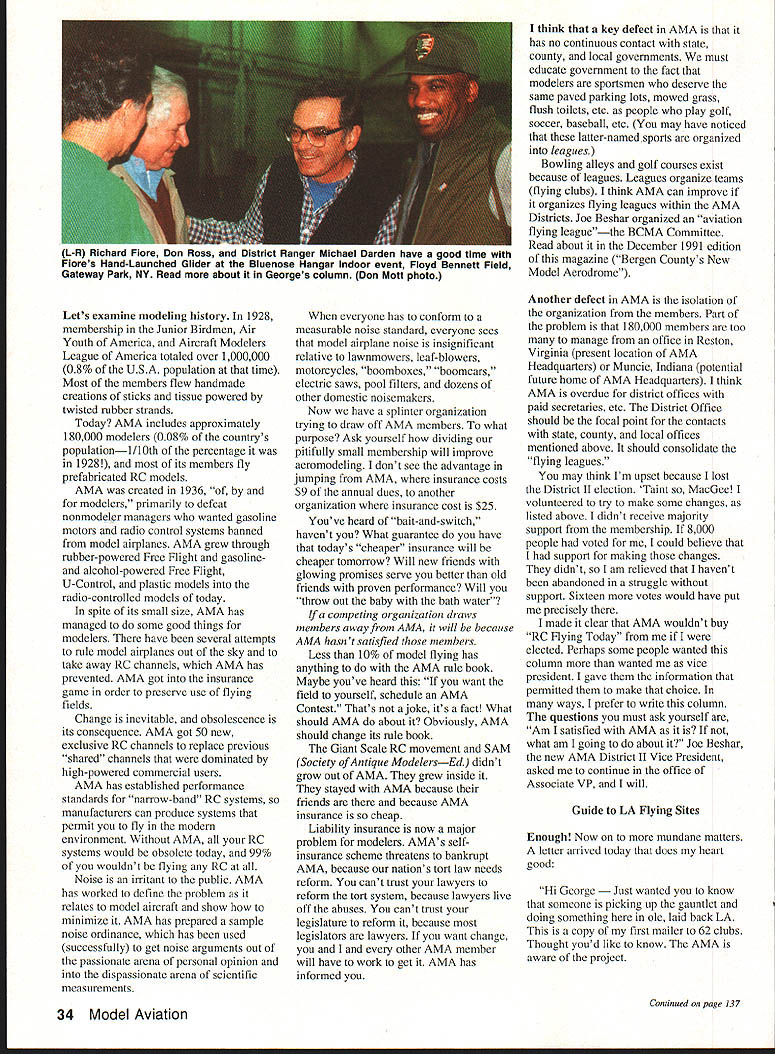
I visited an Indoor fun-fly on Sunday, November 3, 1991. It was held in the Blue Nose Hangar (40° 35.28' N; 73° 53.46' W) at Gateway National Recreation Area, Breezy Point/Jamaica Bay district, Floyd Bennett Field, Brooklyn, New York. The organizer was the Metro Sport Squadron (Club #232). Don Ross flew his 6-watt electric Porterfield (two-minute flights) and worked on his CO2-powered RC stick model (Ace R/C pulse transmitter, Albin receiver, magnetic actuator).
Gregg Poulos tried an electric-powered RC (Cannon Micro) foam King Condor, which flew very slowly but is a bit too large for the hangar. We should restrict Indoor RC planes to about 24-inch wingspans for this site. None of us thought to bring our electric RC helicopters, which might kick up too much disturbance for the microfilm planes. Glider towing by RC electric-powered tugs is under consideration for next time. Maybe someone will bring an R/C balloon or blimp.
There were many Free Flight Peanut, Pistachio, and Walnut Scale models flying (most rubber-powered but some electrics), plus Pennyplanes, some microfilm jobs, and an indoor hand-launched glider. Somebody left behind a rubber-stick model. One of the spectator boys found it and had a ball flying it (quite well). Delta Darts next time!
The hangar interior is about 50 ft high by 90 ft wide by 300 ft long, which provided for three "flying circles." The roof has suspended lights and open trusses. A good time was had by pilots and spectators alike, of which there were at least 100.
The site was made available through the courtesy of Gateway Park Center Superintendent Kevin Buckley, BP/JB Superintendent Joseph Avery, and NPS District Ranger Michael Darden. The next event at Blue Nose Hangar is planned for June 1992. Interested District II members should contact Don Ross at (201) 568-5272.
Transcribed from original scans by AI. Minor OCR errors may remain.

