
RC Flying Today
George M. Myers
The AMA has urged you to write to your senators and congressmen in opposition to FCC PR Docket 92-235, which will destroy R/C as we know it, beginning in 1998. The reason for contacting your representatives is simple: they control the lifeblood of the bureaucracy — which is money. Every so often you get a chance to elect someone to office. When you vote, you tell that candidate, "Take my money, and do what you think is right with it."
Now if you don't keep telling them what you think is right or wrong, how can you expect them to know? If you failed to write before February 26, you've got a second chance. The FCC has extended the response period to May 28, 1993.
So write! Write! Write! Now!
HOW TO BOOST ATTENDANCE AT YOUR CLUB MEETINGS
From what I hear, the main reason given for poor attendance at club meetings is that people want to avoid the endless arguments over nothing. So if the word gets out that the debating society has been abolished, attendance will improve. Most clubs get by on 30% attendance and 10% flying. I think you might like to know how the Silent Electric Flyers of Long Island (SEFLI) operate. SEFLI averages 80% attendance.
Meeting attendance correlates strongly with RC flying activity. I write this in January 1993, and the Northeast weather is frightful. Even so, 15 members appeared at the field for our monthly A/B electric sailplane meet. That's about 80% of the sailplane SIG.
"What's a sailplane SIG?" you ask. Well, it isn't one of the AMA SIGs that I discussed in the March '93 column.
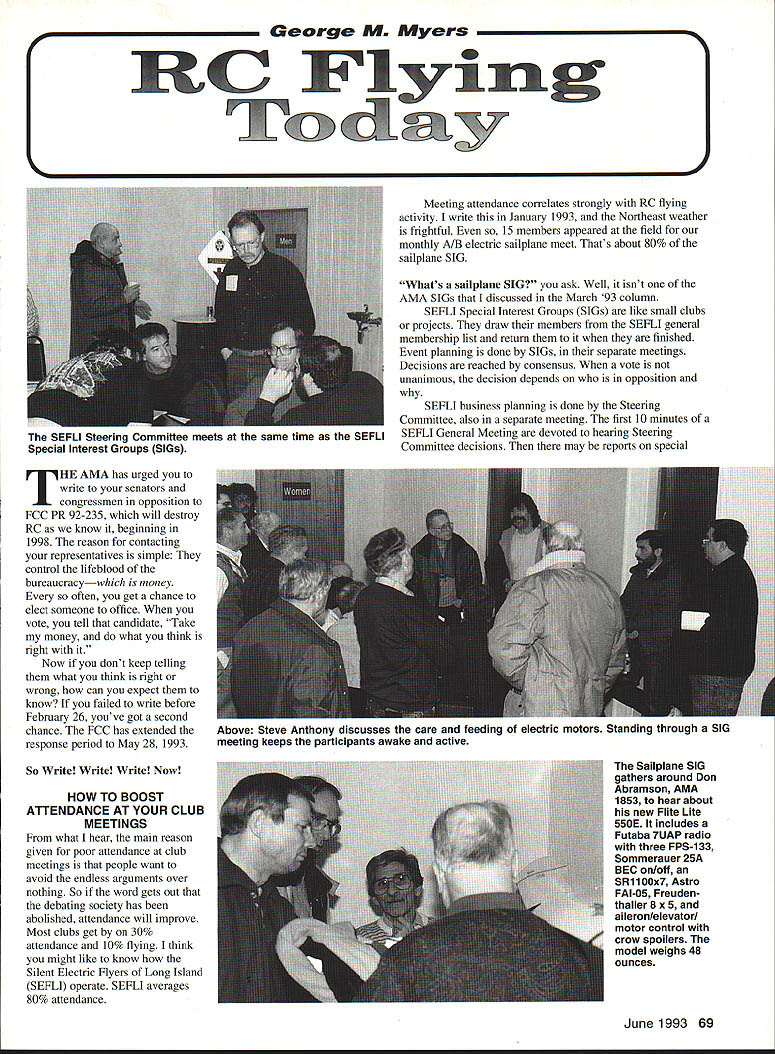
SEFLI Special Interest Groups (SIGs) are like small clubs or projects. They draw their members from the SEFLI general membership list and return them to it when they are finished. Event planning is done by SIGs, in their separate meetings. Decisions are reached by consensus. When a vote is not unanimous, the decision depends on who is in opposition and why.
SEFLI business planning is done by the Steering Committee, also in a separate meeting. The first 10 minutes of a SEFLI General Meeting are devoted to hearing Steering Committee decisions. Then there may be reports on special matters like the FCC's PR Docket 92-235 or 15-minute lectures on subjects of general interest, usually staged by a SIG. After that, the members separate into their SIG meetings. The SEFLI General Meeting provides an opportunity for the SEFLI SIGs to meet and exchange information.
Any member can join a SEFLI SIG. A member can join several SIGs. SIGs may get special flying sites (e.g., a lake for seaplane flying, a building for indoor flying). SIGs form and disband according to interest or need. Last year a 17-member SIG staged the "unofficial electric Nats" at Springfield, Massachusetts.
We don't keep old SIGs around just for tradition. But the Travel SIG is already making plans for a contingent to help and compete at the '93 Nats at Lawrenceville. Our active SEFLI SIGs are now, alphabetically:
- Indoor fliers
- Newsletter
- Old-Timers
- Public education and service
- Pylon racers
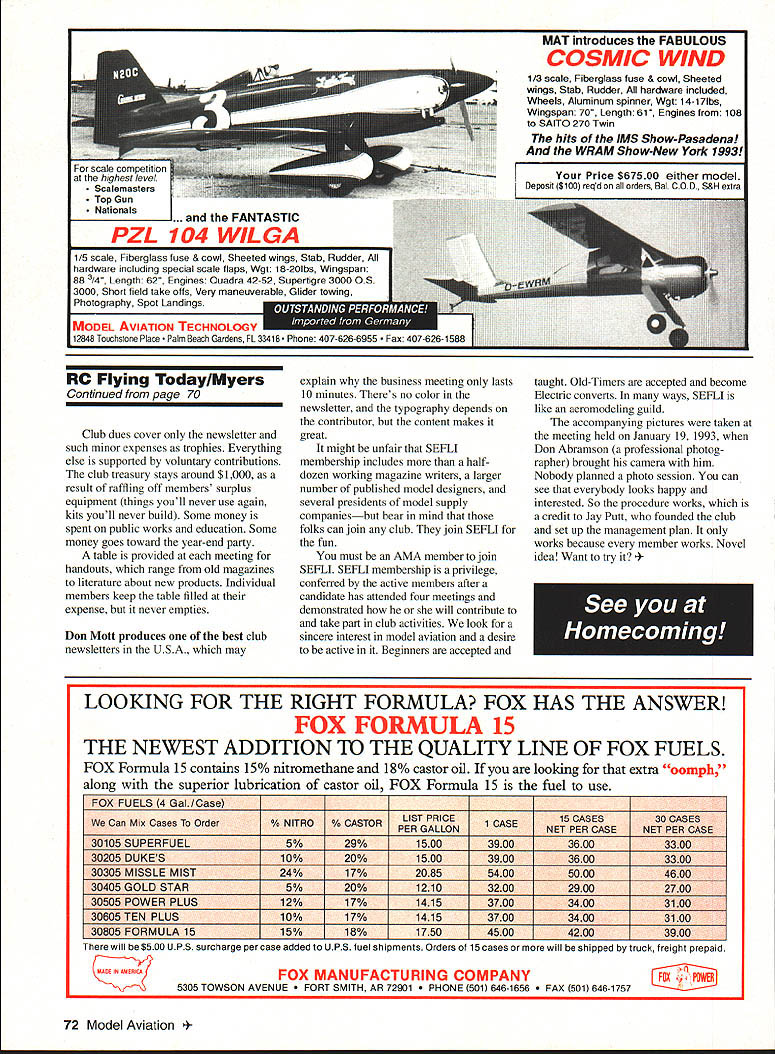
- Sailplane competitors
- Scale modelers
- Seaplanes
- Steering committee
- Travel (to fun-flys, shows, contests, etc.)
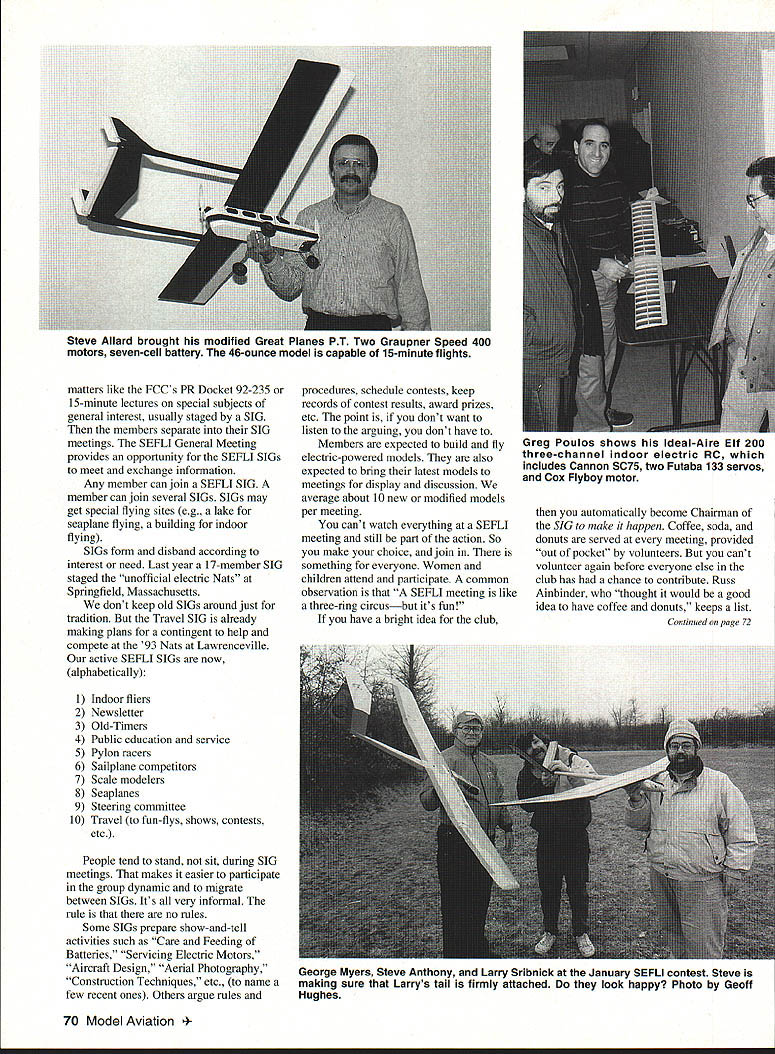
People tend to stand, not sit, during SIG meetings. That makes it easier to participate in the group dynamic and to migrate between SIGs. It's all very informal. The rule is that there are no rules.
Some SIGs prepare show-and-tell activities such as:
- Care and feeding of batteries
- Servicing electric motors
- Aircraft design
- Aerial photography
- Construction techniques
Others argue rules and procedures, schedule contests, keep records of contest results, award prizes, etc. The point is, if you don't want to listen to the arguing, you don't have to.
Members are expected to build and fly electric-powered models. They are also expected to bring their latest models to meetings for display and discussion. We average about 10 new or modified models per meeting.
You can't watch everything at a SEFLI meeting and still be part of the action. So you make your choice and join in. There is something for everyone. Women and children attend and participate. A common observation is that "A SEFLI meeting is like a three-ring circus — but it's fun!"
If you have a bright idea for the club, then you automatically become chairman of the SIG to make it happen. Coffee, soda, and donuts are served at every meeting, provided "out of pocket" by volunteers. But you can't volunteer again before everyone else in the club has had a chance to contribute. Russ Ainbinder, who "thought it would be a good idea to have coffee and donuts," keeps a list.
Club dues cover only the newsletter and such minor expenses as trophies. Everything else is supported by voluntary contributions. The club treasury stays around $1,000 as a result of raffling off members' surplus equipment (things you'll never use again, kits you'll never build). Some money is spent on public works and education. Some money goes toward the year-end party.
A table is provided at each meeting for handouts, which range from old magazines to literature about new products. Individual members keep the table filled at their expense, but it never empties.
Don Mott produces one of the best club newsletters in the U.S.A., which may explain why the business meeting only lasts 10 minutes. There's no color in the newsletter, and the typography depends on the contributor, but the content makes it great.
It might be unfair that SEFLI membership includes more than a half-dozen working magazine writers, a larger number of published model designers, and several presidents of model supply companies — but bear in mind that those folks can join any club. They join SEFLI for the fun.
You must be an AMA member to join SEFLI. SEFLI membership is a privilege, conferred by the active members after a candidate has attended four meetings and demonstrated how he or she will contribute to and take part in club activities. We look for a sincere interest in model aviation and a desire to be active in it. Beginners are accepted and taught. Old-Timers are accepted and become electric converts. In many ways, SEFLI is like an aeromodeling guild.
The accompanying pictures were taken at the meeting held on January 19, 1993, when Don Abramson (a professional photographer) brought his camera with him. Nobody planned a photo session. You can see that everybody looks happy and interested. So the procedure works, which is a credit to Jay Putt, who founded the club and set up the management plan. It only works because every member works. Novel idea! Want to try it?
See you at Homecoming!
Transcribed from original scans by AI. Minor OCR errors may remain.

