
RC Flying Today
George M. Myers
Abstract:
- Self-Launching Sailplane Pilots' Association, Inc.
- AUTOMAP, Street Atlas USA, and AERO*COMP software
- Electric airplane design software
More on Self-Launching Sailplanes
Since publication of the May 1993 issue of Model Aviation, I have received several enthusiastic comments about including self-launching sailplanes (SLS) in the National Soaring Society (NSS). Mike McQuisten of Potter Valley, California, wrote:
"Your (May) column made my day. Tell it to the LSF. ...Yesterday, I got a 1.5-hour flight with power left over to get me back over the fence, if necessary. To each his own. I've got mine! Keep up the good work."
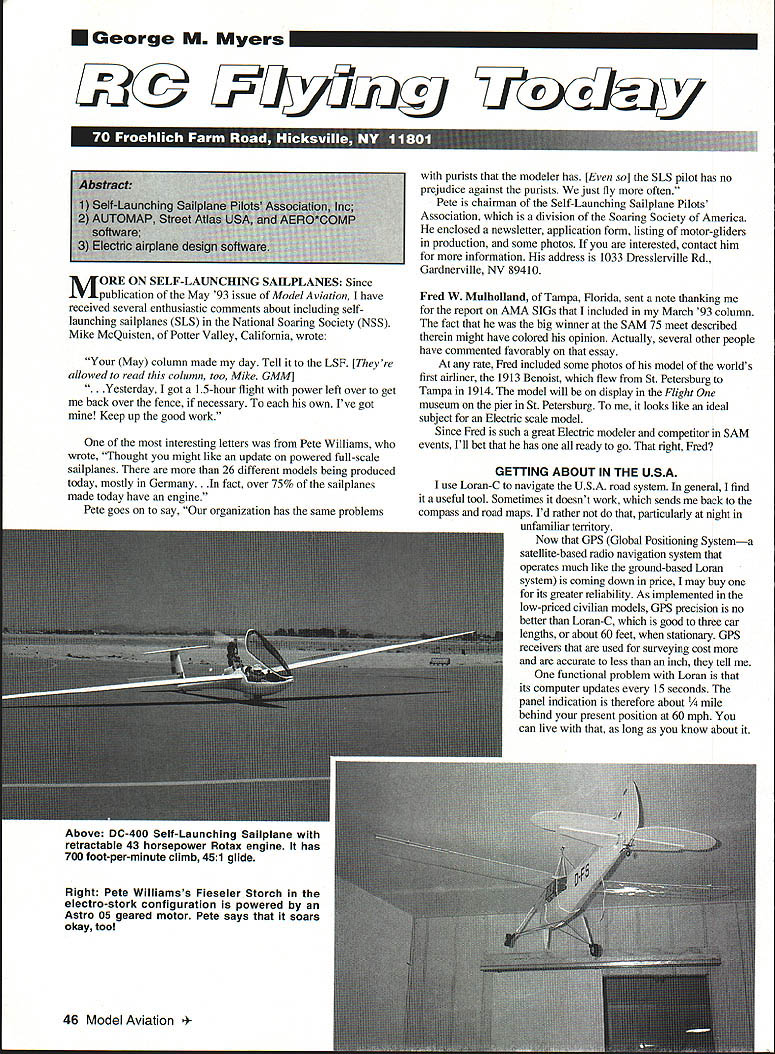
One of the most interesting letters was from Pete Williams, who wrote, "Thought you might like an update on powered full-scale sailplanes. There are more than 26 different models being produced today, mostly in Germany.... In fact, over 75% of the sailplanes made today have an engine."
Pete goes on to say, "Our organization has the same problems with purists that the modeler has." [Even so] the SLS pilot has no prejudice against the purists. "We just fly more often."
Pete is chairman of the Self-Launching Sailplane Pilots' Association, a division of the Soaring Society of America. He enclosed a newsletter, application form, a listing of motor-gliders in production, and some photos. If you are interested, contact him at: 1033 Dresslerville Rd., Gardnerville, NV 89410.
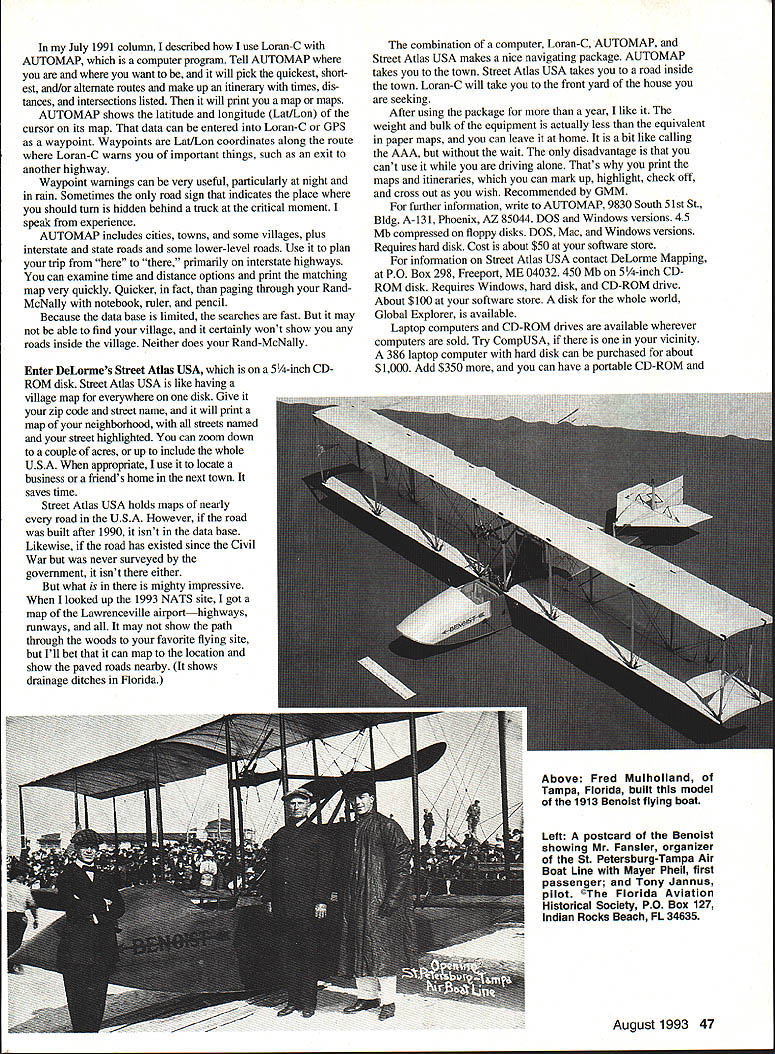
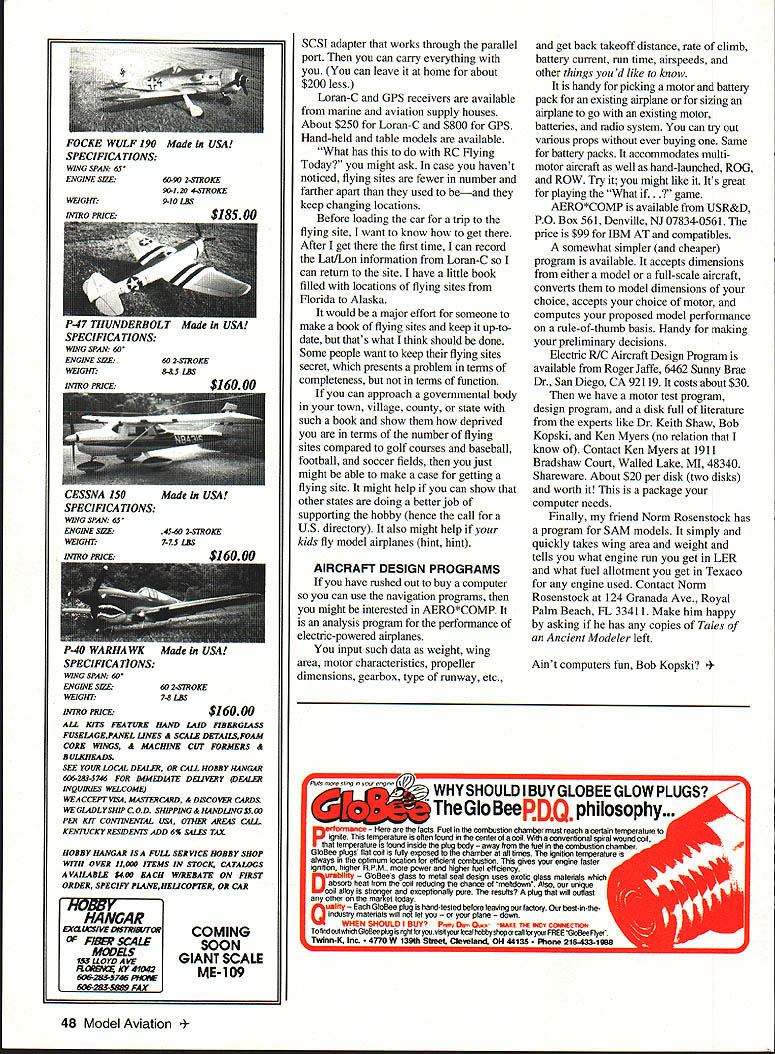
Fred W. Mulholland of Tampa, Florida, sent a note thanking me for the report on AMA SIGs that I included in my March 1993 column. The fact that he was the big winner at the SAM 75 meet described therein might have colored his opinion. Several other people have also commented favorably on the essay. Fred included photos of his model of the world's first airliner, the 1913 Benoist, which flew from St. Petersburg to Tampa in 1914. The model will be on display in the Flight One museum on the pier in St. Petersburg. To me, it looks like an ideal subject for an electric scale model. Is that right, Fred?
Getting About in the U.S.A.
I use Loran-C to navigate the U.S. road system. In general, I find it a useful tool. Sometimes it doesn't work, which sends me back to the compass and paper maps — something I try to avoid, particularly at night in unfamiliar territory.
GPS (Global Positioning System) — a satellite-based radio navigation system that operates much like the ground-based Loran system — is coming down in price; I may buy one for its greater reliability. As implemented in low-priced civilian models, GPS precision is no better than Loran-C, which is good to about three car lengths, or roughly 60 feet, when stationary. GPS receivers used for surveying cost more and are accurate to less than an inch, I am told.
One functional problem with Loran is that its computer updates every 15 seconds. The panel indication is therefore about 1/4 mile behind your present position at 60 mph. You can live with that, as long as you know about it.
The combination of a computer, Loran-C, AUTOMAP, and Street Atlas USA makes a nice navigating package. AUTOMAP takes you to the town; Street Atlas USA takes you to a road inside the town; Loran-C will take you to the front yard of the house you are seeking.
After using the package for more than a year, I like it. The weight and bulk of the equipment is actually less than the equivalent in paper maps, and you can leave it at home. It is a bit like calling AAA, but without the wait. The only disadvantage is that you can't use it while you are driving alone. That's why you print the maps and itineraries, which you can mark up, highlight, check off, and cross out as you wish. Recommended.
For further information:
- AUTOMAP: AUTOMAP, 9830 South 51st St., Bldg. A-131, Phoenix, AZ 85044. DOS and Windows versions. 4.5 MB compressed on floppy disks. Requires hard disk. Cost is about $50 at your software store.
- Street Atlas USA: DeLorme Mapping, P.O. Box 298, Freeport, ME 04032. 450 MB on a 5-1/4-inch CD-ROM. Requires Windows, hard disk, and CD-ROM drive. About $100 at your software store. A global disk, Global Explorer, is also available.
Laptop computers and CD-ROM drives are available where computers are sold. A 386 laptop with hard disk can be purchased for about $1,000. Add roughly $350 and you can have a portable CD-ROM and a SCSI adapter that works through the parallel port, allowing you to carry everything with you. (You can leave the CD-ROM at home for about $200 less.)
Loran-C and GPS receivers are available from marine and aviation supply houses: about $250 for Loran-C and about $800 for GPS. Hand-held and panel/table models are available.
What has this to do with RC Flying Today? Flying sites are fewer in number and farther apart than they used to be — and they keep changing locations. Before loading the car for a trip to a flying site, I want to know how to get there. After I get there the first time, I record the lat/long information from Loran-C so I can return. I have a little book filled with locations of flying sites from Florida to Alaska.
It would be a major effort for someone to make a book of flying sites and keep it up to date, but that's what I think should be done. Some people want to keep their flying sites secret, which complicates completeness, but not the idea. If you can approach a local government body with such a book and show how deprived you are in terms of flying sites compared to golf courses and organized sports fields, you might be able to make a case for getting a flying site. It also helps if you can show that other states are doing a better job of supporting the hobby. And it might help if your kids fly model airplanes (hint, hint).
Aircraft Design Programs
If you have rushed out to buy a computer so you can use the navigation programs, you might also be interested in AERO*COMP. It is an analysis program for the performance of electric-powered airplanes.
You input data such as weight, wing area, motor characteristics, propeller dimensions, gearbox, type of runway, etc., and get back takeoff distance, rate of climb, battery current, run time, airspeeds, and other useful performance figures.
AERO*COMP is handy for picking a motor and battery pack for an existing airplane or for sizing an airplane to match an existing motor, batteries, and radio system. You can try various props and battery packs without buying them. It accommodates multirotor aircraft as well as hand-launched and ROG types. It's great for playing the "What if...?" game.
AERO*COMP is available from USR&D, P.O. Box 561, Denville, NJ 07834-0561. Price: $99 for IBM AT and compatibles.
A somewhat simpler (and cheaper) program is available that accepts dimensions from either a model or a full-scale aircraft, converts them to model dimensions of your choice, accepts your choice of motor, and computes proposed model performance on a rule-of-thumb basis. Handy for preliminary decisions.
- Electric R/C Aircraft Design Program: Roger Jaeger, 6462 Sunny Brae Dr., San Diego, CA 92119. Cost: about $30.
- Motor-test, design program, and literature disk: Ken Myers, 1911 Bradshaw Court, Walled Lake, MI 48390. Shareware. About $20 per disk (two disks). Features material from experts such as Dr. Keith Shaw, Bob Kopski, and others.
- SAM-models program (quick wing-area and weight to engine-run and fuel allotment calculations): Norm Rosenstock, 124 Granada Ave., Royal Palm Beach, FL 33411. Ask if he has any copies of Tales of an Ancient Modeler left.
Ain't computers fun, Bob Kopski?
Transcribed from original scans by AI. Minor OCR errors may remain.

