
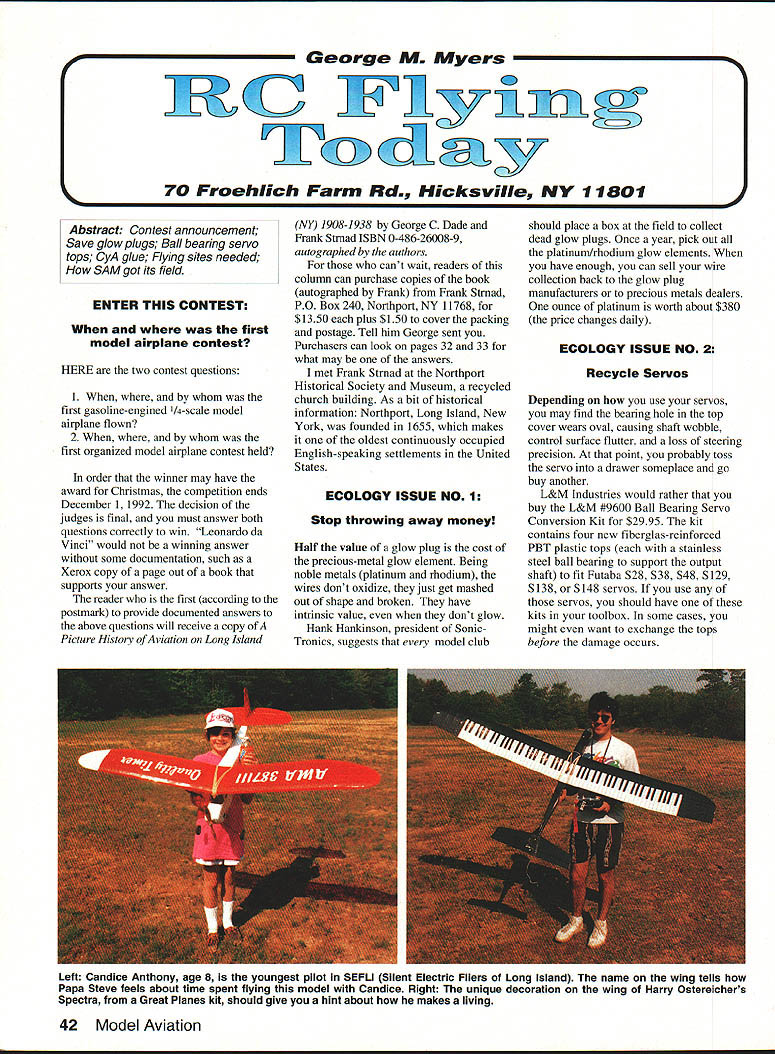
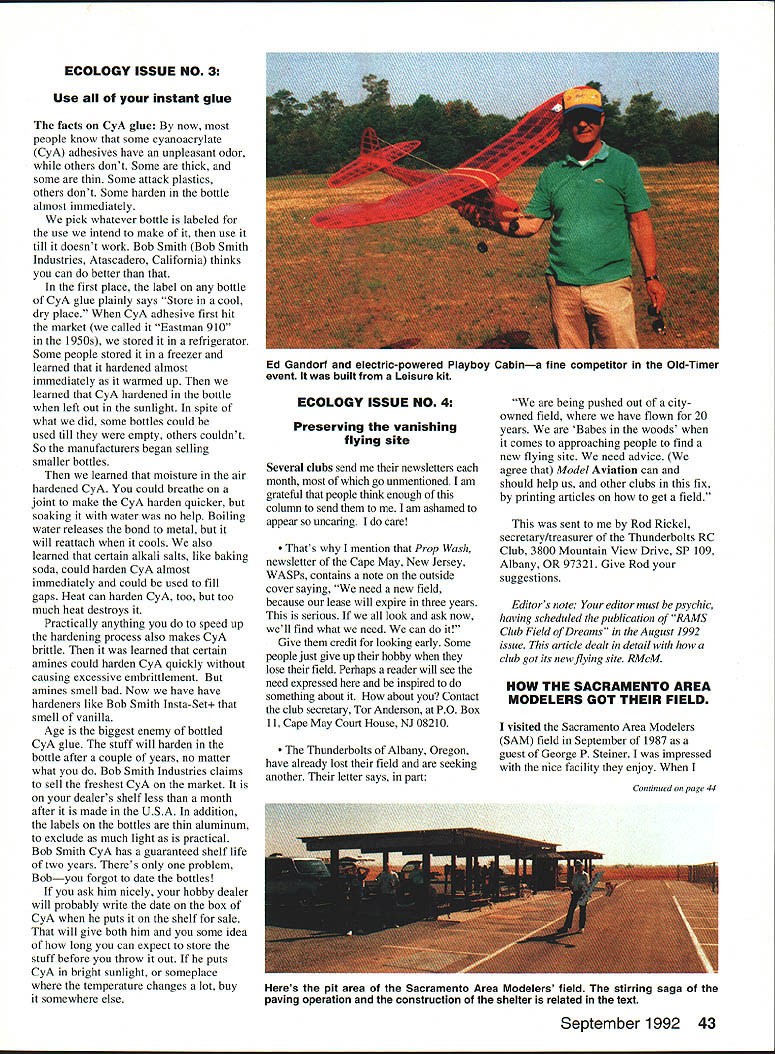
RC Flying Today: Enter This Contest — When and where was the first model airplane contest?
Enter this contest
When and where was the first model airplane contest?
Two contest questions:
- When, where, and by whom was the first gasoline‑engined 1/4‑scale model airplane flown?
- When, where, and by whom was the first organized model airplane contest held?
One reader may have an award at Christmas. The competition ends December 1, 1992. The judges' decision is final. Entrants must answer both questions correctly to win and should include documentation (for example, a Xerox copy of a page from a book) that supports their answer.
The reader whose entry is postmarked first and provides documented answers to the above questions will receive a copy of A Picture History of Aviation on Long Island (NY) 1908–1938 by George C. Dade and Frank Strnad (ISBN 0-486-26008-9), autographed by the authors.
If readers can't wait, they can purchase copies autographed by Frank Strnad from:
- Frank Strnad, P.O. Box 240, Northport, NY 11768.
- Price: $13.50 plus $1.50 to cover packing and postage.
- Tell him “George sent you.”
- Purchasers can look on pages 32–33 for material that may contain one of the answers.
A bit of historical information: Northport, Long Island, New York, founded in 1655, is one of the oldest continuously occupied English‑speaking settlements in the United States.
ECOLOGY ISSUE NO. 3: Use all of your instant glue
The facts on cyanoacrylate (CyA) glue: by now, most people know that some CyA adhesives have an unpleasant odor, while others don't. Some are thick, and some are thin. Some attack plastics, others don't. Some harden in the bottle almost immediately.
We pick whatever bottle is labeled for the use we intend to make of it, then use it until it doesn't work. Bob Smith (Bob Smith Industries, Atascadero, California) thinks you can do better than that.
- The label on any bottle of CyA glue plainly says "Store in a cool, dry place." When CyA adhesive first hit the market (we called it "Eastman 910" in the 1950s), many of us stored it in a refrigerator. Some people stored it in a freezer and learned that it hardened almost immediately as it warmed up. We also learned that CyA hardened in the bottle when left out in sunlight. Despite precautions, some bottles could be used until they were empty and others couldn't, so manufacturers began selling smaller bottles.
- Moisture in the air hardens CyA. You can breathe on a joint to make the CyA harden quicker, but soaking with water is no help. Boiling water releases the bond to metal, but it will reattach when it cools. Certain alkali salts, like baking soda, can harden CyA almost immediately and be used to fill gaps. Heat can harden CyA too, but too much heat destroys it.
- Practically anything you do to speed up the hardening process also makes CyA brittle. It was later learned that certain amines could harden CyA quickly without causing excessive embrittlement, but amines smell bad. Now we have hardeners like Bob Smith Insta‑Set that smell of vanilla.
Age is the biggest enemy of bottled CyA glue. The stuff will harden in the bottle after a couple of years, no matter what you do. Bob Smith Industries claims to sell the freshest CyA on the market — it is on your dealer's shelf less than a month after it is made in the U.S.A. In addition, the labels on the bottles are thin aluminum to exclude as much light as is practical. Bob Smith CyA has a guaranteed shelf life of two years. There's only one problem, Bob — you forgot to date the bottles!
If you ask him nicely, your hobby dealer will probably write the date on the box of CyA when he puts it on the shelf for sale. That will give both him and you some idea of how long you can expect it to store before it will not perform. If he puts CyA in bright sunlight or someplace where the temperature changes a lot, buy it somewhere else.
ECOLOGY ISSUE NO. 4: Preserving the vanishing flying site
Several clubs send me their newsletters each month, most of which go unmentioned. I am grateful that people think enough of this column to send them to me. I am ashamed to appear so uncaring. I do care!
Prop Wash, the newsletter of the Cape May, New Jersey, WASPS, contains a note on the outside cover saying, "We need a new field, because our lease will expire in three years. This is serious. If we all look and ask now, we'll find what we need. We can do it!" Give them credit for looking early. Some people just give up their hobby when they lose their field. Perhaps a reader will see the need expressed here and be inspired to do something about it. How about you? Contact the club secretary:
- Tor Anderson, P.O. Box 11, Cape May Court House, NJ 08210.
The Thunderbolts of Albany, Oregon, have already lost their field and are seeking another. Their letter says, in part: "We are being pushed out of a city‑owned field, where we have flown for 20 years. We are 'Babes in the woods' when it comes to approaching people to find a new flying site. We need advice. (We agree that) Model Aviation can and should help us, and other clubs in this fix, by printing articles on how to get a field."
This was sent to me by Rod Rickel, secretary/treasurer of the Thunderbolts RC Club:
- Rod Rickel, 3800 Mountain View Drive, SP 109, Albany, OR 97321.
Give Rod your suggestions.
Editor's note: Your editor must be psychic, having scheduled the publication of "RAMS Club Field of Dreams" in the August 1992 issue. This article dealt in detail with how a club got its new flying site. MCM
HOW THE SACRAMENTO AREA MODELERS GOT THEIR FIELD
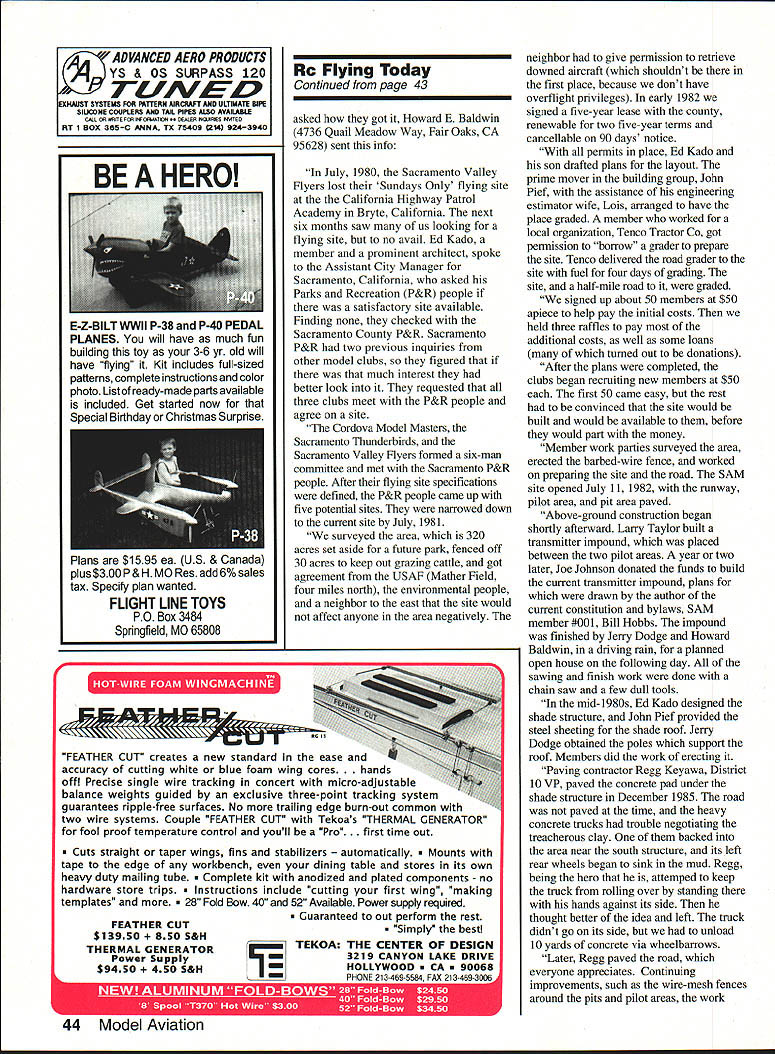
I visited the Sacramento Area Modelers (SAM) field in September 1987 as a guest of George P. Steiner. I was impressed with the nice facility they enjoy. When I asked how they got it, Howard E. Baldwin (4736 Quail Meadow Way, Fair Oaks, CA 95628) sent this information:
In July 1980, the Sacramento Valley Flyers lost their "Sundays Only" flying site at the California Highway Patrol Academy in Bryte, California. The next six months saw many of us looking for a flying site, but to no avail. Ed Kado, a member and a prominent architect, spoke to the Assistant City Manager for Sacramento, who asked his Parks and Recreation (P&R) people if there was a satisfactory site available. Finding none, they checked with the Sacramento County P&R. Sacramento P&R had two previous inquiries from other model clubs, so they figured that if there was that much interest they had better look into it. They requested that all three clubs meet with the P&R people and agree on a site.
The Cordova Model Masters, the Sacramento Thunderbirds, and the Sacramento Valley Flyers formed a six‑man committee and met with the Sacramento P&R people. After their flying site specifications were defined, the P&R people came up with five potential sites. They were narrowed down to the current site by July 1981.
We surveyed the area, which is 320 acres set aside for a future park, fenced off 30 acres to keep out grazing cattle, and got agreement from the USAF (Mather Field, four miles north), the environmental people, and a neighbor to the east that the site would not affect anyone in the area negatively. The neighbor had to give permission to retrieve downed aircraft (which shouldn't be there in the first place, because we don't have overflight privileges). In early 1982 we signed a five‑year lease with the county, renewable for two five‑year terms and cancellable on 90 days' notice.
With all permits in place, Ed Kado and his son drafted plans for the layout. The prime mover in the building group, John Reif, with the assistance of his engineering estimator wife, Lois, arranged to have the site graded. A member who worked for a local organization, Tenco Tractor Co., got permission to "borrow" a grader to prepare the site. Tenco delivered the grader to the site with fuel for four days of grading. The site, and a half‑mile road to it, were graded.
We signed up about 50 members at $50 apiece to help pay the initial costs. Then we held three raffles to pay most of the additional costs, as well as some loans (many of which turned out to be donations). After the plan was completed, the clubs began recruiting new members at $50 each. The first 50 came easily, but the rest had to be convinced that the site would be built and would be available to them before they would part with the money.
Member work parties staked the area, erected the barbed‑wire fence, and worked on preparing the site and the road. The SAM site opened July 11, 1982, with the runway, pilot area, and pit area paved.
Above‑ground construction began shortly afterward. Larry Taylor built a transmitter impound which was placed between the two pilot areas. A year or so later, Joe Johnson donated the funds to build the current transmitter impound; plans for it were drawn by the author of the current constitution and bylaws, SAM member #001, Bill Hobbs. The impound was finished by Jerry Dodge and Howard Baldwin, in a driving rain, for a planned open house the following fall. Much of the sawing and finish work was done with a chain saw and a few dull tools.
In the mid‑1980s, Ed Kado designed the shade structure, and John Pief provided the steel sheeting for the shade roof. Jerry Dodge obtained the poles which support the roof. Members did much of the work of erecting it. Paving contractor Regg Kearney, District 10 PVP, paved the concrete pad under the shade structure in December 1985. The road was not paved at the time, and the heavy concrete trucks had trouble negotiating the treacherous clay. One of them backed into the area near the south structure, and its left rear wheels began to sink in the mud. Regg, being the hero that he is, attempted to keep the truck from rolling over by standing there with his hands against its side. Then he thought better of the idea and left. The truck didn't tip over, but we had to unload 10 yards of concrete via wheelbarrows.
Later, Regg paved the road, which everyone appreciates. Continuing improvements, such as the wire‑mesh fences around the pits and pilot areas, have been made and the work continues.
Transcribed from original scans by AI. Minor OCR errors may remain.

