
RC Flying Today: New Batteries and Some Good Old Chargers
70 Froehlich Farm Road, Hicksville, NY 11801
Abstract:
- Some new battery technologies, including NiMH.
- M.E.N., SR, and CaRa chargers.
- Source addresses.
New Batteries and Some Good Old Chargers
The periodic table seemed simple back in high school, but later work on Navy aircraft and corrosion studies reminded me how many practical metal combinations can be used for batteries. Literally, a couple of pieces of metal and seawater will make a cell.
Emerging battery technologies
AER Research (Atlanta, GA) has revived the zinc–air cell and licensed a rechargeable version; a 1-3/4-pound battery has been offered to notebook manufacturers. Valence Technology (San Jose, CA) is developing a thin-film lithium polymer cell for notebooks; at present it reportedly tolerates about 150 deep-discharge cycles (capacity/current not stated).
Neither of these cells is available to hobbyists right now. Based on their target market (notebooks), they will likely be low-voltage, low-current batteries intended for long discharge durations (three or more hours). They have limited immediate application to electric airplanes but could extend run time for transmitters and receivers.
NiMH batteries
Nickel–metal hydride (NiMH) batteries have appeared for hobby use. For practical purposes, think of NiMH as similar to Ni–Cd but with roughly double the charge capacity and without cadmium. NiMH packs are available now to extend transmitter/receiver run time without increasing weight or bulk; they are also used in laptops and portable phones.
One U.S. vendor is High TEK Models, offering AA NiMH cells (1,100 mAh, 24 g) at $6 and full C cells (3.5 Ah, 80 g) at $13. These are designed for one-hour discharge (maximum rate) and 16-hour recharge, and they weigh roughly half as much as comparable Ni–Cd cells.
Charging NiMH batteries
- General-purpose NiMH cells are typically charged at constant current for 16 hours at a C/10 rate.
- During overcharge, heat is generated in proportion to the overcharge rate. Trickle charging at less than C/10 can be maintained indefinitely.
- Some NiMH cells are designed for very fast charging (manufacturer claims down to 15 minutes), but such cells are not yet widely available to hobbyists.
- Fast charging requires accurate temperature and voltage control; expect a temperature rise of roughly 5° to 10°C during fast charge and an absolute limit in the 35°–45°C range.
- The NiMH voltage curve is similar to Ni–Cd, so dV/dt (peak or slope detection) methods can be used for charge termination.
- Temperature and operating ranges: charge 0° to 40°C; discharge -10° to +50°C; storage -20° to +35°C.
Applications for RC
Sailplane pilots and users of PCM systems will find NiMH attractive. Small modern servos often draw more current than older standard servos; NiMH can provide roughly double the energy capacity of a "standard" 600-mAh pen cell pack without increased weight or bulk.
Some Useful Chargers
M.E.N. C-504 pulse charger
The old Model Engineering of Norwalk (M.E.N.) C-504 pulse charger is well suited for NiMH AA cells because it senses voltage and tapers the charge along the recommended schedule.
Brief overview:
- The C-504 is a pulse charger with two outputs (commonly one for eight Ni–Cd cells and one for four, other configurations exist).
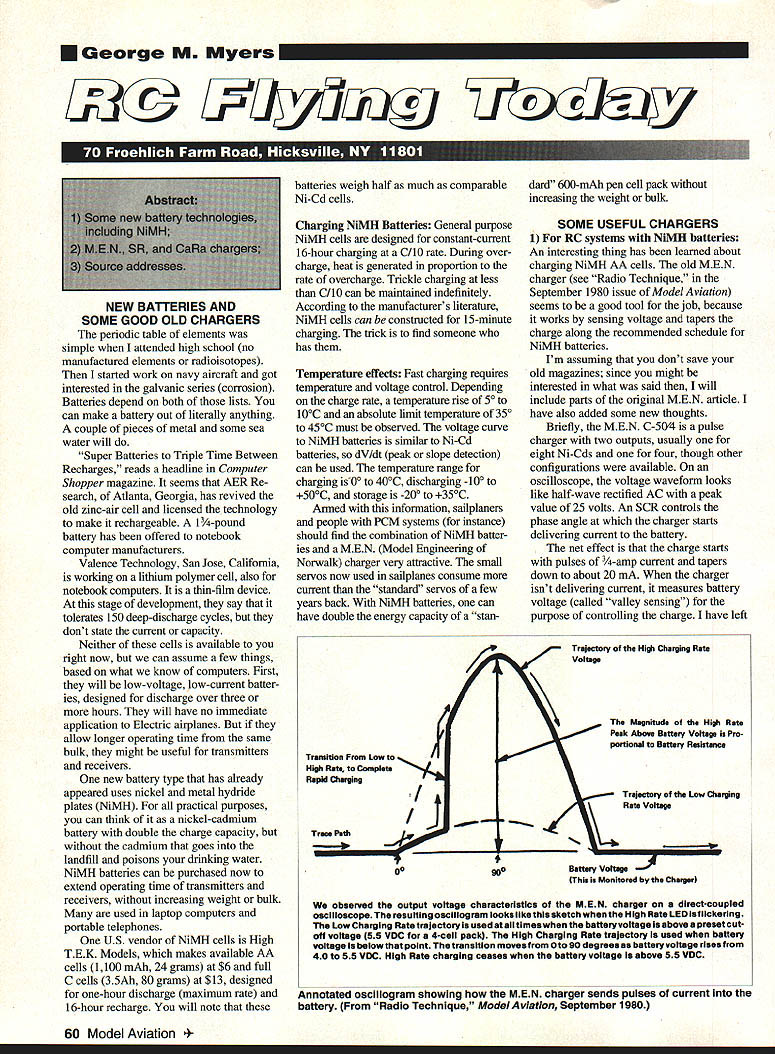
- On an oscilloscope the output looks like half-wave rectified AC with a peak near 25 V. An SCR controls the phase angle at which current is delivered, producing pulses of about 3-1/4 A that taper to roughly 20 mA as the charger stops delivering current and measures battery voltage (valley sensing).
- The charger uses two charging trajectories: a Low Charging Rate trajectory when battery voltage is above a preset cutoff (5.5 V DC for a 4-cell pack) and a High Charging Rate trajectory when voltage is below that point. The transition angle changes as battery voltage rises from about 4.0 to 5.5 V DC; High Rate charging ceases once the battery voltage exceeds 5.5 V DC.
- I have left batteries connected to the M.E.N. charger for months without damage.
Older M.E.N. units could be sensitive to spikes on the 110 VAC line from certain motors, which could occasionally cause the charger to fail full-on or full-off. Modern semiconductors and a simple circuit change eliminate most of that problem; stability of the measuring circuit is excellent.
Measuring the M.E.N. output
You cannot accurately measure the voltage or current from the M.E.N. charger with conventional digital AC/DC meters because their sampling time is too long to settle on the pulsed waveform. Coil-type meters can be damaged by the pulses. The only panel-mount meter likely to tolerate the pulses is an "iron vane" meter. Unless you have an oscilloscope or an iron vane meter, don't attempt to measure the output.
Performance tests and restoring capacity
Summarizing bench tests:
- A marginal 500-mAh pack placed on the M.E.N. showed the LED flicker then go out; after a short charge and discharge it read ~300 mAh. After a 16-hour charge and subsequent discharge the capacity improved to ~475 mAh. Cycling the pack restored capacity and the M.E.N. handled both high- and low-resistance states without problem.
- Another pack that had been charged only with a manufacturer’s 50-mA charger and seen only partial discharges tested at 350 mAh. Repeated cycles (discharge at a two-hour rate, then 16-hour M.E.N. charge) produced 350 → 375 → 400 → 400 mAh. After a full discharge to 0 V with a 10-ohm resistor and an eight-hour M.E.N. recharge, the pack measured 450 mAh. Routine cycling with the M.E.N. can revive packs that otherwise seem headed for the scrap pile.
Identifying and servicing M.E.N. units
M.E.N. serial-number letters indicate preset voltage configurations:
- Numbers only: for 4- and 8-cell packs.
- "H": for the old Kraft Sport series (4 and 5 cells).
- "S": for Cox/Sunwa (4 and 9 cells).
- "X": for Kraft Signature and World Engines systems (4 and 10 cells).
- "R": for two 4-cell packs.
If your M.E.N. has an unwanted letter setting or a serial number less than 8200, don't discard it. Sending the unit back to M.E.N. for cleaning and/or updating is prudent. Simple circuit changes can remove earlier spike sensitivity and can change the preset voltages. Expect to spend about $15–$30 (roughly half for return postage) to get back a like-new charger; the current list price is around $94.95.
SR Smart Charger/Cycler
- The SR Smart Charger/Cycler is useful for electric-powered models and RC systems with NiMH batteries. It accepts either an AC power supply or 12 VDC (car battery red/black).
- Charge range: roughly 100 mA to 5 A depending on pack size.
- It can fast-charge and then switch to trickle-charge when any of three cutoffs occur: battery temperature rise (~10°F), battery voltage peak, or preset timer limit. All three cutoffs are active during fast-charging.
- Because of these protections, the SR unit is suitable for charging NiMH cells; consult SR literature for specific settings and precautions.
CaRa chargers and accessories
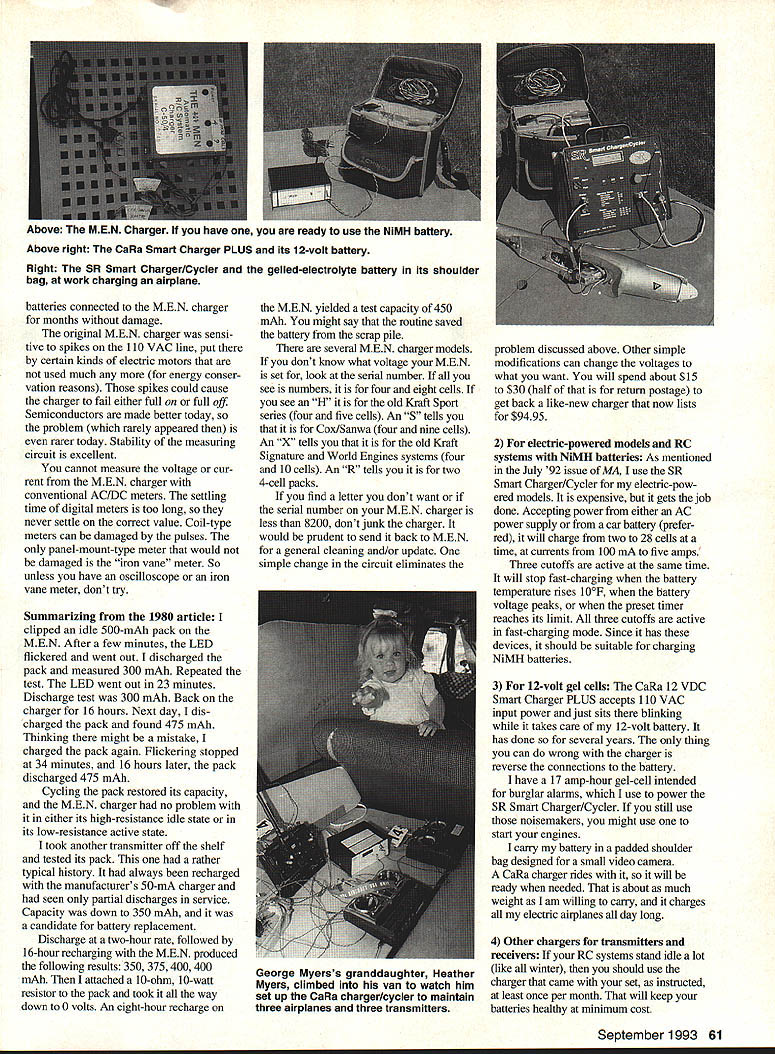
- CaRa 12 VDC Smart Charger PLUS: accepts 110 VAC input and maintains a 12 V gel-cell battery. The only common mistake is reversing battery connections.
- A typical setup: a 17 Ah gel cell (intended for burglar alarms) can power the SR Smart Charger/Cycler in the field. I carry a CaRa charger in a padded shoulder bag (video-camera type) and it charges electric airplanes all day while remaining portable.
- CaRa Trickler: can maintain up to 40 battery packs at full charge for up to 10 years. Manufacturers consider 10 years a practical shelf-life limit, but packs should be tested periodically.
- CaRa RC System Automatic Cycler–Charger: can be powered from 110 VAC or 12 VDC, constant-current charges 4- and 5-cell receiver packs and 8- and 9-cell transmitter packs (switch selected), and uses voltage-slope detection for charge cutoff. The test function discharges the pack at 300 mA to 1.1 VDC and then recharges to report an approximate capacity; it also provides simultaneous trickle outputs for other packs. This unit is useful on the road and for travelers using electrics (no fuel handling).
- CaRa recommends returning the Cycler–Charger every three years for recalibration (the fee typically includes return shipping). Periodic recalibration is good practice for any calibrated equipment.
Maintenance advice
- If your RC systems stand idle for long periods (e.g., during winter), use the charger that came with the set at least once per month to keep batteries healthy at minimal cost.
- Using a trickler (like the CaRa Trickler) eliminates the need for monthly recharges by maintaining full charge over long storage periods.
Sources
- High TEK Models, 510 Harlan NE, Grand Rapids, MI 49503; Tel.: (616) 458-2261 — NiMH batteries.
- Model Engineering of Norwalk, 54 Chestnut Hill, Norwalk, CT 06851 — M.E.N. C-504 Charger for Ni–Cd and NiMH batteries.
- SR Batteries, P.O. Box 287, Bellport, NY 11713; Tel.: (516) 286-0097; Fax: (516) 286-0901 — SR Smart Charger/Cycler for electric-power batteries.
- CaRa Products, P.O. Box 221, Canton, SD 57013; Tel.: (605) 987-5924 — CaRa Smart Charger PLUS and other specialty chargers.
Transcribed from original scans by AI. Minor OCR errors may remain.

