
RC Flying Today: Rib Stitching and Gluing
Abstract
- Rib-stitching and gluing
- New sources for scale plans
- Computer tools for modern modelers
- How SEF-L got a flying site
- How to lose a flying site
Rib Stitching and Gluing
How often have you heard someone say, "Iron-on covering doesn't stick to ribs"? Take a look at the wing and, sure enough, the covering is stuck only to the leading and trailing edges. You can reasonably be certain the covering did stick to the ribs when the plane was built — otherwise the person wouldn't be complaining. So the real question is: why (or how) did the covering get loose?
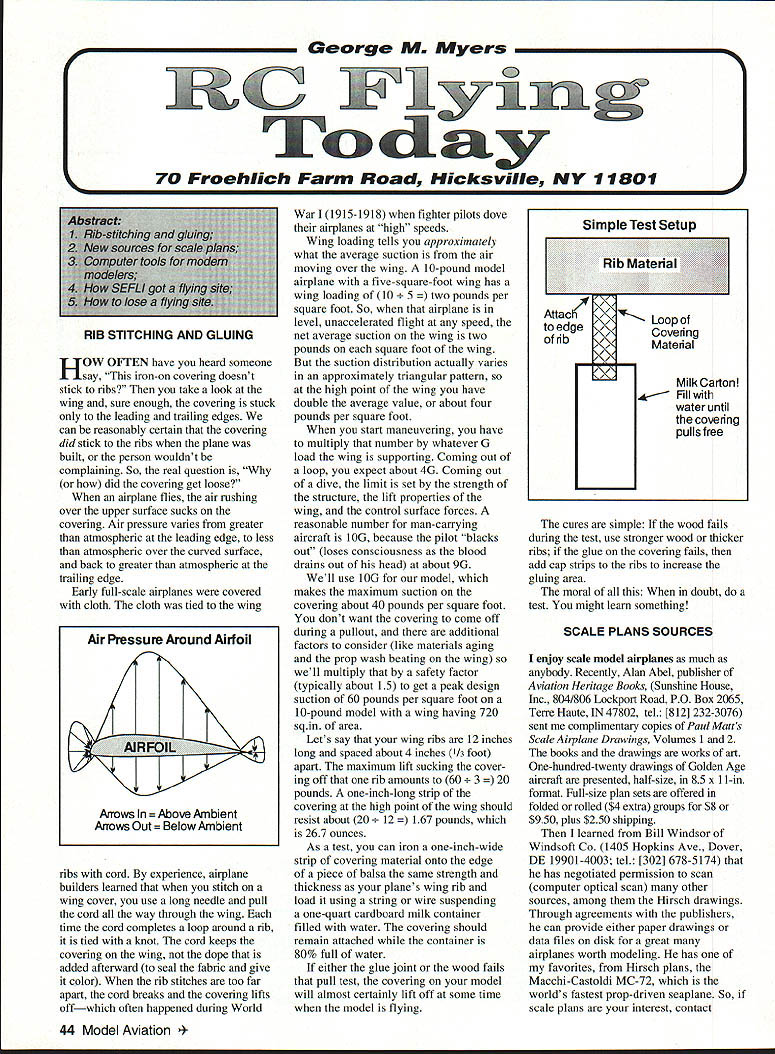
When an airplane flies, the air rushing over the upper surface sucks on the covering. Air pressure varies: greater than atmospheric at the leading edge, less than atmospheric over the curved surface, and back to greater than atmospheric at the trailing edge.
Early full-scale airplanes were covered with cloth which was tied to the wing ribs with cord. From experience, builders learned to stitch the wing covering: use a long needle to pull cord all the way through the wing, and each time the cord completes a loop around a rib it is tied with a knot. The cord — not the dope added afterward to seal and color the fabric — keeps the covering on the wing. If rib stitches are too far apart the cord can break and the covering will lift off — a problem that often happened during World War I (1915–1918) when fighter pilots dove at high speeds.
Wing loading tells you approximately the average suction produced by air moving over the wing. For example: a 10-pound model airplane with a five-square-foot wing has a wing loading of (10 ÷ 5 =) 2 pounds per square foot. In level, unaccelerated flight the net average suction on the wing is about 2 lb/ft². Because suction distribution varies in an approximately triangular pattern, the peak value at the high point of the wing is roughly double the average — about 4 lb/ft².
When the airplane maneuvers, multiply that number by the G load the wing supports. Coming out of a loop you might see about 4G. The structural and aerodynamic limits determine maximum G; a reasonable extreme for man-carrying aircraft is 10G (a pilot blacks out at about 9G). Using 10G for our model raises the maximum suction on the covering to about 40 lb/ft².
We don't want the covering to come off during a pullout. Allowing for material aging, prop wash, and other effects, use a safety factor (typically about 1.5) to reach a peak design suction of roughly 60 lb/ft² for a 10-pound model with a 720 in² (5 ft²) wing.
Say your wing ribs are 12 inches long and spaced about 4 inches (1/3 ft) apart. The maximum lift sucking the covering off the area between ribs is (60 × 1/3 =) 20 pounds. A one-inch-long strip of covering at the high point of the wing should resist about (20 ÷ 12 =) 1.67 pounds, or about 26.7 ounces.
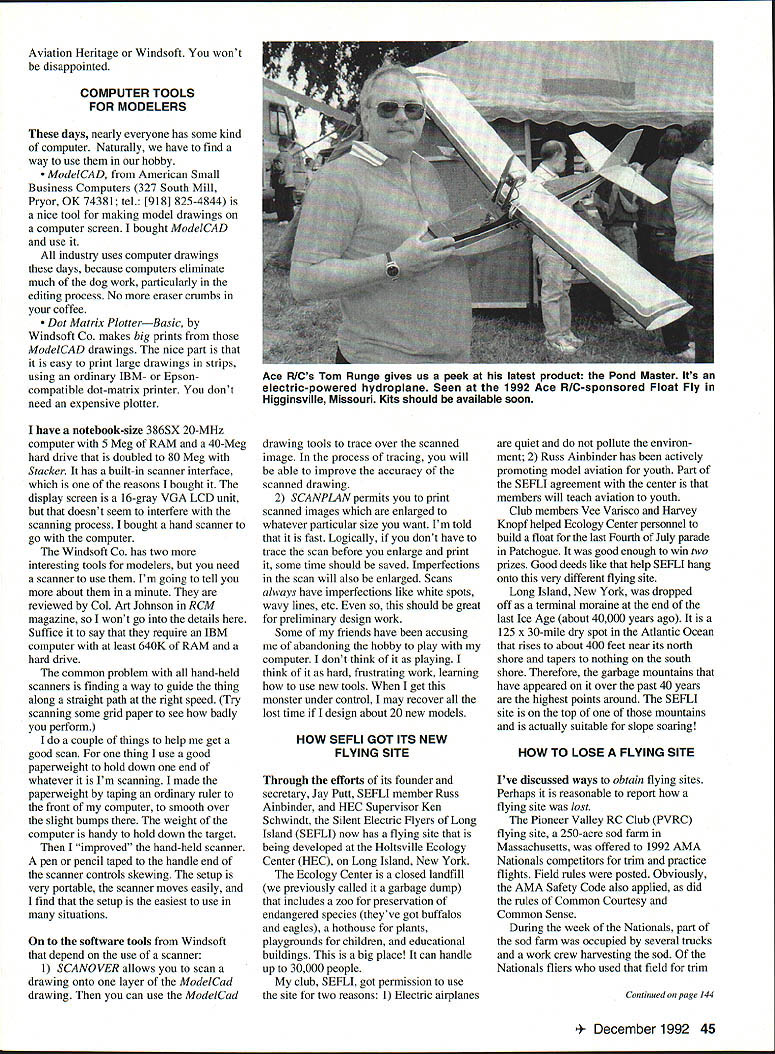
As a practical test, iron a one-inch-wide strip of the covering material onto the edge of a piece of balsa that matches the strength and thickness of your wing rib. Suspend a one-quart cardboard milk container (filled with water) by string or wire. The covering should remain attached while the container is about 80% full. If either the glue joint or the wood fails this pull test, the covering will almost certainly lift off sometime during flight.
Cures are simple: if the wood fails, use stronger wood or thicker ribs; if the glue on the covering fails, add cap strips to the ribs to increase the gluing area. The moral: when in doubt, do a test — you might learn something.
And finally, now that this month's column is finished, I still have to decide whether to do the chores or go flying. All in favor of flying for fun, start loading your cars!
Scale Plans / Sources
I enjoy scale model airplanes as much as anybody. Recently Alan Abel, publisher of Aviation Heritage Books (Sunshine House, Inc.), sent complimentary copies of Paul Matt's Scale Airplane Drawings, Volumes 1 and 2. The books and the drawings are works of art: 120 drawings of Golden Age aircraft are presented half-size in 8.5 × 11 in. format. Full-size plan sets are offered folded or rolled (small extra charge).
Contact:
- Aviation Heritage Books (Sunshine House, Inc.), 804/806 Lockport Road, P.O. Box 2065, Terre Haute, IN 47802; tel. (812) 232-3076.
I also learned from Bill Windsor of Windsoft Co. that he has negotiated permission to scan many of the Hirsch drawings. Through agreements with the publishers, Windsoft can provide either paper drawings or computer data files on disk. Great airplanes worth modeling are available from Hirsch plans — for example, the Macchi-Castoldi MC-72, the world's fastest prop-driven seaplane. If scale plans interest you, contact Aviation Heritage or Windsoft.
Contact:
- Windsoft Co., 1405 Hopkins Ave., Dover, DE 19901-4003; tel. (302) 678-5174.
Also see Model Aviation (Froehlich Farm Road, Hicksville, NY 11801) for additional resources.
Computer Tools for Modelers
These days nearly everyone has some sort of computer. Naturally modelers have found ways to use them in the hobby. ModelCAD, American Small...
Transcribed from original scans by AI. Minor OCR errors may remain.

