
RC Flying Today: Sailplaners Unite
Abstract
- Sailplaners unite
- Take a dump
SAILPLANERS UNITE
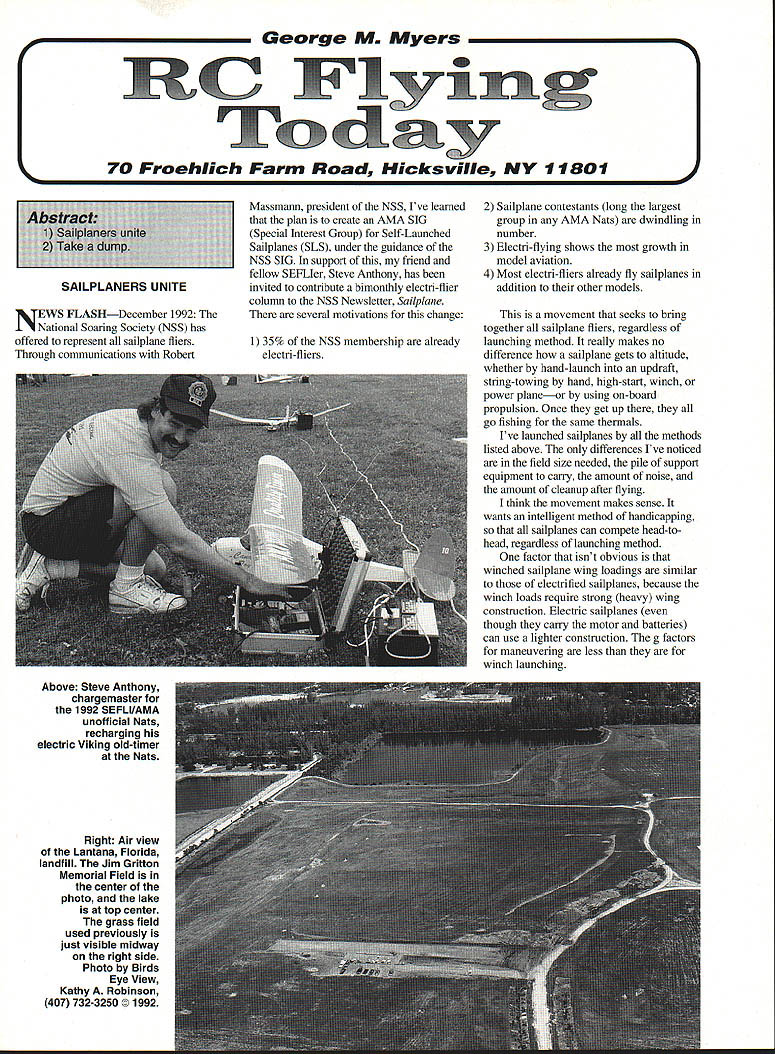
NEWS FLASH — December 1992: The National Soaring Society (NSS) has offered to represent sailplane fliers. Through communications with Robert Massmann, president of the NSS, I learned of plans to create an AMA SIG (Special Interest Group) for Self‑Launched Sailplanes (SLS), under the guidance of the NSS. In support of this, my friend and fellow SEFLIer Steve Anthony has been invited to contribute a bimonthly electric‑flier column to the NSS newsletter, Sailplane.
Several motivations for the change:
- 35% of the NSS membership are already electric fliers.
- Sailplane contestants, long the largest group at the AMA Nats, are dwindling in number.
- Electric flying shows the most growth in model aviation.
- Most electric fliers already fly sailplanes in addition to their other models.
This is a movement to bring together all sailplane fliers, regardless of launching method. It really makes no difference how a sailplane gets to altitude — by hand‑launch into an updraft, hand‑tow, high‑start, winch, tow by a power plane, or by using on‑board propulsion. Once they are up, they all fish for the same thermals.
I've launched sailplanes by all the methods listed above. The only differences I've noticed are the field size needed, the amount of support equipment to carry, the amount of noise, and the amount of cleanup after flying. The movement makes sense: what we want is an intelligent method of handicapping so that all sailplanes can compete head‑to‑head regardless of launching method.
One factor that isn't obvious is that winch‑launched sailplane wing loadings are similar to those of electric sailplanes, because winch loads require strong, heavy wing construction. Electric sailplanes, though they carry the motor and batteries, can often be built lighter; the g‑factors encountered in maneuvering tend to be less than those imposed by winch launches.
There are purists in every sport. "Pure" sailplaners will argue that no sailplane should have any kind of motor — ignoring full‑scale examples such as the Nelson Bumble Bee, the Fournier RF‑4, the American Eaglet, the Ryan, and various ASW models. If they wanted to be really pure, they would be towing their sailplanes behind motor cars, as the Du Ponts did, or behind power planes, as most full‑scale operators do today. Auto‑towing is like towing a water skier and requires at least three people.
A glider tug or piggyback power‑plane setup is similar: it requires two pilots, two airplanes, and two ground support kits, and it's noisy. I can speak from experience — I've logged over 250 glider tows (see Model Aviation, January 1980). The only crash we had on the first tow was when we used a rudder/elevator airplane as a tug — a bad choice.
A winch is heavy, bulky, and a chore to set up and support, particularly when flying alone. A contest winch setup needs two people in addition to the pilot, one often on an off‑road motorbike to retrieve the line. Nobody wants to see children running around a field where a winch is in use, because the fast‑moving lines are dangerous. Winch fliers suffer wing failures and line tangles. Still, a winch is a good way to launch many different sizes and weights of sailplanes in a short time — almost as good as having a motor in the sailplane.
Sailplanes can be launched by rocket, diesel, glow, or electric motors. Power pods are convenient for towing, but they make noise. Noise is model aviation's second‑largest problem; retaining flying fields is the biggest. The quietest launch methods are hand‑launches, hand‑tows, and high‑starts.
High‑starts and hand‑tows take time to set up and tear down, not to mention the time spent looking for the line after launch. Hand‑launched sailplanes — slope soarers — need the least support equipment. Most sport‑plane airports ban free‑flight models, sailplanes, control‑line models, pylon racers, helicopters, and similar aircraft.
Still, I've yet to have any club refuse me guest privileges after demonstrating the precision aerobatics and speed of my F3E 10‑cell WACO. Hand‑tow‑and‑goes are sometimes looked on as a stunt, but flying a standard pattern to a precision landing usually impresses more than anything else.
As Mr. Massmann noted, he has learned more about soaring in the year since he first flew a self‑launched sailplane than he learned in the previous 15 years of flying string‑launched sailplanes. After his sailplane falls out of a thermal, he can restart the motor and continue — in the process he learns more about how thermals move and how to fly sailplanes well. Once they are aloft, all sailplanes (except slope soarers) fly alike.
Old‑Timers should join this SIG. Except for appearance, it is hard to find any difference between an Old‑Timer and a self‑launched sailplane. When Old‑Timers are electrified, they are quiet. There were electric models in the old days, so why separate fliers by launching method?
I predict the SLS SIG will develop mainly to serve electrified sailplanes. Electric‑powered sailplanes are the ultimate in convenience: clean, relatively quiet, and launchable and retrievable in very small spaces because the motor can be restarted in flight. If every type of sailplane flier took to the air at once, the first in the air would likely be electric fliers and hand‑launchers.
An electric‑pod and a hand‑launcher might land at the same time, but the electric flier could motor back against the wind while the hand‑launcher might be preparing to climb a tree or cut it down to recover his model. Greater concern for smaller fields and quieter operations clearly points to the future of model aviation.
Free flight has all but disappeared on the East Coast because large vacant fields have disappeared. Perhaps not all of them — Dave Platt and Norm Rosenstock found an ideal site near Melbourne, Florida.
Electric motors are ideal for multiengine scale
Scale modelers may be next to embrace electricity. They can use scale propellers without "unscale" mufflers, and electricity doesn't soak off paint or spread oil. Many modelers already fly electrified scale models. If nothing else comes from the SLS SIG, at least electric sailplanes shouldn't be left out of consideration for the next Nats!
TAKE A DUMP
Norm Rosenstock says, "There ought to be a law requiring a model airport on top of every closed landfill." That makes sense: aircraft modelers will tolerate conditions other park users reject (bugs, smells, lumpy soil, undergrowth, snakes, etc.). All it takes is someone to start the action.
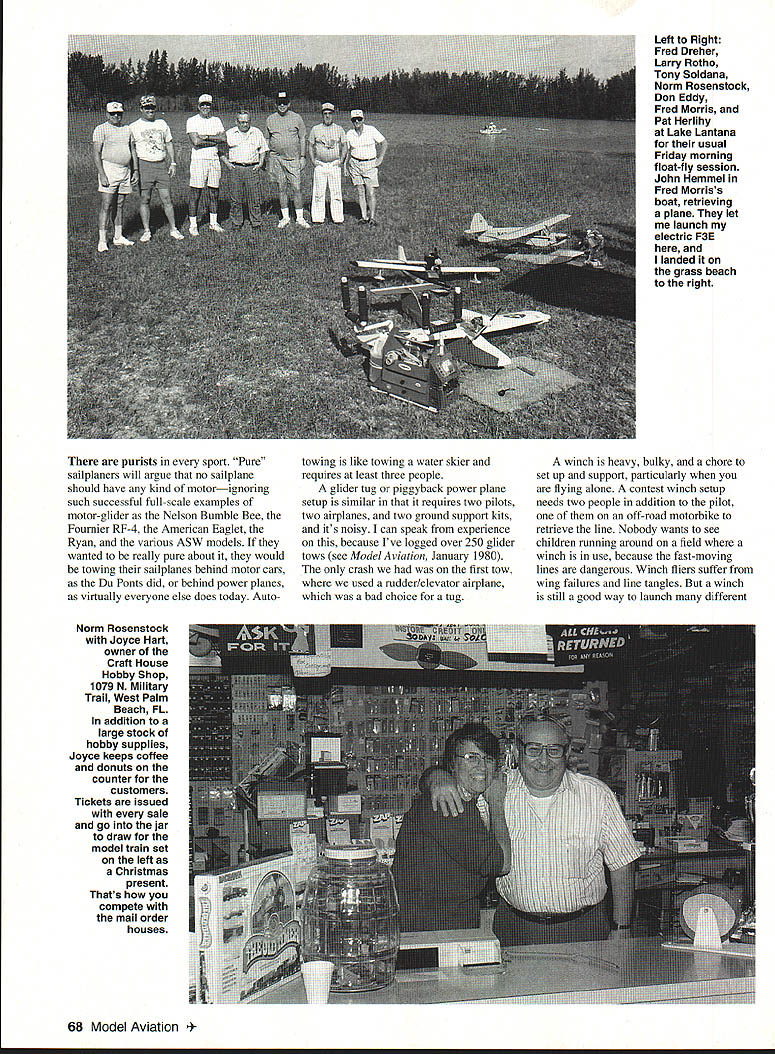
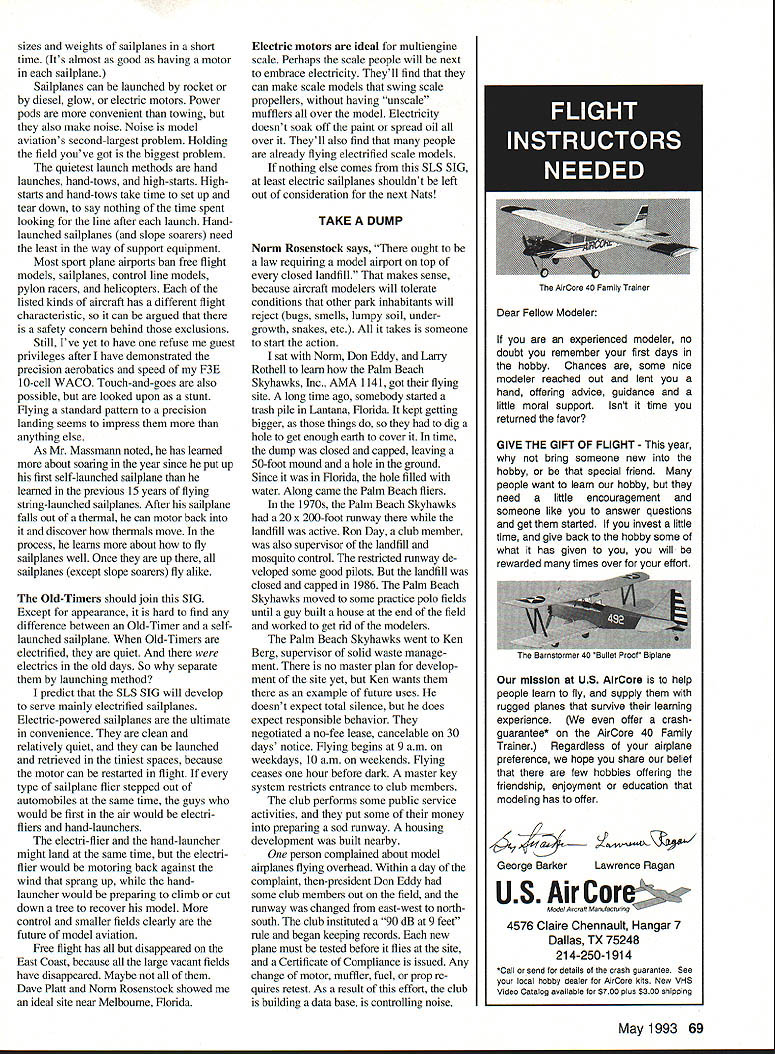
I sat with Norm, Don Eddy, and Larry Rothell to learn how the Palm Beach Skyhawks, Inc., AMA 1141, got their flying site. A long time ago someone started a trash pile in Lantana, Florida. It kept getting bigger, so they had to dig a hole to get enough earth to cover it. In time the dump was closed and capped, leaving a 50‑foot mound and a pit that filled with water. Along came the Palm Beach Skyhawks.
In the 1970s the Palm Beach Skyhawks had a 20 x 200‑foot runway while the landfill was active. Ron Day, a club member, was also supervisor of the landfill and provided monitor control. The restricted runway developed some good pilots. But the landfill was closed and capped in 1986. The Skyhawks moved to practice fields until a nearby homeowner worked to get rid of the modelers.
The club approached Ken Berg, supervisor of solid waste management. There is no master plan for development of the site yet, but Ken wanted the club there as an example of future uses. He didn't expect total silence, but he did expect responsible behavior. They negotiated a no‑fee lease, cancelable on 30 days' notice. Flying begins at 9 a.m. on weekdays and 10 a.m. on weekends. Flying ceases at dusk. A master‑key system restricts entrance to club members.
The club performs public‑service activities and invested in preparing a sod runway. A housing development was built nearby. One person complained about model airplanes flying overhead; within a day, then‑president Don Eddy had club members out on the field and the runway was changed from east‑west to north‑south.
The club instituted a "90 dB at 9 feet" rule and began keeping records. Each new plane must be tested before it flies and is issued a Certificate of Compliance. Any change of motor, muffler, fuel, or prop requires retesting. As a result of this effort, the club is building a database, controlling noise, and maintaining good relations with the community.
Transcribed from original scans by AI. Minor OCR errors may remain.

