
A SMART CHARGER/CYCLER
Purchased: SR Smart Charger/Cycler (SC/C), SR Batteries, Bellport, NY 11713; tele. (516) 286-0079; Fax (516) 286-0901; $299.95 list.
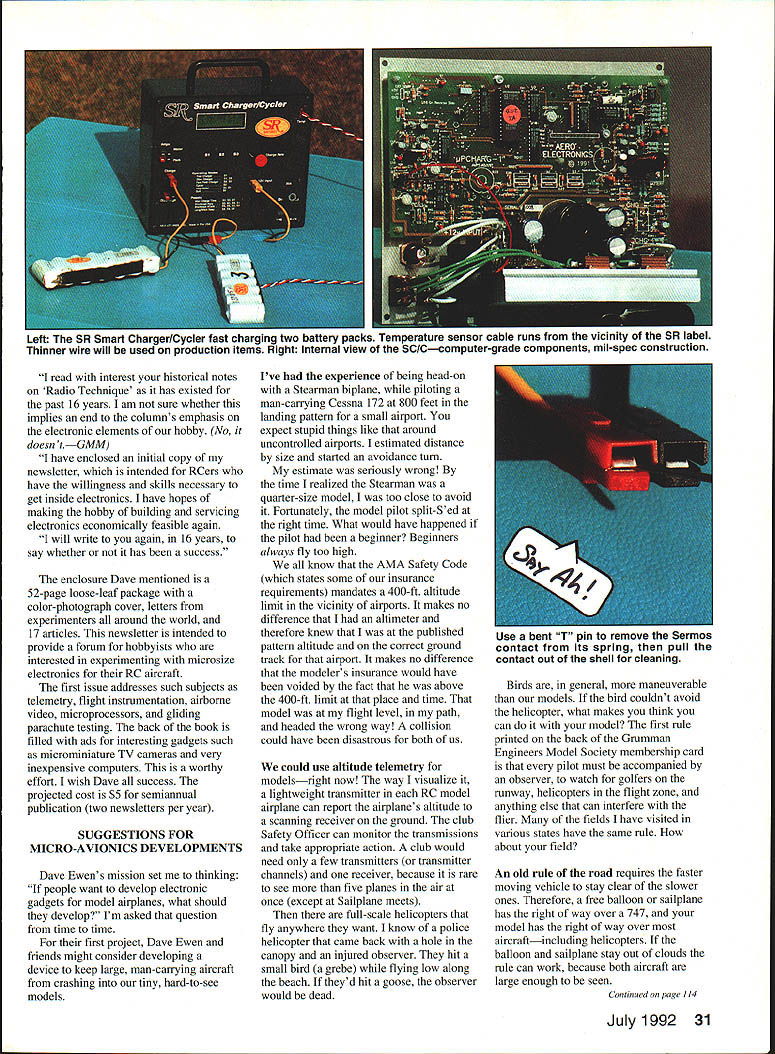
The SC/C is aimed at the electric airplane market and is one of the most sophisticated hobby battery chargers available. It is 12 VDC powered and is a CONSTANT-CURRENT charger, delivering 0.1 to 5.0 amps (adjustable in 0.1-amp steps). It services a wide range of cell sizes and cell counts. All functions are controlled by a user-programmed microcomputer.
Fast charging is terminated by time, peak-voltage detection, and/or temperature rise. Discharging is terminated by time and/or minimum voltage. A panel meter displays current, time, voltage, and other information.
What it can do
- Fast charging
- Can be used as a fast charger with time, temperature-rise, and peak-voltage detection to terminate the charge.
- Internal circuitry multiplies the input voltage so it can fast-charge two to 28 Ni-Cd cells at the same time (if they are all at the same state of discharge, of the same cell type, and rated from 100 to 5,000 mAh).
- SC/C reverts to slow charging when the fast charge is completed.
- Example: it can charge four seven-cell 1,200-mAh Ni-Cd power packs at the same time. It can also fast-charge devices such as an electric razor, electric screwdriver, flashlight, laptop computer, transmitter, receiver, and power batteries for electric airplanes and helicopters.
- Constant-current slow charging (overnight, C/10)
- Can be used as a constant-current slow charger for two to 28 cells requiring rates of 0.1 to 200 mA.
- That means it can charge cells rated 50 mAh through 2,000 mAh, covering most model-category batteries.
- You can charge multiple packs in series (for example, two transmitters or three- or four-cell flight packs) provided all cells in the series have the same rating.
- Constant-current discharging
- Discharge rates range from 0.1 amp through 10 amps, suitable for most battery test needs.
- The panel meter shows discharge current, voltages, and discharge time.
- Temperature probe
- A temperature probe is included. Heat from fast charging damages batteries, so you can bury a sensor inside each pack and use it to control fast charging.
- Additional sensors can be purchased for $5 or $9 if you want the Molex plug that fits the SC/C front panel. SR battery packs are now made with sensors built in (at the prices quoted).
- Fast field-charger function
- Included for receiver battery packs. When selected, the pack is charged at its rating (e.g., a 300-mAh pack is charged at 300 mA).
- The charge rate reverts to slow charge when charging is about 75% complete; the point at which it reverts varies with ambient temperature as measured by the probe.
- 250-amp meter for motor tests
- SC/C includes a 250-amp meter for motor testing.
Additional features
- Both the input and output are reverse-voltage protected to prevent damage from reverse connections.
- The SC/C warns you, then shuts off, when the source voltage drops too low to run the charger—this can prevent assuming packs are fully charged when they are not.
- The computer program and limits can be changed by burning a new program into the EPROM (not a job for the do-it-yourselfer).
- The enclosure has a convenient handle for carrying and includes a thermostatically controlled cooling fan that switches on only when needed. The fan runs full-time during heavy discharge tests to cool the discharge elements.
Photos / Internal view
- Left: The SR Smart Charger/Cycler fast charging two battery packs. Temperature sensor cable runs from the vicinity of the SR label. Thinner wire will be used on production items.
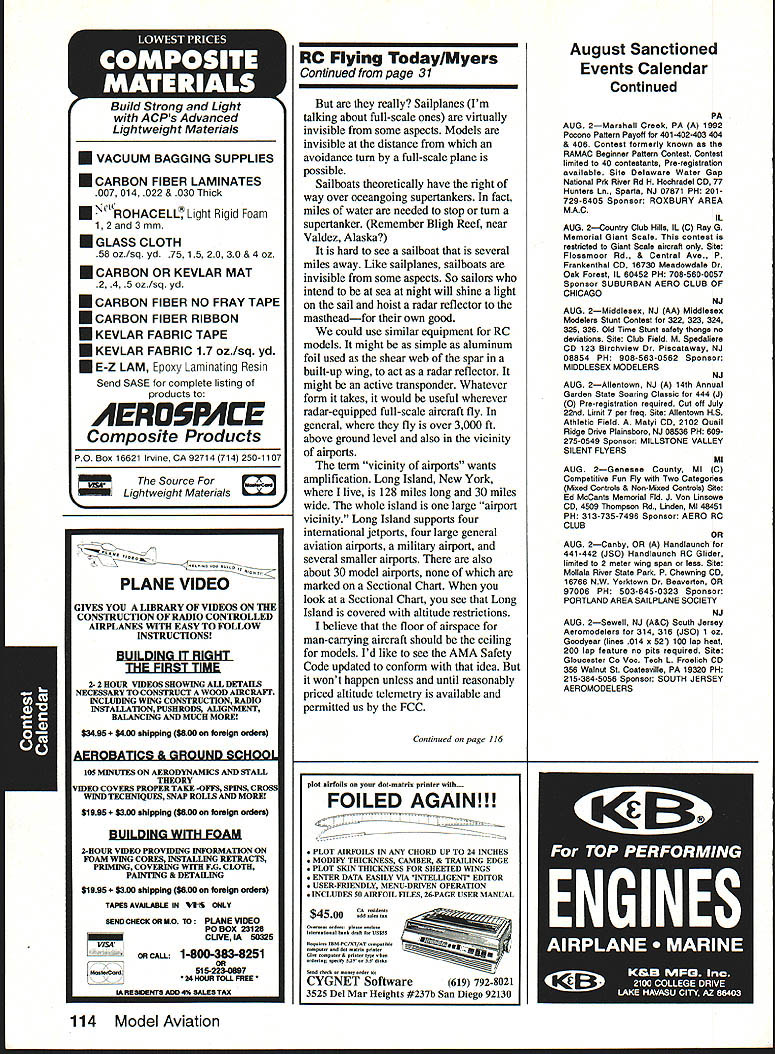
- Right: Internal view of the SC/C — computer-grade components, mil-spec construction.
MODEL VISIBILITY AND SAFETY
But are they really visible? Sailplanes (full-scale ones) are virtually invisible from some aspects. Models are invisible at the distance from which an avoidance turn by a full-scale plane is possible.
Sailboats theoretically have the right of way over oceangoing supertankers, but miles of water are needed to stop or turn a supertanker. It is hard to see a sailboat that is several miles away. Like sailplanes, sailboats are invisible from some aspects. Sailors who intend to be at sea at night will shine a light on the sail and hoist a radar reflector to the masthead—for their own good.
We could use similar equipment for RC models. It might be as simple as aluminum foil used as the shear web of the spar in a built-up wing to act as a radar reflector, or it might be an active transponder. Whatever form it takes, it would be useful wherever radar-equipped full‑scale aircraft fly—generally above about 3,000 ft. AGL and in the vicinity of airports.
The term "vicinity of airports" needs amplification. Long Island, New York, for example, is compact yet supports multiple large airports and many model fields. Many model airports are not marked on Sectional Charts. When you look at a Sectional Chart, you see that Long Island is covered with altitude restrictions.
I believe the floor of airspace for man-carrying aircraft should be the ceiling for models. I'd like to see the AMA Safety Code updated to conform with that idea, but it won't happen unless reasonably priced altitude telemetry is available and permitted by the FCC.
AMA has begun to collect the latitude and longitude of model airports (MAPTs). The FCC might be persuaded to give us altitude telemetry and radar transponder privileges if we request them as part of an integrated safety package that includes giving the FAA the locations of MAPTs.
Sailplanes and Old-Timers tend to fly to the limit of their pilots' ability to see and control the model (which, depending on size, can be up to one-half mile above the pilot). I've come upon RC sailplanes while flying 2,000 feet above the ground. That puts the models up among big airplanes, where the speed limit is 200 mph—dangerous.
Sailplanes, whether models or manned, are virtually invisible from some aspects. The wonder is that so few are struck by larger, faster aircraft. Every so often a mangled sailplane pilot falls to earth; the fatality is often ascribed to "structural failure in turbulence." Perhaps the turbulence was the vortex trailing from a heavy jet. I've hit wake turbulence in a Cessna 150—it's invisible but hits like a stone wall.
Every time I've come upon a sailplane in flight, I've wished they carried strobe beacons. Strobes are available that operate for eight hours from two "D" batteries and cost less than $100; they're used on life jackets. A strobe light on a model airplane could be useful in several situations, and you wouldn't have to run it all the time—you could flip it on via RC to warn away larger airplanes.
Have you ever lost sight of your plane in a dull gray sky? Wouldn't you like to be able to flip a switch to start a strobe? Have you ever made a "tree landing"? A strobe might help you find the model. For all I know, a strobe might even scare off an eagle or hawk that has decided to attack your airplane.
The best way to set up the strobe for models would be to specify a flash repetition rate different from those used on life jackets, emergency vehicles, and man-carrying aircraft. Maybe we should send the Morse code "M" for model—dash-dash—and flash that repeating pattern. I'd like to see AMA take the lead by specifying a flash rate for models now, before more money is spent developing equipment.
Another possibility is a radar transponder. One radar transponder on the ground per flying site would be sufficient. If an airliner's radar shows a blip from a transponder at a flying site, the pilot will know to stay one-half mile away. Practically all airliners have radar and altitude-reporting radar transponders, so nothing new has to be invented. If you forget the transponder and leave it turned on when no one is flying, nobody will be hurt.
That's enough theorizing for now. Does anyone care about this stuff?
Abbreviations used in this article
- $ = dollar = unit of United States of America currency
- AK = Postal code for the state of Alaska
- AMA = The Academy of Model Aeronautics
- amp = ampere = unit of electrical current
- EPROM = Electrically Programmable Read-Only Memory
- °F = degrees Fahrenheit = unit of temperature
- FAA = The Federal Aviation Authority
- Fax = Facsimile transmission of pictures
- FCC = The Federal Communications Commission
- GMM = my initials
- Lat/Lon = Latitude and longitude = Earth units of location
- MAPT = Model AirPorT (my term for a flying site)
- mAh = milliampere hours = energy stored in a battery
- mph = miles per hour = unit of velocity
- Ni-Cd = The chemical symbol for nickel and cadmium (batteries)
- NY = Postal code for the state of New York
- RC = Radio Controlled
- RV = Recreational Vehicle
- SC/C = Smart Charger and Cycler (manufacturer's—SR—name for it)
- tele = telephone number
- VDC = Volts, Direct Current
- Volt = the unit of electrical pressure
Transcribed from original scans by AI. Minor OCR errors may remain.

