
RC Flying Today: Use Electric Power for Your Multiengine Projects
Author
George M. Myers
Abstract
Electric motors for multiengine models. SR Deluxe Smart Charger/Cycler.
Use electric power for your multiengine projects
For my first outing since the stroke, Henry Prew chauffeured me to Quakertown, Pennsylvania, for what has become the greatest electric fun-fly on the East Coast. Bob Kopski, who created and motivated the event, will report on it in detail. I chose to highlight one aspect of the event: far more large multiengine scale aircraft were present at this noncompetitive KRC event (more than a dozen of them) than are likely to be seen during a year of "wet power" competitions. Obviously, there is some connection between multiengine scale and electric motors, and we should investigate that connection.
It is well known that twin-engined man-carrying aircraft are more dangerous than singles. When one engine stops in flight, the resulting asymmetrical thrust usually requires compensating rudder deflection. That creates drag, which wastes some of the remaining power, so the pilot is left with less than half power. Many twins can't even maintain altitude on one engine.
On a full-scale airplane a pilot can more easily identify the dead engine: he feels it through his feet — the foot that needs increased pressure to keep the airplane straight is on the side of the running engine. RC pilots don't have that feedback. The significant point is that electric motor failures are rare, which makes multiengine models much easier to manage.
Electric power configurations for multiengine models
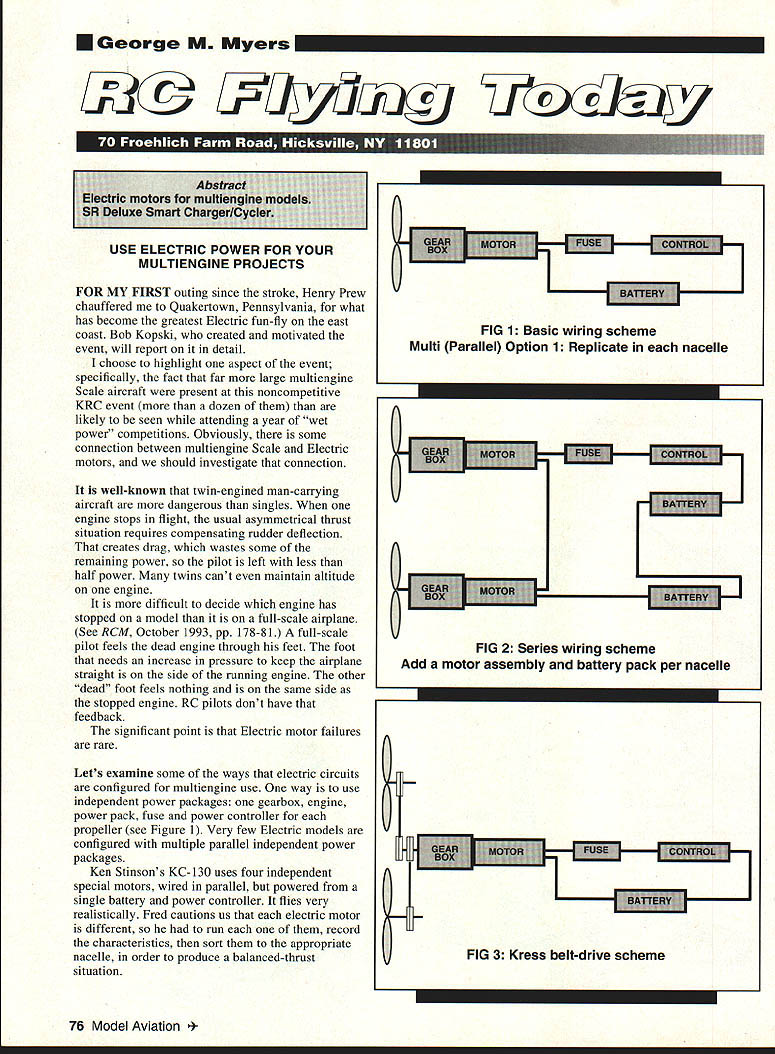
There are several ways electric circuits can be configured for multiengine use. Examples from the KRC fly-in illustrate the variety and advantages of electric systems.
- Independent power packages
- One gearbox, engine, power pack, fuse, and power controller for each propeller. Very few electric models are configured with multiple parallel independent power packages.
- Multiple motors powered from a single battery/controller (parallel)
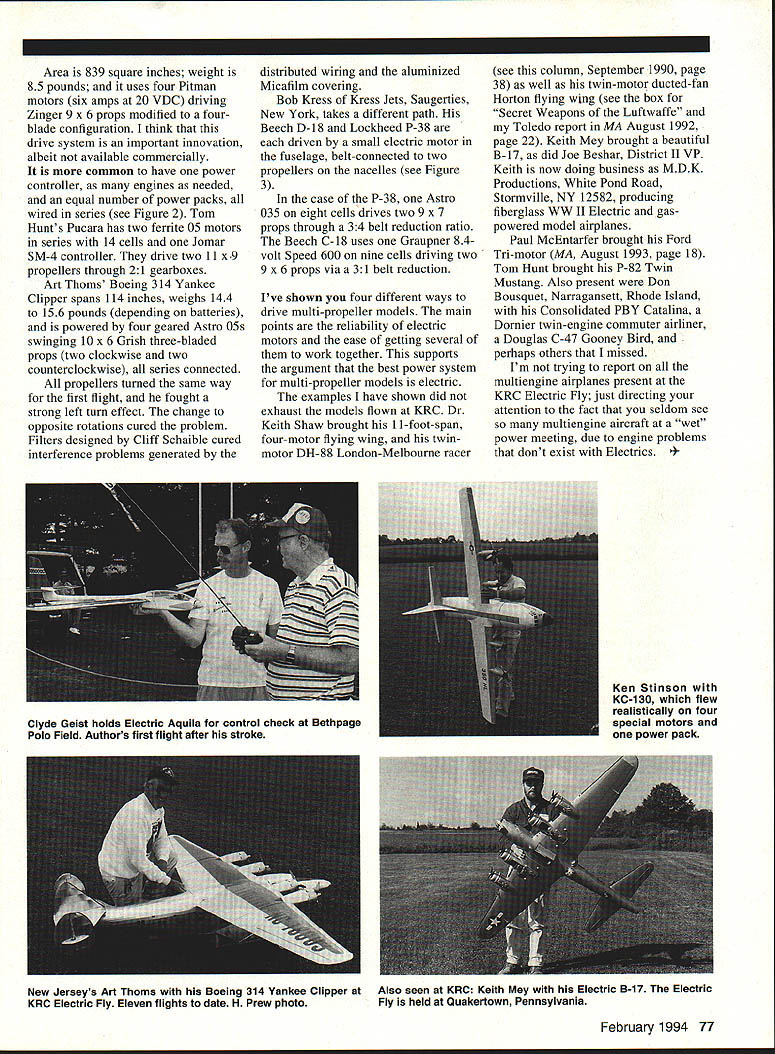
- Ken Stinson's KC-130 uses four independent special motors wired in parallel but powered from a single battery and power controller. It flies very realistically. Because each electric motor is different, Ken ran and recorded each motor's characteristics, then sorted them to the appropriate nacelle to produce balanced thrust.
- One controller with multiple power packs (series)
- It is common to have one power controller, as many engines as needed, and an equal number of power packs, all wired in series. Tom Hunt's Pucara, for example, has two Ferrite 05 motors in series with 14 cells and one Jomar SM-4 controller; they drive two 11 x 9 propellers through 2:1 gearboxes.
- Art Thoms' Boeing 314 Yankee Clipper spans 114 inches, weighs 14.4 to 15.6 pounds (depending on batteries), and is powered by four geared Astro 05s swinging 10 x 6 three-bladed props (two clockwise and two counterclockwise), all series connected.
- Single fuselage motor driving multiple props (belt reduction)
- Bob Kress of Kress Jets uses a small electric motor in the fuselage belt-connected to two propellers on the nacelles. For the P-38, one Astro 035 on eight cells drives two 9 x 7 props through a 3:4 belt reduction ratio. The Beech D-18 uses one Graupner 8.4-volt Speed 600 on nine cells driving two 9 x 6 props via a 3:1 belt reduction.
I have shown four different ways to drive multi-propeller models. The main points are the reliability of electric motors and the ease of getting several of them to work together. That supports the argument that the best power system for multi-propeller models is electric.
Examples from the KRC electric fly-in
- Dr. Keith Shaw brought an 11-foot-span four-motor flying wing, a twin-motor DH-88 London–Melbourne racer, and a twin-motor ducted-fan Horton flying wing.
- Keith Mey brought a beautiful B-17.
- Joe Beshar, District II VP, is now doing business as MDK Productions, White Pond Road, Stormville, NY 12582, producing fiberglass WWII electric and gas-powered model airplanes.
- Paul McEntarfer brought a Ford Tri-motor.
- Tom Hunt brought a P-82 Twin Mustang.
- Don Bousquet, Narragansett, Rhode Island, brought a Consolidated PBY Catalina, a Dornier twin-engine commuter airliner, and a Douglas C-47 "Gooney Bird," among others.
One example had an area of 839 square inches, weighed 8.5 pounds, and used four Pitman motors (six amps at 20 VDC) driving Zinger 9 x 6 props modified to a four-blade configuration. I think this drive system is an important innovation, albeit not yet available commercially.
All propellers on Art Thoms' Boeing 314 initially turned the same way on the first flight, and he fought a strong left-turn effect. Changing to opposite rotations cured the problem. Filters designed by Cliff Schaible cured interference problems generated by the distributed wiring and the aluminized Micafilm covering.
Bob Kress' fuselage-motor approach produces a clean installation and works well for certain twin configurations.
Conclusion
The models at KRC demonstrate that electric power makes multiengine scale modeling practical and reliable. You seldom see so many multiengine aircraft at a "wet" power meeting because engine problems that plague glow or gas systems don't exist with electrics. If you're considering a multiengine project, electric power is a smart choice.
Transcribed from original scans by AI. Minor OCR errors may remain.

