
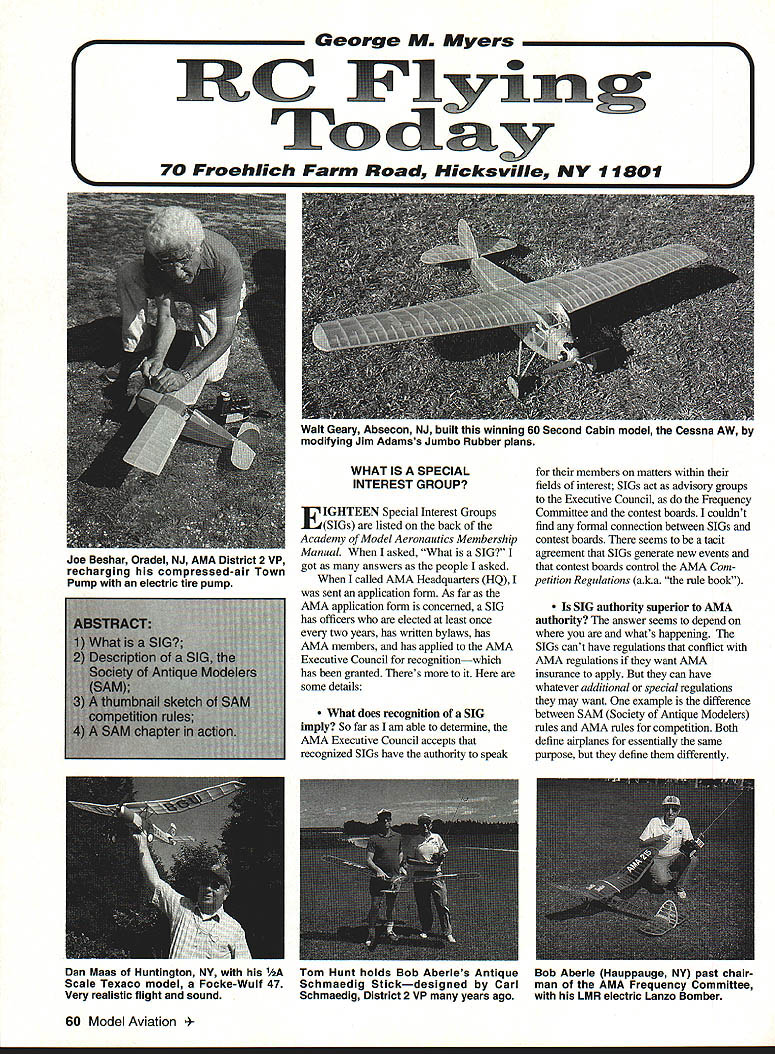
WHAT IS A SPECIAL INTEREST GROUP?
Eighteen Special Interest Groups (SIGs) are listed on the back of the Academy of Model Aeronautics Membership Manual. When I asked, "What is a SIG?" I got as many answers as the people I asked.
When I called AMA Headquarters (HQ), I was sent an application form. As far as the AMA application form is concerned, a SIG has officers who are elected at least once every two years, has written bylaws, has AMA members, and has applied to the AMA Executive Council for recognition—which has been granted. There's more to it. Here are some details.
What does recognition of a SIG imply?
So far as I am able to determine, the AMA Executive Council accepts that recognized SIGs have the authority to speak for their members on matters within their fields of interest. SIGs act as advisory groups to the Executive Council, similar to the Frequency Committee and the contest boards. I couldn't find any formal connection between SIGs and contest boards. There seems to be a tacit agreement that SIGs generate new events while contest boards control the AMA Competition Regulations (the "rule book").
Is SIG authority superior to AMA authority?
The answer seems to depend on where you are and what's happening. SIGs cannot have regulations that conflict with AMA regulations if they want AMA insurance to apply. They can, however, have additional or special regulations of their own. One example is the difference between SAM (Society of Antique Modelers) rules and AMA rules for competition: both define airplanes for essentially the same purpose, but they define them differently.
A SIG will have its contests sanctioned by the AMA, though AMA competition rules are generally used. Note the distinction between "sanction" and "insurance." Sanction covers such matters as protests, radio frequencies and safety. For AMA insurance to apply, rules in the Academy of Model Aeronautics Membership Manual must be followed.
Does a SIG get its authority from the AMA? The authority to conduct SIG competitions comes from the common consent of SIG member modelers. The authority to represent SIG members before the AMA Executive Council is granted when a SIG is recognized by the Executive Council.
Where does a SIG get its authority?
- Authority to conduct SIG competitions comes from the common consent of SIG member modelers.
- Authority to represent SIG members before the AMA Executive Council is granted by SIG members and recognized by the Executive Council.
What do SIGs do?
SIGs do anything their members want them to do. A SIG develops an activity and its rules—which become AMA rules when there is enough support.
Historically, groups of modelers got together and did something not recognized by AMA competition regulations. They kept doing it until their activities were too large or their organization too well advertised to be ignored. That is not meant to imply an adversarial relationship; it simply describes how new events and rules have been incorporated into the organized hobby.
A look at the list of SIGs shows that most of them grew from a desire to create or develop some kind of competition: PAA-Load in free flight, Pylon Racing or Helicopters in radio control, Antique models in various categories, and so on. SIGs do not last forever; some come and go. For example, at the time of writing the SIG for electric-powered airplanes was no longer recognized by the Executive Council.
Once electric power systems developed to the point that electric motors could power types of models never before powered by internal combustion engines, the question arose whether separate competition classes were needed. Rather than require special classes, handicaps can be written to equalize competition between models driven by various power systems. There are many power systems—diesel, gasoline/spark ignition, alcohol/glow ignition, rubber, electric, CO2, jet, etc.—and because these systems have intrinsic differences, handicaps must be developed.
The AMA will sanction a SIG contest even if AMA competition rules are not used, but all rules in the Academy of Model Aeronautics Membership Manual must be followed for AMA insurance to apply. Those rules discuss sanctions, insurance, Contest Directors, protests, radio frequencies, and safety.
Electric-powered flying is the fastest-growing part of the hobby, so electric fliers should get organized and compete. The issue is less about creating separate competitions and more about making AMA competitions that electric-powered airplanes can enter and win. Convince the Contest Directors that your electric airplane is equal to conventionally powered entrants in the events you want to enter — then fly against them and win.
DESCRIPTION OF A SIG: THE SOCIETY OF ANTIQUE MODELERS (SAM)
Sometimes I think the United States is losing its technological edge because too many youth focus on the obscene incomes available from drugs, pop music, and professional sports instead of tackling technical challenges. When a good engineer can work his whole life to earn less than a football player earns in a year by endorsing alcohol and tobacco, something about our economy is very warped.
Now that I've gotten that off my chest, let's examine one SIG in which internal combustion engines coexist with electric motors.
SAM is the nation's largest SIG by far. It is national in scope, maintains a small national headquarters in Muncie, Ind., publishes a monthly newsletter (not a glossy magazine), keeps official rules and bylaws, operates a national contest (the SAM Nationals), and is a 501(c)(3) nonprofit organization. Membership dues are collected nationally; local clubs are affiliated with SAM chapters and operate under SAM's rules. The SAM idea is to revive and preserve modeling from the "Golden Age"—pre-WWII and immediate post-war. Their people are as enthusiastic as any of the SIGs, and they have a well-organized program of events.
The Society of Antique Modelers (SAM) is the national SIG for people who like to fly pre-1943 models. Some SAM models are powered by antique engines or replicas thereof, and they are noisy. The engines often perform better than remembered from the old days. Where we used to mix white gas (unleaded, 80 octane) with #70 petroleum oil in a 3:1 ratio, now people substitute unleaded regular gasoline (87 octane).
Putting Schnuerle-ported glow engines in those old designs and loading in high-nitro alcohol fuel makes a big difference in performance. SAM members debate the handicaps that should be applied to four-stroke-cycle engines, Schnuerle-ported glow engines, cross-scavenged engines, etc. The important point is that they have and use such handicaps. When electric motors enter the discussion, some protest that "we never used electric motors in the old days." That is to be expected.
What you don't expect is the great pleasure you can take from not hearing electrics fly, especially right after an Anderson Spitfire ignition engine or an open-exhaust K&B .65 glow engine roars aloft. Mufflers are permitted in SAM competition, but mini-pipes or tuned pipes are not allowed. Electric airplane performance is now about equal to that of the best internal-combustion models, despite being quieter. When noise becomes the principal concern, electrics will have the advantage.
A SAM contest is basically an eyesight test. The planes rocket to altitudes where only a big model can be seen. Binoculars are not allowed as a contest aid — although they can be used to find or recover a model. The engine or motor is shut off by radio, then the planes glide for about eight minutes (or so the pilots hope), by which time the pilot's neck begins to ache and his tonsils get sunburned. In free flight, glide timing stops when you again touch the radio controls to bring your model back to the field for landing. In RC mode, the plane is under control at all times.
The so-called Texaco events are fuel-allotment events (the engine's fuel quantity is limited by rules) without a maximum time limitation on flights. An RC-operated ignition shutoff is used primarily to protect the ignition coil of an engine from burning out after the engine runs out of fuel. Without the cutoff, if the ignition points remained closed after the engine stopped, the ignition system batteries would send a constant current through the coil — and the coil isn't designed for that. Planes in the 1/2A Texaco event do not use a shutoff.
Most of the good pilots "wax out" all their flights, so the engagement often ends with a mass flyoff. The best glide time with a landing on the model airport wins. It's a nice way to end the competition; everyone can see who wins.
Lest you think that this is just a bunch of old men reliving their youth, know that most of the competition takes place between the ears of the competitors. This is cerebral flying. The basic elements of success are preparation and flying strategy. You must have a plane that flies predictably, an engine that starts and runs reliably (a big problem, particularly in Texaco), a radio that has minimum weight and maximum reliability, plus a good idea of what the weather is doing so you can pick your flying time.
Most competitors fly in several events, so time management is critical. They may complete four to twelve flights per day, usually with several different airplanes. They also have to know the rules. In that respect, SAM competition is a bit like a chess game: the right move at the wrong time is worse than no move at all. Where do the rules come from? The SIGs write the rules. That's what a SIG does.
A THUMBNAIL SKETCH OF SAM RULES AND DEFINITIONS
- Any model plane that was designed, was the subject of a published construction article, or was kitted through December 31, 1942, qualifies, except in the Antique and full-size Texaco events.
- LER = Limited Engine Run. Run time is set by the type of engine in the model.
- LMR = Limited Motor Run. Run time set by the type of (electric) motor in the model.
- Glow = Alcohol-fueled engines equipped with glow plugs.
- Ign = Gasoline-fueled engines equipped with spark plugs.
- A/B = Classes A and B combined. (Class is determined by engine placement.) These are relatively small engines.
- C = Class C. Large-displacement engines.
- Antique = A model designed, published, or kitted before 1939. Allowable engine run is determined by total weight of the plane.
- Texaco = Antique-era model originally designed for Texaco event, using fuel allotment determined by total weight of plane.
- 1/2A Texaco = Antique or Old-Timer replica powered by Cox Black Widow or Texaco .049 engine. (The most popular event.)
A SAM CHAPTER IN ACTION
The Long Island, New York, chapter of the Society of Antique Modelers is SAM 75. Let's watch it in action.
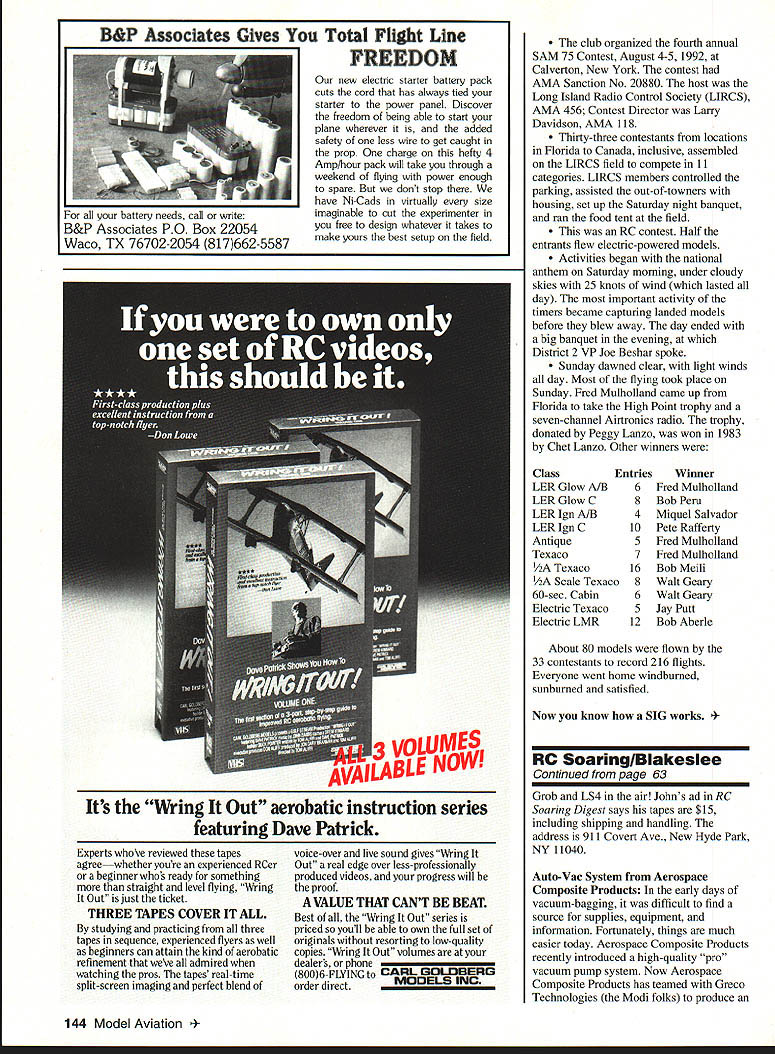
The club organized the fourth annual SAM 75 Contest, August 4–5, 1992, at Calverton, New York. The contest had AMA Sanction No. 20880. The host was the Long Island Radio Control Society (LIRCS), AMA 456; Contest Director was Larry Davidson, AMA 118.
Thirty-three contestants from locations as far as Florida and Canada assembled on the LIRCS field to compete in 11 categories. LIRCS members controlled the parking, assisted out-of-towners with housing, set up the Saturday night banquet, and ran the food tent at the field.
This was an RC contest. Half the entrants flew electric-powered models. Activities began with the national anthem on Saturday morning under cloudy skies with 25 knots of wind (which lasted all day). The most important activity for the timers became capturing landed models before they blew away. The day ended with a big banquet in the evening, at which District 2 VP Joe Beshar spoke.
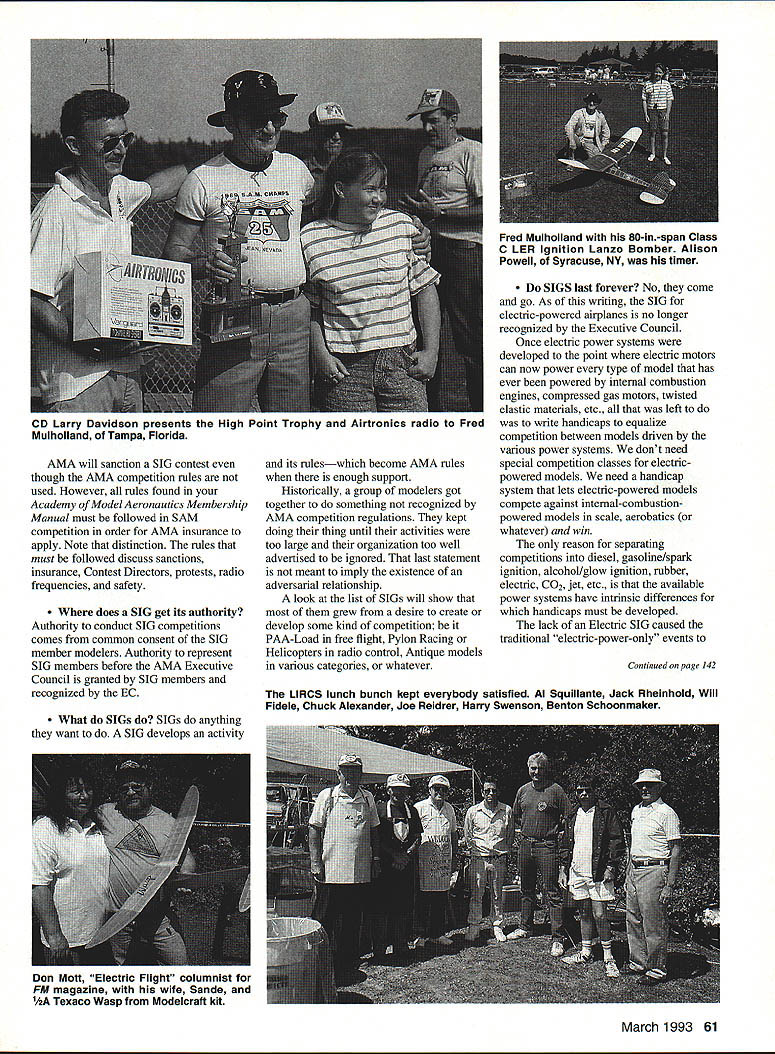
Sunday dawned clear with light winds all day. Most of the flying took place on Sunday. Fred Mulholland came up from Florida to take the High Point trophy and a seven-channel Airtronics radio. The trophy, donated by Peggy Lanzo, was first won in 1983 by Chet Lanzo. Other winners were:
- LER Glow A/B (6 entries) — Fred Mulholland
- LER Glow C (8 entries) — Bob Peru
- LER Ign A/B (4 entries) — Miguel Salvador
- LER Ign C (10 entries) — Pete Rafferty
- Antique (5 entries) — Fred Mulholland
- Texaco (7 entries) — Fred Mulholland
- 1/2A Texaco (16 entries) — Bob Meili
- 1/2A Scale Texaco (8 entries) — Walt Geary
- 60-sec. Cabin (6 entries) — Walt Geary
- Electric Texaco (5 entries) — Jay Putt
- Electric LMR (12 entries) — Bob Aberle
About 80 models were flown by the 33 contestants in 216 flights. Everyone went home windburned, sunburned and satisfied.
Now you know how a SIG works.
Transcribed from original scans by AI. Minor OCR errors may remain.

